
Leasing On vs. Your Own Operating Authority: The Core Decision Facing Truck Owners
For anyone buying commercial trucks – a business owner, an operator, a logistics professional – the purchase is the easy part. The harder question comes next: under whose authority will those trucks run, and who answers for the freight they haul? You are choosing between two operating models, and that choice reaches into your daily schedule, your tax structure, and how much of each load you keep.
On the first path, you lease on to a carrier. You sign an agreement, put your truck under that company’s DOT and MC authority, and drive the freight it finds. The carrier handles most of the regulatory work and pays you a percentage of each load. Dispatch, fuel programs, and much of the compliance paperwork come with the deal, which keeps your week simple and predictable.
The second path is filing for your own operating authority – registering with the Federal Motor Carrier Safety Administration (FMCSA) to run under your own MC and DOT numbers. As your own carrier you set rates, deal with shippers directly, and choose your lanes. You also take on every compliance deadline, safety report, and insurance requirement yourself.
Neither route wins by default. What fits you comes down to capital, experience, and how much risk you will carry. Working out the financial side first sharpens the comparison, which is why many new owners read up on finance tips for first-time truck owners before they commit.
The comparison below runs the two models through six practical dimensions: control, cost, revenue, compliance, insurance, and financial readiness.
Lease-On to a Carrier
Plenty of new operators want to run their own trucking business long before the paperwork allows them to haul legally. Leasing on bridges that gap. Rather than build operating authority from scratch, you park your truck under another company’s umbrella and let them carry the compliance and sales work while you drive and earn.
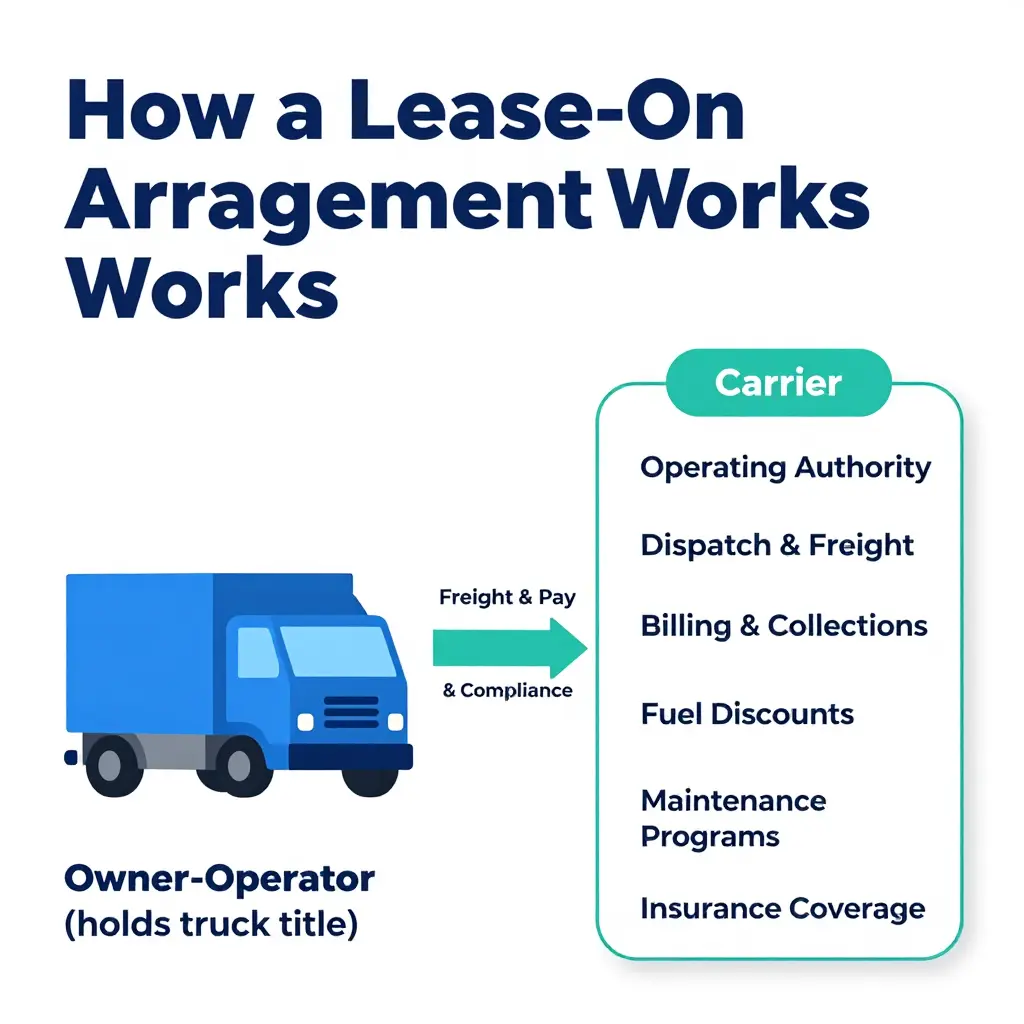
How the Lease-On Model Works
You stay the owner-operator here. You hold the title, make the truck payment, and keep it road-ready. The carrier supplies the operating authority – its DOT and MC numbers – and that is what lets freight move legally under your wheels.
Beyond authority, the carrier usually finds and dispatches loads, bills shippers, and collects payment before sending your share. Many add fuel discounts at partner truck stops, negotiated maintenance programs, and sometimes plates and permits.
You run your own truck as a small business, but you run it through someone else’s infrastructure.
The Practical Benefits
Leasing on sells itself on speed and simplicity.
- Reduced administrative burden. No back office to staff, no invoices to chase, no FMCSA filings to handle yourself.
- Immediate access to freight. You can earn from the day you sign instead of waiting weeks or months for authority.
- No insurance filings to make. The carrier’s authority usually brings its own liability coverage, so you skip the cost and delay of arranging your own.
For a first-timer still learning the ropes, it feels like starting a business with training wheels.
The Trade-Offs You Should Weigh
None of this is free. The carrier takes a percentage split of gross revenue – often 20% to 35% – in return for what it provides.
You give up autonomy, too. The carrier decides which loads you run and when, so less control over routes comes with the deal. Your income rides on someone else’s sales pipeline, which means dependency on the carrier’s freight volume: when their season slows, so does yours.
Typical Lease-On Agreement Structures
Agreements vary, but most take one of a few recognizable shapes:
| Structure | How You Get Paid | Watch For |
|---|---|---|
| Percentage split | Fixed % of load gross | What costs are deducted before the split |
| Percentage + escrow | Split, minus held-back escrow | How and when escrow is returned |
| Mileage-based | Flat rate per loaded mile | Deadhead and accessorial pay |
| Hybrid | Base pay + fuel/maintenance allowances | Whether allowances are truly “free” |
What to Review Before You Sign
Read every clause as if you expect to be surprised. Pin down the exact percentage and what is deducted before it is applied. Ask who eats deadhead miles, detention, and fuel surcharges. Learn the escrow rules and how long your money is held.
Then read the termination terms: how much notice you owe and whether leaving costs you anything. Check who pays insurance deductibles, cargo claims, and maintenance disputes. And make sure you are classified as a contractor rather than an employee, so your taxes stay clean.
If cash is tight, arrange your financing before you sign – these finance tips for first-time truck owners can keep a slow first month from derailing you.
Leasing on is often the fastest, lowest-risk way to put your own truck to work. Go in with your numbers checked and a contract you actually understand.
Choosing between leasing on to an established carrier and filing for your own operating authority comes down to how much control, capital, and paperwork you are willing to take on. The table maps the two paths side by side.
| Dimension | Lease-On to a Carrier | Your Own Operating Authority |
|---|---|---|
| Who holds the operating authority | The carrier (you run under its DOT/MC number) | You (you hold your own DOT/MC number) |
| Up-front cost | Low – typically just onboarding and drug testing | High – authority fees, insurance, plates, and setup |
| Revenue split or gross revenue | Carrier keeps a percentage; you get a negotiated split (commonly 60-75%) | You keep 100% of gross (minus broker fees, factoring, and costs) |
| Dispatch responsibility | Carrier dispatches loads for you | You find, negotiate, and book your own loads |
| Insurance requirements | Covered under the carrier’s policy | You must buy your own liability, cargo, and physical damage coverage |
| Compliance and filings | Carrier handles DOT, FMCSA, IFTA, and reporting | You file and maintain everything yourself |
| Fuel and maintenance programs | Carrier discounts and shop networks often included | You source fuel discounts and maintenance on your own |
| Administrative workload | Low – carrier handles back-office tasks | High – you manage billing, taxes, and records |
| Speed to first load | Fast – often days after onboarding | Slower – weeks to secure authority and insurance |
How to read the trade-offs: Leasing on trades a slice of revenue and some independence for a fast, cheap start with far less paperwork and risk. Your own authority flips that: you keep more of every load and shoulder the insurance, compliance, and back-office work yourself. Which one fits depends on your cash reserves, your patience for administration, and how soon you need the wheels turning.
If independence appeals, read up on financing your first truck before you commit.
Filing for Your Own Operating Authority
Going independent means the truck, the trailer, and the revenue are yours. Before you can legally haul one paid load, you file for your own operating authority with the federal government – a formal declaration that you are a for-hire carrier, not a leased driver. The steps run in order: registrations, insurance filings, then tax enrollments.
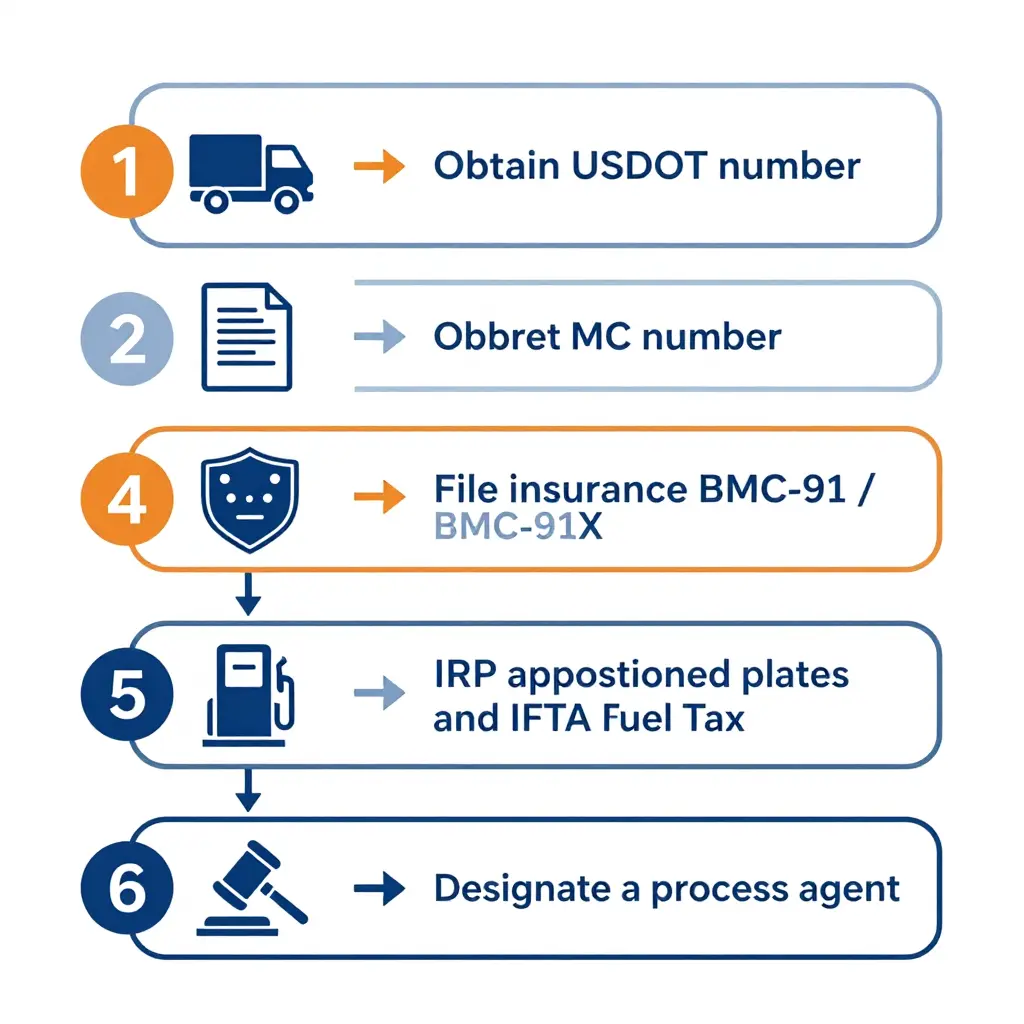
Step 1: Obtain Your USDOT and MC Numbers
Every for-hire carrier needs two numbers. The USDOT number identifies you for safety and compliance and links to your crash, inspection, and hours-of-service records. The MC number (Motor Carrier authority) is the one that lets you operate for hire and charge for hauling.
Apply for both through the FMCSA’s Unified Registration System. Once active, your authority is public, so shippers and brokers can check you before they hand over a load.
Step 2: Register with the FMCSA
The FMCSA (Federal Motor Carrier Safety Administration) grants your authority and tracks your safety record. Registration means submitting your business details, stating your operation type, and agreeing to follow the safety rules.
Your authority usually goes active only after registration is complete and proof of insurance is on file.
Step 3: File Your Minimum Insurance (BMC-91 or BMC-91X)
You cannot operate legally without proof of liability coverage filed with the FMCSA. BMC-91 meets the public liability minimum; BMC-91X combines public liability and cargo insurance in one filing.
Your insurer files these forms for you, and your authority will not activate until the FMCSA has them.
Step 4: Register for IRP Apportioned Plates and IFTA
If you cross state or provincial lines, you need IRP (International Registration Plan) apportioned plates, which split registration fees among the jurisdictions you travel. You also enroll in IFTA (International Fuel Tax Agreement) reporting, which pools fuel tax collection across member jurisdictions. Both require disciplined records.
Step 5: Designate a Process Agent
A process agent is a person or company that accepts legal documents for you in the states where you operate. The FMCSA requires one in every state you run in, so a lawsuit or legal notice can reach you properly.
What Independence Actually Delivers
Your own authority gives you control. You set routes and rates instead of hauling someone else’s freight at their price. You build direct relationships with shippers and brokers, which tends to bring repeat business and better margins. And you build a name – yours on the door, your reputation in the market.
The Real Costs and Responsibilities
Independence costs money. Your premiums will run far higher than a leased driver’s because you now hold the full liability exposure. The back office multiplies – dispatch, billing, safety compliance, tax filings, recordkeeping all land on your desk. And you source your own freight, so a slow week comes straight out of your pocket.
Understanding the Authority Threshold
The “authority threshold” is the rough break-even point where your own authority starts paying better than leasing on. Below it, the steady pay, covered insurance, and supplied loads of a lease usually win. Above it, the higher gross from direct freight and your own rates beats the extra costs.
Add up your realistic revenue, insurance quotes, and overhead before you commit.
Reading the Market Before You Commit
Freight rates, fuel prices, and capacity all move that break-even line, so timing matters. Reviewing key insights on navigating economic uncertainties in the trucking market can help you judge whether this is the season to leap.
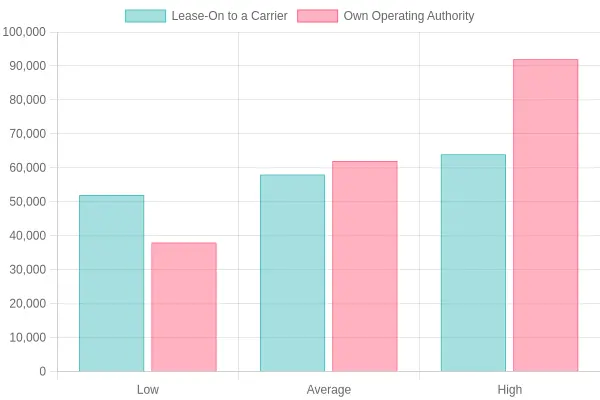
Figure: Comparative net earnings under a lease-on arrangement versus running on your own operating authority across low, average, and high utilization scenarios.
Most new owner-operators feel this chart before they can calculate it. Leasing on produces a narrow, predictable band of net earnings – roughly $52,000 to $64,000 whether you run light or heavy weeks. Your own operating authority swings much wider: thinner than a lease-on when utilization is low (around $38,000), but up near $92,000 when freight volume is strong. The gap widens as utilization rises, which is why the upside of independence comes attached to real downside risk. Lease-on buys stability; authority rewards volume and punishes soft markets.
How to Read This Comparison
- Lease-On to a Carrier: Steadier, lower-ceiling earnings with less exposure to fuel, insurance, and empty miles — the carrier absorbs much of the volatility.
- Own Operating Authority: Higher potential net earnings at strong utilization, but you carry fixed costs and market swings on your own balance sheet.
- Break-even insight: Owning authority only out-earns a lease-on once utilization reaches average-or-better levels. Below that line, the extra freedom can actually cost you money.
If startup costs and financing are still open questions, review these finance tips for first-time truck owners so your earnings assumptions survive contact with the real world.
For a truck owner, the road splits two ways: lease on to a carrier for steady work and a share of the revenue, or file for your own operating authority for independent operation and full control.
Figure: The path you choose, whether you lease-on to a carrier or file for your own operating authority, shapes your income model, your control, and your day-to-day operations.
Insurance and Risk Exposure: Lease-On vs. Your Own Operating Authority
Insurance separates the two paths more sharply than any other line item. Compare commercial trucks under a lease-on against filing your own authority, and the premium gap, the paperwork, and the risk you personally carry can change the whole business case.
Insurance Structures Under a Lease-On Model
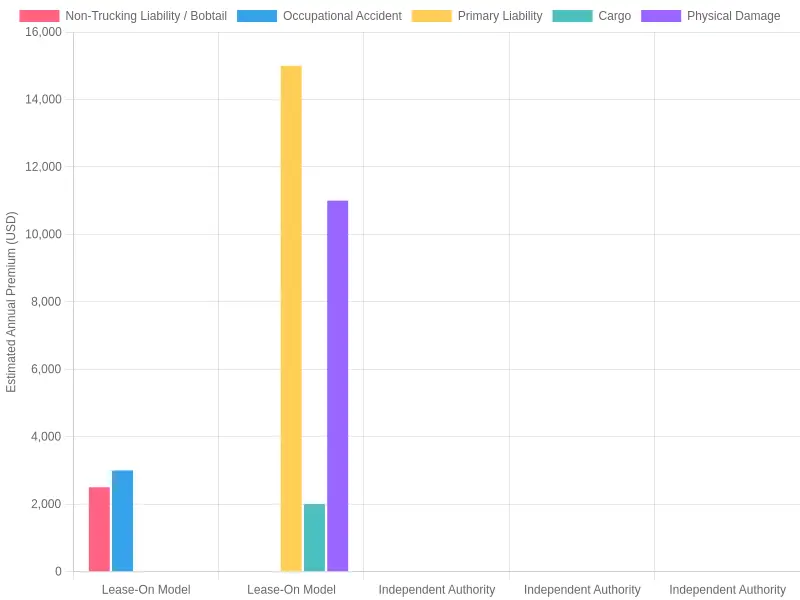
Lease-on operators usually run under the carrier’s primary liability policy, so the big federal-limit coverage is already in place. Instead of buying primary liability, you pick up two smaller policies:
- Non-trucking liability (bobtail) insurance covers the truck when it is not dispatched under the carrier’s authority.
- Occupational accident coverage stands in for the workers’ compensation a lease-on driver would otherwise go without.
Since the carrier holds the primary exposure, the lease-on operator’s premiums stay relatively light.
Insurance Requirements With Your Own Operating Authority
With your own authority, you step into the role the carrier used to play. You secure primary liability, cargo, and physical damage coverage, then file proof with FMCSA. For general freight the federal minimum on primary liability is $750,000, and hazmat or heavier operations often carry higher limits. Without an active filing, you cannot legally haul a load.
Why Insurers Price Independent Authority Higher
New authority gets priced high because insurers are underwriting an unknown: no loss history, no safety rating, often one commercial truck with thin reserves behind it. Add required cargo and physical damage limits and the premium climbs fast. The same driver can pay several times more in year one just for holding their own authority instead of leasing on.
How Claims History and Safety Scores Move Your Rates
After year one, your rates follow your record. A preventable accident, an out-of-service inspection, or a rising CSA score can push renewals up by double digits; a clean multi-year history earns discounts. Carriers and brokers screen on safety scores, so a weak score costs you twice – in insurance dollars and in freight you cannot book.
Protecting Asset Value and Financing Risk
Physical damage coverage is tied to what your truck is worth, and equipment values move with emissions rules and demand. Understanding how emissions standards affect used truck prices helps you insure and resell at the right moment.
Equipment value drives financing, too. Lenders require physical damage coverage as a loan condition, and stable values keep premiums and terms predictable. Tracking used truck price stability gives you a clearer read on financing risk before you sign.
Choosing a path is half numbers, half risk. Lease-on lowers your insurance burden and caps your upside; your own authority raises premiums and puts the safety and claims record in your hands.
Key Factors to Weigh Before You Decide
Choosing between a lease-on agreement and your own operating authority comes down to a few practical realities that differ for every operator.
- Available working capital. Going independent means covering insurance, permits, fuel, and repairs before your first invoice clears, so you need enough in reserve to float several weeks of expenses. If that cushion is thin, a lease-on lets the carrier absorb much of the upfront load while you build savings.
- Tolerance for administrative work. Your own authority means you own the paperwork: IFTA filings, DOT compliance, driver logs, invoicing. If you would rather drive than do back-office admin, leasing on to an established carrier keeps those tasks off your plate.
- Access to consistent freight. A reputable lease-on carrier usually supplies a steady stream of loads; independent operators have to build their own broker and shipper relationships. Without dependable freight, the freedom of your own authority turns into unpaid downtime.
- Insurance appetite and budget. Independent authority requires your own motor carrier policy, which can cost several times more than a leased operator’s coverage and demands a larger down payment. Before you buy commercial trucks, get real quotes so you know whether your budget can take the premium.
- Comfort with regulatory filings. Registering with the FMCSA, getting a USDOT number, and keeping your authority active all take ongoing attention and fees. If compliance deadlines and audits sound stressful, leasing on may be worth the trade-off.
- Growth ambitions. Lease-on suits testing the waters, but scaling a fleet under your own authority gives you more control over branding, pricing, and customer relationships. Decide whether you want to stay a single-truck operator or build a business.
- Current market freight rates. Weak rates squeeze thin margins and make the fixed costs of independence harder to justify; strong rates reward operators who can negotiate directly. Track rate trends before you commit so you time the move rather than guess at it.
- Risk tolerance for revenue volatility. Independent operators keep every dollar they earn and absorb every slow week, breakdown, and deadhead mile. Leasing on trades some upside for predictability, so be honest about how much income swing you can handle.
Weigh these honestly, with some solid finance tips for first-time truck owners in hand, and you will land on the path that matches your finances and temperament rather than the one that sounds more impressive.
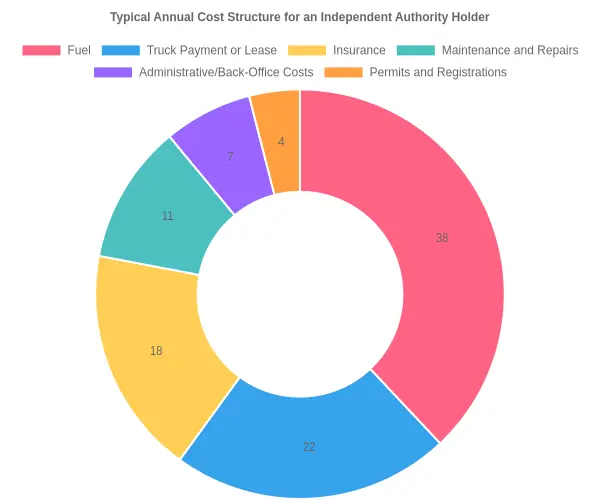
Typical Annual Cost Structure for an Independent Authority Holder
Figure: This doughnut chart breaks down the typical annual cost structure for an owner-operator running under their own operating authority, showing the percentage share of each major expense category and a center label summarizing the estimated total annual operating cost of $180,000.
Reading the Numbers
| Cost Category | Share of Annual Operating Cost |
|---|---|
| Fuel | 38% |
| Truck Payment or Lease | 22% |
| Insurance | 18% |
| Maintenance and Repairs | 11% |
| Administrative / Back-Office Costs | 7% |
| Permits and Registrations | 4% |
Two categories climb the most when a driver moves from lease-on to holding their own authority: insurance and administrative or back-office costs. Under a carrier, insurance is pooled across hundreds of trucks, so one owner pays a fraction of the true premium, and the carrier handles bookkeeping, dispatch setup, safety compliance, and tax filing. Carry the authority yourself and that umbrella is gone. You buy your own commercial auto and cargo liability policies and either build or outsource a full back office – which is why these two lines jump from near nothing to a quarter of the budget. Fuel and the truck payment or lease stay remarkably stable between the models, because moving freight costs about the same either way. The real difference is not what it costs to run the truck but what it costs to run the business behind it. For help with those new obligations, see these finance tips for first-time truck owners.
Financing and Cash Flow Readiness
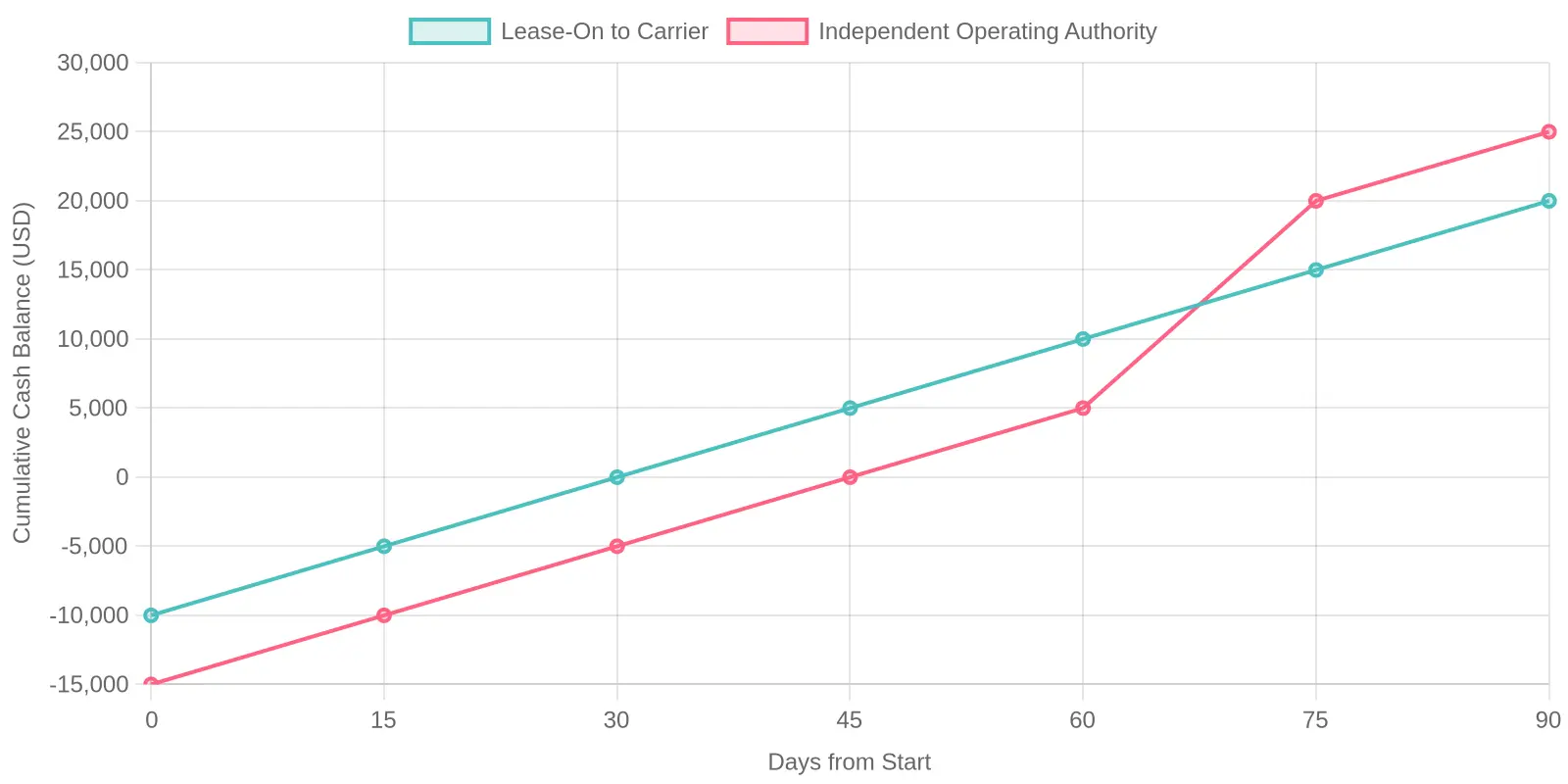
Leasing on or filing for your own operating authority is a cash flow decision as much as a business one. The model decides when money arrives, how much you spend up front, and how long you can ride out a slow month. Map the timing of every dollar before you sign anything.
Lease-On: Faster Money, Shared Revenue
Lease on to an established carrier and the carrier bills for you. Settlements usually arrive weekly or twice a month, so the cycle is short and predictable. For a new owner-operator, that fast turnaround makes fuel, maintenance, and truck payments easier to cover without touching savings.
The trade-off is a revenue share – usually a percentage of each load – and less say over your rates and routes. You give up upside for stability, which for many people is the right place to start.
Independent Authority: Bigger Upside, Longer Waits
With your own operating authority, your name is on the invoice, so you can chase higher-paying shippers and brokers directly. But those customers often pay on 30-60 day terms, and that gap is the main reason new carriers run out of cash.
Beyond slow receivables, expect larger insurance deposits and upfront costs for USDOT and MC registration, IRP plates, IFTA setup, and per-state authorities. Together they can demand several months of runway before steady cash shows up.
Financing Your Commercial Trucks
How you pay for the truck matters as much as how you get paid. Most buyers choose among a few options for commercial trucks: bank or credit-union loans, in-house dealer financing, lease-to-own programs, and SBA-backed lending if they qualify. Each carries a different down payment and monthly burden, so compare total cost rather than sticker price. It also pays to read financing tips built for first-time truck owners before you shop, and to weigh a dealer against an auction based on your budget and risk tolerance.
Why a Cash Reserve Is Non-Negotiable
A cash reserve is your shock absorber. Under a lease-on, three to six weeks of operating expenses is a reasonable buffer. Under your own authority, aim for three to six months. That cushion absorbs late broker payments, surprise repairs, and the slow season without pushing you into high-interest debt.
Modeling Break-Even Under Both Scenarios
Break-even is where revenue finally covers every fixed and variable cost. Run both sets of numbers with realistic assumptions for your lane and equipment.
| Cost / Factor | Lease-On to Carrier | Independent Operating Authority |
|---|---|---|
| Payment cycle | Weekly to bi-monthly | 30-60 days |
| Upfront authority costs | Minimal | USDOT/MC, IRP, IFTA, insurance deposits |
| Revenue share | Carrier takes a percentage | You keep the full rate |
| Insurance deposit | Lower | Higher |
| Recommended reserve | 3-6 weeks | 3-6 months |
| Break-even horizon | Weeks | Often 2-4 months |
Model both with your own numbers, then pick what your bank account can actually support. The bigger headline rate is not always the one that keeps your commercial trucks moving and the lights on.
How to Choose Between the Two Paths
There is no single right answer to owning commercial trucks. What fits depends on your goals, your risk tolerance, and how much administrative work you will take on. Running under your own operating authority and leasing on to a carrier solve different problems, so match the path to your situation rather than to someone else’s success story.
Use the criteria below as a quick filter before you commit.
Choose lease-on to a carrier when…
- Capital is limited. You skip the upfront cost of authority, compliance setup, and higher insurance premiums, and put that money toward a truck and fuel instead.
- You value predictable dispatch. The carrier feeds you loads, so you spend less time hunting freight and more time driving.
- You want a lighter administrative load. The carrier usually handles billing, IFTA reporting, and regulatory paperwork for you.
- You are building experience. Running under an established carrier is a low-risk way to learn the business, understand margins, and build a safety record before going solo.
Choose your own operating authority when…
- You have a cash reserve. You can absorb slow weeks, insurance deductibles, and compliance costs that arrive before revenue does.
- You can source or broker your own freight. You have the relationships or sales skills to keep the truck loaded without someone else’s load board.
- You want higher earning potential. You keep the full rate instead of sharing it, which can lift take-home pay once you are established.
- You can manage compliance and insurance independently. You are comfortable with filings, DOT requirements, and negotiating your own coverage.
The two paths side by side
| Factor | Lease-on to a carrier | Own operating authority |
|---|---|---|
| Upfront capital | Low | High |
| Dispatch | Provided by carrier | Self-sourced |
| Administrative work | Minimal | Extensive |
| Earning ceiling | Moderate | Higher |
| Risk level | Lower | Higher |
Timing your equipment move
Whichever path you pick, the equipment market matters. Used truck prices and availability shift quarter to quarter, so timing your purchase to favorable conditions stretches every dollar. Watching current trends in used truck sales growth helps you decide whether to buy now or wait – especially if you are leaning toward your own authority and carrying more financial weight alone.
The bottom line
Neither option is universally right. If you are short on cash, want stability, and are still learning the market, leasing on is the safer first step. If you have reserves, a freight pipeline, and the appetite for compliance, independence can pay off. Weigh your goals and your risk capacity honestly, then choose the path that lets you sleep at night while the truck keeps earning.
Frequently Asked Questions About Lease-On vs. Your Own Operating Authority
Signing on with an established carrier or striking out with your own operating authority is one of the biggest calls a new truck owner makes. These are the questions business owners and logistics professionals ask most.
What is the difference between lease-on and own operating authority?
Lease-on to a carrier and you operate under that company’s DOT and MC numbers, hauling freight they broker or dispatch while your equipment sits under their umbrella. Filing for your own operating authority means getting your own MC number, contracting with shippers directly, and controlling your rates and lanes. Leasing gives you steadier work with less administration; independence gives you full control and full responsibility. Many owner-operator drivers lease on first to build cash flow, then move to their own authority later.
How much does it cost to file for operating authority?
The federal filing fee is only $300, but real startup cost runs much higher once you add the required BOC-3 process agent (roughly $25 to $100), a Unified Carrier Registration fee, and any state or Canadian provincial registrations. You also have to prove financial responsibility by carrying minimum liability insurance, and if you register as a broker or freight forwarder, add a surety bond – together several thousand dollars in your first-year budget. The biggest variable is equipment, and fleet costs keep moving with import duties and demand. For a closer look at how those pressures hit pricing, see this analysis of the impact of tariffs on truck sales. Budget carefully: the paperwork fees are the smallest part of the bill.
Can I switch from lease-on to my own authority later?
Yes – thousands of owner-operator drivers make that switch every year. The cleanest route is to run under a carrier while you save capital, then file for your own operating authority once you have a cash cushion and a client base. Read your lease first, because some contracts carry non-compete clauses or notice periods before you can haul independently. Once you are clear, you can hold both your MC number and your leased position for a short time to avoid gaps in income.
Do I need my own insurance if I lease on to a carrier?
In most cases, no. When you lease on to a carrier, that carrier’s liability policy covers the freight you haul under its authority – one of the arrangement’s biggest advantages. You will still usually need your own non-trucking liability or bobtail coverage for miles you drive without a load. Hold your own operating authority instead, and you must carry primary liability yourself, with premiums set by your safety record and operating history.
How long does it take to get an MC number?
After you file with the FMCSA, the agency usually assigns your MC number within a few business days, but you cannot legally haul interstate freight until your authority is fully active. Activation generally takes about 21 days after publication, which allows time for protests and for your insurance to be verified. If you also register in Canada or additional states, expect the total to stretch to four to six weeks. Plan around that window so a new owner-operator business does not lose early contracts.
Which option is better for a first-time truck owner?
For most first-time owners, leasing on is the safer start: consistent loads, built-in insurance, and back-office support while you learn the business. Running under someone else’s operating authority lets you focus on driving and cash flow instead of compliance and sales, which matters most in year one. Once you know your costs, lanes, and customer relationships, moving to your own authority can unlock better margins. There is no single right answer, but lease first and grow into independence suits most new owner-operator ventures.
Conclusion: Matching the Right Path to Your Business Reality
There is no single correct way to own commercial trucks. The better path depends on four practical factors: how much capital you can commit, how much risk you can tolerate, how much administrative work you will take on, and how much freight access you can realistically secure.
Both routes – leasing on to a carrier and holding your own operating authority – are valid ways into fleet ownership. Neither is inherently better. Each shifts cost, control, and responsibility in a different direction, and each rewards a different kind of operator.
Business owners often tilt toward stability. If predictable revenue matters most and you would rather skip the back-office burden of compliance, insurance, and direct shipper relationships, leasing on keeps trucks earning with less overhead. If you can fund slower months and want control over your brand and clients, your own authority may deliver stronger long-term upside.
For operators, the question is autonomy versus simplicity. Leasing on offers consistent loads and lighter paperwork, which suits drivers who want to stay behind the wheel. Your own authority rewards those ready to manage dispatch, pricing, and customer relationships directly.
For logistics professionals, it is a network question. Leasing on adds capacity quickly and cuts administrative drag; your own authority gives you direct control over service levels and contracts. To time the decision well, follow current truck ownership market momentum and track how shifting freight economics affect acquisition costs.
Deregulation, fuel prices, and freight cycles keep moving. Revisit these trade-offs each year so your fleet strategy stays aligned with where the business is actually heading.