
Introduction
Carrying a firearm in a commercial truck means transporting a weapon — loaded or unloaded, within reach or locked away — inside a commercial motor vehicle used in interstate or intrastate commerce. Those trucks cross state lines and fall under federal motor carrier oversight, so no single rule covers the practice. Three layers of authority apply at once: state permit law, which decides who may possess or transport a weapon in a given jurisdiction; federal transport law, which sets the conditions for moving firearms across state lines; and the policy of the carrier that employs the driver.
The three rarely line up. A concealed-carry permit issued in one state may mean nothing in the next, and federal law addresses how to move an unloaded firearm without saying anything about an employer’s internal rules. A weigh station is often where they meet: an inspection that starts as a weight and paperwork check can turn into questions about what is stored in the cab. Compliance decisions reach into licensing, liability, and the driver’s job, so the regulatory environment matters as much as any individual rule. This guide compares state permits against company policy for CDL drivers, explains how each layer works, and marks the points where they conflict.
The table below shows how permit requirements, reciprocity, constitutional carry, and vehicle-storage rules differ across a representative set of states. Those differences are why a single company policy so often collides with the permits a driver carries.
State Firearm Permit Variables for Commercial Drivers
| State | Permit Required (Yes/No) | Recognizes Out-of-State Permits (Reciprocity) | Constitutional Carry Status | Vehicle Storage Rule Summary |
|---|---|---|---|---|
| California | Yes | No | None | Handgun must be unloaded and in a locked container during transport |
| New York | Yes | Very limited | None | Unloaded and locked in trunk or secure container; strict local review |
| Illinois | Yes | Limited | None | Must be unloaded and enclosed in a case; FOID card required |
| Colorado | Yes | Yes (partial) | None | Loaded handgun in vehicle requires a valid permit |
| Pennsylvania | Yes | Yes (partial) | None | Loaded handgun in vehicle requires a valid permit |
| Texas | No | Yes | Yes (since 2021) | Handgun may be stored loaded inside the vehicle |
| Florida | No | Yes | Yes (since 2023) | Concealed handgun allowed if securely encased or not readily accessible |
| Arizona | No | Yes | Yes | Loaded firearm permitted in the vehicle |
| Georgia | No | Yes | Yes (since 2022) | Handgun may be kept loaded in the vehicle |
Table 1: State firearm permit variables for commercial drivers.
Company Policy as the Operative Standard
A state concealed-carry permit is a license to carry under state law. It is not a license to carry anywhere, in any vehicle. Step into a company-owned or leased truck and a different set of rules applies — usually the employer’s, not the permit holder’s.
Private employers can prohibit firearms on property they own or lease, and commercial trucks are property. That right holds regardless of state carry law: a carrier can ban weapons across its fleet even in the most permissive states.
Federal law adds another constraint, and a narrow protection with it. Under 18 U.S.C. § 926A, a person who may lawfully possess a firearm can transport it from one state to another if the weapon is unloaded, locked in a case or container other than the glove compartment or console, and not readily accessible from the passenger compartment — provided possession is lawful at both the origin and the destination. School zones and federal facilities carry their own federal prohibitions. None of this grants an employer permission to allow firearms; it sets the boundary the employer may narrow.
At-will employment and lawful carries
In most U.S. states, employment is at will. A driver can be fired for carrying a firearm in a commercial truck even when the carry is entirely lawful under state law. The employer does not have to prove a crime occurred; a documented policy violation is enough. Company rules and state law have to be read together, not separately.
Personal vehicles versus company equipment
Policy for personal vehicles and policy for company equipment are two different things. A driver’s own car is personal property, and carry rules there follow state law and the driver’s choices. A tractor or trailer owned or leased by the carrier is company equipment; the carrier sets the terms, and those terms may be stricter than state law. The same driver who may legally carry in a personal pickup at home can be fired for carrying inside a company truck on the same road.
Owner-operators under contract
An owner-operator who hauls under a carrier’s authority is often treated as an independent contractor, yet the contract frequently binds the driver to the carrier’s safety and conduct standards. Leasing agreements typically require compliance with the carrier’s operating rules, and those rules may include firearm restrictions. Contract status is not an exemption. Drivers in these arrangements need to know where employment classification ends and contractual obligation begins, which is why clear information on driver misclassification matters for anyone signing a lease.
State law sets the floor for what a permit allows, but company policy sets the ceiling for what a driver may do inside a commercial truck. Permits, contracts, and federal rules each carry weight, and the employer’s standard usually decides the outcome.
One Truck, Three Rulebooks: The Layered Authority Model
Carrying a firearm in a commercial truck is governed by three stacked layers of authority, shown in the diagram below.

Reading the Layers
- Bottom band (federal transport rules): The baseline. Federal law sets the floor for what may be transported and how, but it rarely grants permission to carry. It defines the outer boundary.
- Middle band (state permit requirements): Permits are issued state by state. Cross a border and the rules change; reciprocity is patchy, and some states recognize no out-of-state permits at all.
- Top band (company policy): The narrowest layer and usually the most demanding. A carrier can prohibit firearms entirely, even where state law allows them.
The upward arrow is the point: authority stacks, and each higher layer can be more restrictive than the one below it. The most restrictive layer wins. If federal law permits the transport, a state permit covers the driver, and the company bans firearms anyway, the gun stays home. That ranking is worth knowing before a truck reaches a weigh station.
These layers shift with legislation and administrative priorities — federal oversight of trucking can change on short notice — so a policy that was fine last quarter may not be fine today. Check all three before a long haul.
Weigh Station Inspections and Firearm Discovery
A weigh station stop is routine, but it can involve more than a weight reading. Knowing the stages helps a driver anticipate when a question about a firearm may come up, and how a routine check differs from a full inspection.
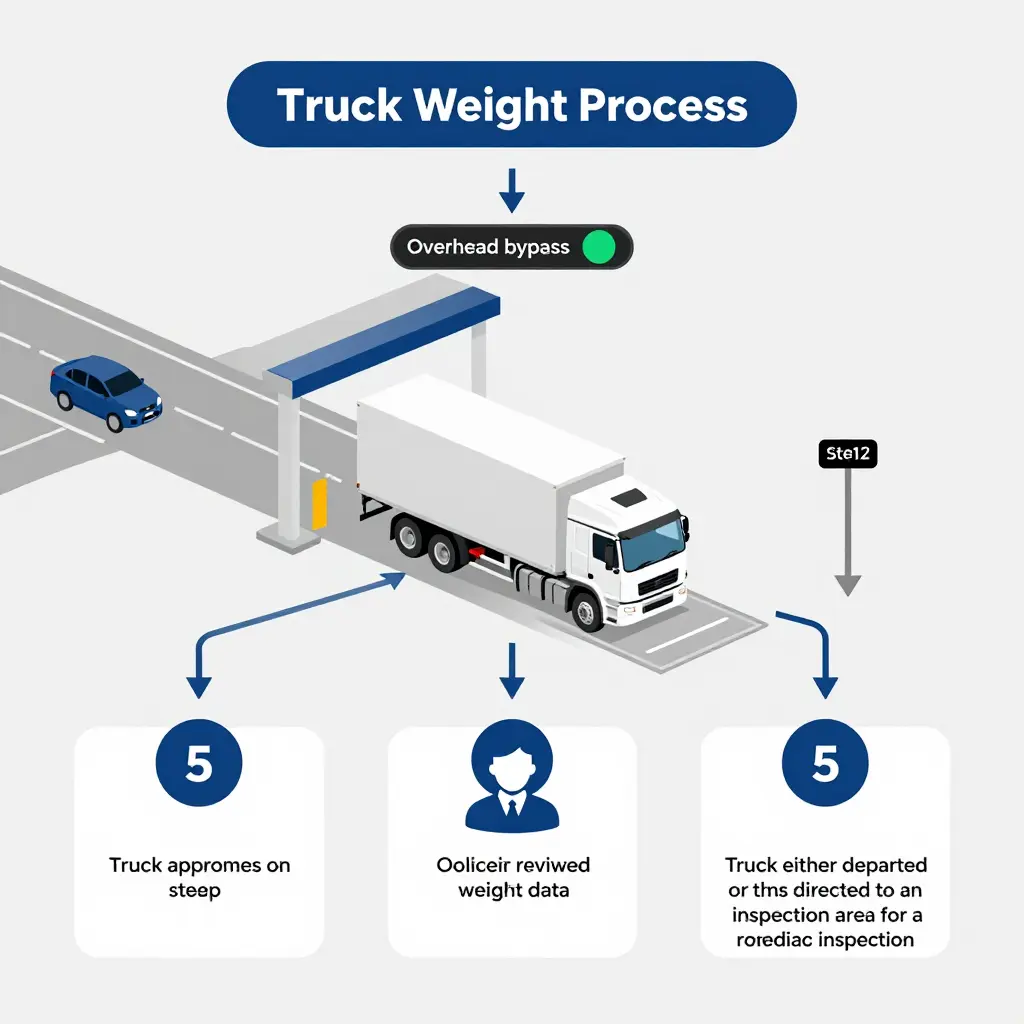
The Approach and Bypass Signal
As a truck nears a weigh station, sensors read an electronic transponder or the license plate. An overhead signal then tells the driver to bypass (green) or pull in (red). A bypass lets the truck continue; a red signal sends it up the ramp to the scale.
Weighing and the Inspection Pull-In
On the scale, an automated or officer-monitored system records gross, axle, and gross vehicle weights. The inspector then either waves the truck on or directs it to an inspection bay. A routine weight check ends at the scale. A pull-in means an officer wants a closer look at the vehicle and its paperwork, which may become a roadside inspection.
Levels of Inspection
Not every stop has the same scope, and the difference matters legally.
- Routine weight check: the truck is weighed, the data logged, and the driver departs. The cab is typically not examined.
- Level I inspection: the most thorough stop, covering driver, vehicle, and documents, and often including the cab and sleeper berth.
- Consent-based search: the officer asks permission to look further. The driver may decline, though that can extend the stop while other checks proceed.
Officers may ask for a driver’s license, medical card, registration, insurance, and shipping papers, and may question the driver about the vehicle and cargo. They generally cannot search personal areas without legal authority or consent.
When Firearm Questions Arise
During an inspection, inconsistencies surface quickly — a state permit that does not match the state where the truck is stopped, a firearm stored differently from one trip to the next, or a company policy that bars weapons in the cab. Officers look at several things:
- Driver qualification and hours-of-service records
- Vehicle condition, including brakes, tires, lights, and coupling devices
- Cargo securement and shipping documentation
- Registration, insurance, and operating authority
- Visible or accessible items in the cab and sleeper berth
A discovered firearm is not automatically a criminal matter. It often becomes a legal and administrative question shaped by state permits, reciprocity rules, and employer policy. Because oversight of the industry can shift, keeping current on developments in trucking oversight helps owners and drivers prepare before a truck reaches the scale.
Carrier policies vary widely. Some prohibit all firearms, some allow them with a permit and prior approval, and others have no written policy at all. Because a state permit does not override company policy, a driver should ask for the carrier’s written rule rather than assume one. A silent policy is not permission.
Use this checklist before leaving the yard or rolling onto a scale.
- Confirm the current state’s permit rule for carrying a firearm, including whether the route crosses a state that does not recognize your license at all.
- Review the carrier’s written policy on firearms, because a lawful carry may still violate stricter internal rules.
- Understand the federal interstate transport requirements and the narrow protection they offer when a firearm stays locked, unloaded, and inaccessible.
- Verify that the firearm is stored in a locked hard case, unloaded, and kept separate from any accessible area of the cab.
- Check that ammunition is stored apart from the firearm and outside the driver’s immediate reach or sleeper access.
- Confirm reciprocity paperwork for every state on the route, and note which concealed-carry licenses the carrier and the state actually recognize.
- Collect current copies of permits, licenses, and any written approvals in one folder that can be reached without searching.
- Document every written approval from a dispatcher or compliance officer so it can support the driver’s position during a roadside inspection.
- Re-check the rules and inspection practices at each weigh station on the route before departure, since some enforce stricter checks than others.
- Brief the co-driver on the plan and the location of every compliance document before leaving.
Penalties and Consequences of a Firearms Violation in a Commercial Truck
When a driver is found carrying a firearm in a commercial truck in violation of the law or employer rules, the fallout rarely stops at one outcome. State, federal, and employer rules operate at the same time, so a single traffic stop, weigh-station inspection, or terminal check can start several processes at once.
Legal Penalties
State authorities usually bring the first charges, and federal agencies may open a parallel case.
- State criminal charges. Depending on the state and the circumstances, a violation can be charged as a misdemeanor or a felony, carrying fines, probation, or jail time. Aggravating factors such as a prior record or prohibited-person status raise the severity of the charge.
- Permit revocation. A concealed-carry or state firearms permit can be suspended or permanently revoked, often removing the driver’s ability to carry lawfully anywhere, not only on the job.
- Federal transport violations. Moving a firearm across state lines or through restricted areas such as school zones or federal facilities can create federal charges under interstate transport statutes, independent of any state case.
Employment and Business Consequences
The professional costs often arrive before the court dates.
- Termination. Most carriers treat a firearm violation as a breach of company policy and grounds for immediate dismissal, regardless of how the legal case ends.
- Loss of driving privileges under a carrier. A carrier can bar the driver from its equipment and report the dismissal, making future hiring harder in a market where background screening is standard.
- Insurance implications. A claim or violation tied to a firearm can raise premiums, trigger a non-renewal, or lead to denied coverage for both drivers and fleet owners.
- Contract loss for owner-operators. Independent drivers may lose broker and shipper contracts, terminal access, and even operating authority.
A single act can trigger legal and professional consequences together. A criminal charge can cost a driver the job before the case is resolved, and a policy violation can end a business while federal charges are pending. Freedom, livelihood, and business standing can all be affected at once, which is why the layers of exposure deserve attention long before a weigh station.
The Two-Gate Decision at a Glance
Before a driver reaches a weigh station with a firearm on board, two separate gates have to be cleared, and they do not move together. The first is legal: does the state being entered or crossed permit carry? The second is contractual: even if the law permits it, does the carrier’s written policy allow it?

The diagram traces that path. One starting node feeds a first decision — a permit green light or a red light. The green path leads to a second, independent decision: company policy. Only when both branches resolve favorably is the outcome a compliant carry. Any red light, from the state or the employer, leads to the same result: do not carry.
The visual matters because the two gates are easy to merge in a driver’s mind. Someone holding a valid concealed-carry permit can reasonably assume the trip is legal, yet policy sits outside that permit and can override it. Laying the logic out as parallel checkpoints — state first, employer second — makes clear that compliance is a stack, not a single stamp of approval.
Frequently Asked Questions About Firearms in Commercial Trucks
Can my company ban firearms in my truck even if my state permit allows carry?
Yes. A private employer can prohibit firearms in company-owned trucks even when state permits allow carry. Property rules generally override personal carry rights, and many carriers enforce no-weapon policies for insurance and liability reasons. A violation is more likely to cost the driver the job than to bring criminal charges. Read the carrier’s handbook before bringing a firearm into a commercial truck.
Does my CDL affect my right to carry a firearm?
No. A CDL does not restrict Second Amendment rights, and no federal rule strips firearm rights from licensed drivers. Carry eligibility depends on state permits, residency, and local law. Federal transport rules may still apply to certain weapons, and an employer can add its own restrictions. Beyond those, a commercial license changes nothing about carrying a firearm in a commercial truck.
What happens if a firearm is found at a weigh station?
It depends on state law and the driver’s documents. Lawful carry with valid permits usually leads to no charge, while unlawful possession can mean confiscation, fines, or arrest. An inspector may also report the finding to the carrier, which puts the job at risk. Keeping the firearm legal and following company policy is what protects a driver at a weigh station stop.
Do I need separate permits for every state I drive through?
Many, but not every one. Most states honor out-of-state permits through reciprocity agreements, while others require their own license. California and New York, for example, rarely recognize permits from elsewhere. Drivers who cross state lines should map the route and verify each state’s rules before departure, because carrying without valid authority can lead to serious legal trouble.
Can an owner-operator carry a firearm in their own truck?
An owner-operator has more room, since no company policy applies to a personally owned truck. State permits and federal transport rules in every jurisdiction still do. Ownership is not an exemption from local carry law, and the line between independent contractor and employee affects how a lease is structured; see independent contractor versus employee status. An owner-operator carrying a firearm in a commercial truck should confirm each state’s requirements and store the weapon lawfully.
How should a firearm be stored for interstate transport?
Store it unloaded, locked in a hard case, and separate from ammunition, ideally where it cannot be reached while driving. Federal law protects lawful transport when the firearm is inaccessible and possession is legal at both the origin and the destination. Never keep a loaded weapon within reach. Proper storage is what keeps both the driver and the carrier defensible.
Best Practices for Drivers and Fleet Owners
The friction between state permits and company policy is one of the most misunderstood risks in trucking. A driver can be fully legal under state law and still be fired, fined, or cited for breaking an employer’s rule. A carrier’s silence is not permission either. Because firearm rules vary so much across state lines, the durable strategy is preparation on both sides of the cab.
For Drivers: Verify Before You Carry
Before each trip, ask the carrier for its written policy and read it; keep a dated copy rather than relying on word of mouth. Keep current reciprocity documentation for every state permit you hold and check it against the planned route, since a permit honored in one state may be void in the next. For storage, choose a locked case or secured compartment that satisfies both the strictest state on the route and the carrier’s own requirements. Drivers new to the industry can start with compliance training that covers CDL firearm laws and company expectations; see how education empowers new truckers.
For Owners and Fleet Managers: Set the Standard
Owners should put the firearm policy in writing, spelling out what is allowed, what is prohibited, and where equipment may be stored. Train drivers on interstate rules, not just home-state law, because the legal landscape changes at every border. Keep signed acknowledgements on file. Fleet owners budgeting for that training and compliance work can review finance tips for first-time truck owners.
Quick Best-Practice Checklist
- Confirm and retain a dated copy of the carrier’s written policy.
- Keep current documentation for every state permit you hold.
- Verify reciprocity for each planned route before departure.
- Use compliant, locked storage that satisfies the strictest applicable rule.
- Train drivers on interstate firearm rules, not just home-state law.
- Document and file signed policy acknowledgements.
| Responsibility | Drivers | Owners and Fleet Managers |
|---|---|---|
| Written policy | Request and read the full text | Draft and distribute a clear policy |
| Documentation | Carry current state permits and reciprocity proof | Verify driver records annually |
| Storage | Use locked, compliant compartments | Specify approved storage in writing |
| Training | Learn interstate CDL firearm laws | Deliver recurring compliance training |
| Records | Keep a signed copy of the policy | File and retain acknowledgements |
When a firearm is in a commercial truck, the strictest applicable rule governs. Treating state permits as a floor and company policy as a ceiling keeps drivers employed and carriers protected.
Documentation and Recordkeeping
Staying compliant with firearm rules in a commercial truck depends as much on paperwork as on judgment. Whether a driver relies on state permits, company policy, or both, the records behind those choices should be organized, current, and easy to produce.
A driver or fleet should keep a file that ties each firearm-related decision to its legal and internal authority. A single folder, physical or digital, keeps it from going missing a month before a weigh station inspection.
Records to keep on hand:
- Current state permits and licenses – copies of every valid concealed-carry or transport permit, with issue and expiration dates.
- Reciprocity reference materials – printed or saved summaries showing which states recognize which permits, updated as laws change.
- Signed company policy acknowledgements – dated signatures confirming the driver has read and agreed to the employer’s firearm, cab, and possession rules.
- Transport documentation – bills of lading, manifests, and shipping papers that establish the legitimate commercial purpose of the load.
- Inspection and training logs – records of prior stops, findings, and any completed safety or compliance training.
Retention should follow the longer of the applicable state requirement or internal policy. Keep current permits for their full active period plus a short buffer, signed acknowledgements for the length of employment and several years after, and transport documentation for the period federal and state regulators set.
Good records reduce risk in two ways. Legally, they show good-faith compliance, which can shorten an inspection and limit exposure to citations. On the employment side, dated acknowledgements and training logs protect both driver and employer if a dispute arises, and they reflect the accountability behind driver education and classification.
Organized, consistently maintained records turn an uncertain situation into a verifiable one.
Conclusion: When the Rules Collide, the Stricter One Wins
When a state permit and a company policy disagree about carrying a firearm in a commercial truck, the stricter standard governs. A driver never gets to rely on whichever rule is more convenient. The federal floor sets the baseline, state permits decide what is legal inside a jurisdiction’s borders, and the employer’s written policy decides what is allowed on the clock. If any one layer is more restrictive, that layer is the real-world limit.
Put plainly: the law says what you can do, and the company says what you may do. A permit that checks every legal box means nothing if the carrier bans firearms, and a permissive handbook offers no protection against a state that treats the weapon as contraband.
The safeguards are unglamorous but effective: prepare before you roll, and document everything. Carry copies of permits, keep the company policy on hand, and confirm the rules for each state on the route before approaching a weigh station or inspection point. When an officer or a dispatcher asks hard questions, paperwork is what turns a stressful stop into a routine one.
Related Reading
- Finance tips for first-time truck owners
- How education empowers new truckers against driver misclassification
- Used truck prices: stability and key insights for 2025
- Current trends in used truck sales growth
Verify state permits and company policy before every trip, honor the stricter of the two, and a weigh station stop is far less likely to become a problem.