Riding in the bed of a commercial truck raises crucial legal and safety questions for trucking companies, construction teams, and logistics firms. This article comprehensively examines the relevant federal regulations and state laws governing this practice, alongside significant safety concerns that impact both companies and individuals. Understanding these regulations is imperative for fleet managers and procurement teams to ensure compliance and to protect both drivers and passengers from the inherent risks associated with riding in cargo areas. Each subsequent chapter elucidates various aspects of this topic—from federal mandates to specific state statutes, safety implications, and the legal exceptions to these rules, equipping industry professionals with the knowledge to navigate this complex landscape effectively.
null
null
Guardrails and Ground Rules: The Legal and Safety Boundaries of Riding in the Beds of Commercial Trucks
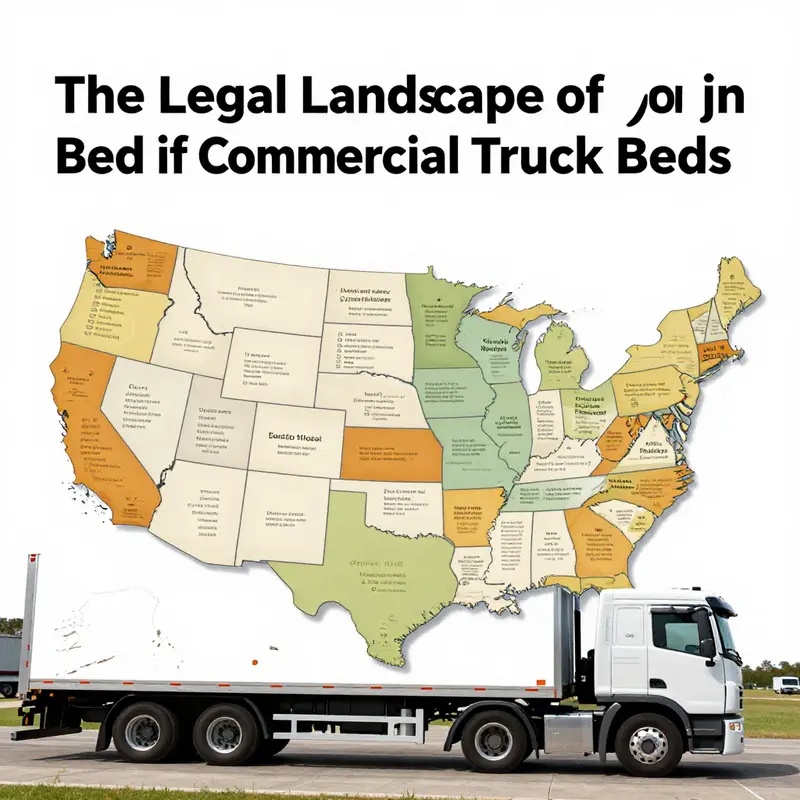
Riding in the bed of a commercial truck is one of those practical questions that quickly reveals the difference between everyday convenience and the far more carefully calibrated world of safety and law. In the real world of logistics, roadside work, and everyday transport, the cargo area of a truck is designed for payload movement, not for passenger comfort or crash protection. This distinction—between what a vehicle can haul and what it can safely carry as a person—frames a broad and persistent legal regime across the United States. The upshot is clear: in virtually all jurisdictions, passengers are prohibited from riding in the cargo bed while the vehicle is moving. The rule is not a minor courtesy to avoid nuisance; it is a deliberate, safety-driven prohibition designed to reduce severe injuries and fatalities in crashes, sudden stops, or rollover events. To understand why this is so, one must consider how federal and state authorities view the cargo space, how the law translates that risk into enforceable rules, and what counts as an exception, if any, for workers performing certain tasks. The principal authorities behind this framework—the Federal Motor Carrier Safety Administration (FMCSA), the Department of Transportation (DOT), and state departments of transportation—treat the bed as a hazardous zone rather than a passenger compartment. The ledger of regulations, handbooks, and code provisions collectively paints a consistent picture: the bed is for carrying cargo, not people, and safety systems such as seat belts, airbags, and protected seating are not present in the cargo area in most configurations. The practical message for drivers, employers, and workers is inevitably practical and uncompromising: do not ride in the bed when the vehicle is moving, and if you must be near or around a truck in work contexts, use designated seating with appropriate restraints and protective barriers. This is a matter of risk management as much as it is a question of the letter of the law. A practical frame for this discussion begins with the federal position and then turns to state enactments that fill in the details, sometimes with subtle but important distinctions about who counts as a passenger, under what circumstances, and what safety measures must be in place. The FMCSA, while not articulating a blanket prohibition on every conceivable passenger scenario, emphasizes that drivers must comply with state laws and must ensure passenger safety. In other words, federal directives delegate to state statutes the specifics of who may ride where and under what conditions. The Department of Transportation has repeatedly underscored a baseline principle: when passengers are allowed in or around commercial trucks, arrangements must be made to protect them from harm, and the cargo area—lacking seat belts or other protective devices—is typically not a safe space for riding. This framing makes state laws especially important for any profession that relies on trucks to move people within and around worksites, from construction crews to utility teams. The bed becomes a non-negotiable risk zone, not merely a gray area to be navigated on a casual basis. The legal texts, departmental advisories, and enforcement practices that flow from this stance share a common aim: to minimize ejections and blunt-force injuries. The rationale is straightforward. In a crash, the bed offers no integration with a restraining system. There are no airbags in the cargo area. A person in the cargo bed can be thrown out or crushed as the vehicle collides with another object, comes to a sudden stop, or flips over. Even with a slow rate of speed, the absence of a protective shell, the lack of a robust restraint system, and the exposure to shifting loads can turn a routine ride into a life-altering event in moments. The risk is not hypothetical. It is the kind of risk that appears in accident reports and in the cautionary guidance issued by safety agencies. In this context, the bed is not a space for improvisation or convenience, but an area that must be treated with the same respect as any potentially dangerous work zone. The state-level enactments are the practical instruments by which this risk calculus is translated into everyday behavior. California, a particularly influential example, entrenches the principle in statute and case practice. California Vehicle Code § 21011, among other provisions, makes clear that riding in the bed of a moving truck is unlawful except for explicitly authorized tasks carried out by designated personnel equipped with appropriate safety measures. The framework in California rests on a simple logic: if the vehicle is in motion and the cargo bed is not fitted with containment, restraint, or protective enclosures, there is no legitimate basis for riding in that space. Other states mirror this logic, sometimes with different formulations or penalties but with the same underlying emphasis on safety. In Texas, New York, Illinois, and many other states, enforcement hinges on similar lines: moving cargo areas are off-limits to passengers, and violations can carry fines, points on a driver’s record, or even more serious consequences if the action contributes to harm. Yet the exact contours of law—what constitutes a passenger, what exemptions exist, how enforcement is carried out—vary by state. The overall pattern, however, remains consistent: the bed is a high-risk area, and most jurisdictions explicitly prohibit occupancy during operation. It is common for statutes to carve out narrow exceptions for authorized work crews or emergency responders, but even these exemptions are bounded by conditions designed to ensure safety. For instance, authorized personnel may ride in the bed only when there is a clearly defined operational need, strict supervision, and the use of safety equipment that aligns with the task’s risks. In practice, this means that someone such as a flagger, a supervisor, or a utility worker who must temporarily access the bed for a mission-critical function may be allowed to do so only under tightly controlled circumstances. Otherwise, the default rule is that the bed is off-limits to riders. The message for employers is straightforward: if a job requires an additional person to be present in a truck, the safest and most compliant approach is to provide proper seating inside the cab with seat belts, or to use alternative transport arrangements that place passengers in seats designed to protect them. This logic supports the broader safety culture in logistics and field work. It also aligns with the responsibilities that fall on drivers. The FMCSA and DOT stress the driver’s duty to maintain a safe operating environment. This includes curbing risky practices, enforcing seat belt use, ensuring that passengers are appropriately restrained, and refusing to allow anyone to ride in the cargo area when the vehicle is in motion. The consequences of ignoring these rules can be significant, ranging from fines and penalties to increased liability in the event of an accident. From a legal perspective, violations can also imply that an employer bears responsibility for negligent safety failures, particularly if the organization knew or should have known that workers were riding in the bed and did not implement protective measures or training. The policy implications extend beyond the immediate enforcement action. They shape corporate safety protocols, driver training, onboarding for field crews, and the design of work plans that minimize the need for any person to be in or around the cargo area during transit. In the everyday workflow, this translates into practical decisions: plan routes and methods that minimize the need to cross the cargo space; designate loading and unloading zones that prevent live traffic interactions for workers; and invest in proper equipment or vehicles that accommodate the number of personnel without risking exposure in the bed. It is easy to underestimate the habit of improvisation, especially on long lines of work where the pace of operations creates pressure to “get everyone where they need to be.” Yet the safety science behind the regulations is clear. Even a single moment of compromise—standing in the bed to reach a load, hanging onto a tailgate during a jostle, or riding in a bed while the truck navigates a rough highway—can produce catastrophic outcomes. In this light, the bed becomes more than a space for moving cargo; it becomes a testing ground for the discipline that governs the interaction between human risk and mechanical design. The legal system mirrors that discipline by distinguishing between what is technically allowed and what is prohibited, and by offering a framework that holds employers and drivers accountable for unsafe practices. The internal logic of this framework relies on clear definitions: what counts as a passenger, what constitutes a compliant work setting, and what safety measures are required when exceptions are made. The state statutes, by spelling out these definitions, provide a road map for compliance that can be checked, audited, and enforced. They also provide a basis for industry education and for public safety campaigns. For workers who have questions about their personal safety, the best course is to consult official sources and seek guidance from supervisors and safety officers who understand the specifics of their jurisdiction. The go-to resources include federal advisories and state code texts, but practitioners should also consult authoritative summaries and practice guides that interpret how the rules apply to particular work scenarios. If there is a moment of doubt, the principle is simple: do not ride in the cargo bed when a vehicle is moving. If a job requires additional personnel, shift the arrangement to an enclosed cab or to a vehicle that is designed to accommodate seating with restraints. In addressing this topic publicly, industry voices often surface in professional blogs and safety training materials. For readers seeking a practical overview and community framing, the discussion in the McGrath Trucks blog offers insights into how fleets interpret and implement these rules on a day-to-day basis. While blogs are not legal texts, they reflect how practitioners translate statute into practice, including common questions, best practices, and the challenges of compliance in busy work environments. For readers who want to anchor the legal discussion in the primary sources, it is worthwhile to consult the state and federal texts themselves. The California example is particularly instructive because it demonstrates a formal recognition of the risk in the bed and the careful conditions under which any exception might be permitted. In California, and in many other states, the bed is treated as a hazardous space with limited, carefully circumscribed allowances. This is not a matter of preference or caution alone; it is a reflection of the observed risk profile and the design of vehicle safety systems that do not extend to the cargo area. The front line, then, is not merely code language but a demonstration of how safety science translates into enforceable rules. The broader takeaway is about consistency and accountability. States align with federal expectations, and employers anchor their policies in that dual framework. The bed of a commercial truck, once a pragmatic staging ground for cargo, becomes, in law and in practice, the focal point of a safety system that protects workers and the public. In the end, the question—Is it lawful to ride in the bed of a commercial truck?—receives a clear answer: not under ordinary operating conditions in most jurisdictions, and not in any way that would expose a rider to the predictable hazards of a moving vehicle without protective restraints. When there are exceptions, they are narrow, carefully supervised, and bound to specific safety protocols. The aim is to reduce needless risk and to promote a culture of safety that aligns legal compliance with everyday workplace realities. For readers who want to explore the statutory language in a concrete jurisdiction, consider California’s approach as a representative case study, where the law explicitly weighs risk, duty, and the means to manage both within a cohesive legal framework. External readers should refer to official texts for precise language and current phrasing. External resource: California Vehicle Code § 21011 and related provisions provide the primary statutory anchor for riding in the bed of a moving truck, and they illustrate how the rule operates in practice across many jurisdictions. See https://leginfo.legislature.ca.gov/faces/codes_displaySection.xhtml?sectionNum=21011&lawCode=VCC. For further nuance and practical perspectives, you can also explore industry discussions in the McGrath Trucks blog, linked earlier, which surveys how fleets implement these rules in real-world settings. The combination of law, safety data, and professional practice creates a robust boundary that keeps workers safer and keeps the roads a bit safer for everyone who shares them.
Beyond the Open Bed: The Legal Boundaries and Safety Realities of Riding in a Commercial Truck’s Cargo Space
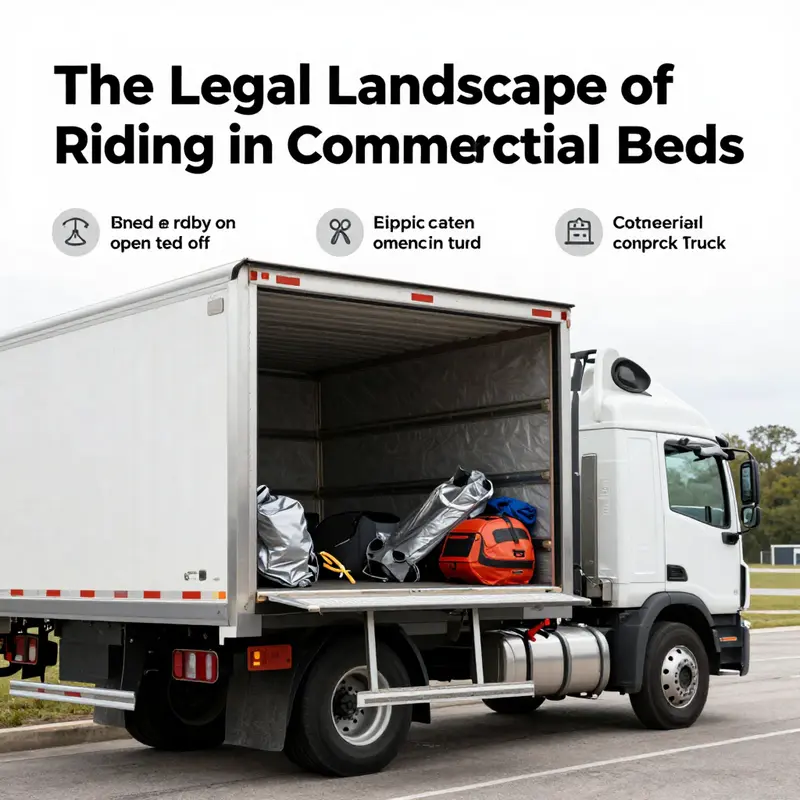
The image is compelling: a worker perched in the open bed of a pickup or light-duty truck, wind roaring past as the world rushes by in a blur. In some work cultures, riding in the bed is framed as a practical shortcut, a way to move people and tools when cabins are full. Yet the question at the center of this chapter—whether it is lawful to ride in the bed of a commercial truck—remains a matter of law, safety, and responsibility that far outpaces any pragmatic impulse. The answer, across most jurisdictions in the United States, is clear and unequivocal: it is not lawful for general passengers to ride in the cargo area of a commercial truck. This prohibition is embedded in federal and state rules, and it exists because the bed offers no structural protection, no seat belts, and no airbags to shield riders in the event of a crash, a sudden stop, or a rollover. When velocity, momentum, and mass collide on a highway or job site, the math of injury becomes brutally simple: the open bed magnifies risks and concentrates consequences on a person who cannot be secured or protected by design. The moral of the story is not a moralism about risk, but a citation of safety engineering and public regulation that prioritizes human life over convenience.
The legal architecture behind this prohibition is layered but coherent. At the federal level, the Federal Motor Carrier Safety Administration (FMCSA) sets the standards that govern who may ride inside the cab and who may ride outside, and under what conditions. The Department of Transportation (DOT) guidelines explicitly address passenger restrictions in commercial operations, defining the truck’s cargo area as a space not intended for carrying passengers under normal operating circumstances. The emphasis is not merely on a rule’s existence but on the underlying safety rationale: without seat belts, without doors designed to contain occupants during a crash, and without systems to manage ejection risk or protect against loose cargo, the bed becomes a liability machine rather than a place of transport. States reinforce this framework with statutes that often echo the same prohibitions while drawing attention to particular scenarios—including the presence of work crews, specialized equipment, or temporary seating arrangements—where exceptions may be tightly regulated and guarded by strict safety protocols. For example, California Vehicle Code § 21704 illustrates how state-level rules can carve out narrow, highly structured circumstances in which any seating in the bed would be restricted to authorized personnel with protective measures in place. Even when a company argues that workers are simply riding to a work site, the presence of an unsecured, open space inside a moving vehicle is a serious legal vulnerability. In practice, the law is clear enough to deter casual risk-taking, because the consequences of violating these norms include fines, penalties, and potential liability for negligent acts that cause harm. In other words, legality is not a blank canvas in which someone can sketch a permitted scenario; it is a framework built around fundamental protections for people who share the road and the work space.
Safety professionals translate that legal posture into tangible risk assessments that read like a list of red flags. The bed’s lack of a seat belt is not a minor omission; it is the absence of a basic life-support system. There are no airbags to cushion the impact of a collision, no rigid door structures to contain a rider, and no roof to shield against head injuries during a rollover. In the event of even a minor crash, the consequences can be catastrophic. The risk of ejection is not hypothetical: it is a consequence observed across accidents of varying severity, a function of the vehicle’s momentum and the rider’s exposure. In highway speeds or on busy work corridors where trucks circulate with heavy loads, the danger is magnified. The NHTSA’s warnings about riding in a truck bed underscore that this is not just a personal risk; it is a concern for the broader safety ecosystem, because a rider in the bed can become an unpredictable projectile in the event of a crash, presenting danger to other drivers and bystanders alike. Beyond the crash dynamics, environmental hazards come into play. Wind pressure at speed can cause fatigue, disorientation, and even loss of balance. Debris, tools, or unsecured cargo in the bed can become accelerants of harm, striking a rider or shifting suddenly in a way that might trap or injure someone who cannot react quickly enough. Temperature extremes, rain, or dust can also impair visibility and comfort, reducing a rider’s ability to react to commands or hazards.
In commercial settings, the stakes grow even higher. Trucks built for cargo transport are optimized for payload capacity and fuel efficiency, not for human occupancy in the cargo area. They travel on highways and secondary roads with little concern for the finite protection a cab offers, and they often carry variable loads that can shift during transit. A sudden brake, a swerving lane change, or a gust of wind can convert a routine trip into a dynamic, risk-laden event. The absence of a protective shell in the bed means there is no barrier to containment in a crash, no structural redundancy to keep the occupant from being ejected, and no system to mitigate the risk of being struck by loose equipment. The environmental hazards—wind, rain, dust, and temperature fluctuations—are not cosmetic annoyances; they degrade sensory perception and physical endurance, turning a ride into a test of resilience rather than a controlled transport scenario. This is not a theoretical argument; it is a practical accounting of how real-world conditions interact with design limits and regulatory boundaries to create a dangerous combination that public safety agencies repeatedly warn against.
From a liability perspective, allowing passengers to ride in the bed of a commercial truck is a minefield. Employers and operators must consider not only the immediate risk to individuals, but also the potential for cascading consequences. An injury sustained by a bed rider could trigger workers’ compensation claims, OSHA or state safety regulation inquiries, and civil liability in the event the accident caused damage to others. Even the appearance of permissible bed riding, if challenged in court or by regulators, can become a broader indictment of a company’s safety culture. The standard set by federal and state rules establishes expectations for how vehicles are operated and who is allowed to travel where in those assets. When a company flouts or overlooks those boundaries, it invites scrutiny of its risk management practices, training programs, and safety audits. The simplest, most effective way to avoid these liabilities is to adhere to the recognized safety model: keep passengers inside the cab, secured by seat belts, with appropriate egress and occupant protection that is compatible with the vehicle’s design and the journey’s requirements.
Yet the conversation about legality and safety cannot be reduced to a single checkbox labeled legal or illegal. There are often calls for exceptions, particularly in remote work environments or in situations where a quick transfer of personnel into a work zone seems necessary. Some jurisdictions and regulatory frameworks permit certain configurations for authorized work crews that include enclosed cab access or designated secure seating, with seatbelts and other safety measures in place. The key, however, is that these are not open-ended allowances; they are carefully bounded by rules that govern how many riders can be accommodated, where they sit, what protective equipment they must wear, and how the vehicle must be operated to maintain overall safety. In short, even when a local ordinance or industry practice seems to offer an exception, the safety and legal architecture remains anchored in restraint—restraint that protects workers, other road users, and the integrity of the operation itself. This is why many safety professionals urge businesses to invest in better workflow planning, rather than bending rules to gain a marginal advantage. Aligning operations with the cab-to-bed safety boundary is not a concession to efficiency; it is a recognition that risk, once unleashed, rarely respects boundaries or budgets.
The practical takeaway extends beyond the law’s letter. For organizations that manage fleets, the certification and training of drivers, the design of work protocols, and the establishment of on-site accommodations for crews all intertwine with the bed-riding question. The presence of a vehicle in a job sequence does not automatically justify occupying its bed. Instead, the emphasis should be on creating pathways for workers to move and access tools within a controlled, protected environment. When the job requires additional seating, the answer is not to place someone in the bed but to reconfigure the work plan so that all personnel travel in a manner compliant with safety requirements and regulatory expectations. It also means reinforcing a culture where safety considerations are not an afterthought but a primary criterion in every operational decision. When a company publicly commits to safety, it signals to employees, clients, and regulators that risk is managed deliberately rather than tolerated as a mere inconvenience. The broader impact of this stance extends to brand trust, recruitment, and long-term operational resilience. A fleet that prioritizes safety in its core design and daily routines tends to experience lower incident rates, fewer regulatory interruptions, and steadier maintenance cycles—a calculus that pays dividends over the life of the business.
In reflecting on these issues, it is helpful to recognize that the tension between efficiency and safety is not a unique dilemma of trucking. Yet the specificity of the bed-in-vehicle problem makes it particularly acute in this industry. The bed is a space that invites improvisation but punishes improvisation with severe consequences. The law has responded by setting boundaries, and safety science has reinforced those boundaries with data and real-world case studies. The result is a practical framework in which companies can operate with confidence when they adhere to established norms and invest in robust safety practices. For readers seeking a concise synthesis of the practical realities and the regulatory landscape, industry resources and safety guides provide accessible summaries that translate regulatory language into actionable steps on the ground. These sources emphasize not only the prohibition but the alternative practices that protect workers without sacrificing operational efficiency. They make clear that safety and productivity are not mutually exclusive but are complementary elements of responsible fleet management. As readers continue to explore this chapter and the broader article, a reminder remains central: the bed of a commercial truck is not a passenger seat. It is a work space designed for cargo, not for people. Keeping that truth at the center of policy, training, and daily decisions is essential to sustaining safe, compliant, and effective operations.
For readers who want to see how these principles play out in practice, the following reflection offers a practical lens: when a company designs its procedures around the bed-riding prohibition, it often discovers a more streamlined and safer workflow. The bed’s inaccessibility to passengers becomes a boundary that focuses attention on securing the cargo, optimizing routes, and improving cab-based mobility solutions. The result is a system that reduces risk while preserving or even enhancing throughput. Moreover, this approach aligns with the broader goals of safety culture that modern fleet management seeks to cultivate—clear expectations, consistent enforcement, ongoing training, and a commitment to continuous improvement. If you are curious about how one organization translates these principles into day-to-day practices, a broad view of industry perspectives is available through the general safety and operations content in the McGrath Trucks Blog. McGrath Trucks Blog
External resource: for a comprehensive look at the safety risks and legal considerations beyond the brief overview provided here, consult the CarInterior safety guide: https://www.carinterior.com/is-it-legal-to-ride-in-the-bed-of-a-truck/. This external resource aggregates safety perspectives and case-based reasoning that illuminate why the bed-of-truck riding prohibition persists across jurisdictions and why regulators, insurers, and safety advocates stay aligned on this issue. In a field where policy and practice continually evolve, grounding decisions in well-documented safety guidance helps reduce ambiguity and supports safer, more compliant transport operations.
Beyond the Rule: Legal Exceptions and the Realities of Riding in the Bed of Commercial Trucks
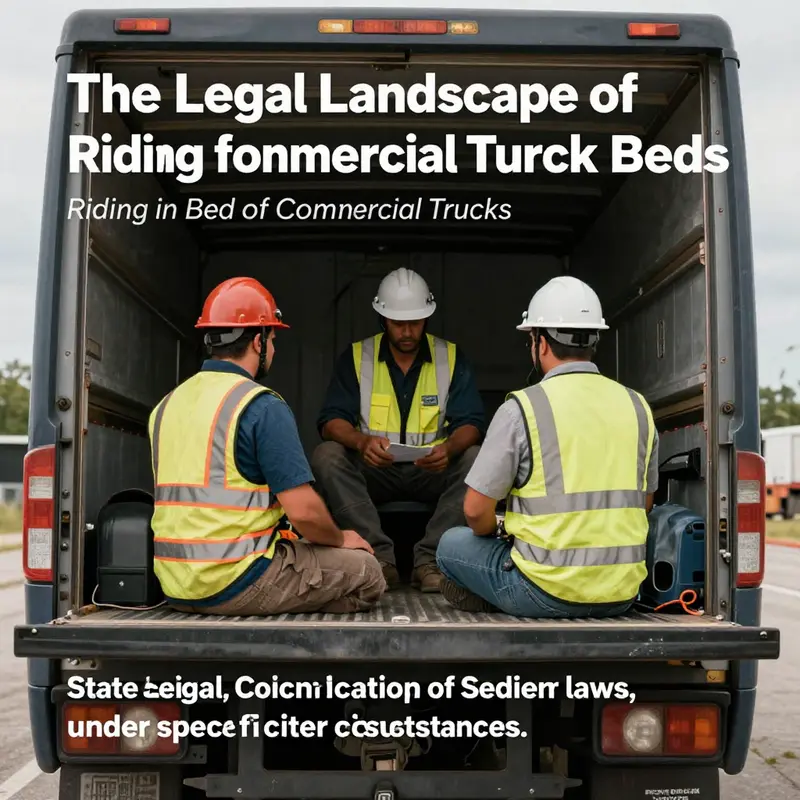
The bed of a freight truck is not a passenger seat. Across the United States, the space designed for cargo is governed by safety rules that treat the cargo area as off-limits to people under ordinary conditions. This is not a mere preference of regulators; it is a clear safety stance intended to prevent injuries and fatalities in the event of a crash, sudden stop, or rollover. When people ride in the bed, they lose access to protective features that are standard in an enclosed cab—seat belts, airbags, reinforced restraint structures, and the vehicle’s safety systems. The truth is straightforward: in most jurisdictions, riding in the cargo bed is illegal for the same reason it is dangerous. The law reflects a collective judgment that the risk is too great and that ordinary operation should not require people to accept it as a normal hazard of work or life on the road.
Still, law is rarely a single line drawn in stone. It exists within a spectrum of regulations that adapt to context, jurisdiction, and the realities of work. In the United States, the Federal Motor Carrier Safety Administration (FMCSA) provides a baseline that bars passengers from riding in the cargo area during typical operations. States reinforce this baseline with their own statutes and enforcement practices. California, for instance, codifies a prohibition against riding in the load area unless one belongs to an authorized work crew and safety measures are in place to protect those occupants. The emphasis on safety is consistent: the bed is for freight, not for people who could be injured by shifting cargo, by a sudden maneuver, or by a crash that the protected cabin might not survive. Even where a minor exception is contemplated by a jurisdiction, it comes with a heavy caveat—strict controls, protective barriers, and certified seating arrangements designed to maintain a safety margin that is otherwise absent in an open cargo bed.
On the other side of the world, similar questions arise under different legal scaffolds. In China, the Road Traffic Safety Law makes the prohibition unmistakable in Article 50: “It is forbidden to carry passengers in freight motor vehicles.” The implementing regulations reiterate the prohibition in Article 55: “Passengers are strictly prohibited from being carried in the cargo compartment of a truck.” Yet, in both places, regulators acknowledge that work realities sometimes demand movement of personnel alongside cargo. Hence the limited exceptions. In China, those exceptions are highly conditional. They principally apply to work-related contexts where the vehicle’s operation necessitates crew presence in the cargo area. The passengers—typically essential workers such as maintenance staff—must be protected by safety measures. They may ride in the cargo space only if the vehicle is carrying goods, the passengers are essential to the operation, and safeguards are in place to prevent injury. The concept is not to normalize bed riding as a standard practice, but to permit it under tightly wound safety criteria that minimize risk.
Where local nuance enters the picture, some urban regulatory frameworks have carved out even more restricted allowances. In certain municipal contexts, such as specific interpretations in some Chinese cities, it has been possible to permit temporary carriage of up to five workers in the cargo bed for urban operations. These allowances are rare, tightly bounded, and contingent on the absence of overloading and the presence of a carefully designed risk management plan. They are often described as exceptions born of practical necessity rather than a shift in safety philosophy. What remains constant across jurisdictions is the emphasis that such exceptions are not a green light to treat the cargo bed as an ordinary passenger area. They are a calibrated response to specific, constrained circumstances.
All of this serves to illuminate the core incentive behind today’s regulatory posture: safety first. Cargo beds lack the protective architecture of the cab; they are high off the ground, easy to destabilize under sharp steering or abrupt maneuvers, and prone to dangerous cargo shifts that can crush or injure any occupant. When a vehicle collides or experiences a severe jolt, the risk of ejection becomes acute. In this sense, bed riding is less a question of legality than a question of risk management. Regulators and industry professionals repeatedly emphasize that the bed is designed for goods transport. The decision to allow any occupancy beyond empty or crewed seats, then, is a decision not to loosen safety standards but to implement carefully designed mitigations that address a narrow work-related need.
The practical implications reach beyond the letter of the law. For workers, the implications touch on how jobs are organized, how fleets are scheduled, and how safety culture is built within a company. If a job truly requires personnel to accompany cargo to a site, the safe path is to arrange for transport that keeps passengers inside an enclosed cab with seat belts or to adopt an alternative vehicle type whose design accommodates people in safety-certified seating. Employers should not view bed riding as a convenient option. It should be treated as a high-risk, tightly regulated measure that triggers formal risk assessments, appropriate training, and proper equipment. This is not a matter of courtesy or preference but of protecting lives and ensuring accountability when something goes wrong on the road.
The cross-border dimension further clarifies why this topic matters beyond a single country’s borders. In global supply chains, trucks cross regional boundaries with varying enforcement climates, and industry players must understand both the safety imperatives and the legal boundaries that apply to them. A broader industry perspective helps fleets reconcile operational needs with the non-negotiable requirement of rider protection. This broader context is explored in industry discussions about market trends and regulatory uncertainties, which provide a lens on how norms evolve and how compliance practices mature. For readers seeking a broader view of the regulatory landscape and market dynamics that shape these decisions, consider the discussion on Navigating economic uncertainties in the Canadian and U.S. trucking markets. The link offers insight into how fleets plan around risk and regulation in a cross-border trading environment while balancing efficiency and safety.
Even when exceptions exist, the bar remains high. The very concept of an exception signals not a relaxation of safety expectations but a require-to-modulate approach to a specific operational need. The exception framework typically demands clear documentation of why the bed is used, what safety measures are in place, and how such arrangements are supervised. Documentation may include written risk assessments, operator training records, the presence of secure seating and barriers, and signage that informs workers and bystanders of the potential hazards. In practice, a company cannot simply decide to seat workers in the cargo bed on a whim. The decision must be grounded in a credible safety strategy that aligns with regulatory expectations and industry best practices. When these controls are not in place, a bed ride is not only illegal but dangerously negligent.
This brings us to the responsibility carried by employers, regulators, and the workers themselves. The law, the science, and the ethics align in a shared aim: to prevent harm. For fleets, that means adopting safety policies that prioritize cab seating and, when possible, dedicated transport options for personnel. It also means investing in training that helps workers recognize why the bed is off-limits and how to advocate for safer alternatives without compromising the job’s needs. Regulators reinforce this mindset through enforcement actions and safety investigations that hold parties accountable for risky practices. The result is a culture that treats bed riding as a last resort—if considered at all—and only under conditions that have been deliberately designed to mitigate risk, not normalize danger.
To close this picture, remember that the bed’s design purpose remains central. It is engineered for cargo handling, not for passenger comfort or crash protection. The legitimate exceptions are rare and narrowly defined, serving only when they precisely address a work-related requirement while upholding the highest possible safety standards. For anyone weighing a decision about bed riding, the prudent response is to default to enclosed-cab transportation and to pursue formal, documented safety pathways if a job truly demands otherwise. The consequences of misjudging this balance extend beyond fines or ticketing; they reach into the lives and livelihoods of workers who deserve protection when they go to work each day.
For a formal anchor to the regulatory framework and to understand how these principles play out in practice, consult the official U.S. framework on commercial vehicle regulations. See the FMCSA regulations page for the baseline safety expectations that govern passenger restrictions and the narrow conditions under which any exception might be contemplated: FMCSA regulations.
Final thoughts
In conclusion, understanding the legal landscape surrounding the riding of passengers in the bed of commercial trucks is essential for all stakeholders in the trucking and logistics industries. Not only do federal regulations prohibit this practice under most circumstances, but state laws can vary significantly, posing potential liabilities for companies that fail to comply. The safety risks associated with riding in an unprotected cargo area are substantial, further necessitating adherence to safety practices. Moreover, while there are specific exceptions, these are often tightly regulated. Being informed about these legal frameworks will help prevent accidents, ensure compliance, and safeguard the well-being of everyone involved.