
Parking a commercial truck in a residential driveway is a complex issue that involves understanding local zoning laws, homeowner association (HOA) regulations, and the broader impact on neighborhood aesthetics. For trucking company owners, fleet managers, construction and mining procurement teams, and logistics firms, the rules can vary dramatically by location and governance. This article aims to unravel these complexities, providing a comprehensive guide that covers the various legal frameworks and considerations that come into play. Chapter one will delve into local zoning laws that govern vehicle parking, while chapter two will explore the roles of homeowner associations. Chapter three will examine how parking large vehicles contributes to neighborhood aesthetics, and chapter four will discuss the potential legal consequences of non-compliance, ensuring that readers are well-informed before making parking decisions.
Driveway Dilemmas: Parking a Commercial Truck at Home and Local Zoning
A driveway is typically a practical space for private vehicles, but when the vehicle is a commercial truck the question of what is allowed moves from convenience to compliance. Local zoning laws, neighborhood covenants, and safety considerations can limit or prohibit long term parking of large business vehicles in residential areas. The core question is not simply can I park here, but under what conditions, for how long, and with what permits or restrictions. Rules vary by city and by HOA, so you should check both municipal codes and CC&Rs for your address.
In many communities, the distinction between personal and commercial use matters. Municipal codes often restrict overnight or extended parking of large vehicles in residential zones and may limit the number of hours the vehicle can be left in a driveway. In some places, there are height or length limits or requirements that the vehicle be screened from view. If you belong to an HOA, the covenants may be stricter, prohibiting commercial parking in driveways or requiring storage in screened areas, with potential fines or enforcement for violations.
To determine what applies to you, begin with the local code and search terms like vehicle storage or residential parking. Contact the planning or building department for guidance tailored to your address, the truck size, and how you plan to use the vehicle. If an HOA governs your property, request the current CC&Rs and any amendments related to parking.
If permits or variances are possible, learn what approvals are needed, what notices are required, and how the decision will balance business needs with neighborhood impact. Some jurisdictions offer conditional use permits or parking exemptions under certain conditions, though the process can be lengthy and involve public hearings.
Practical alternatives can reduce risk while preserving business operations. Consider relocating the vehicle to a commercial or industrial area, a designated lot, or a screened storage space off the street. If you must park at home, look for ways to minimize visibility and disruption, such as fencing, landscape screening, or a carport that creates a clearer boundary between private life and business activity.
In all cases, approach the issue as a structured review rather than a confrontation. Gather precise information about vehicle class, hours parked, and any mitigation measures, then discuss with officials and your HOA. Clear communication, openness to adjustments, and a plan to reduce impact on neighbors often improve the odds of a workable outcome.
Finally, remember that rules can evolve. Regulations in one city may differ from another, and even within the same jurisdiction, changes in policy or enforcement focus can occur. For authoritative guidance specific to your address, consult the official municipal code and department pages.
null
null
Parking in Plain Sight: The Aesthetic and Social Signals of Driveway Trucks
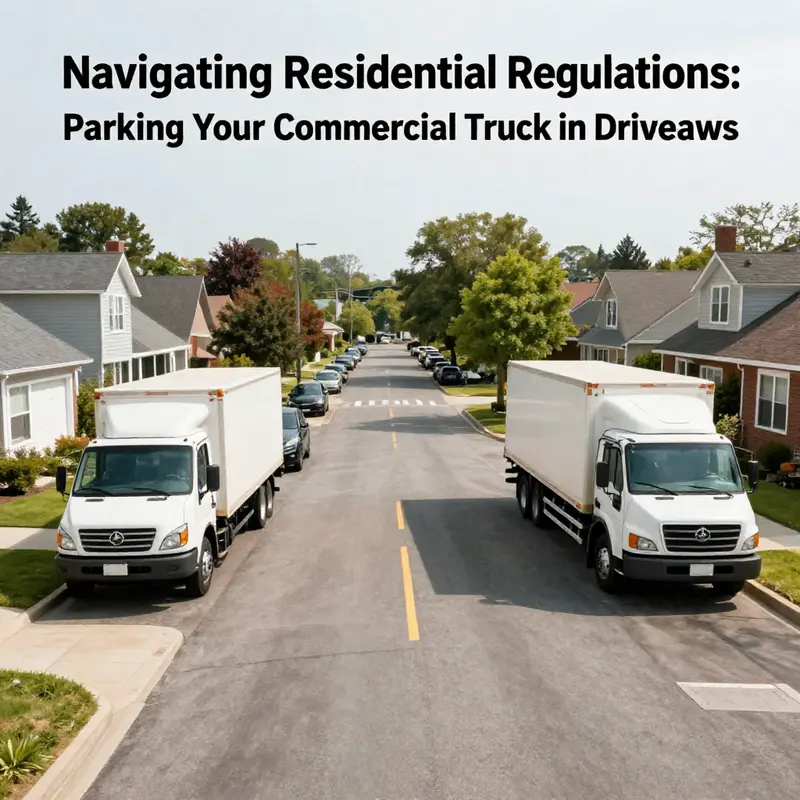
In many neighborhoods a large commercial truck parked in a driveway becomes a visual anchor that changes how the street reads. It can shift the perceived scale of the block and alter how neighbors experience daily life. The aesthetic impact depends on upkeep, color, and how well the site is integrated with surrounding greenery and architecture. Even a tidy truck can stand out if it dominates the curb or blocks sightlines. Sightline preservation, landscaping, and careful placement help reduce disruption while keeping business needs accessible. A complementary approach is to explore storage options such as off street parking, screened enclosures, or shared community spaces that protect curb appeal while preserving readiness for work. Community norms and local rules often balance practical needs with shared standards. Homeowners associations, zoning codes, and planning departments may specify limits on vehicle size in driveways or require screening. The aim is not to erase work life but to preserve legibility and calm in the street. When neighbors engage in early conversations about scheduling, maintenance, and screening, they often find workable compromises that respect both livelihoods and the public realm. From policy to everyday life, the thread is about shared space and common identity. A driveway is not only private space but a part of the broader urban fabric.
The Fine Line Between Convenience and Compliance: Legal Risks of Parking a Commercial Truck in a Residential Driveway
Parking a commercial truck in a residential driveway may feel like a practical answer to storage needs, especially for owner operators juggling city work, on call routes, or limited cash flow until a fleet expands. Yet behind the convenience lies a complex layer of regulations designed to keep neighborhoods safe, aesthetically consistent, and accessible to emergency services. The question of whether you can park a commercial truck in your driveway quickly shifts from a simple space decision to a legal inquiry with real consequences. This chapter connects the dots between everyday parking choices and the enforcement that follows, underscoring how local ordinances, HOA rules, and municipal codes can shape what seems like a minor habit into a significant constraint. Understanding these rules is not a dry exercise in compliance for compliance’s sake; it is a practical framework that protects the business, the owner’s finances, and the community’s safety and order.
Local zoning and parking rules do not exist in a vacuum. They are crafted to address how large vehicles interact with residential streets, driveways, and public rights of way. In many jurisdictions, the core concern is not the act of parking itself but the implications of that act for traffic flow, sight lines, and the neighborhood’s character. Regulations may specify the size or type of vehicle that can be kept on private property, set limits on the hours during which certain vehicles may be parked, or even prohibit long term storage of commercial trucks on private driveways. The practical effect is that even if a vehicle is not actively used for business on a given day, simply leaving a large truck in a driveway could trigger a violation. Because rules vary by city, county, and even by neighborhood association, there is no universal veto on driveway parking. Yet the risk of penalties, towing, and license consequences is real enough that operators should treat this question with a careful, location-specific approach rather than a provisional, it’s just a driveway mindset.
To navigate this terrain, the first step is to consult the local municipal code. Check the city or town’s official website and search for terms such as vehicle storage, parking regulations, or residential zoning. Municipal codes are precise about where vehicles can be stored, how long they can sit in a private space, and what counts as a violation. A quick online search may reveal a matrix of rules that distinguishes between residential, mixed-use, and commercial zones, and it may indicate exemptions for certain vehicle types or sizes under specific conditions. If the code is not entirely clear, contacting the planning or building department with your exact address can provide a definitive answer. They can confirm whether your driveway meets the jurisdiction’s standards for a parked truck and whether any permit, screening, or improvements would be required to bring your parking arrangement into compliance. Even if you find a path that seems permissive, it is essential to verify whether there are additional constraints, such as restrictions on overnight parking or limitations on vehicle idling while parked in a driveway.
If your property falls under an HOA, the story can become more restrictive. Homeowners associations often operate under covenants, conditions, and restrictions that can exceed local ordinance requirements. CC&Rs commonly address aesthetic concerns, vehicle types, and storage in a way that prioritizes curb appeal and uniformity across the community. A truck that is perfectly lawful to park under city rules might still breach an HOA agreement. HOA guidelines are typically accessible through the management company or the association’s website, but they are also enforceable through fines or disputes between neighbors. When a drive space is involved, the HOA’s stance on long-term vehicle storage, visible equipment, and even the color or modifications associated with the vehicle can become the deciding factor. Therefore, owners must review CC&Rs early, and, if needed, discuss deviations or solutions with the HOA board. It is not unusual for operators to seek permission or to propose alterations such as off-street parking in a designated area, fencing, or screening to maintain neighborhood aesthetics while sustaining business operations.
The legal consequences of parking a commercial truck in violation can unfold swiftly and with tangible costs. In many municipalities, authorities can issue fines that accrue with each violation and can rise with repeated offenses. The specific amount varies greatly by jurisdiction, but the general pattern is that violations accrue punitive penalties quickly for habitual noncompliance. In some areas, enforcement officers have the authority to tow a vehicle parked in violation, sometimes immediately or after a short waiting period, with the owner bearing the cost of towing and storage. The financial impact, even for a single incident, can be substantial, and repeated offenses can lead to progressively harsher penalties. Beyond fines and towing, there is the broader risk of more lasting constraints on business operations or mobility within the jurisdiction. Recurring violations may invite escalations such as abbreviated grace periods, warnings turning into tickets, or even official notices that curb certain business activities associated with the vehicle or its use in that locale.
Compliance matters for more than avoiding penalties. Knowing the rules fosters predictability in operations and protects a business’s financial health. Noncompliance, even when driven by a temporary need for extra storage, introduces financial risks through fines, towing costs, storage fees, and potential lawsuits. It also elevates safety concerns, as improper parking can create sightline hazards, impede maneuvering space for neighboring vehicles, or interfere with access routes for emergency vehicles. The broader social cost includes the perception that a business is not accountable to the communities where it operates. For fleets and owner operators who rely on consistent access to work sites, building a culture of proactive compliance mitigates risk and helps preserve working relationships with property owners, municipalities, and neighbors.
To stay compliant, it helps to approach the issue as a continuous process rather than a one-off check. Start with a careful review of local codes and any HOA CC&Rs that apply to your property. When in doubt, reach out to the appropriate city departments for guidance. The planning or building department can confirm whether a driveway’s use for a commercial vehicle is permissible under the property’s zoning designation. If permissible, they can advise on any permit requirements, screening, or improvements that might be necessary. In parallel, consult the HOA guidelines to ensure alignment with CC&Rs and to determine whether an exception or alternative arrangement is possible. Even if the drive seems acceptable, consider documenting your parking arrangement and obtaining written confirmation from the HOA or city, so you have a clear reference if questions arise later.
From a practical perspective, there are often humane and business-friendly ways to address storage needs without breaching rules. One common path is to explore off-street storage options in compliant spaces such as a lot that is zoned for commercial use or a structure built to house a truck when not in operation. In some cases, municipalities allow temporary off-street storage or require a special-use permit that accommodates a vehicle of your size. If your business relies on consistent access to a large vehicle, discuss with a licensed consultant or a local attorney who is familiar with traffic and zoning regulations in your area. A number of operators have found success by designing a compliant storage solution that preserves driveways for everyday use while using a permitted off-site facility for long-term storage, thereby maintaining safety standards and neighborhood aesthetics. This approach reinforces the principle that compliance and practical business needs can be reconciled when approached thoughtfully and with the right documentation and approvals.
To connect this discussion to broader resources, consider the practical insights offered in industry-focused discussions and case studies that appear on reputable trade blogs. For a general reference on how vehicle storage and parking enforcement interact with business operations, see the McGrath Trucks blog, which provides accessible overviews and practical considerations for truck owners navigating regulatory landscapes. The intent is not to substitute for local guidance but to offer context for how other operators think about storage challenges and how they balance compliance with business needs. If you want to explore official standards and enforcement patterns that shape these rules, you can look to city level resources that spell out parking regulations in detail; for example, major city portals often host comprehensive pages on vehicle storage and residential parking restrictions, which can serve as a useful template when you search for rules in your own jurisdiction.
As a final note, while the driveways of many homes are built for vehicles, not all driveways are treated equally under law. Parking a commercial truck in a driveway can be perfectly legal in some places and categorically prohibited in others. The key is to approach this decision with a clear understanding of the jurisdiction’s expectations and your HOA’s covenants. The aim is to prevent a simple space decision from snowballing into a series of penalties that disrupt business operations and strain community relations. The law’s primary purpose in this space is not to punish but to preserve safety, ensure access for emergency services, and uphold neighborhood standards that make residential areas livable for all residents.
For those who want to widen their lens beyond a single driveway and seek solutions that align business needs with community norms, the next steps involve proactive planning, transparent dialogue with local authorities, and a willingness to adjust storage strategies when required. In practice, this means staying current with changes in municipal codes, maintaining open lines of communication with the HOA, and paying careful attention to any changes in the status of a vehicle in a driveway. The more you treat compliance as a continual process rather than a one time audit, the more resilience you build into your operation. This approach also reduces the likelihood of costly disputes and keeps the focus on delivering reliable service while maintaining good standing in the communities where you operate. The difference between a driveway that simply holds a vehicle and a driveway that supports a compliant business operation lies in informed choices, timely action, and a willingness to adapt to the rules that govern the space you occupy.
External resources provide additional context for governance patterns that shape these decisions. For broader perspective on how large cities regulate parking and vehicle storage, consult official municipal sources such as the parking regulations page of a major city. These resources illustrate how local authorities frame the issue, offer guidance to residents and businesses, and demonstrate that compliance is achievable through careful planning and collaboration with the appropriate departments. External reference: https://www.cityofnewyork.gov/site/parking/traffic-regulations.page
Final thoughts
Understanding whether you can park your commercial truck in your driveway hinges on multiple factors including local zoning regulations, HOA rules, and community standards. With each chapter providing critical insights into these variables, trucking operators can make informed decisions that uphold compliance and enhance community relationships. Prior to parking your commercial truck, always consult local ordinances and engage with HOA representatives to avoid potential legal repercussions and community conflicts as outlined in our detailed discussions.