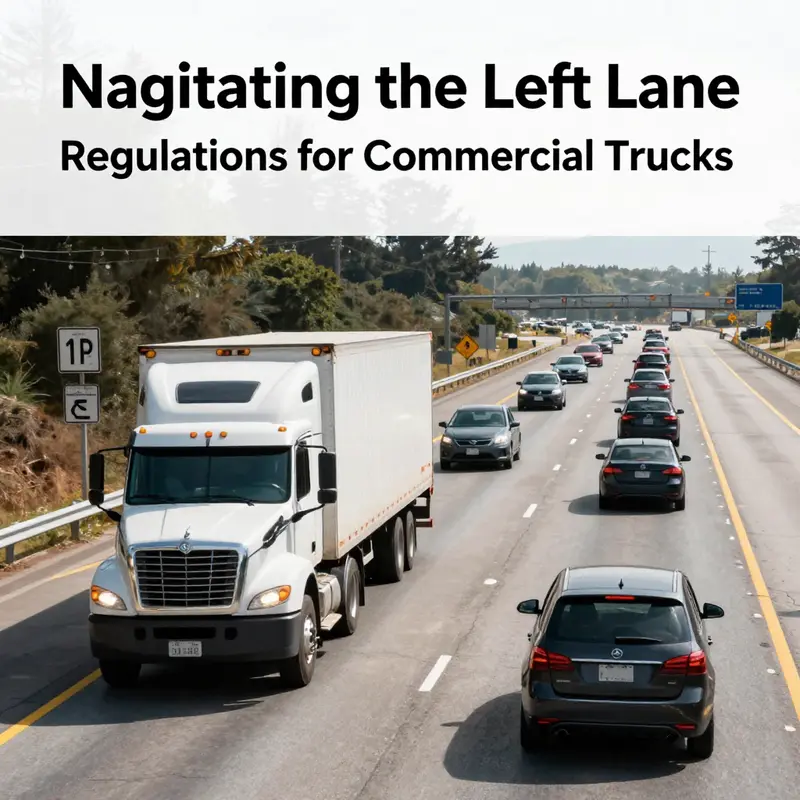
The question of whether commercial trucks can safely navigate the left lane of multi-lane highways is critical, especially for trucking company owners, fleet managers, and logistics firms. The regulations surrounding left lane usage vary significantly across states, reflecting a balance between ensuring road safety and accommodating the operational needs of commercial drivers. This article will delve into state-specific laws, focusing on California and Texas, before examining broader regulations across various jurisdictions and their implications for traffic flow and safety. Each chapter provides insights tailored to the needs and responsibilities of industry professionals, informing them of their obligations and operational best practices regarding left lane usage.
null
null
Left Lane Prudence: Texas Rules, Ongoing Debates, and the Road for Commercial Trucks
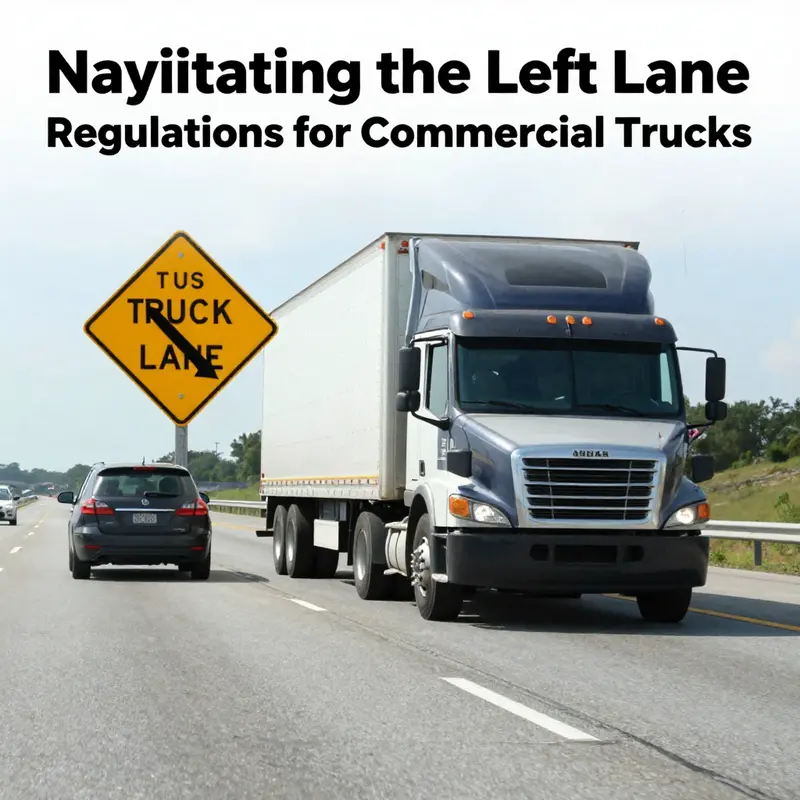
Across the vast network of Texas highways, the question of whether commercial trucks may drive in the left lane is not merely a matter of etiquette but a policy question tied to safety, efficiency, and evolving enforcement. Texas, like several other states, currently restricts large trucks from lingering in the leftmost lane except when they are actively passing slower vehicles. This approach rests on a simple premise: the left lane is primarily a passing lane, reserved for faster-moving traffic and for overtaking, not for extended cruising by heavy vehicles. The rationale is straightforward enough in theory—minimizing interactions between slower, heavier rigs and a stream of faster passenger vehicles reduces the likelihood of slowdowns, rear-end collisions, and the disorganized flow that can emerge when a truck holds a position in the fastest lane without a clear purpose. Yet the practical landscape is more nuanced. Road geometry, congestion levels, weather, and the presence of construction or incidents can shift the enforcement emphasis and the expectations of drivers. In multi-lane freeways, the rule is not a brittle prohibition but a functional guideline that requires trucks to contribute to, rather than obstruct, the rhythm of the highway. When a truck is passing, it stays in the left lane; when the pass is complete, the vehicle should move back to the right unless conditions or direct instruction from law enforcement indicate otherwise. This framework aims to align the behavior of heavy trucks with the flow of faster traffic, preserving the ability of passenger cars to maintain safe speeds without being forced to weave around impediments. It is a principle that transcends mere compliance and speaks to the broader calculus of route timing, fuel efficiency, and crew management for fleets that operate on Texas corridors. The practical impact is felt most acutely during peak travel periods, where the difference between a clean, predictable passing sequence and an elongated left-lane hold can translate into minutes of delay, sudden braking, or erratic lane changes that cascade into near-misses. In Texas, as in many states, the left lane becomes a test of discipline for drivers who must balance the imperative to pass with the duty to return to the right and keep traffic moving. The enforcement reality mirrors this pedagogy: law enforcement officers frequently monitor lane usage, particularly on heavily traveled interstates and on routes known for heavy tractor-trailer volumes. A truck that remains stationary in the left lane beyond the required passing window or that unnecessarily lingers can exceed the expectations of traffic laws and raise the risk profile for all road users. The result is a governing principle with teeth: compliance in the left lane is context-driven, not a blanket exemption for trucks to dominate any one lane. The state’s approach to lane usage rests on the presumption that drivers achieve a balance between safety and efficiency, with the left lane reserved for overtaking and the right lanes serving the broader stream of traffic.
This policy alignment does not exist in a vacuum. It sits alongside a broader set of mobility and safety considerations that Texas regulators continue to study and adjust. Move Over laws, which require motorists to shift lanes when approaching stationary emergency and service vehicles, intersect with truck lane rules in ways that reinforce the objective of predictable, safe lane transitions. When corridors are congested or the weather tightens visibility, the priority shifts toward minimizing abrupt lane changes and the cascading effects those maneuvers can produce. In practice, the rule has become a navigational discipline for drivers: anticipate the overtaking need, time the pass, execute cleanly, and return to the right promptly. Fleet operators increasingly bake this discipline into dispatch routines, driver training modules, and performance metrics. The aim is to harmonize the operational realities of heavy-haul tasks with the tempo of highway traffic so that a truck’s passage does not become a bottleneck or a risk amplifier.
In parallel with these established norms, Texas is actively exploring enhancements to left-lane restrictions, particularly on multi-lane interstates and busy freeways. The motivation behind these discussions is pragmatic: improving traffic flow, reducing fuel consumption associated with unnecessary left-lane cruising, and addressing the safety concerns that arise when slower-moving, heavy vehicles occupy the leftmost lane for extended periods. Lawmakers and transportation officials have signaled openness to expanding restrictions or tightening enforcement while weighing the impact on freight reliability and economic competitiveness. The conversation reflects a broader national trend in which policymakers increasingly scrutinize the balance between permissive lanes for trucks and the collective need for smooth, predictable roadway performance. This evolving discourse, while focused on Texas, resonates with other states that grapple with similar lane usage questions and safety trade-offs. The practical upshot for carriers is clear: stay informed about potential regulatory shifts, and be prepared to adapt operations if new rules tighten the permissible window for left-lane activity. It is not merely about complying with a single lane rule; it is about aligning fleet strategy with a regulatory climate that prizes safety, efficiency, and predictable highway performance.
For drivers and fleets, the implications extend beyond the moment of overtaking. Route planning increasingly accounts for lane usage expectations as well as the timing of passes to minimize left-lane exposure. This means selecting routes that optimize traffic flow, scheduling passes during periods of lower congestion, and training drivers to monitor shoulder traffic and the speed differential of surrounding vehicles. It also means refining speed management to ensure that a truck can pass decisively without lingering in the left lane longer than necessary. The effect on fuel economy, tire wear, and brake usage is subtle but real; consistent left-lane cruising can introduce unnecessary rolling resistance and frequent speed variance, while disciplined lane behavior supports steadier speeds and more predictable engine loads. In this sense, the left-lane rule in Texas becomes a lens through which fleets can examine operational efficiency, driver behavior, and risk management in a single, practical frame.
As the industry evolves, the market environment also shifts in ways that touch left-lane considerations indirectly. The used-truck market, for instance, reflects broader demand patterns, maintenance profiles, and the total cost of ownership that influence how fleets allocate assets to specific lanes and routes. Fleets that manage aging equipment or that rely heavily on regional distribution may prioritize different lane strategies than those operating high-mileage, newer equipment with long-haul commitments. Buyers and sellers watching the market can glean insights from trends in used-truck prices, depreciation pace, and the geographic distribution of demand. For readers planning investments in equipment or contemplating fleet expansions, staying attuned to these market rhythms can inform decisions about which trucks are best suited for the long hours on congested Texas corridors and which configurations offer better maneuverability and safety in left-lane situations. To explore these market dynamics and their implications for fleet decision-making, consider following current trends in used truck sales growth, which provides context on how purchase cycles, financing conditions, and asset turnover interact with regulatory expectations around lane usage.
Of course, the Texas policy canvas is not isolated from national and regional transportation developments. The ongoing discussions around left-lane restrictions reflect a nuanced assessment of how to balance freight reliability with traveler safety. The evolving policy landscape requires fleets to be vigilant, not only about current law but about anticipated changes that could alter driver behavior, enforcement priorities, and the cost of compliance. The potential expansion of left-lane limits would likely be accompanied by clearer guidance on exceptions, enforcement mechanisms, and penalties, as well as a framework for routine review that weighs traffic volumes, incident history, and weather-related risk. For truck operations that cross state lines, the interplay between Texas rules and neighboring state regulations adds another layer of complexity. A carrier might optimize a route for a given day based on expected congestion and lane usage rules in Texas, only to confront a different regulatory posture upon entering another jurisdiction. That reality elevates the importance of robust policy monitoring and adaptive dispatch practices, ensuring that drivers are prepared to adjust lane behavior in real time when crossing borders or navigating multi-state corridors.
In summarizing the current trajectory, Texas maintains a left-lane prohibition on extended truck cruising while permitting overtaking as the standard pathway for left-lane use. The state’s posture is a cautious but forward-looking one, recognizing the potential gains from tighter limits while acknowledging the operational realities of freight movement. For stakeholders, the practical takeaway is to embed lane-awareness into routine operations: train drivers to identify when a pass is complete, emphasize timely lane returns, and design dispatch plans that minimize the necessity for prolonged left-lane occupancy. This approach is not about micromanaging every lane change but about cultivating a culture of predictable behavior that aligns with both safety and efficiency goals.
As policy debates unfold, one should also keep an eye on official sources for current stipulations. The regulatory climate can shift with new legislative sessions, transportation department guidance, and shifting traffic data. In the meantime, Texas remains a reference point for how states balance the competing demands of heavy-truck mobility and highway safety on busy, multi-lane corridors. The practical guidance for drivers and fleets remains steady: treat the left lane as a lane for passing, monitor speed differentials, and return to the right when a pass is complete. When in doubt, err on the side of caution and compliance, and consult the official DMV or transportation authority for any road-specific exceptions or temporary restrictions.
For readers who want to connect market dynamics with policy discourse, consider this related exploration of industry trends that shape fleet decisions, including how equipment cycles interact with regulatory expectations: current trends in used truck sales growth.
For ongoing policy developments, see a related external resource that captures the Texas discussion on left-lane limits for trucks: https://www.ttnews.com/articles/texas-consider-more-left-lane-limits-trucks.
State-Specific Truck Lane Rules and Exceptions: Navigating the Left-Lane Question Across U.S. Highways
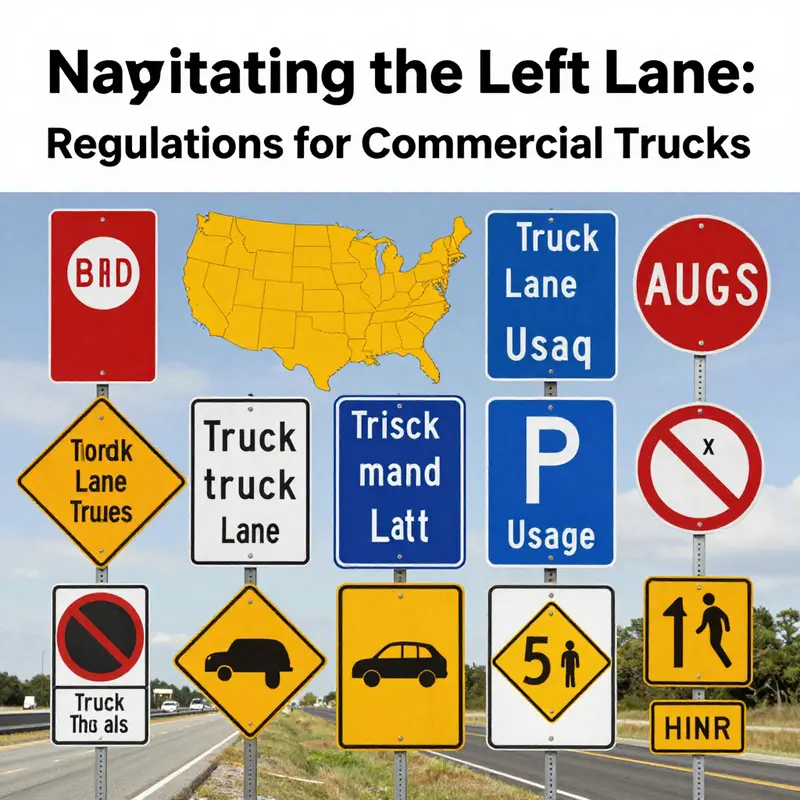
On multi-lane highways, the left lane is commonly treated as the passing lane. For heavy trucks, the default is to stay in the right lanes and only move left to overtake when it is safe and does not impede other traffic. States differ in how this principle is implemented, with variations in signage, lane design, and enforcement practices. Some states provide marked truck lanes or specific lane controls to separate slower trucks from general traffic, while others rely on general pavement markings and posted speed limits. Because the rules can change at state borders, drivers should be prepared for different lane-use philosophies as they travel.
In California, trucks are typically expected to use the right lanes and only use the left lane to pass, after which they return to the right. There are dedicated truck lanes on some corridors, and fines can apply for unsafe lane changes or blocking traffic. In Texas, rural and major corridors generally favor right-lane use, with left lanes reserved for passing when it is safe; urban corridors may have designated routes or lane controls to manage congestion. In Florida, trucks are generally restricted from the leftmost lanes except for overtaking, followed by immediate return to a more appropriate lane. In New York, heavy trucks face tighter restrictions including stay-right rules on interstates and bans from certain HOV/HOT lanes in many cases. Oregon aligns with federal guidance but uses proactive signage and occasional weather- or incident-based lane restrictions that influence left-lane use.
Across the board, enforcement practices and penalties vary, and real-time traffic information can influence when and where a truck driver chooses to overtake and re-enter the right lane. The overarching aim is to reduce slow-truck bottlenecks, maintain predictable speeds for others, and improve safety by minimizing unnecessary left-lane occupancy. Drivers should always read the posted signs, anticipate lane restrictions near construction zones, and factor in the possibility of dynamic changes due to incidents or weather. A practical takeaway is that the left lane is a tool for safety and efficiency, not a default home for heavy vehicles. Ongoing training and up-to-date information help fleets and drivers navigate the evolving landscape of lane-use rules.
The Left Lane Dilemma: How Regulations for Commercial Trucks Shape Traffic Flow, Safety, and Highway Etiquette
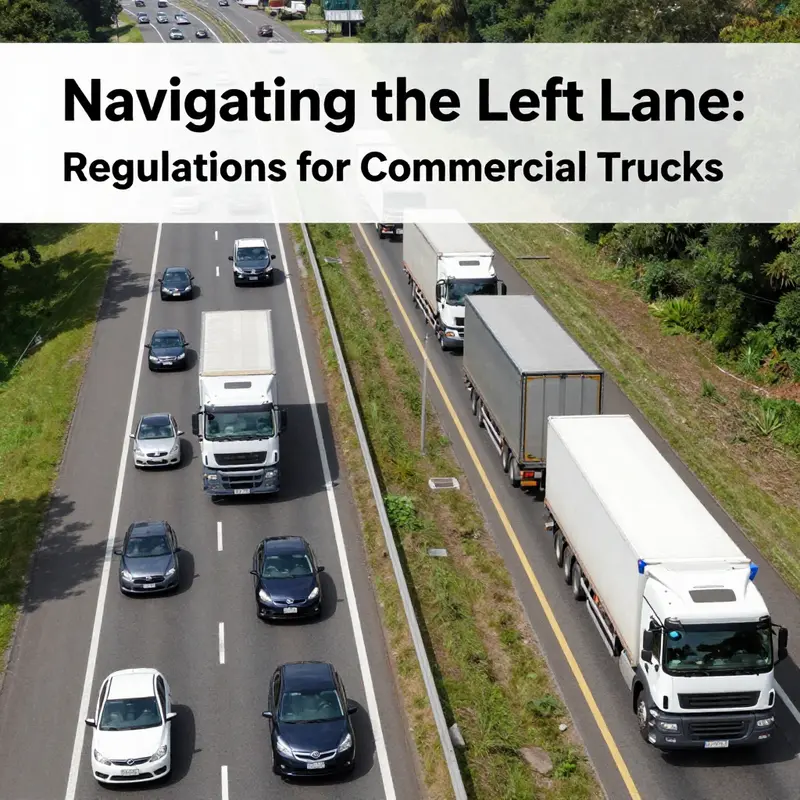
The question of whether commercial trucks belong in the left lane is not merely about lane preference. It is a lens on how regulations, driver behavior, and road design converge to shape traffic flow and safety on busy intercity corridors. Across jurisdictions, the leftmost lane is not a free-for-all zone; it is a carefully managed space whose use is meant to harmonize the momentum of heavy vehicles with the faster, lighter stream of passenger cars. Where this balance is not understood or enforced, the result is predictable: more lane changes, more abrupt decelerations, and a higher likelihood of conflicts that can escalate into preventable crashes. Where it is understood and enforced, the left lane becomes a temporary, predictable pass-through rather than a cruising lane for any vehicle willing to maximize time in that position. The core idea is simple, but the real-world implementation is intricate. It rests on three pillars: clear regulations that designate lane usage, enforcement that reinforces compliant behavior, and a shared social norm among all road users to respect the flow of traffic rather than test it at every opportunity.
In many places, the legal skeleton of left-lane use is built around the notion of the left lane as the passing lane. This means commercial trucks may use the left lane for overtaking slower vehicles but are generally expected to return to the right once the maneuver is complete. In California, for instance, the rule is that trucks may engage the left lane to pass, but they should move back to the right once the pass is completed, unless directed otherwise by law enforcement or traffic conditions dictate a different approach. Texas mirrors this approach in spirit, though it leaves the door slightly ajar for situational discretion when traffic dynamics demand it. The practical implication of these rules is that a truck should not linger in the left lane if it is not actively passing and if doing so would impede the overall flow of traffic. The difference between a passing maneuver and a sustained left-lane occupation is subtle but consequential, particularly on multi-lane highways where congestion forms as a patchwork of speed differentials that compel constant lane changes.
Yet the landscape is not uniform. Across other states, the picture becomes more curvilinear. Some states explicitly prohibit or discourage slow-moving trucks from residing in the left lane except during overtaking, framing the left lane as a corridor primarily for faster traffic. In these places, the obligation to stay to the right is not merely a courtesy but a legal expectation, reinforced by enforcement and public awareness campaigns. The result can be a more predictable flow, with faster passenger vehicles finding it easier to maintain their preferred speeds without being repeatedly checked by merging trucks. This predictability is not only a matter of convenience; it translates into tangible safety gains. When drivers anticipate the behavior of trucks, they can make more informed decisions about lane changes, following distances, and overtaking strategies. Conversely, if a driver assumes a left-lane truck will always be there to yield, the likelihood of miscalculation and sudden braking increases.
The interplay between regulation and driver behavior becomes even more complex when we consider regional variations in enforcement. In jurisdictions where left-lane compliance is actively monitored, the benefits become more robust because the behavior of thousands of individual drivers converges toward a common practice. In places where enforcement is more lax or inconsistent, a tacit tolerance for slower trucks lingering in the left lane can erode the efficiency gains that the regulations are meant to deliver. The essence of effective regulation, then, is not solely the text of the law but the degree to which it is visible in daily driving. Caltrans officials and similar authorities have emphasized that even when the law does not require a truck to exit the left lane the moment it finishes a pass, encouraging a habitual practice of returning to the right can reduce lane changes and help maintain steady traffic progression. This is not merely a matter of discipline among truck drivers; it is a matter of shared norms among all road users.
From a safety perspective, the logic behind limiting left-lane occupancy by large commercial vehicles is compelling. Trucks have longer stopping distances and include more mass that responds slower to sudden changes in traffic conditions. When a slower truck sits in the left lane, it typically becomes a moving obstacle to faster traffic, prompting frequent lane changes by passenger vehicles. Each lane change is a moment of potential error, especially when followed by another vehicle in the adjacent lane that is also attempting to merge, accelerate, or decelerate to accommodate the altered gap. Research across high-speed road networks consistently shows that speed differentials are a key driver of crash risk. A vehicle traveling several miles per hour slower than surrounding traffic is more likely to be involved in crashes than one that accelerates to close the gap. The left lane thus becomes a zone where the hazard of a sudden merge or a rear-end event is amplified by the combination of heavy vehicle mass, extended stopping distances, and the high probability of multiple vehicles attempting a single overtaking maneuver in quick succession.
German highways offer a well-known contrast. On many of these corridors, the discipline is so ingrained that trucks are typically restricted to the right lanes, with the left lanes reserved for faster traffic that is overtaking only. The lower incidence of variance between trucks and passenger cars in velocity reduces the need for abrupt lane changes and helps create a smoother, more stable flow. The result is not merely theoretical: it is measurable in the way traffic behaves, how often drivers overtake, and how swiftly the overall throughput moves along. The German experience demonstrates that disciplined lane usage can coexist with high-speed travel, as long as the driving culture supports it and the infrastructure accommodates it with appropriately designed lanes and clear signage.
But the conversation does not stop at Europe or the mature expressways of the United States. In other parts of the world, debates about allowing freight trucks to drive centrally in the left lane on multi-lane highways have gained traction as a potential congestion solution. Proponents argue that placing trucks in the left lane can reduce bottlenecks at entry ramps by consolidating the slower, heavier vehicles into a predictable lane. Critics, however, warn that such an arrangement increases the right-side blind spots for vehicles attempting to pass and can lead to higher rear-end collision rates as smaller cars attempt to overtake from the right and misjudge the truck’s proximity. The evidence as it stands points toward a cautious approach: left lanes should indeed be used for passing, but not as a permanent home for trucks. The risk of misjudged gaps, insufficient escape routes, and the delicate balance of visibility around heavy vehicles calls for a design that prioritizes safety just as much as efficiency.
The practical policy takeaway from these varied experiences is not to pursue a one-size-fits-all mandate but to align lane-use rules with the realities of road design and driver behavior. When a left lane is designated primarily as a passing lane and when the vehicle mix on a corridor is known—truck configurations, speeds, acceleration profiles, and driver response times—the system can perform predictably. Enforcement then becomes a tool that reinforces this predictability rather than a punitive measure aimed at a single class of vehicle. Public education is equally essential. In many communities, drivers are unaware that a left-lane truck is typically in a passing position and should not linger. A modest investment in driver education, public messaging, and signage can change behavior more quickly and at a lower cost than broad penalties that may not address root causes. As Caltrans has suggested, encouraging motorists to treat the left lane as a temporary pass-through zone—even when not legally mandated—can substantially reduce unnecessary congestion and the potential for crashes.
The broader takeaway connects to a more fundamental principle of road safety and efficiency: lane discipline is the choreography of a shared space. If every driver understands that the left lane is where faster traffic passes and that slower traffic should move rightward, the choreography becomes smoother. Heavy trucks, with their unique performance characteristics, must be integrated into that choreography with clear rules, measurable expectations, and consistent enforcement. When these elements align, the left lane does not become a battleground but a controlled stage for overtaking that ultimately supports a safer and more efficient highway system. The safe and efficient operation of freight movement does not rest on a single policy lever; it rests on a continuum that includes regulatory clarity, driver training, electric and alternative-fuel truck dynamics, and road design that reduces the friction caused by speed differentials.
For readers seeking a broader context on how these policies interact with broader regulatory environments and market dynamics, a practical overview of economic uncertainties across the Canadian and U.S. trucking markets can provide useful perspective on how traffic rules behave in real-world freight operations. This broader lens helps illuminate why consistent lane-use rules matter beyond the confines of a single state or national boundary. It highlights how compliance, enforcement, and public understanding collectively shape the daily experiences of drivers, dispatchers, and commuters alike. If you want to explore such macro-level insights, you can refer to a recent synthesis of trucking-market dynamics that emphasizes the importance of predictable regulatory environments for long-haul operations. Navigating-economic-uncertainties-key-insights-from-the-canadian-and-us-trucking-markets.
The practical implication for practitioners—truck drivers, fleet managers, and highway planners—is to view left-lane regulations as the backbone of a system designed to minimize unnecessary speed variability and to maximize predictability on multi-lane corridors. This requires a culture of compliance that is supported by signage, ramp metering decisions, and law enforcement visibility in peak periods or on high-traffic routes. It also calls for a design philosophy that respects the balance between efficient freight movement and safe, stable traffic flow. The left lane should remain the lane of overtaking, a lane that is effectively temporary for heavy vehicles and a lane that invites drivers to complete a pass and return to the right with minimal disruption to surrounding traffic. In this sense, the left lane is less a jurisdictional arena and more a shared contract among road users—one that reduces risk, increases predictability, and supports a safer, more efficient highway system for everyone.
In closing, the conversation about whether commercial trucks should drive in the left lane cannot be reduced to a single rule. It is a nuanced topic that depends on how well regulations are written, how consistently they are enforced, and how well drivers and other road users internalize a common etiquette for lane usage. When the left lane is reserved for overtaking and when trucks exit promptly after the maneuver, congestion declines and the chance of rear-end and side-swipe crashes diminishes. The right lanes become the default home for slower-moving traffic, while the left lane remains a dynamic but controlled channel that serves the broader goal of moving people and goods safely and efficiently. The road network, after all, is a shared system where clear rules, consistent behavior, and thoughtful design yield the best outcomes for all users.
External reference for policy context and lane usage guidance: California Vehicle Code – Lane Usage.
Final thoughts
The regulations surrounding left lane usage for commercial trucks are vital for maintaining road safety and efficient traffic flow. Understanding the specific rules in states like California and Texas, as well as across the country, is critical for fleet managers and trucking companies. Compliance with these laws not only minimizes legal risks but also enhances safety for all road users. By adhering to the prescribed regulations, commercial trucks can navigate highways more safely, ultimately supporting a more orderly transportation system.