
The Crucial Role of Trucks in California’s Economy
In the sprawling landscape of California’s economy, trucks play an indispensable role, bridging the gap between suppliers and consumers across the state. With a network that supports industries from agriculture to technology, the classification of trucks as commercial vehicles does not merely denote their function but also shapes the framework within which trucking regulations operate. The implications of this classification ripple through the entire logistics sector, impacting everything from fleet management decisions to operational costs for trucking company owners. These regulations dictate maintenance standards, insurance requirements, and even driver qualifications, thus demanding that fleet managers and trucking entrepreneurs stay vigilant and informed. Amidst the changing parameters of California trucks commercial classification, understanding these nuances can secure competitive advantages and foster corporate resilience. For those navigating the intricacies of logistics, aligning business strategies with compliant practices remains essential to thrive in an increasingly challenging environment. Explore how current trends in used truck sales can directly affect your operation’s bottom line by learning more about the market.
California’s Trucking Regulations
California has stringent regulations governing commercial vehicles aimed at promoting safety, reducing emissions, and managing traffic. Understanding what constitutes a commercial vehicle under California truck regulations is crucial for trucking companies and fleet managers.
Definition of Commercial Vehicles
In California, a commercial vehicle is defined primarily by its weight. Key thresholds include:
- Gross Vehicle Weight Rating (GVWR): Any vehicle with a GVWR over 8,500 pounds is classified as a commercial vehicle. This includes various types of trucks and motorized units used for business purposes.
- Heavy-Duty Trucks: Vehicles exceeding 26,000 pounds in GVWR face stricter regulatory requirements, which include enhanced inspection and maintenance standards.
Key Regulatory Aspects
-
Engine Requirements: Beginning January 1, 2023, California mandated that all heavy-duty trucks (over 26,000 pounds GVWR) must be equipped with engines manufactured in 2010 or later. This measure aims to reduce emissions and increase air quality.
-
Emissions Standards: The California Air Resources Board (CARB) rules stipulate that all new heavy-duty trucks must meet rigorous emissions standards. These requirements are in line with California’s initiative to transition to zero-emission vehicles, particularly under the Advanced Clean Trucks (ACT) program.
- For instance, the ACT requires manufacturers to produce an increasing percentage of zero-emission trucks starting in 2024. Older diesel trucks are subject to specific emission standards based on their age and engine type.
- Local Regulations: While there are broad state regulations, local jurisdictions may impose additional restrictions based on urban development needs and environmental preservation efforts, such as limitations on older vehicles in low-emission zones.
For more detailed insights, trucking company owners can review state resources such as the California DMV and local fleet regulations mapped out under the California Vehicle Code.
Types of Trucks in California
Here’s a detailed comparison of different types of trucks commonly used in California, categorized by weight class, typical uses, and their commercial status according to California regulations:
| Truck Type | Weight Class | Typical Weight Range (lbs) | Common Uses | Commercial Status |
|---|---|---|---|---|
| Class 1 | Light Duty | 0 – 6,000 | Light-duty delivery vehicles, small cargo vans, personal use | Non-commercial (e.g., private ownership for non-business purposes) |
| Class 2 | Medium Duty | 6,001 – 10,000 | Delivery trucks, utility vehicles, small construction equipment haulers | Can be commercial or non-commercial; used in small businesses and service industries |
| Class 3 | Medium Duty | 10,001 – 14,000 | Medium-duty delivery trucks, refuse collection, municipal services | Commercial (CDL required if operating for business) |
| Class 4 | Medium Duty | 14,001 – 16,000 | Box trucks, moving vans, specialized service vehicles | Commercial (CDL required when used for business operations) |
| Class 5 | Heavy Duty | 16,001 – 19,500 | Large box trucks, dump trucks, concrete mixers | Commercial (CDL required for business use) |
| Class 6 | Heavy Duty | 19,501 – 26,000 | Heavy-duty delivery trucks, larger refuse vehicles, construction transport | Commercial (CDL required for business operations) |
| Class 7 | Heavy Duty | 26,001 – 33,000 | Large dump trucks, heavy haulers, semi-truck trailers | Commercial (CDL required; often used in freight and construction) |
| Class 8 | Heavy Duty | Over 33,000 | Tractor-trailers, long-haul freight trucks, large transit buses | Commercial (CDL required; strictly regulated by California DMV and FMCSA) |
For a more detailed understanding of truck classifications, check the California DMV Definitions.
Also, explore the California HVIP PDF for additional information on truck weight classes and categories.

The classification of trucks as commercial vehicles in California has significant implications for trucking company owners and fleet managers, especially concerning operational costs, insurance, and compliance. “Trucks in California commercial” status necessitates a thorough understanding of these facets, as they fundamentally influence fleet management strategies.
Operational Costs
One of the most immediate impacts of truck classification is its effect on operational costs. Commercial trucks often require more significant investment in maintenance, fuel, and insurance compared to non-commercial vehicles. These costs can be exacerbated by California’s stringent emissions regulations, necessitating investments in eco-friendly technologies and compliant models. For fleet managers, this means allocating budget resources more meticulously and seeking strategies to maintain profitability.
- Fuel Efficiency Requirements: As the state pushes for greener technologies, many fleet operators are turning towards hybrid or electric systems, which, while initially costly, can provide savings in the long run.
- Maintenance Costs: Trucks classified as commercial are subject to more rigorous maintenance schedules to comply with safety regulations, increasing operational costs.
Insurance Considerations
Insurance is crucial for commercial trucking operations. California mandates specific insurance coverage levels for commercial trucks, which can vary significantly based on the classification of the truck and its intended use. A recent study by Callahan Law highlights that liability insurance for these vehicles can reach minimums of $750,000, affecting overall business finances. The implications include:
- Higher Premiums: Commercial truck insurance premiums can be higher than personal vehicle insurance due to increased risk factors associated with commercial operations.
- Coverage Requirements: Fleet managers must ensure compliance with state-regulated minimums, which impacts budgeting and financial planning.
Compliance Challenges
Compliance with California’s regulatory environment is a persistent challenge for trucking companies. The California Air Resources Board (CARB) enforces regulations that directly affect fleet management strategies. As policies evolve, fleet managers must stay informed about the changing landscape to avoid penalties:
- Evolving Regulations: Keeping up with CARB regulations regarding emissions and vehicle classification could require investing in newer, compliant vehicles that can be operationally burdensome.
- Potential Fines: Non-compliance can lead to severe penalties, impacting the bottom line and overall operational viability.
Conclusion
In conclusion, the classification of “trucks in California commercial” carries profound implications for trucking company owners and fleet managers. With operational costs rising due to maintenance and compliance, along with the insurance landscape becoming increasingly complex, the pressure on these stakeholders is substantial. Navigating these challenges requires strategic fleet management and a proactive approach to stay compliant while optimizing costs. Stakeholders are encouraged to explore resources such as the California Trucking Regulations Guide for further insights into maintaining profitability in this competitive environment.
By understanding these implications, trucking company owners can better align their fleet management strategies with regulatory requirements and operational demands, ensuring sustainable business practices in California’s dynamic transportation landscape.
User Adoption Data on Commercial Trucks in California
In California, the classification of trucks as commercial is significant to the state’s transportation dynamics. As of 2023, there have been approximately 5,782 commercial truck accidents reported in the state, leading to more than 4,800 injuries and 321 fatalities. This alarming data underscores the necessity for enhanced regulations in the trucking industry to ensure driver and public safety.
Commercial Truck Sales Trends
The commercial truck market in California has shown positive trends in recent years. In 2023, commercial truck sales surpassed 500,000 units for the first time since 2019, marking a significant recovery for the sector. The growth is largely attributed to an improving economy, despite challenges such as high interest rates affecting overall vehicle affordability.
Commercial Truck Accidents Over Recent Years
The number of commercial truck accidents has been on a fluctuating rise, indicating an essential area of focus for fleet managers and trucking companies. The following table summarizes reported commercial truck accidents over the past five years in California:
| Year | Number of Commercial Truck Accidents |
|---|---|
| 2019 | 5,431 |
| 2020 | 4,876 |
| 2021 | 5,102 |
| 2022 | 5,605 |
| 2023 | 5,782 |
These statistics are pivotal for stakeholders in the trucking industry, highlighting the urgent need for better safety measures and training for drivers. Furthermore, the California Freight Mobility Plan projects that total freight will reach 28.9 billion tons, emphasizing trucking’s role in freight transport. For a more detailed look at current trucking trends, learn more about the impact of tariffs on truck sales and explore current trends in used truck sales growth.
Conclusion
Overall, these insights not only highlight the trends in commercial truck sales and accidents but also indicate the critical areas stakeholders should focus on to improve the industry’s safety and operational effectiveness.
Compliance Resources for Truck Owners and Fleet Managers
For truck owners and fleet managers operating in California, understanding and adhering to compliance regulations is critical. Here’s a list of valuable resources that can provide guidance and support regarding California trucking compliance:
-
California Trucking Association
An essential organization that promotes advocacy, safety, and compliance within the trucking industry, offering various resources relevant to California’s regulations. -
ARCpoint Labs – DOT Compliance Services
Provides comprehensive DOT-compliant drug testing and policy support, ensuring trucking employers stay compliant with regulations. -
Safety Hub
Specializes in end-to-end safety compliance management for trucking companies across North America, assisting with both U.S. and Canadian regulations. -
Truck Compliance
Offers expertise in navigating DOT regulations, inspections, and audits to maintain compliance and safety in fleet operations. -
California Air Resources Board – Truck and Bus Regulation
Provides detailed resources on the Truck and Bus Regulation, including inquiries related to compliance and environmental standards. -
US Compliance Services
Offers full-service trucking compliance assistance, ensuring adherence to the correct procedural guidelines. -
Sky Transport Solutions
Focuses on compliance support related to the Clean Truck Check requirements, including maintenance and registration guidance.
These resources are invaluable for navigating the complexities of trucking compliance in California and can help avoid potential fines and penalties.
-
For more insights into the impact of regulations on trucking operations, learn more about current trends.
-
Additionally, you can explore the impact of emissions on used truck prices.
“Understanding truck classifications is crucial for trucking companies operating in California. Different classifications affect everything from regulatory compliance to insurance costs and operational capabilities. Companies that grasp these nuances can optimize their fleets and mitigate risks, ultimately enhancing their business operations.” – Proficient Trucking Industry Expert
Trends in Truck Classifications in California
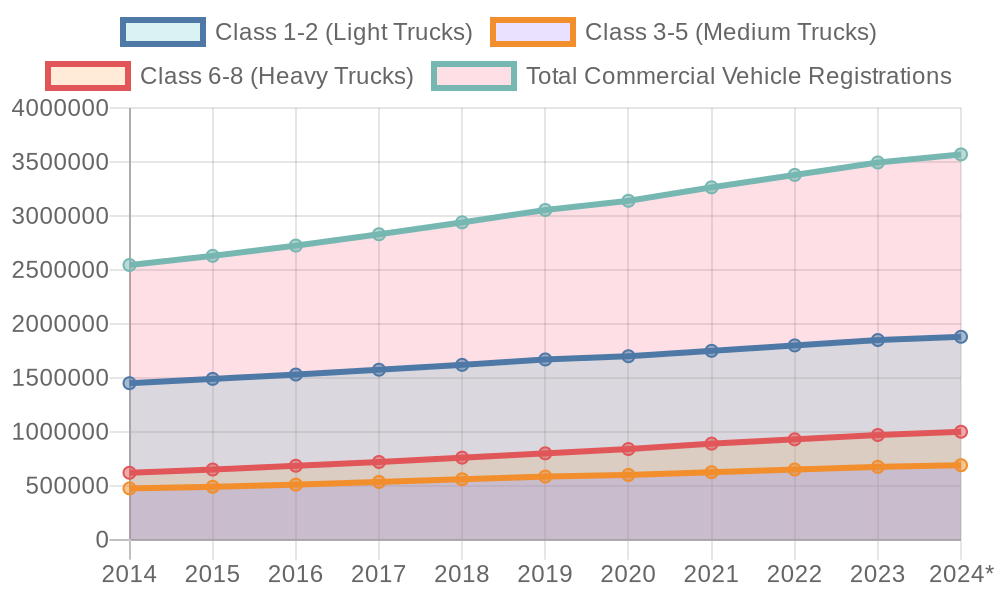
Over the past decade, California has witnessed significant growth in the number of commercial vehicle registrations across various truck classifications, driven primarily by the demands of e-commerce, logistics, and infrastructure expansions. The following table presents the data on truck classifications from 2014 to projected figures for 2024:
| Year | Class 1-2 (Light Trucks) | Class 3-5 (Medium Trucks) | Class 6-8 (Heavy Trucks) | Total Commercial Vehicle Registrations |
|---|---|---|---|---|
| 2014 | 1,450,000 | 475,000 | 620,000 | 2,545,000 |
| 2015 | 1,490,000 | 490,000 | 650,000 | 2,630,000 |
| 2016 | 1,530,000 | 510,000 | 685,000 | 2,725,000 |
| 2017 | 1,575,000 | 535,000 | 720,000 | 2,830,000 |
| 2018 | 1,620,000 | 560,000 | 760,000 | 2,940,000 |
| 2019 | 1,670,000 | 585,000 | 800,000 | 3,055,000 |
| 2020 | 1,700,000 | 600,000 | 840,000 | 3,140,000 |
| 2021 | 1,750,000 | 625,000 | 890,000 | 3,265,000 |
| 2022 | 1,800,000 | 650,000 | 930,000 | 3,380,000 |
| 2023 | 1,850,000 | 675,000 | 970,000 | 3,495,000 |
| 2024* | ~1,880,000 | ~690,000 | ~1,000,000 | ~3,570,000 |
*Note: 2024 data is projected based on recent trends and preliminary reports from the California Department of Motor Vehicles (DMV).
To visualize these trends, the chart below illustrates the growth across different truck classifications:
Sources:
- California Department of Motor Vehicles (DMV) – Vehicle Registration Statistics
- “Class 2b-3 Vehicle Market in California” – eScholarship.org (2025)
This growth trend highlights the continuous evolution of the trucking industry in California, reflecting the increasing reliance on these vehicles in a variety of commercial applications.
For more insights into the current trends in used truck sales, explore our comprehensive analysis
Conclusion
In summary, understanding the classification of trucks in California is crucial for trucking companies seeking to navigate the complexities of compliance and regulations. The state has implemented stringent regulations, particularly through the California Air Resources Board (CARB), which mandates that all diesel-powered trucks must adhere to specific emissions standards. As of January 1, 2023, this includes requirements for vehicles to be no older than model year 2010, showcasing California’s commitment to reducing air pollution and promoting sustainable transportation. Moreover, compliance with safety regulations, inspection protocols, and licensing is essential not just for operational continuity but also for the safety of all road users.
The trucking industry is faced with various challenges including strict emissions regulations, vehicle safety standards, and compliance with hours of service (HOS) mandates that can lead to hefty penalties if violated. Maintaining compliance is not just about avoiding fines; it is integral for enhancing operational efficiency and safeguarding the company’s reputation in a competitive market.
Trucking companies are encouraged to stay informed and proactive regarding regulatory changes, as non-compliance can result in significant operational disruptions. To help optimize your compliance strategy and enhance your fleet’s performance, consider utilizing modern solutions like Summit Fairings, which provide innovative products to improve aerodynamics and fuel efficiency. Learn more about optimizing your fleet with Summit Fairings. Embracing these technologies can lead to significant savings and regulatory compliance beyond mere adherence to laws.
By being well-versed in California’s trucking regulations and actively adapting to them, your business will be well-positioned not only to comply but to thrive in an increasingly regulated industry.