Navigating the complexities of commercial vehicle classifications is essential for trucking company owners, fleet managers, and procurement teams in construction and logistics. Within Illinois, B truck plates represent a significant segment of commercial vehicle registration, indicating that these vehicles are specifically designated for business purposes, including freight transportation and delivery. As the landscape of the trucking industry evolves, understanding the specific regulations, economic implications, and comparative classifications associated with B truck plates becomes critical. Each chapter of this guide will dissect the multifaceted dimensions of B truck plates—from their legal standing to their financial impact—equipping stakeholders with the knowledge necessary to optimize their operations.
B Plates, Business Use, and the Quiet Data Behind Commercial Truck Licensing

Determining whether a B plate is commercial depends on state licensing rules, vehicle weight, and use rather than a universal letter; many states classify plates by class and use, not a single code, so a B label in listings often signals a mid-duty commercial category rather than a nationwide designation. In Illinois and other states, commercial plates correlate with GVWR and use case, affecting registration fees, insurance, and inspections. A fleet manager should verify the exact classification with the DMV, check the vehicle’s GVWR, and confirm the plate class aligns with its business use to avoid surprises at registration or in contracting. While some sellers treat B as a universal sign of commerce, the reality is state-specific, and the safest path is to consult official guidance and current regulations.
The Mark of Commerce: Navigating the Legal Terrain of B Truck Plates for Commercial Freight

When business fleets move goods across city streets and rural lanes, the license plate on each truck is more than a badge of ownership. In Illinois and in many places, the choice of plate type signals how a vehicle will be used, and that signaling carries legal obligations as sturdy as the steel in the chassis. The label “B” in at least some licensing systems is understood as the marker for commercial operation. It ties a vehicle to business use, freight tasks, and typically heavier weight classes. Yet there is no universal, single English-language treaty that defines every nuance of “B Truck Plates” across all jurisdictions. The absence of a global, authoritative definition does not leave operators without guidance. Instead, the legal terrain is shaped by national or regional frameworks that prescribe how plates are issued, what they authorize, and what they prohibit. What remains clear is that commercial use changes the thresholds for registration, taxation, inspection, and enforcement. A plate assigned to a private car is not a pass for commercial activity, any more than a coat of paint can shield a vehicle from the laws that govern it. In practice, a B-type designation is not just a label but an indicator of the vehicle’s role on the road. It signals that the vehicle is engaged in commerce, whether it is a delivery run, a utility service, or a freight hauler moving goods for a business. This use triggers a suite of compliance obligations that go beyond basic registration. The goal is to ensure safety, weight compliance, route suitability, and the integrity of business activity on the road. Because commercial plates encode use, authorities routinely require ongoing documentation, periodic inspections, and accurate reporting of vehicle weight, permissible routes, and cargo. Even if a jurisdiction uses letters like A, B, or C to distinguish plate types, the practical effect remains the same: the vehicle’s license is tethered to its commercial function, and any deviation can invite penalties that are not merely administrative. The risk landscape becomes more acute with illegal modifications or attempts to obscure plate data. Using a plate to cover or obscure information, or to cloak a vehicle’s true purpose, is treated as a serious violation in most enforcement environments. The logic is straightforward: if an agency cannot verify who is operating a vehicle and for what purpose, road safety, taxation, and regulatory compliance all unravel. In this sense, the legal design of B plates is a system of checks intended to deter evasion and to prove accountability. This accountability includes the responsibility to maintain genuine plates, current registration, and truthful data about the vehicle’s weight, dimensions, and the nature of its business use. The consequences of evading these requirements can be severe and multifaceted. Fines, license suspensions, vehicle impoundment, and even criminal charges can arise when authorities detect intentional fraud or misrepresentation. Business operators must also recognize that enforcement has become more precise with technology. License Plate Recognition systems read plates in real time and compare them to centralized records, flagging any mismatch, concealment, or noncompliant use. For fleets, the implication is not merely legal risk but operational risk: vehicle downtime, disruption to delivery schedules, and higher insurance costs can follow a single enforcement action. The discussion of B-type plates thus centers on alignment with legal frameworks rather than the plate itself. In practice, whether in Illinois or elsewhere, the onus is on the vehicle owner and the fleet operator to secure a legally issued plate that matches the vehicle’s documented use. This means accurate registration of the vehicle’s weight, engine class, and intended operations. It also means ensuring that any special permits, such as those for oversized or hazardous cargo in some regions, are obtained and maintained. The identity of a vehicle’s plate is best viewed as part of a broader permission to operate within a regulatory ecosystem. It invites scrutiny not only at the point of registration but at every compliance checkpoint—inspection stations, tax assessments, and even roadside stops during a busy delivery cycle. The absence of a universal legal dictionary for “B Truck Plates” should not tempt operators to treat the designation as a mere formality. At heart, the concept embodies governance: a structured acknowledgement that a vehicle exists to perform business, that it will carry cargo or services linked to a company’s operations, and that its use will be monitored to ensure safety, fairness, and accountability. For those tracking market realities, the connection between plate type and business outcomes matters. Companies that adhere to licensing requirements and that keep their fleets legitimately registered tend to experience fewer regulatory disruptions. They also benefit from more predictable insurance and financing options, since lenders and underwriters weigh compliance as a risk control factor. To stay aligned with best practices, fleets should maintain a current understanding of how plate categories are interpreted in their own jurisdiction and remain vigilant about any updates to registration or inspection rules. A practical reminder is to keep meticulous records of vehicle weight, load types, and routes. When a business considers expanding or altering its fleet, the decision to pursue B-type plates should be made in concert with regulatory counsel or a knowledgeable licensing agent who can translate the rules into real-world steps. The literature may not offer a single international clause that defines B Truck Plates in every country, but the underlying principle remains universal: licensing is a contract between the operator, the vehicle, and the state, designed to ensure that commerce moves efficiently and safely. This contract relies on accurate data, lawful use, and continuous compliance, spanning registration, taxes, and periodic inspections. For readers who want to explore market dynamics while keeping this legal perspective in view, a look at current trends in used truck sales growth can provide context for how fleets plan to adapt to regulatory demands. current trends in used truck sales growth. Beyond the numbers, the chapter’s focus on legality reinforces a simple point: commercial plates are not optional signage; they are a framework that enables responsible commerce on the road. When operators respect the framework, they stand on solid ground to optimize routes, plan maintenance, and coordinate with regulators. When they disregard it, the cost is not only a fine but a broader erosion of trust and reliability in a fleet’s ability to operate lawfully. For a broader international context on licensing standards and the consequences of obstructing plates, see the Safe Driving resource on Vehicle Licensing. External context: https://www.safedriving.com.au/vehicle-licensing/.
B Truck Plates and the Commercial Freight Line: Registration, Taxes, and Compliance in Hong Kong
When people ask whether B truck plates are commercial, the answer often hinges on context. In many places, a lettered plate can signal something about a vehicle’s use, its weight, or its purpose. In Hong Kong, the B-series designation is tied explicitly to goods-carrying vehicles, and that linkage anchors a regulatory regime designed to keep commercial fleets safe, accountable, and properly taxed. The B Truck Plates in Hong Kong thus illustrate a clear principle: plates do more than identify a vehicle; they encode the business use of that vehicle and open the door to a set of obligations and opportunities that shape daily operations for operators, drivers, and managers alike. This is not merely about vanity plates or a simple tag; it is about a system crafted to align fleet movement with road safety, environmental stewardship, and revenue management for a densely used urban transit corridor. The distinction between commercial and private use becomes visible in the paperwork, the periodic checks, and the charges that wind through a vehicle’s lifecycle from license renewal to possible changes in ownership or vehicle configuration. In this sense, the B truck plate is a practical beacon for business-facing compliance in a jurisdiction where space, road rules, and public funding converge on the same chassis of policy design. The broader takeaway is that a plate type is a proxy for a bundle of regulatory expectations, and understanding that bundle helps fleet operators plan, budget, and adapt to shifting rules without losing momentum on the road. For readers who are also looking at how such distinctions play out elsewhere, the Illinois context described in the overview offers a comparative lens: in both cases, a classification tied to vehicle use triggers a chain of registration, taxation, and compliance requirements that differ from those for private passenger plates, even as some underlying principles—accurate record-keeping, regular inspections, and timely payments—remain constant across jurisdictions.
Registration in Hong Kong moves beyond the simple act of stamping a plate on a vehicle. Since April 20, 2020, the Transport Department has issued new vehicle licenses that embed a system-encrypted QR code. This enhancement strengthens security and supports enforcement initiatives such as the Police’s Electronic Fixed Penalty Notice Pilot Scheme. The presence of a QR code means the license plate, the vehicle, and the registered owner are linked in a way that lends itself to digital verification in the field, reducing friction when officers confirm a vehicle’s status during inspections or on the road. Renewal reminders are now delivered through the electronic contact channels registered by the owner, mirroring a modern approach to compliance management. When a renewal is completed, the owner receives a Vehicle Licensing Notification, which signals the next phase of use and confirms that the vehicle remains in good standing to operate as a commerce-related asset. The application process itself remains straightforward but thorough: furnish the required documents, present proof of ownership, confirm the vehicle’s details, and pay the relevant fees either at a licensing office or by mail. The procedure emphasizes continuity and traceability, ensuring every B-series truck in circulation has a traceable, up-to-date license that aligns with its commercial duties.
From the standpoint of taxes and fees, the B truck plate category in Hong Kong triggers two foundational streams: the Annual Vehicle Licence Fee (VLF) and the Road User Charge (RUC). The VLF is not a flat number; it scales with engine capacity, vehicle weight, and the specific vehicle type. Larger, heavier, or more capable goods vehicles typically contribute a higher annual charge than smaller commercial vans, reflecting the greater use of road space and wear on infrastructure. In addition to the VLF, all motor vehicles registered in Hong Kong—including B-series trucks—must pay the Road User Charge. The RUC is a broader levy aimed at funding road maintenance and development, ensuring that the costs of heavy traffic and the wear associated with goods movement are distributed across the system. These core charges are complemented by other potential costs: inspections required to maintain safety and emissions standards, charges for changes of ownership when a fleet moves a truck to a new operator or fleet, and any special permits required for unusual configurations or oversized loads. The financial architecture surrounding B truck plates reflects a philosophy common to commercial fleets worldwide: the vehicle is both a business tool and a user of shared infrastructure, and charges are calibrated accordingly to balance business needs with public goods.
The compliance landscape for B-series trucks in Hong Kong is equally deliberate. Regular safety and emissions inspections are mandatory for commercial vehicles, with non-compliance carrying the risk of fines, suspension, or more severe penalties. The enforcement framework has been enhanced by the Digital Penalty Notices pilot that leverages the encrypted QR code on the license plate to issue notices electronically. This modern enforcement approach reduces delays in response, streamlines case issuance, and increases transparency for operators who must respond promptly to penalties or enforcement actions. Taken together, these elements create a lifecycle of compliance that commercial fleet managers must manage with discipline: maintain current licensing, stay on top of renewal timelines, ensure the vehicle meets safety benchmarks, and anticipate the ongoing costs of RUC and VLF as part of annual budgeting. The system is designed to be predictable but rigorous, rewarding operators who keep their fleets within the letter of the rules and within the spirit of safe, efficient goods movement.
For businesses, these requirements translate into operational realities. Fleet managers must track license expiration dates, coordinate with licensing offices to renew and update vehicle data, and factor in the annual and ongoing charges into cash flow forecasts. The combination of QR-enabled verification and digital penalty notices means that non-compliance can be detected and enforced rapidly, underscoring the importance of proactive fleet governance. In practice, this means establishing a maintenance calendar that includes periodic inspections, training drivers to comply with traffic and weight limits, and maintaining meticulous records for ownership changes and vehicle modifications. The cost calculus extends beyond finance; it includes risk management, insurance implications, and the reputational dimension of operating a compliant fleet. For operators who seek to optimize efficiency, the HK model also hints at opportunities for digital record-keeping, data-driven scheduling, and tighter linkage between licensing data and fleet management systems.
As a point of wider reference, industry discussions on fleet efficiency and regulatory compliance frequently appear in professional forums and blogs. For readers seeking a practical synthesis of fleet-management insights, the topic is explored further in the McGrath Trucks Blog, which offers perspectives on how fleet operators navigate regulatory landscapes, manage costs, and optimize used-truck utilization across markets. You can explore those discussions here: McGrath Trucks Blog.
The B truck plate system in Hong Kong thus embodies a coherent approach to regulating commercial vehicle use: it ties registration and licensing to the economics of road use, links enforcement to secure licensing, and integrates a digital infrastructure that supports timely compliance. In turn, it provides a model—distinct from, yet comparable to, other jurisdictions—that shows how a commercial designation on a plate can be a microcosm of a broader policy framework aimed at safe, accountable, and efficient freight movement. The experience suggests that for any fleet operator, the worth of a B-series designation lies not just in identifying a vehicle as commercial, but in the structured lifecycle it necessitates—one that is transparent to regulators, predictable for business planning, and adaptive to evolving technologies and enforcement tools. As policy and technology continue to evolve, ongoing attention to licensing updates, fee schedules, and inspection regimes will remain essential to sustaining compliant operations on crowded, dynamic roads.
External resource: https://www.td.gov.hk
Commercial by Classification: How Illinois’ B Truck Plates Shape Fleet Operations and Market Dynamics

The question whether B truck plates are commercial hinges on how state systems translate vehicle use into registration categories, fees, and regulatory obligations. In Illinois and many other jurisdictions, the letter designations on license plates are not arbitrary labels; they signify a vehicle’s primary use and the responsibilities that accompany that use. The Illinois system, with its B designation, marks a clear boundary between commercial operations and private transport. The designation is typically reserved for vehicles that perform business-related tasks—delivery and freight, service calls, utility work, and other commercial activities that rely on a vehicle not primarily driven for personal purposes. This distinction serves several practical purposes. It helps the state tailor registration requirements, taxation, safety inspections, and administrative oversight to the realities of commercial mobility. It also provides fleets and regulators with a simple signal about the vehicle’s risk profile, expected duty cycle, and potential impact on road infrastructure and public safety. The result is a regulatory ecosystem in which B plates are understood, within that jurisdiction, as the emblem of commercial use rather than private transport.
To appreciate what that means in practice, it helps to understand what the B designation is designed to separate from. In many plate systems, other letter codes correspond to different uses or vehicle classes. A plates often identify private passenger vehicles, while B plates align with commercial fleets and business tasks. The division is not purely ceremonial; it maps to regulatory obligations that reflect how a vehicle is operated in the real world. For fleet managers, this alignment matters because it shapes registration timelines, tax treatment, and compliance expectations. In Illinois, a B plate signals that the vehicle is part of a business operation, not a personal mission, and that the operator must meet the conventions and inspections associated with commercial traffic on the state’s roads. The practical upshot is that B plates help differentiate risk, paperwork, and fees from those required for privately used vehicles, which can affect everything from insurance underwriting to annual renewal cycles.
This transactional layer—where use determines the administrative burden—flows into the broader economics of operating a commercial fleet. The research materials for this chapter do not quantify a direct, isolated economic impact of B plate designation on transportation industries. Instead, they point to a larger truth: the classification system exists to streamline and clarify regulatory compliance in a field where business needs and regulatory demands intersect constantly. In the absence of precise impact studies, one can still reason about the channels through which plate classification touches economics. First, when a vehicle is clearly categorized as commercial, fleet managers can align registration, inspections, and tax obligations with expected duty cycles. This alignment reduces ambiguity, which in turn can improve budgeting accuracy, maintenance planning, and risk management. Second, the separation between personal and commercial plates helps authorities monitor safety performance and road usage more efficiently, potentially influencing compliance costs and incident reporting. Third, for buyers and sellers in the used-truck market, a consistent classification enhances the informational backdrop against which pricing and resale decisions are made. A vehicle with a clearly identified commercial plate type may carry distinct expectations for wear patterns, service histories, and residual value tied to its typical use case.
The Illinois framework does not exist in a vacuum. The broader transport economy—shaped by demand for freight movement, infrastructure policy, and IFTA-style fuel and weight regulation—intersects with plate classifications in meaningful ways. Fleets that rely on commercial plates often operate large or mid-size trucks that carry goods across regional corridors and through urban centers. Their operating models are sensitive to regulatory signals about emissions standards, idle times, and maintenance intervals, all of which intersect with the administrative realities of commercial plate status. When macro forces swing—such as shifts in fuel costs, labor availability, or cross-border trade policies—fleet planners reassess vehicle utilization, routing, and even the mix of owned versus leased equipment. In this context, the B designation becomes more than a label; it becomes a practical reminder of the obligations embedded in commercial activity and the strategic choices those obligations drive.
From a market perspective, the existence of a formal commercial designation can influence how fleets strategize around capital expenditure and asset replacement. If B plates come with or imply particular registration cycles or inspection regimes, operators may time purchases and retirements to fit the most advantageous renewal windows. Tax planning, too, can be tethered to plate status, with fleet managers coordinating depreciation schedules and compliance costs in ways that reflect the business use of the asset. Even when direct numerical data are sparse, the logic is clear: a clean, consistent classification framework reduces friction in fleet operations, which can indirectly affect price discipline in the market, the speed of regulatory processing, and the reliability of disclosures in sales and auctions.
The practical takeaway for stakeholders who must interpret the B plate designation is that the label conveys more than a simple bureaucratic category. It signals a contract between the vehicle and the state—the vehicle’s function, responsibilities, and the kind of oversight it will be subjected to. In turn, this contracts shapes how fleet operators plan routes, schedule maintenance, and allocate resources. It also feeds into how fleet managers communicate with insurers, lenders, and regulators about risk and compliance. The result is a layered, operator-led ecosystem in which the B plate is at once a marker of commercial use and a lever for operational discipline. To think about B plates simply as a tag for “commercial” is to miss the nuance of how a jurisdiction’s labeling system can streamline, or at least clarify, the interactions among use, regulation, and market behavior.
For readers seeking a broader context on how macro-market dynamics affect trucking and fleet decision-making, consider the general trends discussed in industry analyses that address uncertainty and market cycles in the trucking sector. These elements—demand fluctuations, shifts in regulatory posture, and evolving trade patterns—shape how fleets value and deploy vehicles with commercial registrations. The interplay among these forces and plate classifications is not one-to-one nor is it purely numerical; it is a complex, adaptive relationship that fleet managers navigate every day as they balance compliance, cost, and service reliability. As markets continue to evolve, the B designation remains a practical, communicative tool that helps align a vehicle’s use with the regulatory framework designed to govern commercial road transport. In this sense, B plates are more than a classification; they are a signal of how a vehicle functions within an economy built on moving goods efficiently and safely.
Among the resources that help illuminate the broader landscape of trucking markets, readers may find value in exploring discussions of how market uncertainties shape fleet strategy and asset deployment. For a perspective on the current trajectory of trucking markets and the systemic factors that influence fleet purchasing and utilization, see the analysis linked here: Navigating economic uncertainties in the trucking markets. This material adds texture to the sense that classification systems, like Illinois’ B plate designation, function within a larger ecosystem where policy, market signals, and business strategy converge. It is in this convergence that the practical meaning of B plates crystallizes for operators who must run tight, compliant, and profitable fleets across complex transportation networks.
B Plates on the Road: Demystifying Illinois Commercial Use and the Heavy-Haul Reality of Fifth-Wheel Connections
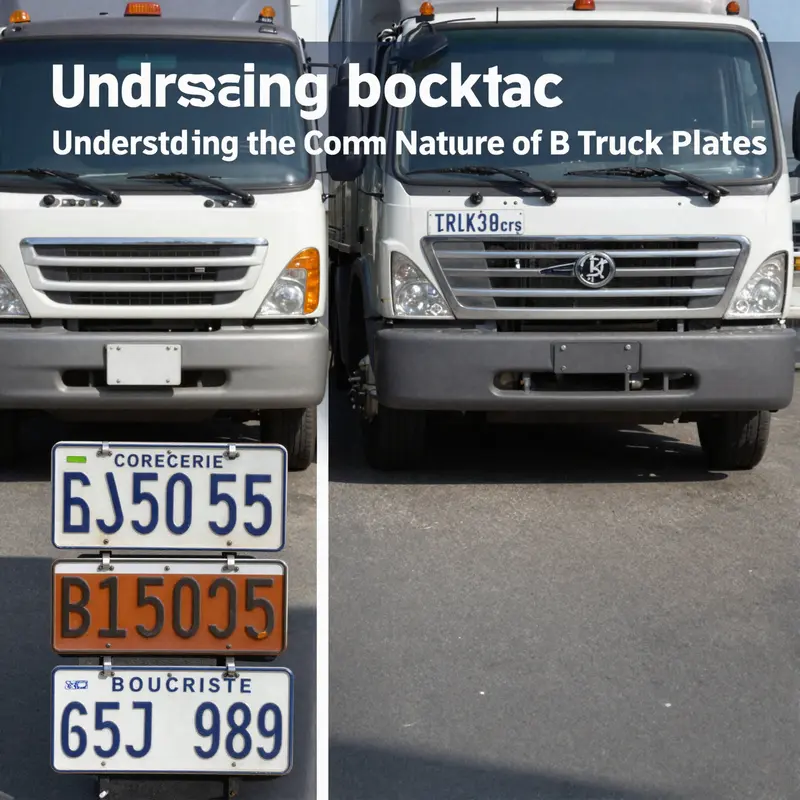
Take a drive through fleets that haul everything from equipment to groceries, and you will quickly sense that the license plate on a truck is more than a badge of ownership. In Illinois, the designation B truck plate marks a vehicle as commercial rather than private. This single label unlocks a cascade of regulatory expectations: what gets registered, how taxes are assessed, when inspections occur, and, crucially, how the vehicle is integrated into a business’s operations. The practical effect is straightforward enough. A B plate signals that a given truck is used in the service of a business, not for personal transport, and that its use is tied to revenue-generating activity. This aligns with the broader framework where plate types—A, B, C, and beyond—reflect not just vehicle size or weight, but the purpose and context of road use. An eBay listing that proclaims an “Illinois Commercial B Truck Plate” underscores the policy logic: the plate is a piece of commercial infrastructure as essential as the truck’s engine or its tires. The classification helps inspectors and registrars verify that a vehicle’s operations match the declared use, and it helps fleets manage the files, fees, and compliance obligations that accompany commercial activity.
Yet the landscape around B plates is more nuanced than a single line on a registration form. The term B truck plates, in common industry parlance, can ripple into specialized equipment needs, especially when fleets pursue heavy-haul or construction-oriented missions. In some discussions, B plates are linked with fifth-wheel arrangements that enable a tractor to couple to a trailer in demanding environments. The exact meaning can shift by jurisdiction, but in the context of heavy-duty trucking, a B designation often points toward durable, business-grade components that tolerate high torque, heavy loads, and the rough demands of onsite transport. This is where the research findings converge on a practical truth: B truck plates, as they relate to fifth wheels and heavy-haul applications, embody a specific engineering intent rather than a generic plateroll. A pair of thickness options—2 inches and 3.5 inches—emerge as recurring design choices for these specialized plates, each with its own performance envelope and field considerations.
The core characteristics are clear. The B truck plate, in this specialized sense, functions as a fifth wheel plate—the interface that connects a semi-truck tractor to a trailer. This connection bears the weight and torque of the entire transport equation, so the plate must resist deformation and maintain alignment under combined vertical and lateral forces. The thickness matters. A 2-inch plate is typically associated with moderate loads and lighter, but still demanding, applications. It delivers adequate strength for many standard operations while keeping weight and cost in check. In heavy machinery transport or other high-demand scenarios, a 3.5-inch plate rises to the challenge. Its increased thickness translates into greater load-bearing capacity and improved resistance to stress concentrations that occur during tight turns, irregular terrain, or when transporting oversized cargo. The engineering logic is pragmatic: thicker plates provide margin where it matters most, reducing the risk of fatigue-related failure in the field.
Engineering considerations behind B truck plates go beyond raw thickness. These plates are designed for high-torque, high-load conditions that accompany fifth-wheel couplings. They must tolerate repeated cycles of engagement and disengagement, withstand directional shifts during dynamic braking, and remain stable as suspensions and landing gears respond to uneven surfaces. Unlike general-purpose trailer components, B truck plates are tailored to harness the physics of heavy-duty hauling. They are expected to preserve alignment, protect the kingpin interface, and maintain safe articulation of the tractor-trailer pair under demanding operating conditions. A robust plate contributes not only to performance but to safety, since a compromised fifth-wheel connection can cascade into trailer detachment or uncontrolled movement in constrained spaces.
Compatibility is the quiet but critical partner to strength. B truck plates must work with a spectrum of trailer suspension systems and landing gear configurations. Fleet operators prize interoperability because it minimizes downtime and maximizes asset utilization. In practice, that means selecting plates with proven dimensional compatibility, precise milling tolerances, and reliable heat-treatment standards that prevent micro-cracking or warping after repeated cycles. When maintenance crews inspect a fleet, the fifth-wheel interface—bolts, pins, and the plate itself—receives careful scrutiny, ensuring that the working clearances remain within spec. Even the finest plate design can falter if mounting hardware loosens or if the plate experiences corrosion in the harsh environments that heavy-haul work often encounters.
In comparing B truck plates with other commercial vehicle plates, the contrast becomes most visible in application focus and equipment demands. General-purpose trailer plates underpin versatile fleet operations—flatbeds, dry vans, refrigerated trailers—where flexibility is prized more than absolute strength in any one dimension. These plates typically address everyday transport tasks, balancing weight, cost, and compatibility across a range of trailer types. By contrast, B truck plates emphasize specialization. They are selected not for broad versatility but for the capacity to shoulder extreme forces associated with heavy or oversized cargo, lowbed configurations, and high-torque connections. This emphasis explains the existence of two primary plate thicknesses in the B-family: the leaner 2-inch option suited to moderate workloads, and the roomier 3.5-inch option built for the heavy end of the spectrum. The result is a clear delineation: B plates are not a one-size-fits-all solution; they are a targeted tool for situations where performance under stress matters most.
The regulatory and operational implications reinforce this distinction. B plates signal commercial activity to authorities, strengthening oversight around registration, taxes, and inspections in ways that reflect ongoing business use rather than incidental travel. For operators, this creates a predictable framework that supports commercial efficiency while upholding safety standards. It also means the plate is part of a larger ecosystem of fleet management: maintenance schedules, load planning, compliance audits, and even insurance considerations that take business risk into account. When fleets contemplate upgrades or replacements for fifth-wheel components, they weigh not only the immediate cost but the long-term reliability under typical routes, weather conditions, and job-site challenges. The aim is to ensure that the plate, the fifth wheel, and the trailer together form a coherent, dependable linkage capable of sustaining the rigors of heavy-haul transport.
Market dynamics play a role as well. The heavy-truck segment often moves with the cadence of construction demand, industrial activity, and regional freight patterns. In this context, the B plate story intersects with broader fleet health indicators and market trends. For readers following market analyses, one can draw insight from current trends in used truck sales growth, which influence decisions around equipment purchases, replacements, and the scale of heavy-haul operations. This broader landscape helps explain why fleets invest in robust fifth-wheel interfaces and why regulatory classifications like B matter for long-term cost of ownership and reliability. See a recent discussion on market trajectories here: Current trends in used truck sales growth.
From a practical standpoint, the B plate narrative invites operators to think about the road-ready architecture of their fleets. It is not merely about fees or classifications; it is about designing a system where the plate, the tractor, the trailer, and the load all function in concert. That means ensuring compatibility across suspensions, confirming mounting hardware integrity, and aligning maintenance planning with the life cycle of heavy-haul components. It also means recognizing that the regulatory tag on the cab is a signal—a signal that the machinery and the people behind it are committed to commercial service, safety, and accountability on every mile. As such, B plates embody a bridge between regulatory clarity and engineering rigor, a bridge that supports the complex choreography of moving large or heavy cargo from site to site with reliability and precision.
External resources aside, the real-world takeaway remains practical: when a fleet chooses B plates or explores heavier fifth-wheel configurations, the decision should be grounded in load requirements, terrain realities, and maintenance discipline. It is a choice that aligns regulatory status with mechanical design, ensuring that the vehicle not only meets legal expectations but also performs where it counts most—in the field, under load, and through the turns of a demanding workday. For ongoing technical references and deeper engineering guidelines that underpin these choices, consult an external manufacturing guide at the following resource. External resource: https://www.duratrack.com
Final thoughts
Understanding the commercial nature of B truck plates is pivotal for anyone involved in the trucking and logistics sectors. This classification not only impacts the legal and regulatory frameworks within which businesses operate but also influences financial decision-making related to registration and compliance. Recognizing the economic significance and legal requirements associated with B truck plates can enhance operational efficiency and enable companies to leverage their assets effectively. As the industry continues to grow and evolve, staying informed about vehicle classifications and their implications remains essential.