Understanding whether an old retired fire truck is classified as a commercial vehicle is crucial for trucking company owners, fleet managers, and procurement teams. This examination bridges legal definitions, roles of regulatory agencies, implications of ownership, and historical context. Each chapter will uncover the intricacies that separate retired fire trucks from commercial truck classification, shedding light on usage, regulations, and potential impacts on procurement and fleet management.
From Sirens to Street: Demystifying the Commercial Status of an Old Retired Fire Truck
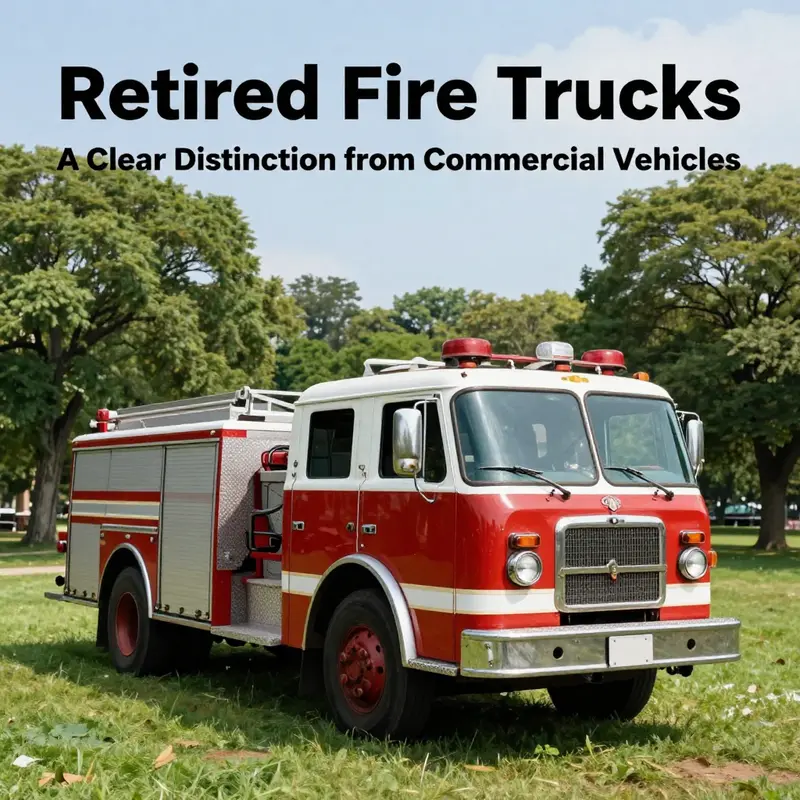
When people encounter an old, retired fire truck sitting in a driveway, at first glance it can feel like a relic. It sparks questions not just about history and memory, but about law, licensing, and what counts as driving a business vehicle in a country built on commerce. The tension is practical as well as philosophical: does that gleaming red machine belong on a public road, or is it better kept as a museum piece, a piece of rescue history rather than a tool of trade? The core of the matter is classification. A vehicle’s status as commercial or non-commercial hinges on how it is used, by whom, and under what circumstances—the same vehicle might wear different labels depending on its day-to-day role and its future plans. The result is a layered answer rather than a single yes or no. An old retired fire truck is not automatically a commercial vehicle, but the path from firefighting asset to civilian road vehicle sits on a map of regulations, weight limits, and local rules that can be navigated with care and attention to detail.
At the heart of the distinction is a straightforward rule of thumb codified in federal guidelines: a commercial vehicle is one used for business purposes, especially for transporting goods or passengers for hire, or for operating a business itself. A fire truck, by its original purpose, falls into the category of emergency vehicle. Its mission was public safety, not profit. Even after retirement, that original purpose often anchors the vehicle’s classification in the eyes of authorities. The emergency vehicle label tends to persist, especially when the apparatus remains equipped and configured for public safety functions. Yet, the practical realities of ownership and use can complicate this label. If the retired apparatus is moved into private hands and repurposed—for example, as a display piece, a training aid, or a ceremonial vehicle—the classification can shift from a regulatory perspective, though not necessarily from a historical one. The consequence is that the vehicle’s day-to-day use will influence what regulatory category applies when it is registered for road use.
A critical piece of the puzzle is weight. In the United States, many who inherit a retired fire engine focus on the Gross Vehicle Weight Rating, or GVWR. When a vehicle has a GVWR under 26,001 pounds, it typically does not require a Commercial Driver’s License, or CDL, for non-commercial use. In plain language, if someone wants to drive a lighter retired emergency vehicle for personal or recreational reasons, the CDL requirement is not automatically triggered simply by age or by the vehicle’s past life. This is the practical hinge that makes a retired fire truck potentially non-commercial, but only if it is not used to transport goods or people for profit. The line, however, is not a universal one. States may implement their own nuances, and local DMV offices often have additional forms, inspections, or restrictions for retired emergency apparatus. The broad standard holds, but the details can and do vary. For anyone contemplating a real-world transition—from firefighting asset to a street-legal, non-commercial vehicle—the first stop is the state DMV, which can clarify registration, safety inspections, and whether a title transfer is needed to reflect the vehicle’s new status.
This is where the tension between policy and practice becomes most evident. The federal framework, notably under the purview of the FMCSA—the Federal Motor Carrier Safety Administration—lays down the general architecture of commercial vehicle definitions and the licensing implications that accompany them. The FMCSA’s guidance helps explain the boundary conditions: commercial classifications are most directly tied to use in commerce, the movement of goods or people for hire, and the ongoing operation of a business on the road. A retired fire apparatus that no longer serves as a vehicle for hire and does not transport products or passengers for profit is typically outside that heavy regulatory envelope. Nevertheless, a curious owner who wishes to operate such a truck on public roads must navigate the licensing, registration, and insurance requirements applicable to the vehicle’s new role. Those decisions are not merely bureaucratic hurdles; they shape the everyday feasibility of keeping a vintage fire truck roadworthy. In practice, many owners pursue a path that emphasizes safety and preservation: restoring the vehicle to a state where it can run legally on the street while honoring its historical role.
To be sure, this is not a one-size-fits-all narrative. Some retired fire trucks are kept in private collections and never leave driveways or private properties, where the issue of commercial use dissolves into personal enjoyment. Others are pressed into community service in a ceremonial capacity—parades, museum shuttles for special events, or charitable drives. In those contexts, the vehicle’s function remains non-commercial at its core, even as it participates in events that involve public visibility. It is in these spaces that the line between regulation and reverence becomes especially delicate. Owners must ensure that their vehicle complies with road safety standards—lights, brakes, tires, and emissions are all part of the equation—while also aligning with any local rules about antique or historic vehicles. These constraints often require periodic inspections or special registrations that acknowledge the vehicle’s unique status.
The practical implications extend beyond licensing and inspections. Insurance, for example, is not a mere afterthought. A retired emergency vehicle may require specialized coverage that accounts for its primary role history, rare use, and the potential for higher maintenance costs. Insurance policies can differ dramatically depending on whether the vehicle is classified as a non-commercial personal vehicle or as a historic or display model. The financial considerations intersect with the legal ones, guiding owners toward a care plan that respects the vehicle’s heritage while ensuring roadworthiness and safety. The balance between preserving history and meeting modern safety standards is a delicate but navigable one, and it often benefits from the counsel of specialists who understand both vintage vehicles and the regulatory landscape.
This chapter does not pretend to settle every case with a single verdict. Instead, it sketches a landscape where the old fire truck begins with an emergency-use identity and gradually shifts into a spectrum of possibilities as ownership moves forward. If the owner does not intend to use the truck for transporting goods or paying passengers, and if the GVWR sits below the CDL threshold, a path exists toward non-commercial operation. Yet the path is not automatic. It requires confirmation from the state DMV about registration and title, a review of safety requirements, and, in some jurisdictions, proof of compliance with certain emissions or safety standards that reflect modern road rules. It is wise to approach the transition as a conversation with the local authorities rather than a unilateral rebranding. When in doubt, a careful check with the DMV can prevent surprises later, such as a road-side stop or a renewal issue caused by an overlooked requirement.
For readers who want to explore these topics in a broader context and see how they intersect with market realities, the conversation rarely ends with the law. The economics of owning a retired fire truck—safety upgrades, maintenance costs, storage, and the potential for sale or display—also shapes what is feasible on the road. The market for vintage and historical emergency apparatus is nuanced. Some communities prize these machines as tangible connections to public safety history, while others see them as collectible assets that belong in a museum or on private display. In any case, the classification question remains central: does the vehicle operate as a tool of commerce, or is its function anchored in memory, education, or public service? The answer is context-dependent and demands both prudence and curiosity.
For readers who want deeper discussion on how these classifications play out in practice, our broader coverage on the subject can be found in the McGrath Trucks blog, where we thread together regulatory insight with real-world scenarios about buying, restoring, and reusing trucks. See McGrath Trucks blog for additional perspectives on how classifications intersect with ownership decisions and how the market responds to vehicles that straddle lines between utility and heritage. McGrath Trucks blog.
If you seek formal regulatory language and official guidance, the Federal Motor Carrier Safety Administration (FMCSA) offers a foundational reference to commercial vehicle definitions and licensing requirements. While each situation differs by state and local rule, FMCSA’s framework provides essential context to understand why a retired fire truck is unlikely to be treated as a commercial vehicle solely due to its age or former use. For direct regulatory detail, see the FMCSA site: FMCSA.
Between Duty and the Road: Legal Boundaries for Old Retired Fire Trucks on Public Roads
An old retired fire truck sits in a quiet lot, its red paint faded but its silhouette still commanding attention. It is more than a museum piece or a parade prop; it embodies decades of service and community memory. The central question for owners and regulators is deceptively simple: is this machine a commercial vehicle once ready to work on public roads, or does its retirement remove that burden entirely? The plain answer is that retirement by itself does not force a reclassification; use matters more than history.
The federal framework for commercial vehicles centers on purpose and impact. The FMCSA defines commercial use through thresholds tied to transporting goods or people for hire and to hazards those movements may entail. A vehicle with a gross vehicle weight rating (GVWR) of 10,001 pounds or more generally falls under the regulatory umbrella when used in commerce. A vehicle designed to carry 16 or more passengers also earns the designation, as does any vehicle transporting hazardous materials requiring placarding. These criteria trigger inspections, driver qualifications, and hours-of-service requirements.
When a fire engine is decommissioned, retirement does not automatically erase regulatory implications. In federal terms, the vehicle may fall outside active emergency-vehicle rules, but if it is repurposed as a mobile business, a tow vehicle, a display rig, or a for-hire transport asset, the same FMCSA standards can apply again. The weight class and the intended use determine status, not the past as an emergency responder.
State and local rules layer additional complexity. Permits, registration categories, and restrictions vary by jurisdiction, and some areas require markings or color changes to avoid confusion with active services. A retired fire truck used for education or charity events, a film production prop, or a stationary display may still implicate safety or nuisance considerations, and may require insurance, parking arrangements, and local permissions even when not used for commerce.
Decommissioning matters as well. Removing sirens, red lights, and emergency markings signals a shift from on road duties to safety-conscious public display or private use. Yet many jurisdictions permit residual markings when properly presented in a museum or educational context, so long as they do not mislead the public about the vehicle’s capabilities. The line between preservation and commerce is nuanced and far from identical across communities.
From a practical standpoint, owners should map out use cases before moving the vehicle onto public streets. If the plan is to transport goods or passengers for hire, verify GVWR, classification, insurance, and driver qualifications. If the plan is education, display, or private collection, address safety standards, parking, and nuisance factors. Engage state and local authorities early to determine required permits and registration options, and document intended use clearly to reduce compliance friction later.
Ultimately, the key message is simple: a retired fire truck is not inherently commercial, but its future on the road is determined by intention and practice. The regulatory landscape exists to ensure safety, predictability, and fairness among road users, and understanding those boundaries helps preserve history while protecting the public.
For authoritative guidance on commercial vehicle regulations, consult the federal FMCSA website and the applicable state motor vehicle agency.
Ringing the Classification Bell: How the DOT Defines Vehicles and Why a Retired Fire Truck Stays Outside the Commercial Category
A question that often circles around the dusty bay doors of firehouse history is whether an old, retired fire truck should be counted as a commercial vehicle. The quick answer at first glance is simple: not usually. Yet the deeper layers of why and how the classification happens reveal a precise framework that governs federal regulation, safety standards, and the long arc of a vehicle’s life—from active service to display or preservation. The U.S. Department of Transportation (DOT) does not stamp every vehicle with a single, universal label like “commercial” or “noncommercial” in the way a catalog might tag an item. Instead, it builds a system of categories that hinge on how a vehicle is used in commerce, its weight, its design, and its intended function. In this sense, the retired fire truck exists in a liminal space. It began life as an emergency vehicle, engineered for rapid response, water delivery, and life-saving teamwork. Its purpose has not necessarily shifted to commercial activity, even when its wheels rest in a museum courtyard or in a private collection. The regulatory frame that matters for commerce is intentionally anchored to use in commerce, not to the vehicle’s political or historical status after service ends. This distinction matters because the DOT’s influence is indirect but powerful: it shapes how vehicles must be built, tested, and labeled for the safety and mobility that public roadways demand, even if the vehicle’s current role is non-commercial and commemorative.
To understand why a retired fire truck sits outside the commercial category, it helps to look at the agencies within the DOT that actually perform the work of classification. The DOT itself does not assign a simple tag like “commercial vehicle” to every make and model. Instead, it delegates this work to its safety and regulatory arms, most notably the National Highway Traffic Safety Administration (NHTSA). NHTSA does not classify vehicles by whim; it uses concrete criteria—weight, design, and the vehicle’s intended use—to determine regulatory categorization. Those categories then determine the applicable safety standards, crash test requirements, and airbag or restraint rules that factories must meet for vehicles sold and operated on public roads. In short, the regulatory ecosystem is built to ensure that a vehicle’s design aligns with its expected role in traffic, whether it’s a family sedan, a delivery van, or a heavy-duty truck used in commerce. The fire truck, even after retirement, keeps its origin in the emergency-services niche, a use that is fundamentally distinct from commercial hauling or passenger service.
For readers who want the official frame of reference, the key takeaway is that commercial vehicle status is regulated under federal guidelines tied to commerce. Retired emergency vehicles do not automatically convert to commercial vehicles simply because they are still roadworthy or because they carry a certain weight. The federal guidance referenced by safety advocates and regulators emphasizes that “commercial vehicle” status is tied to use in commerce, not to a vehicle’s current owner or its post-service life. This distinction is more than a semantic quirk; it underpins licensing requirements, insurance coverage, operating privileges, and the kinds of maintenance and inspection regimes that apply when a vehicle is used to move goods or people for hire or profit. In practice, a decommissioned fire engine intended for display, education, or ceremonial use on public roads may circumvent some commercial-usage requirements, while still needing to comply with general traffic and safety standards that govern any vehicle on the road. The important point is not the power of the engine or the size of the chassis, but the purpose behind its road use and the regulatory category that purpose implicates.
This is where the narrative of the retired fire truck intersects with market realities and public memory. The unit’s original design—reflecting the priorities of public safety, rapid acceleration, robust braking, and reliability under demanding conditions—remains a record of its era. Yet when the siren quiets and the hose reels are retired, the vehicle’s value shifts from frontline service to historical significance, educational potential, and preservation. Museums, fire departments preserving old fleets, and private collectors all grapple with how such a vehicle should be maintained, displayed, and, if ever driven, operated in a way that respects its legacy and adheres to safety norms. The DOT’s classification logic, which remains tethered to use in commerce, thus has an indirect but meaningful impact on decisions about restoration, insurance, and public display. If a former pumper is exhibited under controlled conditions, only occasional, noncommercial demonstrations may occur, ensuring that the vehicle stays outside commerce-driven regulatory demands while still fulfilling its educational mission.
The practical implications extend beyond the walls of a museum or a private garage. When a retired emergency vehicle is occasionally pressed into service for public events, parades, or ceremonial duties, the rules governing its operation can become nuanced. Operators must ensure that road use aligns with local traffic regulations, and that any displays or limited-use activities do not blur the line into commercial transportation. In the broader sense, the retained emergency-vehicle classification underscores a cultural and regulatory separation between the legacy of public safety and the landscape of commercial transport. This dichotomy mirrors broader shifts in how societies reconcile historical artifacts with contemporary infrastructure needs. The old fire truck remains a symbol of a city’s emergency response history, a tangible reminder of the men and women who trained for, and responded to, moments of crisis. It does not, by default, become a workhorse for hire or a carrier of goods in the market sense that drives the vast network of freight and passenger commerce that the DOT governs.
From a storytelling perspective, this distinction enriches the chapter of any article about the old vehicle, because it clarifies why a retired fire engine is part of the public memory rather than a recruitment of market statistics. It also invites reflection on how we value historical machinery. A fire truck’s technical pedigree—the pump capacity, the wheelbase, the water tank’s weight, the highway-legal equipment that kept it safe in high-pressure environments—speaks to a particular era of municipal service. That technical heritage is preserved through careful restoration and documented history, not through commerce-driven valuation. The tension between preservation and regulation becomes a narrative thread that helps readers understand why the question of “Is it commercial?” cannot be answered by a simple yes or no. It requires reading the rules of use, the function the vehicle served, and the life it has led since retirement.
As readers consider how this applies to broader conversations about vehicle classifications, the connection to market dynamics becomes visible in a more nuanced way. Even though the retired fire truck is outside the commercial category in a direct regulatory sense, the way it is perceived in the broader vehicle ecosystem—its value to collectors, its role in education, and its potential as a public showcase—still interacts with the market for used or historical vehicles. For those who follow trends in the broader used-truck and specialty-vehicle markets, a line emerges between mass-market commercial vehicles and niche, non-commercial assets with historical or ceremonial uses. In discussions about how such vehicles are priced, insured, or displayed, one can observe a subtle calibration that reflects both regulatory boundaries and cultural value. To see how market forces are evolving in related spaces, readers may follow ongoing conversations about current trends in used-truck sales growth, which, while centered on traditional commercial equipment, illuminate the shifting expectations of buyers, sellers, and institutions around non-standard or historic vehicles. current trends in used-truck sales growth
For readers seeking a precise map of how the federal framework translates into everyday practice, the official contours of vehicle classification are laid out by the federal agencies, notably through the NHTSA’s guidelines. The definitions inform why a retired emergency vehicle is not automatically recast as a commercial vehicle simply by aging or by changing hands. They also remind us that the boundary between history and commerce is not merely a matter of labeling but of how a vehicle is used on public roads and how it is treated under safety and licensing regimes. To explore these definitions directly, consult the NHTSA Vehicle Classification resources, which provide a comprehensive guide to how classifications are determined and the implications for safety standards and regulatory compliance. The dialogue between history and regulation remains ongoing, but the core truth endures: a retired fire truck’s classification is anchored in its original purpose and current use, not in a desire to reframe its identity for commerce.
External resource: https://www.nhtsa.gov/vehicle-classification
null
null
Historical Echoes and Modern Boundaries: Why a Retired Fire Truck Is Typically Not a Commercial Vehicle
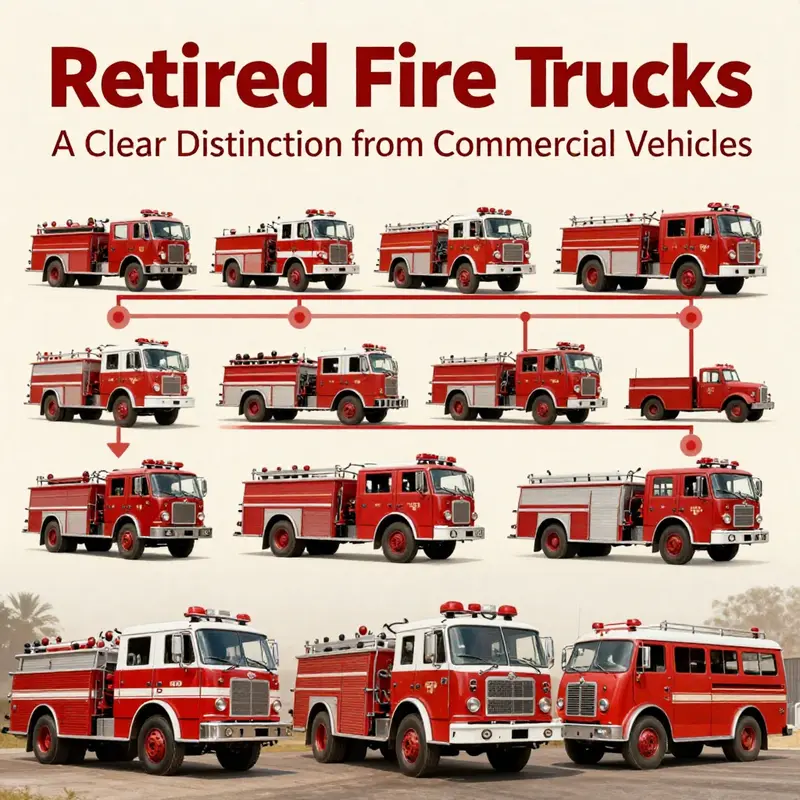
Across the history of urban firefighting, the fire engine is more than a machine; it is a record of how communities organize safety, technology, and law. In tracing how these vehicles are classified, one finds a durable rule: an old retired fire truck remains an emergency vehicle in policy and practice, even when its wheels no longer roll toward a blaze. This chapter threads together the evolution of fire apparatus, the formal families that emerged as needs grew, and the post-retirement lives these machines commonly take. It also explains why a vehicle that may appear in public spaces or commercial contexts is not categorized as a commercial vehicle in standard regulatory terms. The question is not whether a truck looks the part, but how we define its work after service ends and which rules continue to apply.
The story begins with the era of horse drawn pumps and hand devices, which reflect a time when urban hazards were faced with manual effort and civic coordination. The arrival of internal combustion engines transformed the craft, accelerating a shift toward motorized units capable of delivering water with greater reach and pace. This shift did more than improve response times; it redefined the taxonomy of firefighting equipment. As cities grew, fleets splintered into engines, ladders, rescues, and airport fire service; each category carried expectations about reliability, maintenance, and the regulatory frame that defined its mission.
When an engine retires, the question of classification persists. In most jurisdictions, the line that matters is use in commerce, not age or appearance. Fire trucks exist to serve public safety and firefighting, and their emergency designation rests on purpose rather than ongoing service. After retirement, a truck can be repurposed for museums, training, or community outreach without becoming a commercial asset simply because it now serves a civilian role. This distinction matters because it shapes what post life is allowed, how it is insured, and what kinds of inspections may be required. The result is a layered understanding: a retired fire apparatus can operate in a civilian context while staying true to its emergency vehicle origins.
The life after duty is rarely uniform. Some units remain on parade grounds or in ceremonial roles, preserving a living link to departmental history. Others are stripped and repurposed into maintenance platforms, event displays, or educational tools. In rarer cases, machines become portable classrooms or outreach vehicles, leveraging their design to engage communities without entering the commercial domain. Across these paths, the consistent thread is continuity of purpose in spirit, rather than commerce as a determinant of use.
For readers curious about the market for retired equipment, the landscape offers both challenge and opportunity. Even after retirement, apparatus retain intrinsic value: the geometry of heavy frames, the resilience of hydraulics, and the potential for conservation or conversion. Buyers weigh condition, provenance, and the feasibility of practical refurbishment. The same forces that govern used-truck markets can guide decisions about whether a unit will educate, inspire, or stand as a public artifact. Current trends in used emergency-vehicle sales show ongoing interest from museums, restoration groups, and specialized operators who seek character as well as capability.
External considerations also color the equation. In many places, exemptions that shield emergency vehicles from standard commercial license or weight rules do not automatically transform a retired unit into a commercial asset. The vehicle’s legacy, its safety record, and its ongoing public mission can influence insurance terms, registration, and usage restrictions. This nuance matters for owners, restorers, and public agencies considering second lives for old apparatus. It preserves the distinction between public service and private enterprise, even as the same machine may serve in a new setting.
In sum, a retired fire truck occupies a special middle ground. It is born of public safety, defined by a mission that outlives its active service, and navigated by rules that recognize its history even as it adapts to new roles. The classification that mattered on the station floor continues to shape decisions about eligibility, liability, and memory. The result is not a simple label but a layered understanding that honors the vehicle’s origins while embracing practical reuse in a community’s evolving life.
This exploration offers a lens on asset management and civic memory: the value of a retired emergency vehicle lies not only in what it does today, but in what it represents about public trust, safety culture, and the ongoing story of urban resilience.
Final thoughts
In conclusion, understanding the classification of retired fire trucks as non-commercial vehicles is vital for effective fleet management and procurement strategies. As these vehicles transition from active duty to retirement, their uses become focused on community engagement, education, and preservation rather than commercial operations. Recognizing these distinctions can guide business decisions and legal compliance, benefiting all stakeholders in the trucking and fleet management sectors.