In the competitive landscape of commercial truck maintenance, pinpointing technician performance is paramount. Fleet managers and procurement teams must adopt robust tracking mechanisms to ensure effectiveness, quality, and accountability among their technicians. By leveraging advanced digital tools and standardized metrics, truck shops can streamline processes and foster continuous improvement. This comprehensive overview will cover essential practices, including Work Order Management Systems (WOMS), Labor Time Tracking, First-Time Fix Rates (FTFR), Quality Assurance Audits, and customer feedback systems. Each chapter will contribute to a holistic understanding of how these strategies can maximize technician output and enhance overall shop performance.
WOMS as the Nerve Center: Tracking, Trust, and Continuous Improvement in Commercial Truck Shop Performance
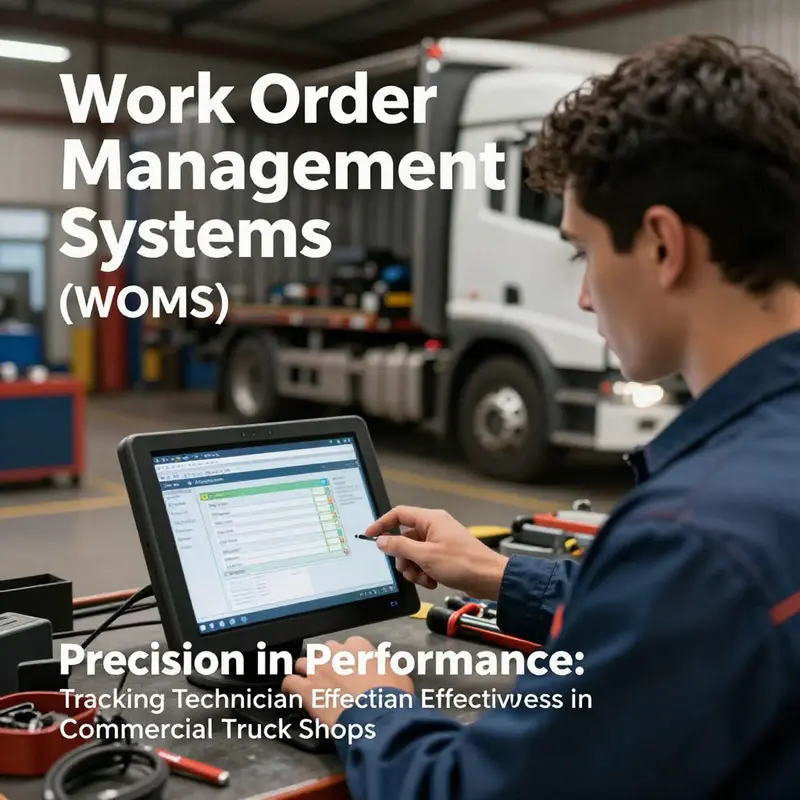
A commercial truck shop operates like a busy manufacturing floor where every wrench turn, every diagnostic blink, and every part drop carries a price and a purpose. In that environment, Work Order Management Systems (WOMS) have evolved from simple job trackers into the nerve center of technician performance. They knit together the shop’s daily rhythm with long-term goals such as reliability, safety, and customer satisfaction. When a supervisor looks at a live dashboard, minutes, not hours, become the currency of accountability. A WOMS does more than log a repair; it records the moment a task begins, the moment it ends, and every decision that bridges those two points. It translates a pile of manual notes into a coherent story about how a job progressed from inquiry to completion. Through this lens, performance is not a vague impression but a traceable sequence of actions that can be measured, compared, and improved. In that sense, WOMS are not merely software; they are the backbone of disciplined, data-driven shop management.
Central to the value of WOMS is centralized monitoring. The system consolidates multiple performance signals into a single, accessible view. It tracks response times to new work orders, the rate at which jobs move to completion, and how closely technicians adhere to scheduled tasks. A good WOMS also collates information about the sequence of events in a repair—from the initial assessment to the order of parts, the allocation of labor hours, and the final quality checks. This convergence supports managers who must balance speed with accuracy in a high-stakes environment. When a discrepancy appears, the system immediately flags it, allowing a supervisor to investigate without sifting through paper notes or disparate spreadsheets. The centralized nature of these metrics reduces bias and helps ensure that performance assessments reflect actual workflow, not anecdotal impressions.
Real-time visibility is the second pillar that makes WOMS indispensable. Digitizing work orders means live tracking of when technicians start and finish tasks, when they pause for parts or information, and where delays creep in along the repair path. In a truck shop, a few minutes here or there can cascade into longer lane times, extended customer wait periods, and missed service windows. Real-time data helps managers see bottlenecks as they form: a diagnostic question that stalls progress, a mislabeled part that slows up procurement, or an overlapped task that ties up a skilled technician. Rather than waiting for a weekly report to reveal trouble spots, leadership can intervene immediately reassigning workloads, adjusting schedules, or providing targeted coaching. That immediacy is critical for maintaining a consistent standard of work and for preserving customer trust in an environment where complex systems demand precise orchestration.
Performance assessment flows naturally from this visibility. WOMS automate the recording of work completion times, which in turn nourishes objective productivity metrics. The system can highlight delays that suggest training needs, fatigue, or process confusion. It also enables trend analysis — are some technicians consistently slower with certain repair types, or do certain shifts underperform due to scheduling gaps? By setting benchmarks and allowing comparisons across individuals and teams, WOMS turn performance into a transparent, teachable discipline. Importantly, these assessments are not punitive on their own; they are diagnostic tools that inform coaching, upskilling, and the design of more effective standard operating procedures. When a technician struggles with a specific diagnostic pathway, the data can guide targeted practice and mentor-led training rather than broad, generic reminders that fail to address the root cause.
Reporting and analytics elevate the practice beyond day-to-day monitoring. Most WOMS include dashboards that translate complex data into accessible visuals: average repair time, utilization rate, variance from standard times, and even warranty claim frequency. These dashboards do more than identify who is fastest; they illuminate how work flows and where the system can tighten. A high-performing technician may have a rapid cycle time, but if their first-time fix rate slips, the overall value of speed is questionable. Conversely, another technician might take longer but consistently achieve accurate, durable repairs, which reduces rework and customer recontact. The art of performance management, therefore, lies in balancing speed with quality. WOMS help managers recognize top performers not merely by tempo but by the integrity of the fix and the sustainability of outcomes. As a result, leadership can shape incentive structures, training priorities, and scheduling that align with the shop’s broader goals for reliability and customer satisfaction.
Data-driven decision making is the practical payoff of these capabilities. When managers can see the full end-to-end picture, they can forecast demand, align technician availability with peak periods, and allocate resources where they are most needed. If a particular diagnostic engine repeatedly triggers a longer diagnostic phase, shops can invest in the relevant diagnostic flow, or create pre-approved diagnostic checklists that speed the path to a correct conclusion. If FTFR–First-Time Fix Rate–begins to lag in a specific repair category, coaching can focus precisely on the diagnostic steps and torque specifications, reducing the chance of redo work. The data also supports workforce planning: cross-training opportunities can be identified where bottlenecks recur across shifts, ensuring that coverage for critical capabilities never leaves a service bay understaffed. In short, WOMS translate operational data into strategic decisions that optimize both people and equipment.
A crucial, often underappreciated, dimension of WOMS is their integration with other quality and safety processes. Modern shops rely on a fabric of checks that ensure procedures align with manufacturer guidelines, torque standards, correct part installation, and safe work practices. Diagnostics data — error codes, system resets, and test results — can be threaded back into the work order so every step is auditable. Quality assurance audits become less about retroactive inspection and more about continuous verification, with the system surfacing anomalies in real time. When a discrepancy is detected, the record trail– from initial fault code to final test result — creates a robust accountability loop. This loop not only improves technical accuracy but also fosters a culture of accountability, where technicians understand the direct link between precise workflow, customer outcomes, and professional growth.
Beyond the mechanics of tracking, WOMS contribute to customer-facing outcomes by closing the loop between shop floor performance and service experience. Customer feedback can be linked to specific work orders, enabling a more granular understanding of what customers value– professional communication, timeliness, and the perceived competence of the technician– as well as areas where service interactions fall short. When managers can pair a customer sentiment score with objective task data, they gain a more nuanced view of performance that informs coaching conversations and service recovery strategies. This integrated approach reinforces the principle that reliability in the workshop translates to trust on the road.
The practical, everyday impact of WOMS is best understood through the lens of a typical day in a busy shop. A work order lands with a fault description, a diagnostic path is recommended, and parts are allocated. The technician’s start time is logged, followed by the first diagnostic check, the sequence of repairs, and interim status updates. The system flags an unusual delay during a valve adjustment; an alert triggers a quick, targeted review by a supervisor, who reassesses the sequence and reallocates manpower to keep the job on track. The completed task moves to quality assurance, where torque specs and installation integrity are verified. The results feed into the customer communication stage, with transparent timestamps and a clear explanation of what was done. At the end of the day, managers review dashboards to compare performance across shifts, identify gaps, and plan targeted training. In this way, WOMS transform a day of work into a continuous loop of learning and improvement that scales with the shop’s growth.
For readers seeking broader industry perspectives or practical examples of how shops leverage these systems, this chapter sits within a wider ecosystem of knowledge and best practices. Industry voices often stress that the real power of WOMS comes from disciplined execution and a consistent emphasis on data quality. A well-designed system is only as good as the processes that feed it, including time stamping fidelity, accurate labor classification, and routine quality checks. To explore broader context and ongoing conversations in the field, the McGrath Trucks Blog provides a forum for practical perspectives on shop management and technician productivity. McGrath Trucks Blog
As the pursuit of efficiency continues, the diagram of a truck shop becomes clearer: people, processes, and machines connected by data. WOMS knit these elements into a single, auditable flow, making performance visible without sacrificing the nuance of human expertise. They enable managers to move beyond anecdote to evidence, from gut feeling to data-driven strategy, and from work in progress to a predictable, trusted experience for customers. In that sense, WOMS are not just tools for monitoring — they are accelerators of improvement, aligning daily workflow with strategic aims, and turning the shop floor into a responsive, learning organization. The outcome is a shop where technicians have clear, measurable goals, managers can coach with precision, and customers receive consistent, high-quality service.
External resource for deeper context: How Work Order Management Software Helps Track Technician Performance. https://www.maintenance.com/blog/work-order-management-software-technician-performance
null

null
FTFR as the North Star: Navigating Technician Performance in Commercial Truck Shops

First-Time Fix Rate (FTFR) stands as a powerful lens on the quality and efficiency of a shop’s technical workforce. It is defined as the percentage of service jobs that are resolved on the first visit, without the need for a follow-up diagnostic or repair. This metric is not just a vanity figure; it translates directly into fleet uptime, customer trust, and the bottom line. When FTFR climbs, downtime contracts, costly repeat visits, and the chaos of misdiagnoses recede, and the shop earns credibility with customers and fleet managers alike. In practical terms, a high FTFR signals that technicians are making accurate initial assessments, selecting the right repair paths, and executing tasks correctly the first time. It also reflects the strength of the shop’s diagnostic process, the availability of the correct parts on hand, and the clarity of the workflow from problem presentation to final verification.
For fleet operators, the implications are tangible. A truck that leaves the shop with the right fix on the first attempt reduces downtime that would otherwise ripple across the supply chain. It minimizes the need for intricate rescheduling, reallocation of assets, and the added wear and tear that comes from repeated road time and test runs. From the shop’s perspective, FTFR acts as a barometer of diagnostic rigor and process discipline. It encourages technicians to document symptoms meticulously, test hypotheses efficiently, and execute repairs with precision, because every misstep is costly in both time and customer satisfaction. In this sense, FTFR sits at the intersection of skill, tools, and process design, making it a natural focal point for performance management within commercial truck service operations.
The relationship between FTFR and other KPIs is not coincidental. FTFR does not exist in isolation; it coexists with metrics like Mean Time to Repair (MTTR) and customer satisfaction scores to form a holistic picture of service quality. MTTR tracks the average duration of repairs, from the moment a work order is opened to the moment the vehicle is back on the road. A high FTFR often correlates with a lower MTTR, because when the first visit is sufficient, the overall repair timeline tightens. But the two metrics can diverge in important ways. For example, a shop might fix many straightforward issues quickly (boosting FTFR and reducing MTTR), while more complex diagnoses that eventually take longer still achieve a respectable FTFR if the initial assessment is sound and the customer acknowledges effective communication. The blend of FTFR with customer feedback scores gives managers a direct line to the customer’s perceived value. When technicians diagnose and repair correctly on the first visit, customers are more likely to rate the service as professional and trustworthy, reinforcing loyalty and opening doors to repeat business.
To leverage FTFR effectively, shops deploy it through a systems view that links data across the repair lifecycle. Work order management platforms capture each repair step, the diagnostic decisions made, and the sequence of actions that culminate in a fixed vehicle. Time-tracking tools record the labor hours invested in each task, while inventory systems ensure the necessary parts are available when the vehicle arrives. In this integrated environment, FTFR becomes a visible, actionable metric rather than a vague quarter-end number. It empowers managers to identify bottlenecks where correct diagnoses stall the first-time fix, and to pinpoint training gaps where diagnostic reasoning or repair execution falters. For example, if FTFR dips on certain vehicle classes or systems, it may indicate the need for targeted technician coaching, updated diagnostic procedures, or enhanced access to specialized diagnostic tools. In turn, teams can align these improvements with the broader goal of reducing downtime and sustaining high customer satisfaction.
The operational playbook for improving FTFR hinges on four pillars. First, technician training must emphasize diagnostic rigor. Courses and hands-on simulations that walk technicians through common fault trees and failure modes help them recognize patterns quickly and avoid premature conclusions. Second, parts inventory discipline matters. A reliable on-hand parts strategy reduces the temptation to pursue ad hoc workarounds that might test the limits of a diagnosis but extend the time to a true fix. Third, diagnostic tool utilization must be streamlined. Modern diagnostic platforms provide code histories, system resets, and test sequences; when technicians are proficient with these tools, they can validate a diagnosis faster and with greater confidence. Fourth, workflow optimization should eliminate friction between the moments of diagnosis and the act of repair. This includes clear handoffs, standardized repair procedures, and proactive scheduling that reserves time for a thorough initial evaluation when required. When a shop couples these four elements with consistent data review, FTFR becomes a living metric—one that guides training plans, parts forecasting, and daily shop-floor decisions.
Industry guidance reinforces the importance of FTFR as a strategic metric. The American Trucking Associations (ATA) emphasizes fleet maintenance excellence as a core driver of reliability and efficiency, underscoring how metrics like FTFR matter for both safety and economic performance. The ATA’s research and standards illuminate how effective maintenance practices, informed by data and disciplined by process, can dramatically improve service outcomes for fleets that depend on predictable uptime. This broader industry perspective helps shop leaders frame FTFR not as a solitary target but as part of a validated approach to continuous improvement and service quality. For readers seeking deeper context on fleet maintenance metrics, the ATA site offers a wealth of guidance and data-driven insights that connect FTFR to the larger ecosystem of fleet reliability. See the American Trucking Associations for more information: https://www.trucking.org.
In practice, a well-implemented FTFR program also recognizes the nuanced realities of service work. Not every job is meant to be a single-visit fix, and honest measurement requires clear definitions. Some repairs may begin with a diagnosis that ultimately requires a follow-up due to a circular fault, a necessary re-torque after a part settles, or the emergence of a related issue discovered during the initial repair. In such cases, a transparent policy defines what constitutes a first-time fix and how subsequent actions are recorded and reported. Clarity in these definitions protects data integrity and ensures that FTFR remains a meaningful driver of improvement rather than a pressure metric that forces shortcuts.
As fleets grow more complex and equipment becomes increasingly sophisticated, the challenge of maintaining a high FTFR intensifies. The shift toward advanced diagnostics, telematics, and more integrated vehicle systems means technicians must interpret broader data streams and coordinate with fleet operators to verify that the promised fix aligns with real-world operation. This reality reinforces the value of a data-rich, process-centric approach to FTFR: one that captures diagnostic steps, validates with proper tests, tracks parts usage, and aligns with customer expectations. In such an environment, a technician’s ability to deliver a correct fix on the first visit reflects not only personal expertise but also the shop’s access to the right information, the right tools, and the right procedural discipline.
To connect these ideas back to the day-to-day experience on the shop floor, consider a scenario where a driver reports a rough idle and an emissions warning. A well-governed FTFR program guides the technician to approach the problem with a structured diagnostic path, supported by a ready-to-use parts package and a checklist that confirms all critical steps—system checks, torque verifications, calibration procedures, and road testing. If the fix proves correct on the first road test, the work order closes with a verified outcome and the customer leaves with confidence. If not, the data captured during the first visit informs the subsequent steps, narrowing the search and reducing the time to resolution on the second stage. In this way, FTFR becomes more than a metric; it becomes a shared language for diagnosing, repairing, and communicating value.
The practical payoff extends beyond the shop floor. When FTFR improves, customers notice shorter downtime windows, fewer unexpected visits, and smoother fleet operations. The business voice surrounding the service experience grows stronger, and the shop’s reputation for dependable, first-pass quality can lead to more predictable demand, better scheduling, and a healthier cycle of technician development. For teams charting a path toward higher FTFR, a disciplined integration of data capture, skill-building, and workflow design is indispensable. The result is a service culture where learning is continuous, fixes are precise, and every work order carries the assurance of a first-time, right-the-first-time outcome. For readers looking to further explore how FTFR ties into broader market trends, a related article on current trends in used truck sales growth provides context on how a shifting fleet landscape creates new pressures and opportunities for service quality: current trends in used truck sales growth.
In closing, FTFR is more than a single performance indicator. It is the north star that guides diagnostic discipline, parts readiness, tool optimization, and process clarity. As shops integrate FTFR into their daily management routines, they build a measurable pathway to improved uptime, lower costs, and stronger customer relationships. The chapter on how commercial truck shops track technician performance would be incomplete without a thorough appreciation of FTFR’s role as both a diagnostic compass and a driver of continuous improvement across the maintenance ecosystem.
Quality Assurance Audits: The Quiet Engine for Measuring Technician Performance in Commercial Truck Shops

Quality Assurance (QA) audits are often perceived as the stern checkpoints in a shop’s workflow, but when embedded in a well-designed quality management system they become the quiet engine that sustains visible and measurable technician performance. They do more than catch mistakes; they illuminate patterns, validate procedures, and anchor every repair task to a defensible standard. In the context of commercial truck service, where downtime translates into costs and reliability directly affects a carrier’s reputation, QA audits offer a rigorous, impartial lens through which performance can be understood, taught, and improved. Far from being an isolated inspection, QA audits integrate with the broader ecosystem of performance tracking—one that already includes work order management, labor-time tracking, first-time fix rate (FTFR) analyses, and customer feedback. Together, these tools sketch a complete portrait of how technicians execute work, how they follow the rules of the road for safety and quality, and how coaching can lift everyone to a higher, more consistent level of proficiency. For teams seeking a broader perspective on performance management, resources in the McGrath Trucks blog provide complementary insights into how workflow design and leadership practices intersect with technician effectiveness.
The audit is not a one-off event but a recurring, structured evaluation that juxtaposes actual on-the-floor practices with a written quality assurance plan. The plan itself codifies the shop’s expectations: the exact sequence of steps for common repairs, the precise standards for calibration, torque, wiring integrity, and safety checks, and the required documentation that accompanies each job. When auditors compare observed activity against this plan, they do so with a balanced eye. They look for technical competence—the ability to diagnose, select the correct approach, and execute with precision—and for procedural compliance—the discipline of following the approved steps, recording outcomes, and maintaining traceability. In this sense, QA audits operate at the intersection of hands-on skill and process discipline. They are less about penalizing deviations and more about exposing where training is effective and where it isn’t, so that targeted learning can close those gaps.
A well-structured QA audit examines several core dimensions. First is calibration accuracy. Technicians must perform calibration tasks—whether for sensors, gauges, or diagnostic tools—in a way that yields repeatable, verified results. Auditors assess not only the final numbers but the method: did the technician follow the manufacturer’s guidelines, use the correct test points, document the results, and reference the appropriate tolerances? Second is safety protocol adherence. In heavy-truck service, the stakes for slip, falls, and improper lockout-tagout procedures are high. Auditors observe whether the job site is organized, whether PPE is worn where required, and whether any potentially hazardous steps are handled with proper precautions. Third is documentation quality. The audit checks that the repair steps, parts used, torque specs, and diagnostic findings are captured in a clear, complete, and auditable format. Good documentation is not only a record; it is a knowledge artifact that reduces rework and supports warranty and compliance activities. Fourth is equipment handling and procedure compliance. Whether it involves lifting devices, hydraulic systems, or electronic control units, auditors verify that technicians follow correct handling practices and install components as specified. Again, the aim is not to catch individuals out, but to verify alignment with standards that protect customer safety and the shop’s reputation.
The benefits of QA audits extend well beyond the moment of inspection. When conducted consistently and objectively, audits create an ongoing, unbiased measurement of performance. They help ensure that a high performer’s skill is transferable across shifts and jobs, and they illuminate training needs that might not be evident from throughput data alone. A technician who consistently demonstrates strong diagnostic reasoning may still need refresher training on documentation or on a specific torque sequence. QA audits capture these nuances by linking observable actions to documented expectations, enabling fair evaluations that recognize excellence while clearly outlining areas for growth. This fairness is essential for building trust. When technicians see that audits are about improving systems rather than policing people, they are more likely to engage with feedback, participate in coaching sessions, and adopt standardized practices with a sense of ownership. The net effect is a culture of accountability and continuous improvement that strengthens every part of the operation, from the shop floor to the customer’s experience.
In practice, QA audits function in harmony with other performance metrics to form a coherent story about technician productivity and quality. Data from QA audits can be cross-referenced with work order details, labor time entries, and FTFR figures to validate that what is recorded on the books matches what is delivered on the floor. If an audit flags frequent deviations in calibration steps for a particular technician, managers can trace these findings back to specific training modules, recommended coaching plans, or updated standard operating procedures. Conversely, when audits confirm precise adherence to procedures and flawless documentation, those results can reinforce the behaviors that lead to operational reliability. In this way, QA audits do not stand alone; they validate what digital dashboards already hint at and enrich the insights those dashboards provide. Real-time performance dashboards may show a technician’s utilization and average ticket value, but QA audits explain why some jobs take longer or why certain repairs require rework. The synergy between qualitative audit insights and quantitative metrics creates a richer, more actionable view of technician performance.
Implementing QA audits thoughtfully matters as much as the audits themselves. A successful program starts with a clear QA plan that outlines the standards, the sampling approach, and the cadence of audits. Planning should define who conducts audits, how findings are recorded, and how feedback is delivered. Auditors themselves need training: they must apply criteria consistently, minimize subjective judgments, and document observations with precision. The cadence should balance thoroughness with practical shop realities; perhaps a mix of scheduled checks for high-risk processes and spot checks on routine tasks keeps the program robust without creating unnecessary disruption. Importantly, the environment surrounding audits should be non-punitive. The goal is coaching, not to assign blame for isolated mistakes, but to illuminate patterns that point to systemic improvements. When a recurring issue is detected, the response should involve targeted coaching sessions, revised procedures, or updated checklists, followed by retesting to confirm that the corrective action took effect.
Technology can support QA audits without eroding the human element. Digital documentation tools can help auditors capture findings on tablets or smartphones, automatically timestamp observations, and attach photos or calibration certificates. A centralized repository ensures audit records are searchable and auditable over time, allowing managers to track improvements, identify persistent gaps, and measure the impact of training investments. Yet even with advanced record-keeping, the most powerful outcomes arise from the dialogue that follows an audit. Feedback conversations should be constructive, anchored in observed evidence, and framed as collaborative problem solving. When technicians participate in the discovery of solutions, they internalize the standards and are more likely to apply them consistently on every job. In some shops, this dialogue extends beyond the immediate team, feeding into cross-functional reviews that align diagnostic procedures with safety and compliance requirements, reinforcing a shared commitment to quality.
Leadership plays a critical role in sustaining QA audits as a meaningful component of performance tracking. Leaders must demonstrate how QA insights feed into resource decisions, including training budgets, staffing levels, and scheduling practices. They should show how audit results influence recognition programs for high performers and how they direct coaching for those who struggle, all in a transparent and predictable framework. When audits become a channel for continuous improvement rather than a remote control mechanism, technicians perceive them as a service to their craft rather than a surveillance tool. The result is greater engagement, higher standards of workmanship, and a customer experience that reflects both efficiency and reliability. For readers seeking further perspectives on performance management, the broader conversation is often reinforced by industry resources such as the McGrath Trucks blog, which explores how workflow design and leadership practices intersect with technician effectiveness.
While QA audits are a powerful lever, they are not a stand-alone fix. They work best when integrated with other performance management practices such as first-pass diagnostic checks, consistent use of diagnostic tools, and transparent customer feedback loops. When a shop coordinates QA findings with FTFR data and parts usage patterns, it can differentiate between issues caused by misdiagnosis, failures in procedural compliance, or simple supply chain hiccups. In other words, QA audits help translate the sometimes abstract concept of “quality” into concrete behaviors and verifiable results. The ultimate aim is a balanced scorecard of performance that recognizes technical prowess, adherence to procedure, safety, and accountability. A well-tuned QA audit program supports the broader ambition of a service operation: to minimize rework, maximize uptime for customers, and sustain a workforce that grows in capability through disciplined practice. In this sense, QA audits are not an end in themselves but a critical mechanism by which a shop translates standards into everyday excellence.
External resource: https://www.iso.org/standard/78241.html
Voices on the Road: Turning Customer Feedback Into Precision Metrics for Technician Performance

Customer feedback is more than a courtesy card left on the counter after a service call. In a well-structured commercial truck shop, it becomes a precise, real-time signal that complements traditional performance metrics. When integrated thoughtfully, customer impressions illuminate the quality of diagnostics, communication, and workmanship in ways that hours logged on a repair order or the number of parts used cannot capture. This chapter traces how feedback from customers travels from a single service visit to meaningful, fair assessments of technician performance, and how that data refines coaching, scheduling, and incentive programs without compromising fairness or accuracy.
The mechanics of collecting feedback are straightforward in concept, but their impact depends on execution. Post-service surveys delivered within a day or two of the visit yield the most reliable reflections of the encounter. Quantitative ratings—such as punctuality, professionalism, and problem resolution—offer a numerical pulse that managers can monitor over time. But it is the qualitative responses that reveal the subtleties of the technician’s approach: did the technician explain the repair steps in plain language, did they listen to the customer’s concerns, did they set accurate expectations for turnaround, and did they follow up when necessary? Those qualitative notes translate into actionable coaching messages, especially when the feedback highlights a pattern rather than a one-off experience.
A technician who consistently earns high marks for clear communication and thoroughness but receives lower scores on perceived speed becomes a teaching moment about time management rather than a dismissal of ability. Conversely, strong technical skill paired with weak customer interaction signals a need for soft-skills development. The goal is not to reward someone for being fast at the expense of quality or to penalize someone for being meticulous, but to align technical excellence with a customer-centered service style that reduces stress, miscommunication, and rework. In this light, feedback becomes a diagnostic tool that identifies where a technician is thriving and where targeted support can lift performance across the board.
Data integration is crucial. Feedback must be linked to performance records in a way that is transparent and verifiable. When customer sentiments are treated as anecdotal noise, they are easily dismissed or misinterpreted. When tied to a structured evaluation framework, however, ratings and comments contribute to a balanced scorecard that also includes traditional indicators such as first-time fix rate, average labor hours per repair, and the rate of warranty claims. The synergy is powerful: customer voices sharpen the focus on how a repair was executed, while quantitative metrics verify whether improvements in process translate into measurable outcomes.
Evidence from external analyses reinforces this approach. A 2025 report by a leading management research firm highlights a clear link between customer feedback and operational performance in service settings. The report notes that when feedback is incorporated into performance evaluations and tied to incentives, organizations see meaningful gains: improvements in first-time fix rates and reductions in repeat service calls. The message is not to rely on feedback alone but to weave it into a broader performance management fabric that recognizes both the artistry of diagnostics and the humanity of service interactions. When feedback becomes part of a formal, fair process, technicians view customer input as a direct line to growth rather than as a punitive aftertaste of a difficult call.
To operationalize this, many shops deploy real-time dashboards that blend customer feedback with internal KPIs. These dashboards provide a continuous view of how individuals perform against a spectrum of measures, making it possible to spot trends early. If the feedback trend for a particular technician begins to tilt toward communication concerns, managers can schedule targeted coaching rather than waiting for a quarterly review. This proactive stance is essential in high-velocity environments where demand, complexity, and downtime costs are tightly coupled. The capacity to intervene early keeps service quality steady and helps preserve customer trust, which is the ultimate currency in a competitive market.
Fairness is paramount when customer feedback enters performance discussions. A statistically sound approach requires enough responses to be meaningful and should account for the influence of long-standing customers or customers with multiple interactions. Weighting ratings to reflect reliability and familiarity can reduce bias. A 360-degree perspective—adding peer reviews and supervisor observations—further moderates any single surge of customer sentiment and anchors the evaluation in a broader, more credible context. In practice, this means that a single low score does not derail a technician’s career, just as a string of exceptional scores does not guarantee a promotion without demonstrating consistent performance across multiple dimensions.
The narrative that customer feedback tells is not only about the individual. It shapes how teams communicate with customers and how managers design workflows. If feedback highlights that customers value concise explanations and proactive updates, shop processes can embed these behaviors into standard operating procedures. Scripted check-ins, proactive status updates during a repair, and a simple, consistent method for summarizing work completed help translate customer preferences into everyday practice. In turn, this alignment strengthens the customer-brand relationship and reduces the likelihood of miscommunication-driven rework, which distorts both customer satisfaction and job profitability.
A crucial feature of this approach is ensuring that feedback remains constructive rather than punitive. When feedback loops are designed with learning as the default outcome—where coaching, not reprimand, follows a low score—the culture shifts from fear to improvement. Technicians are more willing to engage with feedback, share what hindered performance on a given day, and seek the resources they need to grow. This culture of learning feeds a cycle of continuous improvement, where small, consistent gains accumulate into substantial shifts in service quality and reliability. It also makes incentive programs more meaningful. When rewards reflect not only efficiency and productivity but also how customers experience the service, performance becomes multidimensional and authentic.
The practical payoff of integrating customer feedback with traditional metrics is visible in customer loyalty and brand trust. Customers who feel heard and who notice consistent, respectful, and transparent service are more likely to return and recommend the shop to others. This trust, in turn, lowers price sensitivity and can stabilize demand in a market characterized by price competition and fluctuating cycles. The literature on service excellence emphasizes that customer experience is a strategic asset, with feedback acting as a compass that guides both day-to-day actions and long-term capability building. In the context of commercial truck shops, where downtime translates directly into lost revenue for fleets, the ability to diagnose, coach, and reward based on how customers perceive the service becomes a powerful differentiator.
For readers seeking practical, field-tested tactics to translate feedback into improvement, the McGrath Trucks blog offers a repository of pragmatic perspectives on aligning technician development with customer expectations. This resource emphasizes how small changes in communication, scheduling, and follow-up can cascade into measurable gains in satisfaction and efficiency. See the McGrath Trucks blog for more on turning client input into actionable performance insights. https://mcgrathtrucks.com/blog/
As the chapter closes, the broader implication becomes clear: customer feedback is not a footnote in performance management. It is a compass that points toward the behaviors and capabilities that customers value most. When treated with rigor, fairness, and an eye toward learning, these insights help technicians excel without sacrificing the operational discipline that keeps fleets on the road. The result is a service operation that is as reliable as it is trusted—a blend of technical mastery, clear communication, and a customer experience that reinforces loyalty in a market where every hour of downtime matters. The intertwined value of feedback-derived coaching and data-backed performance management aligns with the overarching goal of maximizing technician productivity through the right combination of process, people, and perception.
External resource:
- Harvard Business Review — Why Customer Feedback Should Be at the Heart of Your Performance Management. https://hbr.org/2025/05/why-customer-feedback-should-be-at-the-heart-of-your-performance-management
Final thoughts
Effective tracking of technician performance in commercial truck shops requires a multifaceted approach. By implementing Work Order Management Systems, labor time tracking techniques, and prioritizing first-time fixes, shops can not only enhance technician productivity but also improve customer satisfaction. Quality assurance audits and feedback mechanisms further reinforce the importance of accountability and continuous improvement. In an industry where operational efficiency directly impacts the bottom line, these strategies are essential for maintaining high standards and fostering a culture of excellence among technicians.