
In the realm of commercial trucking, the width of road entries plays a pivotal role in ensuring the seamless operation of fleets and logistics. As industries evolve and cargo sizes increase, the demand for well-designed road entries has never been more critical. Compliance with regulatory standards and safety considerations directly impacts not only operational efficiency but also the economic viability of trucking enterprises. This article delves into the intricacies governing the necessary width of road entries for commercial trucks, focusing on regulatory standards, safety implications, economic impacts, and design best practices. Each chapter builds upon these vital aspects, equipping trucking company owners, fleet managers, and procurement teams with the knowledge necessary to enhance their operations.
Opening Lanes, Safe Turns: Regulatory Truths on How Wide Road Entries Should Be for Commercial Trucks
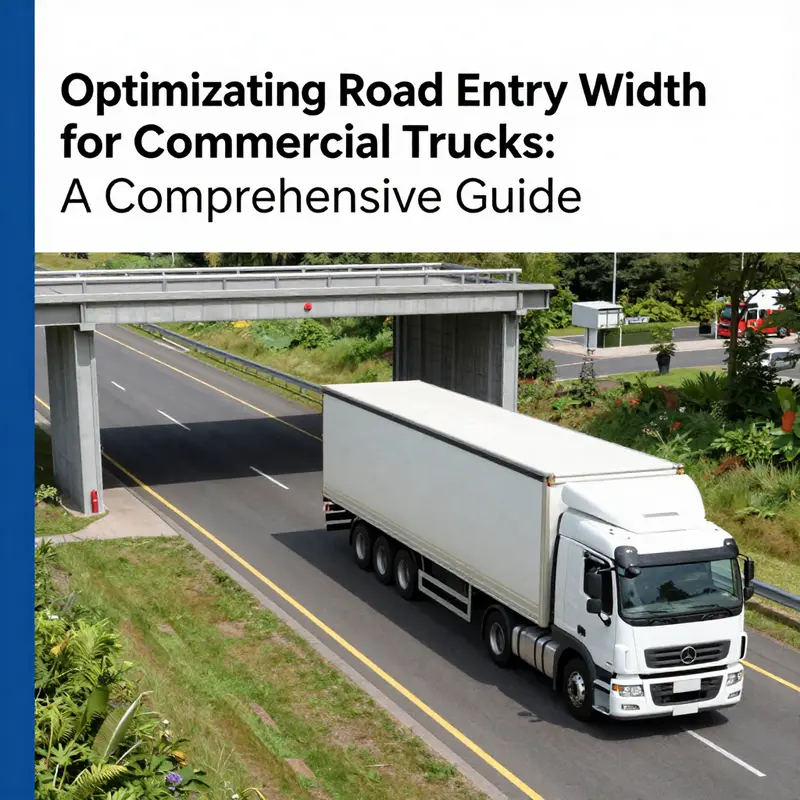
When planners, engineers, and facility managers think about inviting large vehicles into a site, the width of the entry is not a mere detail. It is a life-sized constraint that determines how smoothly trucks will approach, negotiate, and depart the gateway. The discussion of road entry width for commercial trucks sits at the intersection of safety, efficiency, and regulatory clarity. It is not enough to assume that a larger vehicle simply fits if a curb can be sidestepped with a bit of skill. In reality, the geometry of the entry sets up the entire maneuver, from the moment a truck aligns with the approach to the moment the trailer clears the mouth of the opening. The capacity to handle a full-width vehicle plus its cargo, without forcing reductions in speed or precision, is a practical measure that translates into fewer collisions with features such as curbs, guardrails, or adjacent roadway structures, and it reduces the likelihood of bottlenecks that can ripple through a distribution network.
Central to this consideration is how width is defined in the regulatory framework. In China, the national standard GB1589-2016 specifies the maximum permissible overall width for motor vehicles, trailers, and their combinations. This metric is inclusive; it captures the total width of the vehicle and any cargo, packaging, or containers that extend beyond the body. The standard reflects a cautious balance: it seeks to maximize the usable capacity of the road while safeguarding all users from unexpected encroachments into adjacent lanes. The maximum width of 2.55 meters is a hard ceiling for most configurations. Yet this ceiling is not absolute in every context. The regulation acknowledges that some configurations carry side-mounted equipment—such as auxiliary tanks, spare tires, or protective panels—that can legitimately expand the overall width, provided that these extensions meet specific criteria and do not undermine the vehicle’s safe interaction with public roadways. In addition, certain specialized vehicles—refrigerated units, vehicles with air suspension, or dedicated work vehicles—may be exempt or accommodated under a nuanced interpretation of the GB1589 framework, when the full set of dimensional and mass limitations is satisfied. These nuances matter for the practical task of site access planning because they create a spectrum of permissible configurations rather than a single, rigid line in the sand. For engineers, this spectrum translates into principled flexibility grounded in compliance, not improvisation.
From the regulatory center, the discussion quickly widens to the real-world geometry of the approach. The entry width cannot be viewed in isolation from the route it serves. A road entry is part of a corridor that includes the taper, the approach sightlines, the turning radius of the entry, the adjacent lanes, and the curb line itself. In mid- and high-volume contexts, the width must accommodate the trajectory that a vehicle follows when easing into a turn, aligning for a warehouse driveway, or staging in a loading bay. The practical guidance that emerges from GB1589 is that while the national standard fixes a ceiling, the usable entry width should incorporate a margin—a buffer that acknowledges human factors and vehicle dynamics. A conservative rule of thumb is to design road entries at least 2.7 meters wide to allow a 2.55-meter vehicle and cargo combination to fit with room to maneuver. This buffer is not a theoretical luxury; it translates into visible improvements in risk management. It creates space for mirrors, side extensions, and the subtle perpendicular corrections that a driver might need when negotiating a long vehicle with wide side profiles. The buffer also accommodates the occasional non-conforming load or a slight deviation in lane alignment that occurs when traffic is dense or visibility is restricted. In other words, the recommended minimum is not merely about meeting the regulation; it is about creating a practical, humane space for routine operations.
For operators who contend with heavy turnover or with a mix of vehicle classes in a single corridor, the case for larger entries grows stronger. Where traffic volumes are high, or where the trucks are consistently loaded near or at their maximum widths, a 3-meter entry or wider can offer meaningful operational gains. The benefits extend beyond mere clearance; they influence the quality of the turning arc, the predictability of vehicle behavior, and the ease with which a driver can complete the maneuver without needing a second attempt. A wider opening reduces the risk of scraping tires or hitting the curb during the misalignment phase and lowers the chance of abrupt, last-second corrections that can unsettle nearby pedestrians or other road users. In some contexts, this margin also translates into improved ramp and dock accessibility for long or wide trailers, reducing dwell times at entry points and smoothing the flow into warehouses or distribution hubs. The logic is straightforward: when the vehicle can enter with a comfortable arc and stable speed, the entire system operates more reliably.
Yet width is not the only factor in the design equation. The regulatory frame acknowledges that local infrastructure may impose tighter constraints than the national standard implies. Tunnels, bridges, and older urban corridors often feature clearance restrictions that require special permitting or alternative routing for wider vehicles. The entry width must be considered in concert with these local realities. A site that plans to welcome a diverse fleet must map its routes from the public right of way through the facility boundary and into the loading area. This map includes not only the entry width but also the shoulder conditions, the presence of curbs, the alignment of bollards, and the geometry of the adjacent road network. When a city or region has older streets with narrow cross-sections, the entry width decision carries added weight. In such settings, operators balance throughput at peak times with the imperative to avoid interference with unrelated road users. The result is often a combination of standard widths for bulk operations and specialized routes or permits for exceptional vehicle configurations. Local authorities, in turn, may apply additional restrictions or require off-peak movements for oversized loads, underscoring the importance of early coordination and route planning as integral components of compliant, efficient operations.
The design implications extend further into the realm of civil engineering practice. The entry width feeds into the geometry of the approach, the visible sightlines, and the control of turning radii for the mouth of the gateway. A well-proportioned entry must offer a clear, continuous line-of-sight from the driver’s perspective as the vehicle begins its approach. It should enable a clean, controlled entry path without abrupt lane changes or aggressive steering inputs. As part of this, the curb radii, shoulder width, and the presence or absence of medians are not decorative choices; they are functional factors that determine how confidently a driver can navigate the entry. In practical terms, the recommendation for a minimum of 2.7 meters becomes even more compelling when a site must accommodate a mix of long wheelbase trucks, refrigerated units, and trailer configurations that can present slightly different contours near the wheels. The buffer, in this sense, does not encourage lax standards; it fosters a robust, repeatable, and predictable operation that reduces unexpected contact with fixed objects and minimizes delay for subsequent vehicles.
If the discussion shifts to the consequences of undersized entries, the narrative grows sharper. An entry that is too narrow or lacks adequate buffer raises the probability of incidents that disrupt both safety and throughput. The drivers may encounter stern but necessary corrective actions as they attempt to squeeze through, and the attention required to negotiate a tight gateway can degrade attention for the entire approach. In a busy facility, such moments can cause queueing, jitter in the wake of larger vehicles, and ripple effects that complicate dock scheduling. The curb or edge protection must be designed not to tempt misjudgments—no protruding elements that invite contact, no abrupt vertical transitions that surprise a driver as a trailer wheels pass the threshold. Conversely, a generous entry width, paired with thoughtful geometry and clear signage, supports a calmer, more predictable flow. The driver can maintain a steady speed, execute a confident turn, and place the vehicle in position for a dock or gate without the anxiety that often accompanies a tight corridor.
Layered into this discussion is the practical reality that standards must be applied consistently across a network of sites. The national framework provides a clear baseline, but site-specific adaptation remains essential. For a factory entrance, a distribution center driveway, or a loading zone adjacent to a public thoroughfare, the operator must verify that the entry width aligns with the actual vehicle mix that will be permitted to use the route. This involves a disciplined process of route assessment, dimensional checks, and coordination with local authorities where necessary. The outcome should be a design that is not only compliant but also resilient to changes in fleet composition, shifts in demand, and the evolution of vehicle dimensions over time. In that sense, the width policy is a living component of a broader safety and efficiency program, one that must be revisited as traffic profiles and vehicle technologies evolve.
For those seeking a concise anchor to the regulatory landscape, the official standard remains the GB1589-2016 framework issued by China’s national authorities. It frames the maximum permitted width, outlines exceptions for side-mounted equipment and certain specialized vehicles, and points to the importance of local constraints in the broader network. The practical takeaway for road-entry design is straightforward: design for a minimum practical width of about 2.7 meters to accommodate the 2.55-meter maximum vehicle width with a safety margin, and consider 3 meters or more in high-volume or challenging sites where the traffic mix or geometric constraints justify extra space. This approach preserves safe clearance, enhances maneuverability, and contributes to smoother, more reliable operations for commercial trucking supply chains.
One way to connect this discussion to broader industry considerations is to explore how site design interacts with the expectations of a modern trucking ecosystem. Access points to warehouses and industrial zones are critical interfaces where corporate logistics, municipal planning, and driver safety converge. A well-considered entry width supports not only the immediate need of a single truck passing through a gateway but also the cumulative performance of a network of facilities that rely on predictable, reliable movements to maintain schedules. When the width is adequate, drivers can approach with confidence, dock ready, and depart without lingering in the approach or in the surrounding road system. When width is insufficient, the resulting congestion, near-misses, and increased maintenance costs become tangible costs of noncompliance and poor site design. The financial argument thus aligns with the safety argument: investing in appropriate entry width up front reduces risk and elevates throughput across the entire freight ecosystem.
For readers seeking practical context beyond the dimensional rules, industry discussions and case studies in the broader trucking literature often emphasize how regulatory compliance, site design, and operational discipline reinforce one another. A simple, well-communicated design standard helps drivers anticipate entry behavior, reduces the cognitive load in the moment of turning, and lowers the probability of human error. In environments where fleets vary in size and configuration, the ability to accommodate a broad range of vehicle widths within a consistent design philosophy becomes a strategic advantage. In such settings, the balance is achieved not by enforcing a single, rigid measure but by providing a robust margin where feasible and feasible flexibility where needed, all anchored in the safety-first posture that the GB1589 framework embodies.
To connect this chapter to the wider discourse and to offer readers a chance to explore related reflections, consider the following touchpoint from the industry landscape: mcgrathtrucks.com/blog/. This resource provides ongoing context about fleet dynamics, market trends, and the practical implications of regulatory environments for trucking operations. It helps anchor the technical discussion in real-world experience and evolving practice, reminding readers that standard-setting is part of an ongoing conversation about safety, efficiency, and reliability across the supply chain.
From a regulatory and design standpoint, the bottom line is clear: width matters, and in many contexts, wider is safer and more efficient. The GB1589-2016 standard gives a firm ceiling on the vehicle dimension, but the actual entry width that yields the best outcomes for a given site depends on a constellation of factors—traffic volume, vehicle mix, urban constraints, turning geometry, and the presence of adjacent infrastructure. The recommended practice of a minimum 2.7-meter entry, with 3 meters or more in challenging or high-volume sites, offers a practical rule of thumb that translates the regulatory framework into daily operations. The ultimate measure of success is a site where a truck can approach, enter, and dock with predictable performance, minimal risk, and a seamless flow that supports the efficiency that modern supply chains demand. The relevance of these standards extends beyond compliance: they shape the reliability and resilience of the entire logistics network.
External reference for official standards: GB1589-2016 (Ministry of Transport of the People’s Republic of China) https://www.mot.gov.cn/zhengce/zhengceku/201612/t20161213_194788.html
Internal link for broader industry context: mcgrathtrucks.com/blog/
External reference note: The official standard is cited for regulatory baseline; local practice may require additional permitting or route-specific adjustments in cases of tunnels, bridges, or historic urban corridors. For professionals designing or evaluating site access, this chapter provides a framework to justify entry width decisions, grounded in regulation, vehicle dynamics, and the practical realities of industrial traffic. The next discussion will further illuminate design considerations, including sightline optimization, curb radii, and loading-dock interfaces, to extend the thread from regulatory principles to actionable practice across diverse sites.
The Margin of Safety: How Wide Should Road Entries Be to Safely Accommodate Commercial Truck Traffic
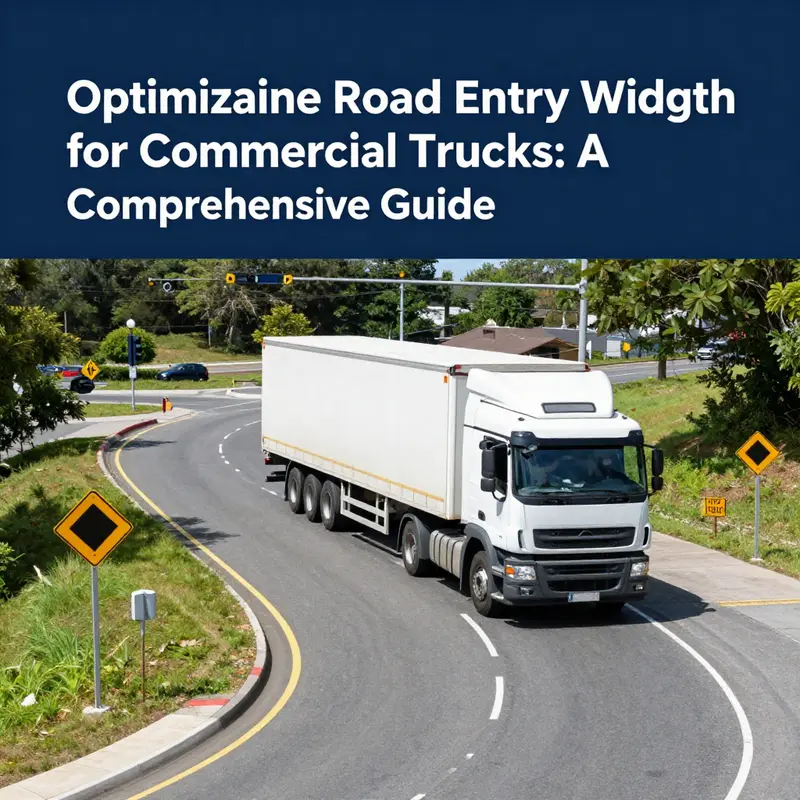
Designing road entries for commercial trucks is not a mere matter of aesthetics or traffic counts. It is a safety-critical decision that stages the first point of contact between huge, heavy vehicles and the built environment. The width of an entry point sets the tone for how smoothly trucks can align, how easily drivers can maneuver, and how reliably the surrounding traffic remains safe. In chapters focused on regulation and basic dimensions, a baseline often appears: accommodate the widest legitimate vehicle, provide some clearance, and anticipate maneuvering. Yet the practical question remains sharper and more nuanced: how wide should a road entry be to genuinely support commercial trucks in a way that reduces collisions, cuts wait times, and minimizes curb or structure damage across varied operating conditions? The answer depends on a blend of legal limits, vehicle geometry, driver visibility, and the realities of the sites where trucks converge with the road network. Across jurisdictions, the principle holds that entry width must reflect the maximum legal vehicle width plus a margin for error and for turning dynamics. In practice, this means that the minimum width should allow for the widest configured combination of vehicle and cargo to pass without contact, while also leaving a buffer for alignment errors, uneven pavement, or gusts of wind that can nudge a trailer or cab toward the curb. It is a design constraint that cascades into every other feature of an entry: the depth of the throat, the radius of the curbline, the approach sightlines, the presence of guide rails or barriers, and the lighting that helps a driver navigate in low visibility conditions. The governing data point in many planning exercises starts with the width of the vehicle itself. A typical heavy truck or tractor-trailer is wider than a passenger car by a substantial margin, often ranging from about 2.6 meters to just over 3 meters, depending on wheelbase, configuration, and whether the cargo adds additional lateral width. This reality underpins the widening of thresholds beyond the bare width of the vehicle. If the vehicle and its load can reach a total width near 2.55 meters in places governed by national standards, then planners are compelled to add a deliberate safety buffer to avoid contact with curbs, guardrails, or nearby structures. The widely cited operational rule is to design road entries at least 2.7 meters wide to accommodate the 2.55-meter limit plus a pragmatic margin for maneuvering. In high-volume or heavy-duty contexts where trucks routinely navigate at slower speeds but with closer precision demands, the target expands toward 3 meters or wider. This is not a fixed prescription but a design intention that recognizes the practicalities of real-world trucking: drivers misjudge alignment, trucks require multiple steering corrections, and tight urban corridors impose constraints on available space. The margin is deliberate. It acknowledges that speed is a factor and that the goal is to give drivers enough room to align courses, correct courses, and exit cleanly without brushing against the curb or encroaching on adjacent lanes. An entry that is too narrow amplifies risk in several ways. Even when a truck could pass if perfectly aligned, any deviation—an off-center approach, a slight bend in the road, or a momentary swerving of the trailer—can press a vehicle into the curb, a guardrail, or a pedestrian refuge. Over time, repeated minor contacts accumulate material damage, raise maintenance costs, and erode trust in the facility’s safety. On the other hand, an overly wide entry carries its own complications. It can necessitate wider median openings, more pronounced curb radii, or longer approaches that disrupt existing traffic flows or pedestrian sightlines. It can also complicate the geometry of adjacent infrastructure, such as turn lanes, crosswalks, and bicycle facilities, requiring more land, more pavement, and greater permeability between modes. The solution, therefore, is not simply to pick a single number and lock it in. It is to establish a robust design envelope that is responsive to the variety of trucks in service, the distinct patterns of entry and exit at a site, and the broader roadway context. The maximum legal vehicle width is only one axis of this envelope. A second axis is turning radius and entry geometry. A truck’s turning radius is rarely reflected by its width alone. Inside the cab, the driver’s view is comparatively limited, and the combination of trailer angle, hood length, and rear overhang can produce a noticeable gyrovity as the vehicle begins to enter. Because trucks do not pivot on a single point, the driver must arrange the vehicle so that the front tires intersect the line of travel at a precise angle, while the rear wheels track along a different arc. If the throat is too short, an operator will need to execute a series of back-and-forth maneuvers, increasing the risk of side-swipe errors with curbs or adjacent structures. A longer, deeper throat provides the opportunity for gradual alignment, reducing the number of adjustment cycles and the probability of contact. The third axis involves perception and visibility. Large trucks suffer from broader blind spots, particularly at the sides and rear. Adequate width must be paired with depth that accommodates the driver’s perspective as the vehicle slides into the entry. The driver needs a window of maneuvering space in which to see the edges of the lane and the presence of pedestrians, cyclists, or other vehicles near the intersection. Lighting and reflective guidance further amplify safety in low-light or foggy conditions. A well-lit entry with clearly marked edges helps drivers judge clearance more accurately and reduces the likelihood of late corrections that could lead to scrapes on the curb or damage to infrastructure. In addition to the physical properties of the entry, planners must contend with environmental variables. Wet pavement reduces tire grip, increasing stopping distances and the potential for lateral slip. On a windy day, a long, unobstructed throat can give a driver time to compensate for gusts that might push the trailer toward the curb. At night, glare from streetlights or vehicle headlights can distort a driver’s perception of the edge lines. Pedestrian and cyclist activity near the entry adds risk, especially when a truck is turning into or out of a facility. A broader width, coupled with buffer zones, helps isolate these modes and reduces the chance that even a momentary misjudgment by a car or bicycle operator will place a truck in a dangerous contact course. Buffer zones are more than just space; they are transitional design elements. They help separate opposing traffic streams, reduce the risk of side-swipe collisions, and provide an area where drivers can correct misalignment without entering the adjacent travel lane. Where sidewalks and cycle paths abut an entry, the buffers also serve as a protective buffer between vulnerable users and the heavy vehicle’s intended path. The design language must also honor regulatory frameworks. National and local standards reflect an aggregate of field data, engineering judgement, and safety research. In some contexts, the maximum legal width of a vehicle and its cargo is codified as a hard limit, with the design adding margins for clearance. In others, standards might set minimum clearance thresholds or recommended lane constructions that implicitly determine entry widths. The practical outcome for planners is to adopt a baseline that is defensible against inspection and audits while also offering a generous margin for unexpected situations. In China, for instance, the maximum vehicle width is defined by GB1589, and practitioners routinely interpret this width in combination with a buffer to guide the minimum entry width. The recommended minimum often lands around 2.7 meters, with 3 meters serving as a prudent target for high-volume corridors and gateways into warehouses or distribution centers. While this framework provides a solid starting point, the real-world application demands site-specific analysis. Every site has unique geometry, traffic patterns, and urban constraints. A procurement plan for a new distribution hub might begin with a 3.0-meter entry to accommodate a wide mix of tractor-trailers, with a paired throat depth of at least 12 to 15 meters to allow multiple alignment attempts at entry and exit. A smaller facility that primarily handles standard linehaul units may justify a narrower threshold, provided the approach speeds are controlled and there is a plan for enforcement of safe turning behavior through signage and lane markings. In practice, the decision process often requires data gathering and scenario testing. Engineers model the typical truck widths, the expected fleet mix, and the most common cargo configurations. They then simulate entry angles, turning paths, and the distance from curb to curb along the approach. The goal is to confirm that a truck can complete the maneuver with comfortable clearance on all sides, even when conditions degrade. This is not merely a theoretical exercise. It translates into tangible outcomes: fewer scrapes, lower maintenance costs for pavements and guardrails, and reduced risk of lane encroachment into pedestrian domains. The broader operations of a fleet can influence width decisions as well. If a facility anticipates a large, diverse fleet—some with longer wheelbases, others with wide trailers—the requested width might trend toward the higher end of the spectrum. Conversely, if the site serves a narrow menu of standard configurations, the width could be slightly less, provided the approach and queue management are designed to prevent congestion and risky maneuvers. For those responsible for planning and procurement, it is worth leveraging knowledge about how fleets choose equipment. The way a fleet assembles its trucks and trailers can determine the required entry width for safety and efficiency. For instance, choosing between different chassis, cab lengths, or trailer models can alter the overall width by a few tens of centimeters. A smaller but more agile fleet may not require the same spacious threshold as a mixed fleet with several broad configurations. In contexts where fleet composition evolves, it is wise to design with flexibility in mind. A modular approach to entry width—one that preserves room for widening or adding peripheral turning space as the fleet evolves—can extend the useful life of the infrastructure. The conversation about entry width does not occur in isolation. In fact, it intersects with broader questions about how a facility sources and manages trucks. When fleets consider how to acquire or replace vehicles, the resulting mix will affect site needs. For readers exploring these questions, a practical angle is to examine how various sourcing approaches influence fleet geometry. A useful resource on this topic discusses the trade-offs between dealer purchases and auctions when selecting trucks, highlighting how choice of procurement method can steer the configuration mix. Choosing Your Truck: Dealer Sales vs. Auctions offers a grounded perspective on how fleet decisions cascade into design requirements, including access points and entry widths that must accommodate a changing lineup of vehicles. Beyond the vehicle dimensions and licensing standards, an effective entry design must be forward-looking and resilient. It should anticipate not only current operating conditions but also future shifts in freight patterns, urban design, and technology. As trucks become smarter, with telematics guiding safer driving practices, the precision of entry maneuvers continues to improve, but the margins for error remain real. A well-conceived width supports safer driving by reducing the need for last-second corrections that can lead to collisions with curbs or other structures. It also improves the efficiency of freight operations by reducing dwell time at gateways, which in turn lowers fuel consumption and emissions due to idling. The topic of safety at entry points is, in essence, about balancing risk and reward. The 2.7-meter baseline offers a robust starting point for many sites, while the 3-meter target provides a level of comfort for operations with heavy-duty or high-volume trucks. Yet the specific choice should reflect a careful audit of a site’s geometry, traffic mix, environmental factors, and regulatory context. The work of safety professionals is to translate these variables into a reliable, verifiable standard for the entry that stands up under inspection and everyday use. For readers seeking additional safety guidance that complements these considerations, there are external resources that synthesize practical best practices for oversized trucks and their operations. For example, the Bryant Law Center provides detailed safety tips for oversized trucks that organizations can consult to augment their internal design processes and training programs. This external reference reinforces the importance of comprehensive safety planning that goes beyond geometry alone and includes behavior, awareness, and incident prevention in near-entry scenarios. In sum, the width of a road entry for commercial trucks should be viewed as a critical structural parameter with far-reaching consequences for safety, efficiency, and lifecycle costs. The recommended minimum, around 2.7 meters, serves as a prudent baseline that accommodates the full width of most trucks plus a margin for maneuvering. For higher volumes and heavier configurations, a 3-meter width or greater becomes a practical goal. The choice is not arbitrary but grounded in an assessment of vehicle geometry, turning dynamics, driver perception, environmental conditions, and regulatory expectations. It is a decision that benefits from data-driven modeling, site-specific constraints, and a thoughtful understanding of fleet composition. By weaving together these considerations, engineers and planners can deliver entry designs that protect vulnerable users, empower drivers, and sustain efficient freight movement across the road network. For practitioners who want to connect this design logic with broader fleet strategy, exploring how procurement choices shape vehicle dimensions can be illuminating. The linked article on dealer sales versus auctions provides a concrete example of how a fleet’s equipment mix can influence infrastructure needs, including entry width requirements. As always, the objective remains clear: provide enough space to prevent collisions, support steady movements, and accommodate a diverse and evolving trucking landscape. External safety resources reinforce the need to couple engineering design with practical safety training and operational discipline, ensuring that the entry works as intended under all weather and traffic conditions.
Chapter 3: Wide Entry, Lean Costs—How Road Entry Width Shapes Trucking Economics and Freight Decarbonization
Width is the quiet workhorse of road freight economics. It does not glitter like a new engine or a sharper tire, yet it reshapes every mile a truck travels. In the context of commercial trucking, the entry width to a road, ramp, or loading zone is not merely a clearance value; it is a performance parameter that constrains or liberates fleet operations. In China, as of 2026, the maximum vehicle and cargo width allowed by the national standard GB1589 is 2.55 meters. Industry practice would compensate for that limit with a small safety buffer, recommending at least 2.7 meters for road entries and often favoring 3 meters or more where traffic volumes and vehicle sizes are routinely high. These figures are not arbitrary. They reflect an explicit balance between legal compliance, space availability, and the practical needs of maneuvering heavy vehicles with trailers, articulated configurations, and sometimes hazardous cargo. A wider entry reduces the friction that makes routine logistics costly, and it does so with a straightforward, measurable effect on throughput and reliability. The broader consequence is economic: entry width translates into faster turnarounds, lower risk of damage to curbs and structural components, and more predictable service levels for shippers relying on consistent, on-time delivery. The decision to widen an entry, then, is not a luxury; it is a strategic investment that touches cost, safety, and competitiveness at the fleet level. For operators contemplating where to allocate capital, the width of the entrance becomes a leading indicator of potential gains in asset utilization and service quality, a metric that often coherently aligns with broader modernization agendas that include decarbonization and the integration of new powertrains. The logic is simple but powerful: when trucks can enter and exit a facility with fewer stops, fewer corrective maneuvers, and less exposure to near-mide attendant risks, the fleet spends less time idling in bottlenecks, and the engine operates more consistently within its efficient bands. This stability manifests as tangible reductions in fuel consumption, tire wear, and brake usage. The cumulative effect is not theoretical; it appears in the availability of trucks for back-to-back shifts, higher daily throughputs, and the ability to meet tight appointment windows that today’s just-in-time supply chains demand. Within such a framework, the width decision interacts with a broader set of geometric and operational considerations—sightlines, turning radii, ramp grades, and the alignment of entry with on-site circulation patterns. The interplay among these elements determines whether a given site becomes a smooth node in the network or a persistent bottleneck that bleeds money through delay costs, increased driver hours, and elevated safety risk. As a baseline, even when other factors are favorable, a narrow entry creates a high-friction environment where drivers must negotiate angular turns, test curbs for space, or stage multiple corrections to align the vehicle with the exit lane. Each correction consumes time, consumes fuel, and multiplies the cognitive load on the driver. For fleets that run high-cycle operations—those with frequent arrivals, departures, and cross-dock transfers—the impact compounds. A few seconds of delay per visit quickly escalates into minutes per day, then hours per week, and finally a measurable drag on annual operating margins. In that sense, the width of the entry acts as a pressure valve for the broader logistics system. When the valve is too tight, the entire process becomes more brittle: queues lengthen, service levels erode, and capacity is effectively constrained regardless of how many lanes exist on nearby roads. Conversely, widening the entry is a forward-looking choice that acknowledges the evolving structure of the freight fleet. Modern trucks increasingly feature longer wheelbases, larger cabs, and more sophisticated safety systems that require more lateral space to operate safely within the constraints of urban and industrial landscapes. The choice to accommodate these needs is not merely about accommodating today’s vehicle fleet but about maintaining flexibility for the future fleet mix, which may include heavier, longer, or alternatively powered vehicles. The infrastructural logic is aligned with the economics of fleet utilization: higher entry widths enable smoother centerline alignment, reduce the likelihood of curb strikes, and minimize the need for on-site pinching moves that force a vehicle to travel in misaligned trajectories. In practice, this means fewer deviations from the planned route, which in turn reduces the cumulative risk of minor collisions, road damage, and insurance costs. In the planning stages, engineers and operators should treat entry width as a key performance indicator rather than a decorative feature. A site with a 2.7-meter minimum can accommodate the legal maximum, with enough buffer to capture human and operational variability, while a 3-meter or wider entry provides a margin that is particularly valuable in high-volume corridors, inland distribution parks, and facilities that manage a mix of trailer configurations. The value realization is further enhanced when such width is paired with thoughtful geometric design: clear sightlines, consistent curb radii, and approach angles that minimize abrupt steering corrections. The result is a driving experience that is both more intuitive and safer, reducing the cognitive load on drivers and the chance of decisions that lead to mistakes, misalignment, or collisions. For managers, these drivers of performance are not abstract. They translate into measurable metrics such as reduced dwell time at entry points, shorter queue lengths during peak inbound and outbound windows, and improved on-time delivery performance. In turn, these improvements bolster the reliability metrics that shippers prize when selecting carriers and when evaluating the total cost of ownership for fleets. The economic calculus of entry width is thus not a single-number problem but a system-level optimization. It requires matching regulatory constraints with site-specific traffic rhythms, the composition of the local truck fleet, and the spatial realities of industrial development. The optimal width will depend on factors such as the frequency of large trailer configurations, the need to accommodate oversize or overweight loads, and the potential for future growth in demand. It should also consider the ramp geometry that links the entry to the broader road network, ensuring that the turning radius does not force the vehicle into risky deviations, which would undermine the hoped-for efficiency gains. A well-designed entry, in other words, acts as a catalyst for smoother operations, reduced energy consumption, and fewer incidents, delivering a return on investment that accrues year after year as traffic volumes rise and the fleet evolves. In the context of decarbonization, the argument for adequate width becomes even more compelling. Efficient driving patterns—characterized by fewer stop-start cycles, steadier speeds, and lower idle times—are central to improving fuel economy and reducing tailpipe emissions. The relationship between road geometry and energy use is not hypothetical; it is reinforced by empirical evidence showing how lane operations, bottleneck management, and entry geometry influence the energy profile of freight movements. When trucks can pass through a facility with minimal dithering and natural lift-off of throttle rather than abrupt deceleration and acceleration, the result is a smoother energy trajectory and a lower CO2 footprint per ton-kilometer. The decarbonization agenda thus reinforces the case for wider entries, not as a green add-on but as a practical enabler of cleaner, cheaper, and more reliable freight transport. It is also worth noting the path forward for fleets and infrastructure planners who see electric or hydrogen-powered trucks as part of the solution. These technologies still contend with fundamental energy and weight constraints, including battery mass, charging needs, and grid capacity. A road network that includes generous entry widths, consistently designed approach sightlines, and predictable geometric relationships reduces the energy penalties associated with frequent stops and starts and helps to extend the practical range of heavy-duty electric or hydrogen trucks. The design implications extend to the pedestrian and cycling environment in multi-use urban settings, where careful separation of flows, appropriate curb protection, and clear wayfinding are essential to maintain safety without compromising the efficiency gains achieved by wider entries. In a broader sense, the width of road entries integrates with policy and planning processes that aim to harmonize freight efficiency with urban livability. Regulatory standards such as GB1589 set the outer bounds, but the decision to implement wider entrances remains a local one, shaped by land availability, zoning, funding, and the willingness of industrial developers and municipalities to view infrastructure as a shared asset that yields ongoing operational benefits. When communities invest in wider entries in entry corridors or industrial gateways, they are acknowledging the economic principle that the friction cost of bottlenecks is a drag on productivity, while the benefits of smoother passage accrue across the entire supply chain. The more consistent and expansive these designs, the more resilient the freight system becomes in the face of demand volatility, fleet modernization, and the transition to low-emission powertrains. As operators and planners look ahead, the practical takeaway is clear: width matters, and its impact on economics is real. It influences fuel efficiency, maintenance costs, safety liabilities, and the reliability that customers rely on for complex supply chains. It also serves as a quiet facilitator of future capability—an entry that can accommodate evolving vehicle configurations, new propulsion technologies, and changing regulatory expectations without requiring repeated rebuilds or disruptive upgrades. Operators who view road-entry width as a strategic asset will likely see a cascade of benefits, from lower total cost of ownership to higher service levels and stronger utilization of fleet capacity. The challenge lies in translating these insights into actionable project scopes, budgets, and risk assessments that align with broader infrastructure programs and land-use plans. In some cases, this means negotiating with landowners and local authorities to secure the necessary right-of-way, coordinating with adjacent developments to prevent curb encroachment, and engineering around existing urban constraints without compromising safety or performance. In others, it means adopting modular design principles that allow future widening or retrofit, ensuring that the initial construction can scale as demand grows, traffic patterns shift, or regulations evolve. The fundamental logic remains intact: where trucks enter matters as much as how they leave. A wider entry base tends to yield a more stable, predictable, and efficient logistically connected system, reducing the indirect costs that accumulate from delays, misalignments, and the energy penalties of stop-start driving. This is not a theoretical conversation; it translates into measurable outcomes that fleet operators can monitor and improve over time. For those seeking practical benchmarks and further reading, the evidence points to a growing body of studies and industry analyses that link infrastructure design with freight efficiency and emission outcomes. As regulations continue to adapt to new vehicle technologies and as fleets pursue lower total cost of ownership, the financial logic of providing ample headroom at entry points becomes increasingly compelling. The question is not whether to widen but how wide to widen given site constraints, peak demand, and the anticipated evolution of truck configurations. In the end, the analysis circles back to fundamentals: space supports speed, safety preserves capital, and steady throughput reduces the appetite for costly contingencies. For operators eager to stay ahead, the path is clear—invest in entry width where feasible, interface that width with precise traffic-management strategies, and align the design with an overarching plan to modernize the freight corridor. The payoff shows up as lower operating costs, higher service levels, and a fleet better prepared for the next generation of freight vehicles and fuels. And as the sector continues to optimize around decarbonization goals, the case for wider road entries becomes not only economically sound but also strategically essential. For further exploration of technical and economic evaluation in road freight transport, see the referenced ScienceDirect article: https://www.sciencedirect.com/science/article/pii/S096585642300175X. Moreover, practitioners may find it useful to review industry perspectives on fleet composition and market dynamics, such as the evolving trends in used truck sales growth, which can influence decisions about entry width and site readiness Current trends in used truck sales growth.
Expanding the Gate: Designing Freight Vehicle Entrances that Safely and Efficiently Welcome Bigger Trains of Goods
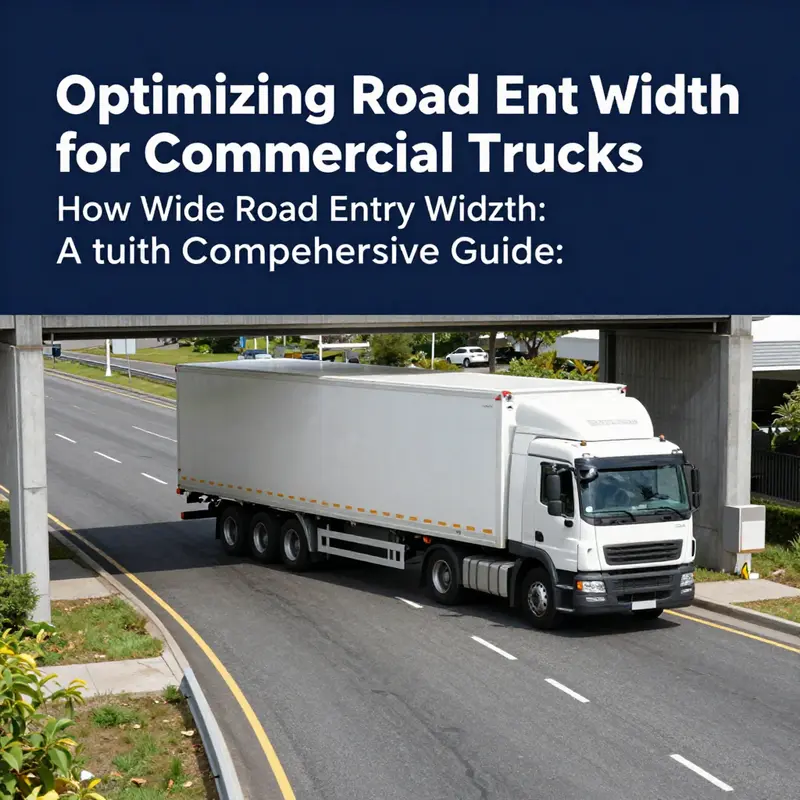
Every freight operation begins with the first couple of meters of access. The road entry to a warehouse, distribution center, or industrial park is more than a doorway; it is a critical interface between public infrastructure and private logistics. When that interface is too narrow or misaligned with the fleet that uses it, the consequences ripple through loading schedules, driver safety, and the carbon footprint of a supply chain. The core question—how wide should a road entry be for trucks—needs to be answered with a careful blend of regulatory baseline, fleet reality, site constraints, and future-proofing. In markets that follow global standards while tolerating local specifics, the width of an entry must reflect the widest vehicles the site anticipates while preserving turning clearance, sightlines, and maneuvering room for occasional backup and hitching activities. From a design perspective, this means starting with the legal maximums and then layering in buffers, geometry, and visibility improvements that keep traffic flowing smoothly and safely.
The regulatory baseline is clear: the maximum overall width of a truck plus its cargo, under the national standard GB1589 in force in China as of 2026, is 2.55 meters. This single figure anchors the scale for most standard road corridors where commercial trucks operate. Yet the width of the entry should be larger than the vehicle itself to allow for safe passage. A practical rule used by planners is to add a small maneuvering buffer, resulting in an entry width of at least 2.7 meters for routine access. The logic is straightforward: a buffer minimizes the chance that a driver must engage in awkward, high-risk corrections near curbs, signage, or gate mechanisms. It is the same rationale that underpins broader safety margins in traffic engineering—give drivers room to adjust their trajectory without encroaching on adjacent lanes or striking fixed objects.
That baseline expands quickly as the frequency and size of the vehicles rise. In high-volume facilities or those that routinely handle heavy-duty fleets, a wider entry becomes a practical necessity, not a luxury. A target width of 3.0 meters is commonly recommended to accommodate the widest vehicles at modest speeds and to lessen the likelihood that mirrors or protruding cargo will contact the curb line or gate posts during turning. When trucks of particularly large profiles or specialized configurations converge on the entry—think of fuel tankers, tanker combinations, or long composite trailers—the necessity for even more generous widths becomes evident. The literature and design guidance converge on 4.0 meters as a robust minimum for heavy-duty or specialized operations, with room left for emergency maneuvers, back-up clearances, and wider turning radii. These guidelines are not arbitrary; they reflect observed dynamics on entry roads, where turning paths, sightlines, and the lived rhythm of loading bays determine both safety margins and operational reliability.
To make these numbers tangible across a mixed fleet, it helps to categorize by vehicle type and relate width to the typical footprint each class presents. Light-duty urban delivery vehicles and small vans, with widths commonly ranging from about 2.0 to 2.4 meters, frequently pass through underserved urban entries. For these vehicles, a 3.0-meter entry often makes sense as a practical minimum, especially in tighter sites where docking bays are offset from the main travel corridor or where the approach is constrained by adjacent structures. The modest width of these vehicles belies the impact of mirrors, step-up bumpers, and cargo extension devices that protrude with significant effect in narrow passages. The goal is not to fit more vehicles through a single opening at maximum speed, but to ensure every vehicle has a predictable, clear path that minimizes the risk of incidental contact with edging, bollards, or facing traffic, while allowing drivers to align with loading zones without oversteering.
Medium-duty trucks—such as those used by moving companies, appliance deliveries, and retail logistics—occupy a middle ground. Their footprints typically fall between 2.4 and 2.6 meters in width, but the critical factor is their turning geometry and side-mirror clearance. A minimum entry width of 3.5 meters is often recommended to accommodate generous mirror sweeps and the occasional need to straighten the vehicle after an off-center approach. In such cases, the entry becomes a corridor rather than a lane, and the additional width yields tangible benefits: smoother alignment with loading docks, lower risk of phone-dock or curb-based incidents, and less aggressive maneuvering that can disturb nearby pedestrian or service traffic. By providing this extra space, facilities also reduce the likelihood of damage that might trigger days-long downtime for repairs or gate recalibration.
Heavy-duty and specialized trucks, including those with wide tanks or long combination configurations, push the envelope of the design challenge. With typical footprints in the 2.6 to 2.8-meter range, these vehicles demand generous horizontal space to avoid gutter and curb contact, to permit safe swerving corrections when misalignment occurs, and to provide sufficient room for the chassis to clear fixed elements during a tight turn. The recommended minimum entry width of 4.0 meters for these categories is a recognition of the operational reality that some vehicles require symmetrical clearance around the entire vehicle profile at the point of entry and during initial docking. In some high-risk configurations, it is not unusual for additional geometric considerations to be evaluated—such as the inclusion of an adjacent deceleration lane or a staggered entry that allows off-aisle parking or staging during peak loading periods. The aim remains the same: reduce friction in the approach, elevate driver confidence, and preserve the integrity of on-site structures and loading equipment.
The turning radius is a silent but decisive factor in these decisions. A six-ton truck, a common workhorse for many facilities, typically requires a minimum turning radius on the order of 12 to 15 meters, depending on model and wheelbase. This radius figure informs how far the entry line can bend toward the curb or edge of the property, and it often dictates the curvature of the access approach. A too-narrow entry forces the vehicle to approach at a sharper angle, risking scrapes along the fender or mirror, while an overly generous width can reduce the throughput efficiency by widening ramp leads and complicating pedestrian and vehicle reconciliation at the gate. Thus, a balanced outcome is sought: a width that allows the truck to align with the gate and dock with minimal steering input, while preserving a clear, consistent drive path that reduces the cognitive load on the driver and the likelihood of staged delays.
Beyond the core geometry, a suite of surrounding design practices supports safer and more reliable access. Visibility and lighting are essential, especially for early-morning or late-evening operations when glare and shadows can mask the truck’s approach or the gate mechanism. Clear signage, reflective markers, and well-lit pad edges help define the entry envelope. Pavement quality matters, too. A non-slip, durable surface reduces the risk of tire slip during braking or acceleration and preserves long-term geometric integrity by resisting rutting and edge deterioration that can accelerate a misalignment scenario. The surface should also minimize windrow effects and puddling, which can undermine a truck’s approach path.
Buffer zones and staging areas play a practical role that often goes underappreciated in the design phase. A short queue or a designated parking pocket near the entry prevents trucks from blocking through lanes while waiting to dock. These buffers enable drivers to maneuver at slower speeds and to calibrate hitching alignment under controlled conditions, rather than in the middle of a shared roadway. In sites with multiple entry lines, staggered widths can be considered as well, with a narrower inbound lane guiding traffic to a wider, high-capacity aperture that handles the bulk of the trucks while preserving space for turning radii and sightlines.
The principle of compliance remains central, but so does adaptability. The European context, for example, has its own standardized expectations for access roads. A leading reference is the European Committee for Standardization’s guidance, including the TR 17140 document on design of access roads for freight vehicles. While the document is not a direct mandate for every jurisdiction, it embodies best practices that emphasize harmonized dimensions, predictable geometry, and safety-focused layouts that can be adapted to regional regulations. The practical takeaway is that planners should resist a one-size-fits-all approach and instead design with the spectrum of intended vehicles in mind, while keeping a clear line to the regulatory baseline and the site’s operational realities. For readers seeking a consolidated view of these standards and how they translate into day-to-day decisions, a concise overview can be found in the broader industry literature and standards discussions, which often point back to the same core requirement: when you widen the entry, you widen the door to safer, more efficient, and more reliable freight operations. To explore further, the following resource provides additional context on standardized access dimensions and infrastructure planning in Europe: https://www.cen.eu.
The design choices at the gateway influence the entire logistics chain. A 3.0-meter minimum entry for light-duty urban deliveries reduces the risk of close-quarters contact with adjacent infrastructure, yet remains lean enough to avoid unnecessary capital expenditure on oversized gates or curbs in small sites. A 3.5-meter width for medium-duty activities strikes a balance between cautious oversizing and practical adequacy, supporting smoother mirror clearance and less aggressive turning. For heavy-duty fleets, a 4.0-meter threshold is a prudent investment in future-proofing—accepting that today’s 3.5-meter entry may become a bottleneck as vehicle designs evolve, or as payloads grow and fleet mixes become more diverse. In all cases, the width decision should be accompanied by a clear understanding of the site’s peak loading moments, the composition of the arriving fleet, and the spatial realities of dock layouts, gate hardware, and surrounding road network.
From an operational planning perspective, it is helpful to anchor the entry width decision within a broader design framework that considers site context, driver behavior, and integration with loading zones. Sight distance is one often overlooked contributor to safety. Drivers must be able to perceive the entry and the dock area with enough time to align properly. If the entry is approached at an angle due to geometry or sight obstructions, even a generous width can be underutilized. Therefore, sightlines from the main approach to the gate and to the dock area should be assessed in the early planning stages. Lighting and signage should be calibrated to complement these sightlines, guiding the driver’s eye toward the correct docking alignment and away from distractions. In practice, this means prioritizing long, unobstructed approach corridors, minimizing visual clutter near the entry, and ensuring that any landscaping or architectural features do not impede the driver’s view of the gate or yard actions.
Ultimately, the question of how wide an entry should be returns to a simple truth: the width is a design choice with safety, efficiency, and cost implications. It is not merely a matter of accommodating the current fleet. It is about creating a resilient access point that tolerates fleet evolution, market shifts, and regulatory updates without frequent, disruptive rework. The recommended targets—2.7 meters as a baseline, 3.0 meters for light-duty contexts, 3.5 meters for medium-duty operations, and 4.0 meters for heavy-duty or specialized fleets—establish a practical framework that aligns with the realities of modern freight logistics while leaving room for adaptive improvements over time. Reading this as a continuum rather than a single fixed figure helps planners and operators make more informed decisions that reflect both present needs and future potential.
For those interested in additional perspectives on industry practice and design thinking, the broader logistics literature and practitioner blogs offer useful, real-world reflections on entry design and curbside relationships to loading zones. A good starting point is the ongoing discussion in logistics-focused blogs that explore the intersection of fleet mix, site constraints, and safety culture. You can learn more by visiting the McGrath Trucks blog, which compiles a range of topics that touch on fleet operations, site planning, and the human factors involved in truck access. https://mcgrathtrucks.com/blog/ (anchor text: McGrath Trucks blog).
As we close this angle on entry width, it is worth reiterating a core design discipline: consistency. The most effective entry layouts present drivers with a predictable geometry, uniform lighting, and clear, unambiguous cues about where to turn, where to dock, and where to stop. When drivers encounter a familiar pattern at multiple sites, their cognitive load diminishes, and mistakes decline. That consistency must be balanced with site-specific realities. Urban infill sites may justify narrower approaches, while logistics parks and bulk-handling facilities may justify broader gateways, offset approaches, or dual-entry configurations to maximize throughput. In all cases, the goal remains the same: a gateway that respects the safety of road users, the efficiency of the operation, and the long-term viability of the facility’s logistics strategy.
The synthesis of regulatory baseline, fleet realities, and site-specific geometry yields a practical path forward. Design teams should begin with GB1589-derived limits and then iteratively refine the entry width by evaluating the mix of fleet types, projecting future changes in vehicle dimensions, and testing how the entrance interacts with the yard layout. The end result is not a single number but a responsive design that harmonizes with the surrounding road network, sensor and gate control systems, and loading dock configurations. In this light, road entry width becomes a proactive design choice that supports safer driving behavior, reduces the likelihood of incidents at the interface, and sustains smoother operations across peak and off-peak periods alike.
External resource for deeper standardization context: https://www.cen.eu
Final thoughts
Understanding the appropriate road entry width for commercial trucks is essential for fostering a safe and efficient trucking environment. Compliance with regulatory standards, coupled with a keen awareness of safety considerations, adds layers of reliability to logistics operations. Furthermore, recognizing the economic impacts of road design on trucking efficiency can lead to significant cost savings and operational improvements. By incorporating best practices into road entry designs, trucking companies can ensure that their fleets remain competitive, compliant, and capable of meeting the demands of today’s cargo transport needs.