In today’s competitive transport and logistics sectors, understanding the nuances of commercial truck rentals is crucial for trucking company owners, fleet managers, and procurement teams. A key concern among industry professionals remains the question of maintenance inclusion within rental contracts. This article offers an in-depth exploration of commercial truck rentals, examining maintenance exclusions and optional packages while evaluating the responsibilities that come with rental agreements. Each chapter builds a comprehensive understanding of how to approach maintenance when renting trucks, ensuring that your company’s operational efficiency is upheld without unexpected costs.
Maintenance Exclusions in Commercial Truck Rentals: Reading the Fine Print

When fleets evaluate commercial truck rental options, maintenance terms are a critical, often overlooked, factor in the total cost of ownership and uptime. The baseline rental rate frequently excludes routine maintenance and most repairs, placing the ongoing upkeep burden on the renter. This separation is by design: it keeps the base price transparent and allows operators to choose whether to assume preventive maintenance risks or to purchase a maintenance protection plan that promises more predictability. In practice, maintenance is less about the vehicle’s capability and more about how a fleet plans for wear, downtime, and unexpected events over a rental term. A truck can arrive roadworthy, but every mile thereafter carries the potential for maintenance activities that affect availability and cash flow. The contract, the maintenance add-ons, and the provider’s service network work together to determine what is included, what is excluded, and how much of the burden can be shifted through a plan.
For many renters, the default is simple: the vehicle arrives ready to operate and the renter handles ongoing maintenance to keep it in safe, serviceable condition. Routine tasks such as oil changes, tire rotations, brake inspections, and engine servicing are commonly framed as normal wear items the renter should address. If a breakdown occurs, repair costs generally fall to the renter unless a maintenance protection plan is active. The logic is practical: the rental company minimizes its risk by ensuring the vehicle is roadworthy at handoff, while ongoing protection against wear and tear is delegated to the user or absorbed by an optional plan. This structure reinforces a core lesson for fleet managers: predictable costs and reliable uptime are more likely when maintenance is explicitly addressed, not assumed by default.
That said, many providers recognize the value of offering maintenance protection to blunt the financial impact of repairs and to stabilize budgeting. Maintenance plans or extended service contracts may cover a subset of repairs, preventive maintenance, and sometimes parts and labor. Coverage varies by provider, vehicle type, mileage thresholds, and geography. What plans typically promise is a framework that makes costs more predictable and downtime more controllable for the renter. Yet even these add-ons are not blanket guarantees against every possible failure. Most plans exclude pre-existing defects, routine wear items, and some high-cost components unless explicitly included. In practice, a renter might pay a fixed monthly fee or a per-mile surcharge to access preventive maintenance services and selected repairs, subject to defined caps and deductibles. In return, a fleet can expect fewer surprise bills and simpler budgeting, which is especially valuable for multi-site operations or businesses that need precise cash-flow planning.
To understand what that means day to day, it helps to separate the maintenance equation into two sides: what the renter must handle and what the protection plan promises. Routine maintenance tasks—oil changes, tire rotations, brake inspections, engine servicing—are typically outside the base rental fee. These tasks are time-consuming, require scheduling, and depend on the truck’s age and configuration. The renter is expected to manage them, either by using a familiar nearby shop or by benefiting from an approved service network if a plan is in place. The practical rationale is straightforward: separating maintenance from the base rate preserves the market-appropriate price for the vehicle while keeping maintenance costs visible and controllable for the renter.
But the landscape brightens for operators seeking predictability. When a maintenance protection plan is added, a portion of the maintenance burden shifts from volatile out-of-pocket costs to a defined, pre-agreed package. Plans may emphasize preventive maintenance—scheduled oil changes, filter replacements, and routine inspections—and organize service through a network of centers. Others concentrate on specific repair categories—electrical systems, cooling systems, drivetrain components—while excluding wear items like tires or brake pads. The exact terms—what is covered, what is excluded, duration of coverage, and any caps or deductibles—can substantially influence the plan’s value. A well-structured plan can reduce downtime and simplify budgeting, which is compelling for operations that run high-mileage fleets or operate on tight maintenance windows.
Everything hinges on reading the rental agreement with care. The contract is the authoritative source for what is included and what sits outside the base rental. Renter obligations are typically outlined in the maintenance or vehicle condition sections, often alongside operator responsibilities. Explicit statements may require the renter to keep the vehicle in a safe, roadworthy state and to perform or arrange maintenance at required intervals. Providers may request documentation of completed service to verify compliance with manufacturer recommendations and internal standards. Without a maintenance add-on, the renter should be prepared to cover routine service costs and any repairs arising from normal wear or operator misuse. The phrase operator misuse is intentionally broad and can cover a wide spectrum from ignoring warning lights to using the vehicle beyond normal duty cycles.
Choosing a maintenance protection plan often comes down to a cost-benefit calculation. Fleet operators compare the predictable monthly or per-mile fee of a plan against the potential volatility of maintenance expenses, downtime risk, and the administrative burden of coordinating timely service. If a plan covers the most disruptive or costly failure modes for a given fleet, its value can be substantial. On the other hand, plans with narrow coverage, narrow caps, or high deductibles may offer limited financial upside. There is also the human factor: who coordinates maintenance, who pays for it, and how quickly a vehicle returns to service after a service event. For some organizations, a robust plan is as valuable as the truck itself because it reduces management overhead and supports uptime and reliability goals.
In practice, maintenance decisions should be treated as a broader risk-management strategy. This means evaluating not only the direct costs but also indirect costs from downtime, delays, and rescheduled work. A vehicle sitting in a shop can ripple into missed deliveries and penalties. A well-designed maintenance plan that minimizes downtime or speeds up the return-to-service process can justify itself even when the upfront cost looks higher. Operational scale matters too: small fleets with irregular usage may find simple pay-as-you-go maintenance more economical, whereas large, consistently utilized fleets may benefit more from budgeting certainty and stronger leverage in negotiations with service providers.
Beyond cost considerations, implementation details matter. Operators should align on service network coverage, warranty alignment, and rules that apply if a covered repair is needed in another region. Network accessibility can be a decisive factor: plans tied to a sparse or distant network might cause more downtime than they save financially. Administrative simplicity is another factor: some plans offer streamlined invoicing, consolidated claim submission, and faster turnarounds; others require more paperwork and longer approval processes. Clarity on who pays whom, who approves repairs, and how emergencies are handled is essential to prevent friction among the fleet manager, operator, and provider.
For buyers seeking concrete guardrails, the most reliable approach is to read the terms of any protection plan against actual usage. Identify exactly what tasks and components are covered, what wears items stay outside the plan, and whether there are caps, deductibles, or mileage thresholds. Confirm whether preventive maintenance tasks are included or billed separately, and whether the plan covers labor and parts or only parts or labor. Clarify how warranties interact with the maintenance plan, especially for pre-existing conditions or existing manufacturer warranties that could affect eligibility for certain repairs. Verify the coverage horizon: does the plan cover the full rental term or only a defined mileage window or calendar period. These details matter because they shape how resilient a fleet will be to routine wear and unexpected downtime.
Finally, consider the ecosystem and practical logistics around maintenance. Some fleets benefit from partnerships with third-party service networks that streamline scheduling and reduce downtime. The value here is not just the predictable cost but a smoother operation: when a maintenance need arises, the network helps route the vehicle to the nearest qualified facility, coordinates the service, and handles paperwork. The decision to pursue such arrangements should weigh network reliability, geographic coverage, and the responsiveness of the provider’s claims process. In high-demand periods or on long routes, these factors can be the deciding edge in keeping trucks moving and customers satisfied.
In sum, maintenance exclusions in commercial truck rentals require an approach grounded in risk management and explicit contract terms. The right mix of base-rate clarity, protection plan coverage, and disciplined maintenance planning can help fleets balance cost, uptime, and administrative ease in a way that aligns with business priorities.
Maintenance on Demand: How Optional Add-Ons Shape Cost, Uptime, and Control in Commercial Truck Rentals
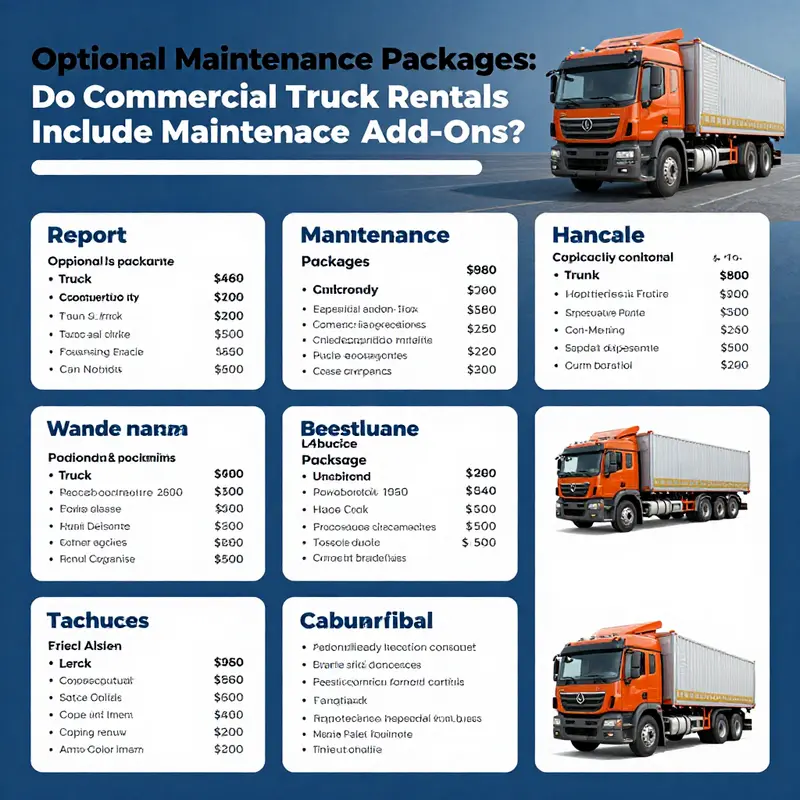
When a business relies on the mobility of its fleet, the question of maintenance in rental agreements becomes more than a detail. It becomes a strategic lever that can determine whether a shipment lands on time, whether a seasonal peak can be absorbed smoothly, or whether an unexpected breakdown derails a delivery schedule. The core reality is straightforward: commercial truck rentals do not automatically include maintenance as part of the base rental agreement. Most contracts leave routine upkeep, troubleshooting, and the majority of repairs to the renter. In practice, this means oil changes, tire care, brake inspections, fluid tops and flushes, and the patchwork of repairs that can arise during a busy cycle largely fall under the renter’s responsibility. Yet the landscape is not a flat, one-size-fits-all proposition. Across the industry, several providers offer optional maintenance packages or preventive maintenance plans that can be layered onto the base rental. These add-ons vary widely in scope, cost, and geographic coverage, and the value they deliver hinges on the renter’s operating profile, the duration of the rental, and the specific demands of the job at hand. For someone tasked with moving goods through a finite window of time, the decision to accept or reject maintenance add-ons becomes a calculation of predictability versus price, of uptime against cash flow, of risk transfer versus control. In this sense, the topic connects directly to the article’s broader inquiry: do commercial truck rentals include maintenance? The answer, in short, is nuanced rather than absolute. It depends on the rental terms, the vehicle type, the length of the engagement, and the provider’s service model. A typical renter venturing into a short term hire might find maintenance largely outside the deal, while a fleet operating on a longer horizon could secure a maintenance add-on that aligns with the business’s uptime targets and its risk tolerance. The decision, in other words, is collaborative between the client and the provider, with the ultimate aim being a plan that reduces downtime and stabilizes cost during a period of high demand or extended utilization. To understand how such add-ons work in practice, it helps to examine what these packages commonly cover, how they can be structured, and what questions to pose before signing any contract. Maintenance add-ons generally center on preventive care and predictable service needs rather than unanticipated, large-scale repairs. They might include routine inspections at defined intervals, scheduled oil changes and lubrication, tire service and rotation, brake system checks, coolant and fluid monitoring, and basic filter replacements. Some programs extend to more comprehensive preventive maintenance that encompasses belts, hoses, battery health assessments, and minor repairs identified during inspections. A smaller subset of offerings may include emergency roadside assistance as part of the package, or expedited access to a network of service centers, which can be a meaningful advantage when time is critical. Yet the scope is not uniform. One provider may cover the preventive maintenance schedule only, leaving any repair work to the renter or to the renter’s chosen third-party shop. Another might extend coverage to user-reported issues that occur within the terms of the rental, but with limitations on the types of repairs or the geographic area where service is available. Because the specifics differ so markedly, the contract language becomes the most important instrument in understanding what is truly included and what is not. The baseline commitment remains clear: a rental agreement is a contract of consequence, and maintenance add-ons function as an extension of that contract, shifting risk and cost in proportion to the renter’s anticipated needs. The distinction between short-term and long-term engagements further clarifies the decision framework. Short-term rentals, measured in days or weeks, are typically anchored to flexibility and minimal administrative overhead. In these cases, maintenance add-ons may feel less attractive because the likelihood of needing a major service during a brief period is small, and the added cost can seem disproportionate to the benefit. However, for fleets that hinge on continuous operation, or for operations deployed in remote or high-demand markets, even a modest maintenance package can offer significant value. Long-term leases and fleet rental agreements, by contrast, align more naturally with maintenance planning. These arrangements often enable the fleet manager to synchronize maintenance windows with the vehicle’s utilization schedule, minimize unscheduled downtime, and stabilize outlays through predictable monthly or quarterly pricing. From an engineering standpoint, this predictability unlocks the ability to optimize asset reliability, improve the scheduling of preventive tasks, and rely on a known service cadence rather than reacting to breakdowns as they arise. In practice, a well-chosen maintenance plan can support operational efficiency on several fronts. It can reduce the total cost of ownership by extending the vehicle’s life, lowering the probability of catastrophic failures, and preserving fuel economy through proper alignment of tire conditions and engine performance. It can also shorten downtime by providing a clear path for service, ensuring that vehicles return to operation within agreed timeframes, and that roadside delays do not cascade into missed deliveries. The value proposition is particularly meaningful when the fleet manager is balancing tight delivery windows, a multi-vehicle pool, and a geographically dispersed operation. The ability to monitor service history, upcoming maintenance needs, and the status of each vehicle becomes a strategic asset. Many providers now offer transparent pricing models and digital dashboards that present service history, upcoming maintenance milestones, and cost projections in a user-friendly format. This visibility allows an engineering team to anticipate wear and plan replacements or repairs before a failure interrupts operations. The practical upshot is that maintenance add-ons, when properly matched to the operation, can convert a variable, uncertain expense into a planned, controllable line item. Yet the decision to adopt such a program should be anchored in careful contract review and a disciplined appraisal of the business case. The contract is the primary vehicle for disclosure. It should spell out exactly what is included in the maintenance add-on, what is excluded, and under what circumstances the coverage applies. It should specify whether preventive maintenance is performed by the rental company’s network or by the renter’s preferred shops, and whether there are required service centers, approved technicians, or limited geographic coverage. It should address who bears the cost of parts and labor beyond specified limits, as well as any deductibles, caps on annual spend, or per-incident caps that could alter the economics of the decision. For a fleet manager, the terms surrounding coverage for wear and tear versus pre-existing defects often determine the practical value of the add-on. A policy that treats routine wear as the renter’s responsibility but covers defects arising after the vehicle has entered service can be attractive for teams that are cautious about upfront costs but want protection against sudden, high-impact failures. Conversely, a plan that lumps routine wear into the same category as a major repair can be less appealing for operations with tight margin envelopes. This is why, beyond the numbers, the clarity of the policy language matters. Another important dimension is the vehicle type and the rental period. The maintenance needs of a dry van are different from those of a refrigerated unit or a specialized flatbed. Refrigeration equipment adds a layer of complexity and maintenance requirements that may influence the scope of a package or the pricing. The length of the rental also matters because longer engagements invite more extensive preventive care. A month-long rental with an option for maintenance might be a relatively small incremental cost, while a year-long arrangement could justify a broader, more comprehensive plan with deeper preventive coverage and more robust roadside services. From a manager’s perspective, operational efficiency often hinges on the alignment between the maintenance add-on and the company’s logistics realities. A well-structured package can transform maintenance from a recurring concern into a managed process. It can enable a fleet to maintain consistent uptime, predict service needs, and reduce the administrative burden of coordinating repairs across multiple locations. At the same time, it is essential to maintain a disciplined approach to evaluating the offer. This begins with a careful review of the contract and a candid dialogue with the rental provider. Questions to pose include: What exactly is covered under preventive maintenance, and what requires a separate repair authorization? Are service intervals defined by mileage or calendar time, and what happens if the vehicle is not driven at the expected rate? Are there restrictions on where service can be performed, and who pays travel time or diagnostic fees if a breakdown occurs outside the network? Are there caps on annual spend, deductibles, or per-incident costs that could negate the perceived savings? How is roadside assistance structured, and does it apply to all vehicles in the fleet, regardless of location or time of day? Are there provisions for rapid replacement if a vehicle must be taken out of service for an extended period? And crucially, how does the plan interact with warranties or existing coverage for pre-existing conditions? The more precise the answers, the more confident a fleet can be in its cost and uptime projections. The modern maintenance add-on is also evolving with advances in technology. Some providers offer dashboards that display the vehicle’s service history, upcoming maintenance tasks, and estimated costs. For engineers who rely on data-driven asset management, this can be a powerful tool. It supports not only cost control but reliability metrics, enabling teams to benchmark the performance of different vehicle classes or powertrains. In some cases, the data can feed into broader fleet optimization initiatives, such as predictive maintenance programs that anticipate failures before they occur, reducing unplanned downtime and extending component life. For readers familiar with the broader trucking industry, these trends align with industry best practices that emphasize uptime, reliability, and a strategic approach to asset management. A respected industry resource highlights the value of maintenance planning as a core discipline for sustaining asset performance and reducing the total cost of ownership over time. The practical takeaway is that a maintenance add-on, when designed to complement the operation rather than merely cushion it, can be a meaningful investment. For a manager weighing options, the decision often comes down to this: will the added cost of the maintenance program be offset by reduced downtime, lower emergency repair bills, and more predictable budgeting? If the answer is yes, the maintenance package can become a strategic tool rather than a transactional add-on. For readers interested in seeing how industry practitioners balance cost, uptime, and risk, a deeper dive into best practices can be found in the broader literature on commercial truck maintenance. It is worth exploring resources that discuss maintenance scheduling, preventive service, and the role of telematics in asset management. To round out the perspective, consider a practical note: when you are evaluating add-ons, bring your own data to the table. Map expected usage, routes, and typical wear patterns for your fleet. Use historical repair costs and downtime data from your operations to estimate potential savings from reduced downtime and more predictable maintenance expenses. If the math supports it, the add-on becomes not just a cushion against disruption but a strategic enabler for your logistics goals. For a succinct view on how fleets can balance cost and uptime through maintenance strategy, see the McGrath Trucks Blog for related industry insights. McGrath Trucks Blog. In parallel, keep in mind that every rental arrangement carries a risk-transfer dynamic. The up-front price of an add-on may be greater than the perceived benefit during a low-utilization period, but that same premium can prove prudent when demand spikes or routes become tightly scheduled. The best practice is to treat maintenance add-ons as part of a larger procurement and fleet-management framework, rather than as isolated line items. That means aligning maintenance coverage with the company’s service-level commitments, its risk appetite, and its overall fleet strategy. In the end, whether maintenance is included by default or purchased as an add-on, the emphasis should remain on uptime, predictability, and control. The chapter’s broader question—do commercial truck rentals include maintenance?—is answered more clearly when you see maintenance as a negotiated asset rather than a fixed cost. The ability to tailor coverage to the specific needs of a route, a vehicle type, or a business season can be the difference between a delivery window that opens on time and one that tightens under the pressure of an unplanned service event. External resource: For additional context on industry-wide maintenance best practices and the impact on asset reliability, consult the following external resource: Commercial Truck Maintenance Best Practices.
null

null
Final thoughts
A clear understanding of maintenance policies in commercial truck rentals is imperative for successful fleet management and operational effectiveness. Each chapter of this article has delved into the critical aspects—maintenance exclusions, optional packages, and rental agreement responsibilities—providing a comprehensive overview tailored to meet the needs of professionals in trucking, procurement, and logistics. Companies equipped with this knowledge can make informed decisions that enhance their operational efficiency while avoiding unforeseen costs.