The complexity of commercial transportation mandates a nuanced understanding of licensing requirements. At the heart of this is the Commercial Driver’s License (CDL), a critical credential for operators of business trucks. For trucking company owners, fleet managers, and procurement teams in sectors like construction and logistics, understanding when a CDL is necessary is vital to ensuring compliance and maintaining operational efficiency. This article will delve into the requirements for obtaining a CDL, the criteria that dictate whether it is needed for specific vehicles, the implications of operating without one, and an overview of different classifications of CDLs—arming readers with the knowledge to navigate the legal landscape effectively.
Knowing the Line: CDL Thresholds, Classifications, and Compliance for Business Trucks
When a business relies on a truck as a core part of its operations, the question of whether a Commercial Driver License (CDL) is required often comes up in planning, budgeting, and risk management. The answer hinges on clear, objective criteria rather than a gut feeling about vehicle size. In the United States, the FMCSA defines a set of weight, passenger, and hazardous materials thresholds that determine when a CDL is legally required. Understanding these thresholds helps ensure safe operations and protects the business from penalties and delays.
First, the backbone of CDL determinations is the vehicle’s weight and its role in transportation. The essential metrics are the gross vehicle weight rating (GVWR) and the gross combination weight rating (GCWR). GVWR is the maximum loaded weight the vehicle is designed to carry. GCWR is the total allowed weight of the vehicle plus any towed equipment. If a vehicle is part of a combination where the GCWR reaches or exceeds 26,001 pounds, and the towed portion weighs more than 10,000 pounds, Class A CDL requirements typically come into play. This category captures the largest and most common tractor-trailer configurations that fleets rely on for moving goods over long distances or for heavy-duty regional work. When the combination stays below those towing thresholds, the vehicle may fall into other classes, but the pivotal point remains the GCWR crossing a defined line.
A related, but distinct path to CDL necessity arises with large single vehicles. Class B CDL requirements apply to any single vehicle with a GVWR of 26,001 pounds or more. This class also covers situations where a vehicle, although heavy, tows a trailer weighing no more than 10,000 pounds. The practical implication is straightforward: a business operating a sizable, non-trailer vehicle—such as a large box truck or a heavy delivery vehicle—will often need a Class B CDL if the vehicle’s GVWR meets or exceeds the threshold. The distinction between Class A and Class B is thus largely about weight distribution and towing: Class A focuses on heavy combinations, while Class B focuses on heavy solo vehicles or heavy solos with light towed gear.
Then there is Class C, which targets a different set of operational realities. Class C CDL requirements apply to vehicles designed to transport 16 or more passengers (including the driver) or to transports involving hazardous materials that require placarding under federal regulations. This category ensures that vehicles in passenger service or those carrying certain dangerous goods meet additional safety, training, and regulatory standards. It is a reminder that CDL obligations are not solely about vehicle mass; they also reflect the potential risk profile of the operation.
To apply these rules correctly, it helps to distinguish between what is a CMV, or commercial motor vehicle, and what is not. A CMV is defined by the FMCSA as a vehicle used on public roads in commerce with a gross vehicle weight rating or gross vehicle weight exceeding specified thresholds, or a vehicle designed to transport certain numbers of passengers or hazardous materials. In practical terms, this means a business truck that regularly logs cargo over the 26,001-pound GVWR threshold, or often hauls a trailer that pushes the GCWR past the critical 26,001-pound mark, will be operating a CMV and will typically be required to hold the appropriate CDL class. The CMV designation also informs other regulatory requirements, including vehicle inspections, driver qualification files, and hours of service rules that govern how long a driver can operate without rest.
The implications for everyday operations are significant. Consider a business that uses large delivery or service vehicles on a daily basis. If the vehicle’s GVWR alone exceeds 26,001 pounds, even without a heavy trailer, the operation is typically within Class B CDL territory. If the business runs a fleet that often couples a heavy vehicle with a sizeable trailer, the likelihood increases that Class A CDL requirements will apply. And if the operation involves transporting 16 or more passengers or moving hazardous materials that require placards, Class C CDL rules come into play. These distinctions affect not only licensing but also driver training, medical certification, and ongoing compliance audits that fleets must navigate.
Obtaining a CDL is not a one-time hurdle but a continuing obligation that includes rigorous training, testing, and documentation. The process generally requires the driver to pass both knowledge and practical skills evaluations, along with a medical examination to ensure fitness for operating a heavy vehicle. Depending on the state, applicants may also need to obtain endorsements for specific operations, such as hazardous materials or passenger transport, which add further testing and certification requirements. The emphasis on training reflects the safety stakes involved: heavier vehicles carry more kinetic energy, demand higher braking and maneuvering thresholds, and pose more complex risk profiles in urban traffic, narrow streets, and congested corridors. For a business, the investment in training translates into reduced accident risk, better insurance terms, and smoother regulatory compliance overall.
The practical decision for a business owner comes down to mapping each vehicle in the fleet to its GVWR and any potential to tow, as well as considering how that vehicle is used in daily operations. If the vehicle’s weight, or its potential combination with a trailer, pushes it into the CDL territory, a license is not optional—it is a legal prerequisite. This is true regardless of the vehicle’s appearance or perceived utility. A truck that looks like a standard pickup can become a CDL vehicle the moment its GVWR crosses the threshold or it routinely tows a heavy trailer. Moreover, these rules apply across state lines in interstate commerce, and while some intrastate operations may have separate nuances, the underlying safety rationale remains consistent: heavier vehicles demand trained drivers, disciplined procedures, and robust oversight.
For business leaders, the implications extend beyond legal compliance. A clear understanding of CDL requirements helps with strategic planning, such as fleet composition, driver recruitment, and insurance considerations. When a fleet is clearly mapped to its licensing needs, training programs can be tailored to the actual risk profile and regulatory expectations. This reduces the chance of accidental noncompliance, which can expose the company to fines, out-of-service orders, or delays that ripple through schedules and customer commitments. It also clarifies the role of ongoing driver qualification files, medical certifications, and recordkeeping—areas that, if neglected, can become costly or time-consuming to rectify. In this light, CDL compliance is not merely a legal checkbox; it is a core component of responsible fleet management and business reliability.
For readers seeking practical context and verification of these classifications, the FMCSA serves as the official source of CDL classifications and the rules that govern their application to different vehicle configurations and uses. To connect with foundational definitions and the latest updates, you can consult the FMCSA website. In addition, practitioners often find value in turning to fleet-focused resources that interpret these rules in real-world terms and provide guidance on training pathways, testing timelines, and documentation workflows. For broader reading and community perspectives, you can explore credible industry resources and regulatory summaries.
In sum, whether a business truck requires a CDL pivots on weight thresholds, towing arrangements, and whether the vehicle moves people or hazardous materials. Class A, Class B, and Class C CDL designations map directly to how the vehicle is used, how much it weighs, and what it transports. The consequences reach beyond licenses to encompass training, safety, and regulatory compliance that shape every aspect of fleet operations. When in doubt, perform a precise assessment of GVWR and GCWR, review how the vehicle is used in routine work, and align licensing, endorsements, and training with the actual risk profile and legal requirements. As with many compliance questions, clarity comes from careful measurement and authoritative sources, with ongoing updates from FMCSA to reflect evolving rules. For a concise orientation to related topics and practical pointers, consider checking the official FMCSA CDL information page at https://www.fmcsa.dot.gov.
Unlatching the License Gate: How CDL Requirements Shape Your Business Truck Operations
When a small fleet considers growth, the question that often rises to the top is deceptively simple: do I need a Commercial Driver’s License to operate my business truck? The answer hinges not on what the truck looks like in the showroom but on clear regulatory thresholds that define how heavy a vehicle can be, how it’s used, and what it carries. The foundational rule comes from the Federal Motor Carrier Safety Administration (FMCSA): a CDL is generally required to operate a commercial motor vehicle (CMV) that meets certain weight or cargo criteria. This is not a bureaucratic hurdle designed to slow business; it is a safety framework that aligns driver qualifications with the scale of the operation. For many owners, understanding this threshold is the first step in prudent fleet planning and risk management, because it shapes hiring, insurance, training, and even the decision to lease versus own certain trucks.
At the heart of the CDL decision lies a straightforward numeric gate: when a vehicle has a gross vehicle weight rating (GVWR) or gross combination weight rating (GCWR) of 26,001 pounds or more, a CDL is required to operate it for business purposes. This criterion captures the heavy straight trucks and most tractor-trailer configurations that haul goods over highways. It also applies when a vehicle is designed to transport 16 or more passengers, including the driver, or when it is used to transport hazardous materials that require placarding under federal regulations. These rules are designed to ensure that drivers entrusted with larger, more complex or more dangerous loads have demonstrated a higher level of training and professional competence.
The practical implication of the weight threshold is often misunderstood. It is not a blanket drawbridge that flips for every large pickup or box truck you see on the street; rather, it targets the vehicles that, by design and payload, create higher stopping distances, greater kinetic energy, and more complex operating scenarios. When a business considers a truck in its fleet, the first step is to locate the GVWR plate or documentation from the vehicle’s manufacturer. If the GVWR is 26,001 pounds or more, and the vehicle is used for commercial purposes, the operator typically needs a CDL. Conversely, a vehicle that sits just shy of that threshold—say, a GVWR of 25,999 pounds—generally does not require a CDL on its own, though there can be exceptions based on how the vehicle is used or configured. The same logic applies to combinations of vehicles: if the coupled GCWR meets or exceeds the 26,001-pound mark, CDL requirements can kick in for the combination. This nuance matters for fleet managers who are deciding between two otherwise similar vehicles and weighing the cost and administrative load of CDL compliance.
Beyond weight, the other two criteria cut more clearly across fleets: passenger transport and hazardous materials. If a truck is built to carry 16 or more people, including the driver, the operator must hold a CDL, regardless of the vehicle’s GVWR, because passenger safety obligations for larger groups are a separate regulatory axis. Likewise, any vehicle involved in transporting hazardous materials that require placarding under DOT rules triggers CDL prerequisites. These are not everyday concerns for most parcel or local delivery fleets, but they become central in segments such as bulk fuel distribution, chemical logistics, or any operation that moves hazmat within or across state lines. Let this be a practical reminder: the CDL isn’t merely a license; it represents a defined scope of operation that aligns driver capabilities with specific risk profiles.
A core part of any business decision is recognizing how a CDL interacts with the Class system in the U.S. The three traditional CDL classifications—Class A, Class B, and Class C—are tied to the vehicle’s configuration and the nature of the cargo. Class A CDLs cover combinations with a GCWR of 26,001 pounds or more, which includes most heavy tractor-trailer setups and many long-haul configurations. Class B CDLs apply to straight vehicles with a GVWR of 26,001 pounds or more, such as large single-trailer trucks. Class C covers smaller combinations and vehicles designed to transport 16 or more passengers, or those carrying hazmat, when the vehicle falls outside Class A or B. For a fleet owner, these classifications are not abstract categories; they dictate the specific licensing path, the endorsements that may be required (such as for air brakes, tank vehicles, or hazmat), and the training protocol a driver must complete.
Yet the CDL decision is not a one-time yes-or-no choice. It unfolds as a continuum of compliance, training, and risk management. Even in a business operating a handful of trucks below the GVWR threshold, an owner might still see value in pursuing CDL-qualified drivers. Insurance carriers and certain clients often prefer or require drivers with CDL credentials for larger vehicles, not only for the driver’s skill set but also because CDL holders are typically trained to handle more stringent regulatory requirements, record-keeping, and safety protocols. The practical outcome is a more consistent safety culture across the fleet, which in turn can influence premium costs, maintenance scheduling, and incident response plans.
The training path for a CDL is both structured and demanding. Prospective CDL holders must pass medical and knowledge tests, followed by a comprehensive skills test that includes a pre-trip inspection, a basic vehicle control test, and a road test. The medical requirement ensures that drivers meet baseline health standards appropriate to operating heavy vehicles over long distances, which is a critical aspect of road safety and public accountability. The knowledge test covers a broad spectrum—from federal hours-of-service regulations to vehicle inspection procedures and the fundamentals of handling hazardous materials if an endorsement is pursued. The skills test then puts the driver behind the wheel in controlled settings, evaluating the ability to maneuver, back up, and safely manage a loaded vehicle under typical operating conditions. Given the time and financial investment, many fleets feel the benefits of a CDL-trained workforce extend beyond regulatory compliance into improved safety records, reduced downtime, and stronger reliability in service delivery.
For business leaders, the decision to require or not require CDL credentials for a fleet hinges on several practical factors. First is the intended use of the trucks. If the operation is local delivery with small payloads, a CDL may not be legally required, but the driver may still benefit from the broader safety and professional competencies that CDL training provides. If the operation involves long-haul routes, heavier payloads, or complex equipment configurations, CDL requirements become not just likely but essential. Second is insurance and client expectations. Some contracts and insurers stipulate CDL qualifications to mitigate risk exposure, particularly for hazmat or multi-vehicle operations. Third is cost and logistics. Training, testing, and ongoing compliance add recurring costs, while the administrative burden of license management, ongoing medical renewals, and endorsements adds complexity to human resources processes. The calculus, in short, is not only legal compliance, but long-term fleet performance, safety, and cost efficiency.
In navigating these decisions, businesses can benefit from a pragmatic approach that begins with a simple audit of each vehicle in the fleet. Identify the GVWR on the vehicle’s certification label and confirm how each unit is used. If any truck meets or exceeds the weight threshold or is used for hazmat or large passenger transport, map out the CDL requirements for the corresponding driver and consider the endorsements that may apply. It is also wise to review leasing or purchasing strategies. Some operators opt for a mixed fleet—vehicles under the threshold managed by non-CDL drivers and heavier units operated by CDL holders. This approach can balance upfront capital expenditure with the long-term payoffs of safer operation and regulatory alignment. As with any policy, the best results come from clear, documented standards and consistent enforcement across the organization. The human element—driver recruitment, training, and ongoing coaching—often determines the ultimate success of a fleet, more so than the truck’s sheet metal or engine displacement.
For readers seeking further context on fleet decision-making and industry dynamics, a quick visit to the broader fleet-management conversation can be illuminating. The McGrath Trucks blog offers accessible discussions on how fleets adapt to changing market conditions, optimization strategies, and practical considerations that accompany fleet growth. It serves as a useful companion resource when weighing licensing decisions against payroll, insurance, and maintenance planning. McGrath Trucks blog
Ultimately, the CDL question is a signal about risk, responsibility, and the scale of your operation. It is not a verdict cast in stone, but a threshold that can shift as your business evolves. If your trucks sit on the cusp of the 26,001-pound line or your operation includes passengers or hazardous materials, a CDL is typically the pathway to lawful operation, safer driving, and more predictable service outcomes. If your use case remains primarily local, light-to-medium payloads, the decision remains nuanced and will hinge on the specifics of your fleet, insurance posture, and client requirements. Either way, the prudent course is to start with a catalogued assessment of each vehicle, confirm how the vehicle is used in daily operations, and align licensing plans with both regulatory expectations and the strategic pillars of your business plan.
For those seeking official guidance on eligibility and licensing categories, the federal framework provides a definitive reference. The FMCSA outlines CDL eligibility, endorsements, and the nuances that determine when a CDL is required, as well as the processes for obtaining one. It is a reliable anchor point for fleet managers to anchor their policies and to ensure that growth plans remain compliant as they scale. The nuanced reality is that licensing is not merely about meeting a regulatory checkbox; it is about cultivating a trained, capable, and accountable driver workforce that can safely move goods from point A to point B in a complex, high-stakes environment. As operations evolve, the horizon of compliance will continue to shape how fleets are structured, how roles are defined, and how investments are prioritized across maintenance, training, and safety,” ensuring that business objectives and safety obligations move forward in tandem.
External resource: For the official criteria and detailed eligibility, refer to the FMCSA’s CDL regulations and guidance: https://www.fmcsa.dot.gov/regulations/eligibility/commercial-driver-s-license-cdl
Weight, Liability, and Compliance: Why a CDL Is Non-Negotiable for Business Trucks
In commercial logistics, the weight of a truck often defines the level of regulatory scrutiny and the required training. A Commercial Driver’s License (CDL) is required when a vehicle’s GVWR is 26,001 pounds or more, when the vehicle tows a trailer or combination that reaches that threshold, when a vehicle is designed to transport 16 or more passengers (including the driver), or when hazardous materials are hauled and must be placarded. Falling into CDL territory triggers licensing, testing, and medical certification requirements and can influence insurance, liability, and penalties for non-compliance.
The practical implications include fines for driving without a CDL, potential increases in insurance costs, and greater risk in the event of an accident or audit. Within the CDL framework, Class A, B, and C describe vehicle types; endorsements tailor credentials for tasks such as passenger transport, tank vehicles, hazmat, or air brakes. Implementing a documented CDL program helps maintain driver qualification files, track medical certificates, and support ongoing safety training. A compliant program promotes a safety culture, smoother inspections, and more predictable service levels, while reducing regulatory risk across the fleet.
For business leaders, the rule is simple: when a vehicle crosses the 26,001-pound threshold, carries 16 or more passengers, or hauls hazmat, a CDL is required and a proactive compliance program pays dividends in safety, reliability, and total cost of ownership.
null
null
Beyond the Wheel: How CDL Classifications Shape the Need for a Commercial Driver’s License in Business Truck Operations
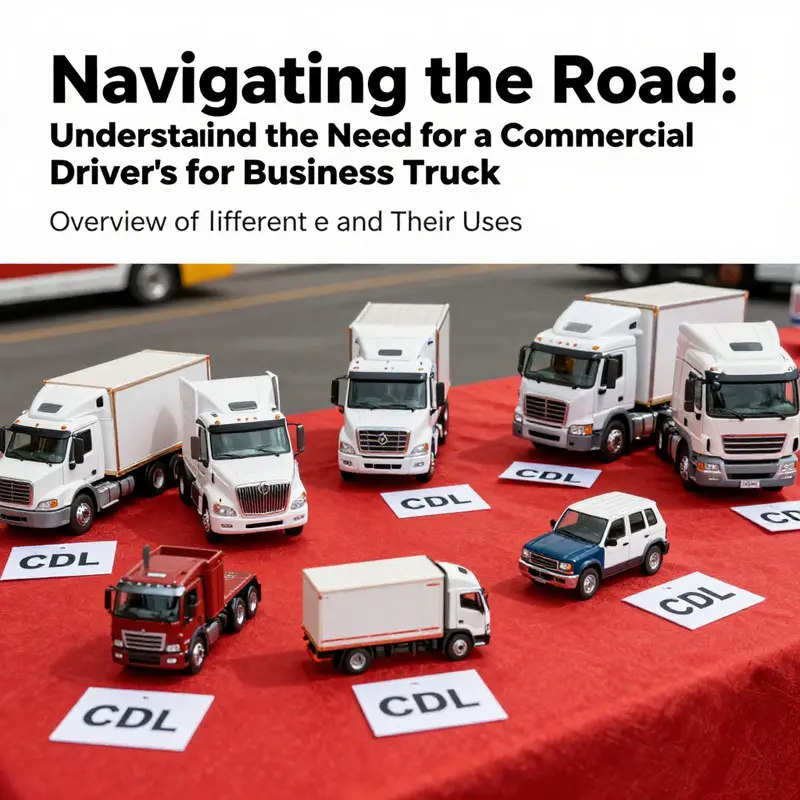
The decision about whether a commercial driver’s license (CDL) is required for a business truck hinges on a few clear but sometimes subtle rules that the Federal Motor Carrier Safety Administration (FMCSA) lays out. For many small and mid-sized operations, the first question isn’t whether a CDL exists in theory, but whether a given vehicle actually crosses the thresholds that trigger a special credential. The simplest rule is weight: if a vehicle has a gross vehicle weight rating (GVWR) of 26,001 pounds or more, driving it for business purposes typically requires a CDL. But weight is not the only route to a CDL. If a vehicle is designed to transport 16 or more passengers, including the driver, or if it is used to haul hazardous materials that require placarding under federal regulations, a CDL is also usually necessary. These criteria—weight, passenger capacity, and hazmat—create a practical framework that business owners can use to decide when certifications must be pursued and when they can be avoided with a lighter, compliant vehicle. In this sense, the CDL system is not about a single, one-size-fits-all license; it is a structured ladder that aligns the complexity of the vehicle and its operation with the level of training and testing required from the driver. This approach also helps explain why some popular work trucks—vehicles that seem capable and mission-critical for local delivery or service routes—do not automatically ride the line of CDL necessity. A light-duty pickup or a small commercial van that stays under the GVWR threshold and does not routinely carry 16 or more people or hazardous materials may fall outside the CDL realm, enabling a standard driver’s license to suffice with only ordinary local driving qualifications. Yet the moment a fleet expands to larger, heavier, or more specialized equipment, the CDL becomes a central piece of the compliance puzzle, not an optional add-on. The practical takeaway is straightforward: when you’re evaluating a business truck, start with the vehicle’s GVWR, then consider passenger capacity and cargo type. If any threshold triggers, the CDL becomes a legal requirement, shaping hiring, training, insurance, and fleet planning in a way that can ripple through every part of the operation. For a broader perspective on how these classifications play out in practice, the industry resources and state guidance are essential anchors, guiding owners away from guesswork toward concrete compliance decisions.
Classifying commercial motor vehicles under the CDL framework begins with three main classes—A, B, and C—each designed to cover different vehicle configurations and operations. Class A CDL is the most expansive. It is required to operate any combination of vehicles with a gross combined weight rating (GCWR) of 26,001 pounds or more, provided the towed vehicle weighs more than 10,000 pounds. In everyday terms, this covers the large tractor-trailers that dominate long-haul freight. If you’re driving a truck that pulls a trailer heavier than 10,000 pounds and the combined weight pushes past the 26,001-pound mark, a Class A CDL is typically necessary. This class is not just about scale; it is about the complexity of coupling, braking, and maneuvering a weighty combination on highways and through evolving traffic patterns, which demands a high level of training and testing.
Class B CDL, by contrast, governs single vehicles with a GVWR of 26,001 pounds or more, or any such vehicle towing a trailer that does not exceed 10,000 pounds. The practical examples of Class B include large straight trucks used for deliveries, city buses, dump trucks, and similar workhorses that still require robust handling and safety protocols but do not involve the complexity of a GCWR scenario with a heavy trailer. In many local fleets, a box truck or a large dump truck that charges through daily routes would fall into Class B territory. The distinction between Class A and Class B is not merely academic; it translates into differences in required endorsements, exam structure, and the on-road testing that drivers will face before earning the license.
Class C CDL is the gateway for vehicles that don’t fit neatly into A or B but are designed to transport 16 or more passengers (including the driver) or carry hazardous materials that require placarding. This category covers smaller passenger shuttles and certain hazardous-material configurations. A business might operate a van or shuttle that has enough seating to trigger the 16-person threshold or transport class-wide chemical products that necessitate safety placards. In practice, Class C is the special-purpose tier that addresses the more nuanced risk profiles of passenger transport and hazmat, requiring drivers to master additional safety and operational procedures.
Endorsements and restrictions layer onto these classifications. A driver may need a Hazardous Materials (HazMat) endorsement to transport certain placarded goods or a Passenger (P) endorsement for service that moves people. Conversely, restrictions might apply to night driving, intrastate operation limits, or requiring the driver to use a specific route or time window, all of which are tied to training results and medical qualifications. The endorsements and restrictions remind us that the CDL journey is not only about the vehicle but also about the context in which it operates—the cargo, the route, and the people on board.
For business owners, this framework translates into concrete planning steps. Start by auditing the fleet: list each vehicle, its GVWR, whether it ever tows a trailer, and what kind of cargo or passengers it serves. If a vehicle is 26,001 pounds GVWR or greater, or if it regularly hauls 16 or more passengers or hazmat, a CDL and the related endorsements will be a prerequisite. The next phase is educational and bureaucratic. A CDL requires passing both knowledge and skills tests, paired with a medical examination to certify fitness to drive heavy or complex vehicles. Some operators pursue in-house training or partner with trucking schools, but many also rely on carrier-sponsored programs that align with insurance and fleet safety practices. In either path, the time and cost investment are real, but the payoff is not merely regulatory compliance; it is safer roads, fewer liability concerns, and a smoother path to reliable fleet performance.
The regulatory landscape adds another layer of nuance. While FMCSA sets the baseline for interstate commerce, many states extend CDL requirements to intrastate operations as well. Some business activities that stay purely within state borders still trigger CDL requirements under state law or administrative regulations. This is why it is essential to consult state DMV resources when planning fleet upgrades or shifts in operations. The dynamic nature of regulations means that a vehicle once considered non-CDL may become CDL-necessary if a fleet expands or route profiles change, and vice versa if a vehicle is reconfigured, decommissioned, or reassessed for local-only use. In other words, the CDL decision is not a static label; it is a fluid assessment tied to vehicle weight, mission, and geographic scope.
To put these concepts into a practical frame, consider a small business that runs a 26,500-pound GVWR straight truck for local deliveries. In most cases, this vehicle would require a Class B CDL because it is a single heavy vehicle not towing a heavy trailer. If the same operation adds a trailer weighing 12,000 pounds, the combination crosses into Class A territory, and the driver would need a Class A license to cover the entire rig. If instead the operation charters or runs a van with seating for 15 passengers, it stays outside the Class C remit—assuming there is no hazmat and the passenger count remains below 16—highlighting how the threshold for CDL can hinge on small but pivotal changes in vehicle or mission. These scenarios illustrate why fleet managers benefit from a disciplined, numbers-driven approach to licensing decisions, rather than relying on assumptions about what the vehicle looks like or how impressive its capacity may feel in day-to-day use. A careful audit backed by FMCSA guidelines and state guidance helps ensure both compliance and operational continuity.
In the broader context of business strategy, securing the right CDL status affects hiring pipelines, driver training timelines, insurance premiums, maintenance planning, and even the resale value of equipment. When a fleet knows in advance which licenses are in play, it can design job roles that align with driver qualification realities and plan for endorsements as part of career development. It also supports safer operations by tying driver competency requirements to the actual risks they face. The up-front work pays dividends later, reducing delays in service, avoiding costly permit schemes or penalties, and enabling a smoother scale-up as the business grows. For readers who want a practical reference on state-specific CDL classifications and requirements, the DMV resources provide targeted guidance tailored to local rules and processes. And for ongoing industry perspectives, the McGrath Trucks Blog offers insights into how fleet practices evolve in the larger market landscape. (Internal link: McGrath Trucks Blog)
Of course, the road to full compliance does not end with obtaining a CDL. It includes maintaining medical certifications, staying current with knowledge and skills tests as required, renewing endorsements when necessary, and ensuring that the fleet’s insurance and safety programs reflect the realities of the trucks in operation. It also means recognizing that technology, maintenance standards, and regulatory interpretations can shift over time, so periodic reviews of fleet configuration and licensing requirements become a routine best practice rather than a one-off exercise. In short, the CDL framework is a critical lever for controlling risk, aligning capabilities with needs, and enabling business efficiency on a scale that matches the vehicle’s heft and the routes it serves. For managers and owners who plan with this mindset, the decision to pursue or defer a CDL is not simply a regulatory checkbox; it is a strategic choice that shapes who drives which truck, how they are trained, and how the fleet evolves as demand and markets change. And as the trucking landscape continues to shift—through regulatory updates, safety incentives, and evolving vehicle technologies—the core principle remains unchanged: know the vehicle, know the mission, and know the license that keeps the operation compliant, safe, and competitive.
External resource for reference on state-by-state CDL classifications and requirements is here: https://www.dmv.org/united-states/ . For ongoing industry insights and practical guidance on fleet operations, you can explore the McGrath Trucks Blog.
Final thoughts
Understanding the requirements for a Commercial Driver’s License is crucial for all businesses that rely on trucks for operations. Ensuring compliance not only prevents legal repercussions but also enhances the safety and efficiency of business activities. By grasping the nuances of CDL necessity, procurement teams, fleet managers, and trucking company owners can make well-informed decisions that align with federal regulations and industry standards.