
Introduction
Have you ever wondered about the current state of commercial truck tire production in China? As one of the leading manufacturers, China’s role in the global trucking industry is crucial, yet it faces significant scrutiny and questions regarding its sustainability and reliability. With a reported production of over 1.39 billion tires in 2023 and a 14% year-over-year increase, China not only dominates the market with a staggering 58.3% of the global share but also influences the operational efficiency and costs for trucking companies worldwide. But what does this mean for trucking firms and fleet managers who rely on these tires for their daily operations?
The demand for high-quality commercial truck tires is paramount as they directly impact vehicle performance, safety, and total ownership costs. In fact, studies show that the right tires can reduce fuel consumption by as much as 8%, leading to significant savings over time. Additionally, with China becoming a key player in the tire manufacturing sector, the implications for the trucking industry are profound. Changes in production practices, tire quality, and even trade policies affect fleet operations and procurement strategies globally.
Moreover, with competition intensifying among domestic brands, innovations in tire technology and services are emerging. Trust in tire quality must be balanced with economic considerations, especially given recent recalls due to safety concerns linked to lower-cost offerings.
Would you be prepared to navigate these complexities as a fleet manager or trucking company owner? Understanding the developments in China tire manufacturing and their impact on the trucking industry will not only enhance your procurement strategy but also ensure that your fleet remains efficient and safe on the road. As we delve further into this topic, we will explore the challenges and opportunities presented by China’s tire production landscape and what it means for businesses in the trucking sector.
Industry Insights into China’s Stance on Commercial Truck Tire Production
Historical Tire Production in China
The history of commercial truck tire production in China is marked by significant milestones that reflect both technological advancements and economic shifts within the country. The journey began in 1934, when the first domestic tire manufacturer, Shanghai Rubber Factory, commenced tire production. This initiative aimed at reducing dependency on imported tires, especially during times of conflict. However, the real transformation of the tire industry unfolded during the 1980s, paralleling China’s economic reforms.
In 1960, the establishment of Hangzhou Zhongce Rubber Co., Ltd., previously known as Hangzhou Haichao Rubber Factory, showcased the emergence of specialized manufacturers. By producing its first handcart tire, the company laid the groundwork for future commercial vehicles, including trucks. By the time the 1978 reform policies were enacted, the industry was ready for significant modernization and expansion.
In 1992, a strategic partnership with Hong Kong’s Zhongce Investment marked a pivotal moment for the company, allowing it to enhance growth and focus on international markets. This partnership fortified its production capabilities and solidified its status as a leading tire manufacturer. By 2003, Zhongce Rubber had forged critical relationships with international suppliers such as Cooper Tire & Rubber Company, demonstrating its readiness to compete on a global scale.
The year 2011 is notable for mass production, with Zhongce Rubber reaching an annual output exceeding RMB 16 billion and entering the ranks of the top ten tire manufacturers worldwide. This affirmed China’s growing influence in the global tire market, particularly in commercial truck tires.
Further global expansion occurred in 2014 with the launch of a factory in Thailand. This development aligned with China’s Belt and Road Initiative, facilitating localized tire production to meet the demands of nearby markets.
Today, the Chinese tire industry boasts a strong competitive advantage, being the largest producer globally, with companies like Zhongce Rubber leading in innovations such as low rolling resistance and eco-friendly materials. According to a report in 2025, China’s commitment to sustainable practices in tire production has not only transformed its national supply chain but has also resonated globally, affecting logistics and by extension, the entire trucking supply chain.
This evolution highlights how the China tire production history has adapted to market changes and technological advancements, ensuring that Chinese-made tires continue to satisfy the growing demand for high-performance, durable products in the trucking sector. For those in the industry, understanding this history is crucial not only for navigating current market conditions but also for anticipating future trends.
Learn more about current trends in the truck industry here and explore how these developments impact logistics and supply chains.
Decline in Truck Tire Production: China vs. Other Countries
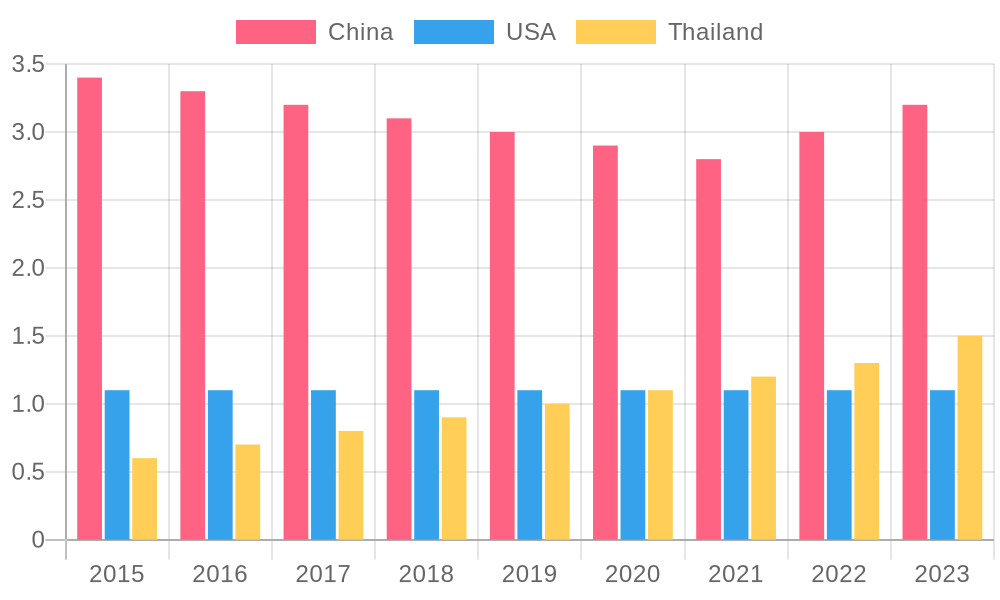
The truck tire production landscape has shifted significantly over the last decade, particularly concerning China, the United States, and Thailand. China remains the largest manufacturer; however, its production has seen a downward trend, while Thailand has experienced growth in its production capacity.
Truck Tire Production Statistics (2015-2023)
Below is the bar chart illustrating the production statistics:
Summary of Production Data
Here’s a brief overview of the production figures:
| Year | China (Million Tires) | USA (Million Tires) | Thailand (Million Tires) |
|---|---|---|---|
| 2015 | 3.4 | 1.1 | 0.6 |
| 2016 | 3.3 | 1.1 | 0.7 |
| 2017 | 3.2 | 1.1 | 0.8 |
| 2018 | 3.1 | 1.1 | 0.9 |
| 2019 | 3.0 | 1.1 | 1.0 |
| 2020 | 2.9 | 1.1 | 1.1 |
| 2021 | 2.8 | 1.1 | 1.2 |
| 2022 | 3.0 | 1.1 | 1.3 |
| 2023 | 3.2 | 1.1 | 1.5 |
Note: The data highlights that while China’s production peaked at 3.4 million in 2015, it has gradually decreased, and the production stability in the USA contrasts sharply with Thailand’s growth.
For more insights on the shifting market dynamics, you may learn more about current trends in used truck sales growth and the impact of tariffs on truck sales.
Implications for Fleet Managers Amid Reduced Tire Manufacturing in China
As the world grapples with supply chain disruptions stemming from China’s recent decision to reduce tire manufacturing, the implications for fleet managers are profound. This situation presents several challenges, including supply chain stability, increasing costs, and the consideration of alternative sourcing options. Understanding these dynamics is essential for fleet managers to adapt their operational strategies effectively.
Supply Chain Stability
China has been a significant player in tire manufacturing, accounting for a substantial portion of the global supply. As noted by a recent report from Bloomberg, a 12% drop in Chinese tire manufacturing volume has led to tighter global supply. Fleet managers now face longer lead times for procuring tires, with delays reported to exceed 30 days in some instances. This unpredictability stresses the importance of robust supply chain strategies.
To navigate this disruption:
- Diversify Suppliers: Many fleet managers are revising their procurement contracts to prioritize suppliers in Southeast Asia and Eastern Europe, thereby reducing dependency on the fluctuating Chinese market.
- Increase Inventory Buffers: Having additional inventory can help mitigate the effects of potential shortages.
- Invest in Predictive Maintenance: Implementing systems that integrate real-time tire usage analytics can optimize replacement cycles, thus reducing downtime.
Rising Costs
The reduction in tire output from China is likely to lead to increased costs for fleet managers. A study by Logistics Today indicated that companies employing diversified sourcing strategies reported up to a 20% reduction in tire spending by proactively managing supply risks and addressing delays before they impact production.
As costs rise, fleet managers must:
- Reassess Budgeting Strategies: Regular reviews of maintaining tire budgets against rising costs can help organizations stay ahead of financial challenges.
- Explore Alternative Materials: The current market dynamics also push for innovations, such as alternative materials and retreaded tires, which could yield cost savings over time.
Alternative Sourcing Options
With China’s tire manufacturing reduction, fleet managers have begun exploring alternative sourcing strategies. Environmental regulations and production shifts have intensified the need for fleet operators to secure reliable tire supplies.
Fleet managers are:
- Identifying Local and Regional Sources: Developing relationships with local suppliers not only reduces shipping times and costs but also supports regional economies.
- Engaging in Scenario Planning: Companies are employing scenario planning tools to better understand potential market shifts, aiding in proactive adjustments to procurement strategies.
Additionally, advancements in technology support fleet managers in adapting quickly to changes in the market. By implementing dynamic supplier risk scoring, managers can evaluate the reliability of potential suppliers more comprehensively.
Conclusion
As the tire manufacturing landscape shifts due to reduced production in China, fleet managers must respond with agility and foresight. By diversifying sourcing options, investing in predictive analytics, and optimizing budgeting strategies, they can mitigate risks associated with supply chain disruptions effectively. The evolving market environment presents both challenges and opportunities, and those who adapt strategically will ensure operational efficiency in this new landscape.
For further insights on the impacts of tariffs on procurement strategies, learn more about the effects of tariffs.
Alternative Tire Suppliers for Trucking Companies
As the global trucking industry navigates potential disruptions from changes in Chinese production, many companies are seeking alternative tire suppliers to ensure continuity in their operations. Here is a list of five viable tire manufacturers to consider:
-
Michelin (France)
A leading tire manufacturer, Michelin operates a plant in Tennessee, producing up to 1 million truck tires annually for the North American market. Known for their innovation and quality, Michelin tires are designed to enhance fuel efficiency and longevity. -
Goodyear (USA)
With a long history in tire production, Goodyear offers a wide range of truck tires tailored to various transport needs. Their extensive distribution network ensures rapid availability across the U.S. -
Bridgestone (Japan)
Bridgestone has increased production in its Mexican facility by 30% to meet rising demand, making it a reliable choice for trucking firms looking for resilient supply options. -
Hankook (South Korea)
Hankook provides high-performance tires with a focus on cost-effectiveness. Their reputation for durability makes them a preferred choice in many fleets. -
Continental (Germany)
With U.S. distribution hubs, Continental is ideally positioned for North American trucking companies. They leverage advanced technology for superior grip and fuel efficiency.
For a broader overview of tire supply trends, learn more about current trends in used truck sales growth and the impact of tariffs on truck sales pricing.
“The recent reduction in production capacities across major commodities in China has led to significant contractions in logistics demands. Trucking companies are now facing a double-edged sword with dwindling freight volumes and a competitive pricing landscape that is pushing profit margins to unsustainable levels. As the market adjusts, companies must embrace innovations such as electric trucks to maintain viability and adapt to new operational efficiencies.”
– Dr. Li Zhang, Logistics Expert at GBT Group
This quote reflects the growing concern among industry professionals regarding the challenges faced by the trucking sector in light of reduced production in China. As companies navigate this landscape, the adaptability towards sustainable practices will be essential for their survival. For more insights on related trends, explore our article on navigating economic uncertainties and the impact of 25% tariffs on heavy trucks.
Conclusion
As we delve into the current landscape of tire production in China, it is essential to recognize the significant role this country plays in the global trucking industry. In 2023, China’s total truck tire production reached approximately 395 million units, showcasing a steady growth from previous years, with an annual increase of around 4.5% (source: China Tire Industry Association). This growth reflects China’s position as the world’s largest producer of truck tires, accounting for 42.2% of global production. The dominance of Chinese tire manufacturers not only impacts pricing but also influences availability and the stability of supply chains across the trucking sector.
The implications for the trucking industry are profound. As the primary supplier of truck tires, fluctuations in China’s production capabilities directly affect tire availability, pricing structures, and ultimately, operational costs for trucking companies globally. For instance, any geopolitical tensions or trade restrictions could disrupt the flow of these critical components, leading to increased lead times and potential shortages. Such disruptions can have a cascading effect, raising operational costs and impeding logistics efficiency.
Given the current scenario, trucking companies and fleet managers must adopt a proactive approach in sourcing their tires. This involves ensuring more robust supply chains, considering alternative suppliers, and potentially diversifying their tire procurement strategies to mitigate the risks associated with over-reliance on a single market. As the trucking industry continues to evolve, adapting to market conditions and anticipating future challenges is not merely advisable but necessary for sustaining competitive advantage.
In conclusion, understanding the dynamics of tire production in China provides valuable insights for strategic planning in the trucking industry. As stakeholders look towards the future, it’s imperative to stay informed and be prepared for shifts in supply chain patterns. To bolster your operations amid these uncertainties, consider exploring our comprehensive insights on navigating economic uncertainties in the trucking market. Being diligent in tire procurement can enhance your operational resilience and ensure you remain ahead in the competitive freight landscape.
Protect Your Ride with Summit Fairings!
As a trucking company owner, fleet manager, or part of a procurement team, you are no stranger to the complexities of vehicle maintenance and safety. While the focus may often be on the performance and quality of truck tires, it is crucial to extend this concern to motorcycle safety-especially in urban environments where motorcycles and trucks frequently share the road.
Why Summit Fairings?
Summit Fairings offers innovative motorcycle fairings that not only enhance the aesthetic appeal of your bikes but also significantly improve safety features. With advanced aerodynamic designs and impact-resistant materials, these fairings cater specifically to urban delivery riders who must navigate congested city traffic safely alongside larger vehicles.
- Enhanced Visibility: Our fairings are designed with integrated LED lighting and reflective panels that increase visibility in low-light conditions. This crucial feature helps reduce the risk of accidents in busy urban areas where blind spots are a significant concern.
- Aerodynamic Stability: The fairings are crafted to minimize wind resistance, ensuring that riders maintain control at higher speeds, essential for urban commuting patterns influenced by commercial trucking activity.
- Safety Standards Compliance: Our products meet and exceed the updated guidelines from the National Highway Traffic Safety Administration (NHTSA) regarding fairing design near large trucks, reinforcing a commitment to rider safety.
In the fast-evolving landscape of the trucking industry-where changes like tariffs impacting truck sales and supply chain complexities are common-consider how important it is to safeguard your motorcycle assets. Whether you manage a fleet of delivery riders or are passionate about motorcycle safety, choosing Summit Fairings ensures you are making a proactive investment in safety.
Ready to enhance your riding experience? Explore Summit Fairings today and make an informed choice for safer riding!