
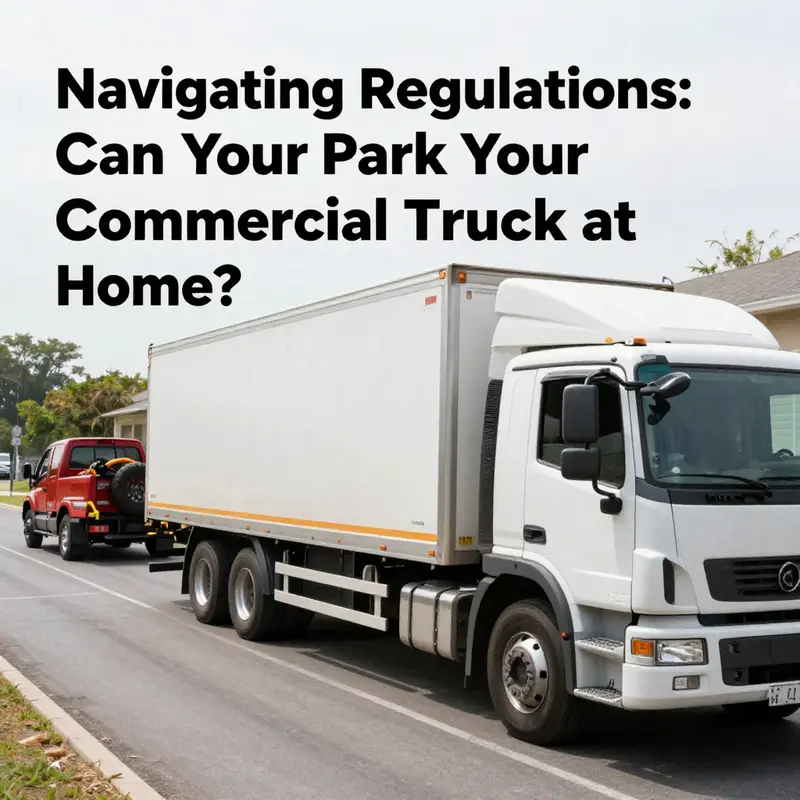
Parking a commercial truck at home is a multifaceted issue that hinges on local zoning laws, homeowners’ association regulations, safety assessments, vehicle legality, and potential repercussions for non-compliance. For trucking company owners, fleet managers, and procurement teams in various sectors, understanding these factors is crucial for responsible vehicle management. Each chapter of this article delves into a critical area of consideration, from examining local zoning laws to evaluating safety concerns and the implications of illegal parking. This structured approach aims to empower you with the knowledge necessary to make informed decisions regarding parking your commercial trucks at home.
Zoning Gatekeepers: Navigating Local Rules for Parking a Commercial Truck at Home
A driveway is a doorway not just to a home, but to a community’s rules about what belongs there. The wish to park a commercial truck on private property often collides with a patchwork of local zoning rules, HOA covenants, and safety considerations. The moment you ask, can I park my commercial truck at home, you are really asking: which jurisdiction governs this space, and what are the consequences of bending or ignoring those rules? The answer is rarely simple, and it typically sits at the intersection of land-use law, neighborhood aesthetics, and public safety. Yet understanding the landscape is essential, because it shapes every practical choice you make about home storage, your vehicle, and your own peace of mind.
At the core, most residential zoning regimes restrict overnight parking of commercial vehicles in a way that is both explicit and practical. A city may define a commercial vehicle as any vehicle used for business purposes, not merely those that haul goods or carry tools. That broad definition matters. A truck that carries a toolbox to a job site, or a courier van used for a home-based service, could be treated as a commercial vehicle even if it is idle in your driveway between assignments. The reason is straightforward: municipalities aim to maintain the character of residential neighborhoods, curb street traffic and noise, and ensure there is clear access for emergency services. The upshot is that while you may legally own and operate a commercial truck, keeping it parked in a residential zone—especially overnight—can trigger enforcement if it violates the local code. In practice, this means the default expectation in many places is “no large trucks in driveways after certain hours,” or “no commercial vehicles at all unless stored in a designated off-street area.” The language, the exceptions, and the exact definitions are what require careful parsing before you decide how to move forward.
Even when a jurisdiction does not flatly forbid parking a large vehicle on private property, it often conditions approval on where and how the truck is stored. A familiar pattern is the designation of an off-street storage area that is either fully detached from the main residence or sheltered within a garage or other structure. Some towns permit the occasional temporary parking of a commercial vehicle on a residential parcel, but only during daytime hours or for a limited number of days per week. Others restrict the storage of such vehicles to locations that are not visible from the street or sidewalks. Some municipalities allow a truck to stay in a driveway if it remains fully enclosed within a garage or similar structure; others may require a separate, fenced-yard or a dedicated storage lot on the property. The common thread is that visibility, duration, and the type of storage play pivotal roles in determining legality.
To navigate this landscape with any confidence, you must first map the jurisdictional terrain. Start with the zoning ordinance for your city or county. This is not a casual Google search; it means pulling the text from the local codes or the planning department’s online portal and cross-checking the definitions used for “commercial vehicle” and “storage.” The definitions can be surprisingly broad. The same ordinance might treat a pickup with a company decal differently from a heavy tractor-trailer parked in your driveway. It is not unusual for a code to distinguish between vehicles that are actively used for business operations and those that are simply stored. The latter, it’s often argued, should not disrupt neighbors or impede safety, but even a stored vehicle can fall under restrictions if it visibly alters the residential streetscape or blocks emergency access routes.
Alongside the zoning code, your HOA’s CC&Rs can vastly compound the puzzle. In many planned communities, HOA rules are more restrictive than city ordinances. The driveway or front-yard appearance, the size of the truck, whether it is allowed to be parked in a driveway at all, and whether it must be kept in a garage or behind a fence—it all may be dictated by the covenant language or architectural guidelines. In some cases, HOA rules reflect the neighborhood’s historical attempts to maintain curb appeal or minimize street-level noise, rather than to provide a precise legal framework for enforcement. The mismatch between city codes and HOA restrictions is a frequent source of confusion and a common reason to seek formal permission or an official interpretation before moving a vehicle onto the property.
If a truck is to be stored on home property in a way that complies with regulations, there often remains the question of permits or conditional use. In some jurisdictions, a special permit from the zoning board or planning department is required to park a commercial vehicle at a residence, even if the vehicle is not being actively used for business operations. This is a delicate path: the process can take weeks or months, depend on the municipality’s workload, and require detailed justifications about safety, traffic impact, and neighborhood character. In such cases, applicants typically present a site plan, show the off-street storage arrangement, demonstrate adherence to setback or sightline requirements, and explain how the vehicle will be used and stored in a manner that minimizes disruption to neighbors. Theoretically, if a permit is granted, the municipality might attach conditions such as restricted hours, signage to indicate the storage of a vehicle, or even periodic inspections.
With those complexities in mind, what steps should a homeowner take? First, contact the local planning or zoning department to request an official interpretation or a formal determination about parking a commercial truck on residential property. Bring concrete details: the truck’s size, weight, whether it is currently registered for commercial use, the exact location on the property, and any improvements to storage that might be proposed (for example, a detached garage or a fenced enclosure). Second, review the HOA CC&Rs with care. Even if the city code permits a certain arrangement, the HOA can deny or restrict it with little room for appeal beyond obtaining permission through its own processes. Third, assess safety and access considerations. Fire codes require clear access to a building and unobstructed egress for emergency responders. Parking a large vehicle near hydrants, driveways, or emergency access points can trigger compliance issues, fines, or mandatory relocation. If the property lacks convenient off-street storage, you may need to weigh alternate options such as parking at a workplace, using a private storage facility, or negotiating a different arrangement with the HOA or the city.
There is value in documenting your considerations and the steps you take. A written summary that includes the zoning codes you reviewed, the HOA restrictions, and any correspondence with municipal staff can prove helpful if questions arise later. It is not unusual to visit the planning office, request a code reference, and leave with a copy of the language that applies most closely to your situation. If you obtain a permit or an official determination, keep it with your property records and be prepared to comply with any stated conditions. If you do not obtain permission, it is wise to respect the letter of the law and explore alternatives before proceeding, to avoid fines, notices, or the risk of enforced removal of the vehicle.
The practical takeaway is not to assume a truck can be parked at home simply because it fits on the driveway or because you are the owner of the property. The rules are context-specific and multi-layered. Even a vehicle that appears to be idle may be regulated as a commercial vehicle if it’s used for business or bears business insignia. The process of determining legality can feel tedious, but it is precisely this diligence that preserves harmony with neighbors and protects you from avoidable penalties. If you discover that the local code allows a form of residential storage, you may still decide to modify your approach to align with the highest standard of safety and aesthetics—perhaps preferring storage in a garage or a fenced, off-street area that remains hidden from sight. If the codes do not permit such storage, you will be left weighing alternatives like on-site business facilities, parking at a business site, or renting off-site storage.
As you navigate the maze, keep in mind that the objective of zoning and HOA rules is not to penalize owners but to maintain safety, property values, and community character. A well-documented path to compliance can actually reduce friction and provide a clearer route to using your vehicle in ways that fit your life and your neighborhood. The tension between personal practicality and collective standards is real, but it is not insurmountable. It often ends up with a solution that respects the statute and serves the owner’s needs—whether that means a permitted storage arrangement, a conditional use approval, or a strategic rethinking of where and how the truck is kept.
For readers seeking a practical perspective that complements the legal and regulatory lens, consider a deeper dive into industry insights and case studies on vehicle storage and regulation in broader contexts. See mcgrathtrucks.com/blog/ for a perspective that ties policy considerations to real-world fleet management and ownership decisions. Engaging with this broader dialogue can illuminate how similar communities balance access, safety, and neighborhood character in ways that are informative even when the specifics of one city differ from another.
Ultimately, the most reliable path is to obtain official confirmation from the local authorities and to review the HOA’s governing documents before making a decision. If the answer is no, you will still have actionable options to keep your operations efficient and within the bounds of the law. If the answer is yes, you’ll have a clear framework—conditions, timelines, and responsibilities—that make it easier to maintain compliance and avoid disputes. The goal is not to avoid the hard questions but to address them head-on with information, a careful plan, and a willingness to adjust as required. The road to a compliant solution begins with a simple conversation with the planning staff and a thorough reading of the codes that govern your street, driveway, and home. From there, a practical, safe, and neighbor-friendly arrangement can emerge, allowing you to benefit from the convenience of home-based storage without compromising the community’s standards or your own peace of mind. External and internal resources will help you chart the course, but the first step remains the same: know the rules, verify them, and choose a path that keeps your home and neighborhood in balance over the long haul. See the external resource below for a concrete example of how one city codifies these concerns and the kinds of provisions that commonly appear in residential zones: City of Los Angeles Zoning Code – Section 17.28.040 (Commercial Vehicles)https://www.lacity.org/document/zoning-code-section-17-28-040-commercial-vehicles
HOA Gatekeepers and the Driveway Dilemma: Navigating Parking a Commercial Truck at Home
A homeowner may wake one morning to a simple question with outsized consequences: can a commercial truck be parked on private property in a residential neighborhood? The instinct to keep a vehicle that powers a business close at hand is understandable, especially when schedules tighten and every mile saved matters. Yet the quiet authority of many homeowners’ associations (HOAs) can act like a gatekeeper, shaping what looks possible and what merely feels practical. The answer, more often than not, rests on the exact language tucked into the community’s governing documents—the CC&Rs, bylaws, and any amendments or guidelines that spell out how property is used and how vehicles may be stored. In these documents, the balance between personal need and neighborhood harmony is negotiated long before any driveway is measured against a truck’s length. Understanding that balance is essential before moving forward, because even a well-intentioned plan to park a large vehicle at home can collide with a rule that seems technical on the surface but carries real consequences for compliance and finances.
In most HOA communities, the concept of a “commercial vehicle” is defined not by a business license or the rider’s intentions alone, but by criteria that the association applies consistently. A common threshold is the gross vehicle weight rating (GVWR) above a certain figure, often around 10,000 pounds. If a vehicle falls into that category, many CC&Rs treat it as a commercial vehicle, regardless of whether the owner uses it primarily for business or personal reasons. This distinction matters because some HOAs ban parking large vehicles in visible areas—driveways, front yards, or curbside spaces—primarily to maintain aesthetics, curb appeal, and a sense of safety and predictability in the streetscape. The mere label of “commercial” can trigger restrictions that make a practical decision feel illegal or at least impractical.
And the inspection list does not end there. Some communities extend their reach beyond weight classifications and look at how the vehicle is used. If a vehicle bears business signage, equipment, or hardware associated with commercial operations, the rule may be triggered even if the weight is modest. Other HOAs may rely on appearance and visibility to determine what is permissible; a truck that dominates the driveway or can be seen from the street can become a focal point for complaints, irrespective of its usage. In these cases, the rules hinge on perception as much as on function. The effect is not merely punitive; it is designed to protect neighborhood character and minimize potential disruptions to neighbors, such as noise, traffic, or the visual clutter that some residents fear when a large vehicle sits in plain sight.
With that framework in mind, it is crucial to read the CC&Rs with care and to speak with the HOA board or management company before taking any concrete steps. Violations of parking rules can carry a range of consequences—from formal notices and fines to restrictions on future use of the property or even legal remedies pursued by the association. The risk is not simply a monetary penalty; it is the possibility of forced removal of the vehicle or ongoing enforcement actions that can strain neighborly relations and create ongoing tension in a neighborhood. Fortunately, many associations recognize that circumstances change and that some residents might require occasional access to larger vehicles. While this awareness translates into potential exceptions, it rarely translates into guaranteed approvals. The board’s discretion is real, and it often hinges on the specifics of the case, the timing of the request, and any accommodations the owner can propose to reduce visual impact or improve safety.
For anyone considering parking a commercial truck at home, the first practical step is a careful audit of the governing documents. Obtain the CC&Rs, any supplementary guidelines, and amendments that address vehicle storage, parking, and exterior appearance. Look for definitions of “commercial vehicle,” the exact prohibitions on driveways or front yards, and any allowances for off-street storage or enclosure. If the language is ambiguous, or if it seems to leave room for interpretation, seek clarification from the HOA board in writing. A concise, documented inquiry often yields a formal answer that can calm uncertainty and set expectations for both sides.
Once you have a clear picture of the rules, approaching the board with a well-prepared proposal improves your odds of a favorable outcome. Proposals that reduce visual impact—such as keeping the vehicle out of sight behind a garage or within a fully enclosed storage area—address the core concerns that often animate HOA restrictions: aesthetics and safety. Demonstrating that a plan preserves curb appeal while maintaining practical access for your professional needs can help bridge the gap between compliance and accommodation. Corroborating your request with evidence of safe operation—proper parking practices, clear access for emergency services, and adherence to local fire codes—can also strengthen your position.
Even with a strong plan, though, there may be a need to explore alternatives. If an HOA is firm about prohibitions or tight restrictions, owners sometimes petition for a variance or seek an amendment to the CC&Rs. Variances are not guaranteed; they depend on the board’s assessment of risk, precedent, and the potential impact on neighboring properties. An amendment, while a longer process, can create a broader, more predictable path for residents with similar needs. In some cases, residents choose to store the vehicle off-site, at a commercial facility or in a dedicated storage space managed by a third party. These options shift the burden from the home itself to an external solution, but they can offer reliability and peace of mind that the home remains in strict compliance.
Importantly, HOA considerations do not exist in a vacuum. Local zoning regulations and safety codes intersect with HOA rules in meaningful ways. Even if the association grants permission, a city or town zoning ordinance may still limit parking of large vehicles in residential areas, or require clear access for fire apparatus and emergency responders. The tension between different layers of regulation is not unusual in communities with mixed-use or evolving zoning patterns. A careful, layered approach—consulting the planning or zoning department in addition to the HOA—reduces the risk of conflict and ensures your plan aligns with both community standards and public safety obligations. The practical upshot is that the path to parking a commercial truck at home is rarely a single leap; it is a sequence of informed steps that honor the letter of the CC&Rs, the intent behind the rules, and the realities of daily life.
As you navigate this terrain, it can be helpful to anchor your decisions in the broader context of the trucking industry’s dynamics. For instance, understanding market trends, capacity planning, and fleet-management considerations can inform how you approach custody of the vehicle and the location from which you operate. To gain broader context on how market dynamics influence fleet decisions, consider reading about Navigating economic uncertainties in the trucking markets. This perspective can shed light on why owners may seek proximity to home for operational efficiency while still respecting the constraints imposed by HOAs and zoning.
Ultimately, the safest and most reliable course is to secure official confirmation before proceeding. If the HOA approves a plan, get it in writing and keep a copy with the vehicle’s registration documents and any correspondence related to the request. If the answer is no, treat it as a design constraint rather than a defeat, and explore compliant configurations or off-site storage options that still align with your business needs. In all cases, maintain open, respectful communication with neighbors and the HOA board, document safety measures, and stay informed about any changes in CC&Rs or amendments. The value here is not merely legal compliance; it is the preservation of property values, neighborly trust, and a sustainable balance between professional obligations and residential harmony.
For readers seeking a reliable external reference on HOA governance and restrictions, the National Association of Realtors provides comprehensive guidance on homeowners’ association rules and restrictions. You can review their authoritative resource at https://www.realtor.org/real-estate-resources/housing-standards-and-regulations/homeowners-association-rules-and-restrictions. This page offers clarity on how HOAs operate, what typical covenants cover, and how homeowners can navigate disputes, petitions, and amendments with a focus on practical, real-world outcomes. The guidance from that resource complements the chapter’s emphasis on careful reading of CC&Rs, proactive engagement with board representatives, and the exploration of compliant storage or alternative arrangements when necessary.
null
null
When Home Yard Becomes a Truck Park: Navigating Law, Safety, and Practicality in Parking a Commercial Vehicle at Home
A home yard can feel like a sanctuary when you run a small fleet out of a driveway, but the promise of convenience quickly collides with real-world constraints. The question of whether you can park a commercial truck at home is less about a single rule and more about a web of local regulations, community covenants, and safety obligations. You may picture mornings spent loading gear, checking fluids, and stepping into a truck that is always ready to roll. Yet before you turn your driveway into a designated park for a heavy vehicle, you must consider not only the legality but the potential consequences for neighbors, emergency access, and your own liability. This chapter unpacks those factors in a way that respects the broader topic of can I park my commercial truck at home, offering a practical lens on what it takes to make a decision that is both feasible and responsible.
The first hurdle is almost always local zoning. Zoning rules regulate what kinds of vehicles can be parked in residential areas, and they vary widely from one city to another. In some places, residential districts simply do not allow large or commercial vehicles to be stored on private property in ways that are visible from the street. Even if your property seems privately contained, the underlying zoning designation may preclude the activity or impose strict restrictions on size, duration, or enclosure. The key step is to contact the planning or zoning department and request an explicit determination for your specific address. Relying on assumptions can lead to unexpected fines, enforcement notices, or the requirement to remove the vehicle entirely. This is not just a technicality; it is a working definition of what your neighborhood considers a residential use and what it does not.
Beyond municipal codes, the rules can be layered within a homeowners association or other community governance structure. If you belong to a neighborhood governed by CC&Rs, your HOA or management company may impose additional limits on where large trucks or commercial vehicles can be parked. These rules are not merely cosmetic. They can address driveway visibility, the impact on curb appeal, and the practical needs of snow removal, drainage, and access for emergency crews. HOA covenants are legally binding, and they can be legally enforceable even when the property is privately yours. The net effect is that, in many communities, a private space may still be off-limits for a commercial vehicle, regardless of what the municipal code allows in theory. A careful read of the CC&Rs and a direct conversation with the HOA board can prevent later conflict and help you explore compatible alternatives.
Even if both local zoning and HOA rules permit storage of a commercial vehicle on your lot, safety remains a live and guiding concern. The logic is straightforward: a large truck parked in a residential setting alters fire routes, pedestrian pathways, and the everyday flow of traffic around your home. Fire codes emphasize unobstructed access to buildings and to emergency services. In some jurisdictions, a vehicle that blocks a fire lane or an accessible exit can trigger penalties and orders to move or remove the vehicle. Even without a formal prohibition, there is a moral and civic obligation to ensure that your truck does not create hazards for neighbors. This is more than a compliance checklist; it is about balancing the convenience of at-home storage with the safety of the broader community. If your driveway or street access proves narrow, or if the truck requires a long turning radius that could encroach on sidewalks or crosswalks, those factors merit serious evaluation before parking begins.
A critical aspect often overlooked in the planning stage is the vehicle itself. Parking a commercial truck at home is not simply about where it sits; it is also about whether the vehicle is technically compliant and properly maintained. A truck that is not properly registered or insured can expose you to legal risk, including penalties for unregistered or uninsured vehicles stored on private property. Maintenance is another pillar of safety and liability. Operators should adhere to the established maintenance framework for road transport vehicles, which encompasses regular inspections of brakes, tires, lights, and vital systems. Routine checks reduce the chance of mechanical failure that could cause an accident or spill on your property or in the surrounding area. The broader principle here is straightforward: a vehicle that travels on public roads is subject to a high standard of upkeep, and that standard applies whether the truck is parked in a commercial lot or a residential driveway.
The practical path to determining viability, then, begins with information gathering. Start by clarifying the exact permissible use of your property with the local planning or zoning office. Ask for written confirmation or guidance on any variances that may apply to your property type and address. Simultaneously, obtain a copy of any CC&Rs from your HOA, and request a definitive ruling on whether parking a large truck in your driveway, on a pad, or in a side yard is allowed, restricted, or prohibited. If restrictions exist, explore whether a formal variance, conditional use permit, or other official process could render a solution that suits your needs without triggering enforcement actions. When you document these steps, you create a roadmap that can be revisited if circumstances shift—such as changes in vehicle size, engine type, or usage patterns.
Alongside these regulatory considerations, you should mentally rehearse the day-to-day realities of living with a home-based truck. Consider how the vehicle sits within the overall curb appeal of your property and how it affects neighboring properties, including potential noise, exhaust, or glare from lights. Think about the storage requirements that extend beyond mere space; you will need a secure area that is well drained, free of leakage risks, and kept clear of debris. Organizing a designated parking area that minimizes runoff, protects pavement from heavy loads, and leaves clear escape routes for both residents and emergency vehicles can transform a potential legal hurdle into a well-managed operational solution. It is not enough to have permission to store a truck; you must also demonstrate that its presence does not degrade the safety and livability of the neighborhood.
The human element matters, too. A home-based truck can complicate everyday routines for family members, guests, and even service providers who need access to the home. A thoughtful approach considers how traffic flow to and from your residence changes with a truck present. If you share a driveway with a neighbor or if street parking is constrained, you may face disputes or complaints that escalate unless clearly communicated and governed by rules that have already received official approval. A proactive plan, often built in collaboration with the HOA and, where applicable, with local authorities, reduces the likelihood of friction and helps preserve good neighbor relations. The most successful arrangements balance practical needs with community standards, and they rely on written, authenticated guidance rather than informal assurances.
In the end, the core takeaway rests on a simple premise: parking a commercial truck at home is generally possible in principle but not guaranteed in practice. The challenge lies in aligning personal logistics with the layered fabric of local law, condominium or neighborhood governance, and safety obligations. It is not merely a question of whether you can do it; it is a question of whether you can do it without creating risk or friction. The responsible path is to obtain official confirmation from the local planning or zoning office and to secure a clear, written ruling from your HOA if one exists. Then, ensure that your truck itself is legally registered and insured, and commit to ongoing maintenance that aligns with industry standards. If you follow this sequence, you not only reduce the chance of penalties but also present a credible case for at-home storage to neighbors and officials alike.
For readers seeking broader context on how vehicle ownership and storage intersect with the trucking market, the blog section offers a centralized resource that explores related issues and practical considerations. Explore more at the blog.
If you need formal, up-to-date regulatory details, you can consult official sources such as the Ministry of Transport Regulations, which outline the framework for maintenance, operation, and permissible storage of road transport vehicles. This external resource provides authoritative guidance that complements the practical steps outlined above. Ministry of Transport Regulations
The Hidden Consequences of Parking a Commercial Truck at Home: Navigating Law, Safety, and Community Impact
parking a commercial truck at home may feel like a practical edge for a small operation or a busy owner-operator, but the decision sits at the intersection of law, safety, and community expectations. The convenience of having a truck close at hand can quickly collide with rules designed to keep neighborhoods orderly, safe, and accessible. The ensuing consequences are rarely purely financial; they ripple into daily life, insurance, property values, and neighbor relations. To grasp the full picture, it helps to see how different layers of regulation interact with the realities of operating a commercial vehicle in what is otherwise a residential setting. This is not a distant problem confined to a single city—many jurisdictions grapple with similar tensions, and the outcomes depend on the exact mix of zoning, HOA covenants, and local safety codes. When you weigh the option, you should imagine not only the benefits of proximity and reduced travel time but also the potential costs of noncompliance, disruption, and exposure to liability.
One of the most important and often overlooked risks is legal liability, even when the truck appears to be stationary and parked on private property. The logic is straightforward: a vehicle that obstructs a public roadway, sidewalk, or access point can create a hazard. If an accident occurs because a driver cannot maneuver around a parked truck, who bears responsibility? In a notable cross-border example, a 2024 incident reported by a major daily outlet described a driver who parked a used cargo truck on a rural road near his home without a designated parking space. Late at night the truck remained stationary, and another vehicle collided with it, causing a fatality. The court held the parked truck liable for the accident, citing its obstruction as the proximate cause, and the vehicle owner bore compensation responsibilities under the country’s compulsory liability framework. While this case originates in one jurisdiction, the underlying principle translates widely: a nonmoving vehicle that creates a hazard can trigger legal accountability and financial liability, especially if the vehicle lacks proper insurance or compliance with local requirements. This is a sober reminder that parking decisions carry more weight than mere occupancy; they can shape outcomes in ways that surprise property owners and operators alike.
Beyond the courtroom logic, the practicalities of local regulation frame what is possible in your neighborhood. Many cities and counties impose explicit limits on parking large commercial vehicles in residential districts. Some areas prohibit the storage of commercial vehicles within certain zones at all, while others allow it only with permits or under strict conditions. In rural and suburban settings, where infrastructure and enforcement resources may vary, residents have occasionally faced what are described as resource occupation fees or similar charges for using private spaces to park trucks. These fees are intended to recover costs for public services or perceived burdens on local infrastructure, but they can be contentious. The friction tends to intensify when enforcement appears selective or unduly punitive, prompting disputes between homeowners and the local authority or the HOA. The risk here is not merely monetary; it is the ongoing administrative burden of petitions, inspections, and potential legal challenges that can derail a business’s plans or erode neighborhood harmony.
Safety, of course, remains a central pillar of the argument against home parking. A large truck in a driveway or on a narrow residential street can impede emergency access. Fire engines, ambulances, or police cars must navigate around parked vehicles, sometimes within a matter of minutes. When a truck is idle near structures, the risk of fire, theft, or vandalism can increase, particularly if the vehicle lacks secure storage, lighting, or surveillance. Maintenance scenarios also creep into safety considerations. Routine checks, minor repairs, and refueling may require fuel spills, fumes, or open hoods in a way that disturbs nearby residents. The effects may be felt not just by neighbors who share the street but by individuals who live in adjacent units or across cul-de-sacs where air quality and noise can travel. Noise from idling engines, running generators, or routine maintenance can become a recurring source of complaints that escalate over time. In some communities, these concerns drive formal complaints to HOA boards or municipal authorities, leading to hearings, fines, or mandates to remove the vehicle from property altogether.
Environmental considerations round out the practical equation. Trucks generate emissions and fuel odors that, when concentrated in a residential setting, can affect air quality and comfort. The sounds of diesel engines, air brakes, or priority maintenance tasks can intrude on the quiet that many neighborhoods prize. In addition, routine activities such as refueling and exhaust-related maintenance raise questions about spill control, runoff, and proper disposal of fluids. In neighborhoods with older infrastructure, dust, grime, and the vibrations caused by heavy vehicles can affect exterior surfaces and landscaping, influencing property owners’ perceptions of value over time. The cumulative effect of such environmental and sensory factors often feeds into neighbor concerns, potentially culminating in formal complaints, negotiations with the HOA, or even the reconsideration of where a business operates its primary fleet.
Of course, the legal and practical realities intersect with the vehicle’s own status. A truck that is registered, insured, and compliant with local licensing requirements stands on firmer ground than a noncompliant vehicle. Parking an unregistered or uninsured truck on private property is a different category of risk altogether; it invites legitimate enforcement actions and can expose the owner to penalties beyond simple fines. The maintenance history of the truck can also affect how others view its presence at home. A poorly maintained vehicle may leak fluids, emit excessive noise, or become a magnet for pests, creating further concerns for the community and for the property’s owner who bears responsibility for maintaining a safe and secure dwelling. These realities show that the decision to park a commercial truck at home is more than a logistical choice; it is a governance problem that touches law, safety, finance, and social order.
In measuring the costs and tradeoffs, many operators consider the most beneficial alternative: a designated, compliant parking solution away from the home. A nearby commercial lot, a secured yard, or a professional storage facility can deliver predictable outcomes. Such arrangements are typically designed with better ingress and egress for heavy vehicles, proper lighting and security, and a regulatory framework that aligns with local zoning and HOA expectations. While these options require ongoing costs—rent, maintenance, and sometimes access fees—they can reduce the chance of sudden regulatory action, eliminate the ambiguity surrounding permit requirements, and shield households from conflicting claims about safety or nuisance. For owners already bound by contracts, licenses, and insurance policies, shifting to a formal parking arrangement can also simplify compliance reporting, streamline tax considerations, and reduce the risk of personal liability in the event of an accident or incident linked to the vehicle.
The decision to pursue home parking, then, should begin with a careful inventory. Before any symptoms of trouble appear—neighbors grumbling, a sudden HOA letter, or a new enforcement notice—an owner can take practical steps to map out the risks and determine the path forward. Start with the basics: confirm the exact zoning classification of the property and whether the residential use permits large vehicles on private land. Review the HOA covenants and restrictions for any explicit prohibitions, permit requirements, or conditional allowances. If there is any ambiguity, seek a formal interpretation or a written permit from the local planning or zoning department. It is prudent to gather inputs from multiple sources—the city or county zoning office, the HOA management, and perhaps a qualified attorney who understands transportation and property law. This holistic approach reduces the likelihood of later disputes and helps set realistic expectations about what is permissible and what is not.
A note on community relations reinforces the need for transparent communication. Neighbors often notice the presence of a large truck and its routine activities long before official actions emerge. Clear, proactive conversations about the truck’s schedule, maintenance routines, and steps taken to minimize disruption can defuse tensions. Offering to coordinate with neighbors on access routes, timing of maintenance, and shared use of driveways during peak hours can transform potential friction into cooperation. In many cases, the mere act of documenting compliance—keeping maintenance logs, ensuring emissions standards are met, and maintaining a clean, well-lit area around the vehicle—helps reassure the community that the truck is a well-managed asset rather than a nuisance.
If you decide to explore the option further, remember that information is a powerful shield. The dialogue with local authorities and the HOA should be grounded in facts, not assumptions. A formal, written plan that outlines parking location, vehicle dimensions, maintenance practices, and mitigation strategies for noise and emissions can be a persuasive baseline for negotiations. It is also worth noting that formal parking arrangements can unlock potential benefits for the business—such as predictable scheduling, easier access for deliveries, and the possibility of tax or insurance considerations tied to a dedicated fleet parking solution. Yet these benefits must be weighed against the ongoing costs and obligations that come with compliance and upkeep. The broader takeaway is that the home should not be treated as an unmanaged parking space but as a regulated space whose use reflects the responsibilities of both the business and the community.
For readers seeking further practical guidance that translates these concepts into actionable steps, the industry blog landscape often provides useful case studies and policy summaries. A reliable starting point is the local industry blog, which aggregates insights about vehicle parking, zoning interpretations, and community responses. This resource can help delineate the difference between allowed practice and prohibited activity across different jurisdictions. See the McGrath Trucks blog for more on how operators navigate these issues and place them in a practical, business-oriented context.
In sum, the decision to park a commercial truck at home is not merely a logistical choice; it is a legal and social negotiation. It entails weighing potential liability in the event of an accident, understanding the exact reach of local zoning and HOA rules, considering safety and environmental impacts, and evaluating the financial implications of penalties or fees. It also invites a forward-looking assessment of safer, compliant alternatives that reduce risk while preserving the operational advantages of proximity. The aim is not to discourage entrepreneurship, but to encourage a disciplined approach that respects the rules designed to keep communities safe and functioning smoothly. By treating the home as a regulated space and seeking formal guidance before parking, operators can protect themselves, their families, and their neighbors while preserving the continuity of business activities. For those who choose to pursue home parking, documenting compliance, maintaining open lines of communication with authorities and neighbors, and planning for contingencies are essential habits that will serve as a steady compass through the complexities of local regulations and community expectations.
External reference: People’s Daily article on parking-related liability
Final thoughts
In conclusion, while parking a commercial truck at home might seem straightforward, navigating the complex landscape of local regulations, HOA rules, and safety considerations makes it a nuanced decision. Fleet managers and trucking company owners must conduct thorough research and consult with local authorities and HOAs. This proactive approach not only mitigates the risk of penalties but also ensures community safety and compliance. Ultimately, responsible management of commercial vehicle parking can lead to enhanced operational efficiency and alignment with legal standards.