
In the trucking industry, effective communication is paramount, especially for commercial truck drivers who navigate complex environments daily. One critical aspect of communication is language proficiency. This article examines the importance of English proficiency for commercial truck drivers, particularly focusing on requirements set by regulatory agencies, safety implications, workplace expectations, and the broader cultural impact. Each chapter will provide insights that equip trucking company owners, fleet managers, procurement teams, and logistics firms with a comprehensive understanding of this vital issue.
Speaking the Road: English Proficiency and Safety in Commercial Trucking
On the surface, the life of a commercial truck driver is about miles, engines, and schedules. Yet language is the practical tool that keeps the road safe and moving. English proficiency is not just a credential but a working capability that supports safety, efficiency, and clear communication with dispatchers, law enforcement, mechanics, and other road users. The question Do commercial truck drivers have to speak English is really about how language shapes decision making under pressure and how safety culture is built in a high stakes environment. This is a policy and safety issue that affects every lane of the highway.
FMCSA sets expectations for English use in safety related tasks rather than issuing a single universal test. In practice the regulation requires drivers to read, write, speak and understand English well enough to perform crucial safety tasks and absorb and act on safety information. The emphasis is on functional English the ability to interpret road signs understand shipping documents and communicate clearly with regulators dispatchers and roadside personnel when a situation demands quick and precise exchange of information. For many employers and regulators this translates into a practical standard of English that supports predictable behavior and reduces miscommunication in high risk settings.
The importance of reading and comprehension is highlighted by the need to parse a stop sign at a difficult intersection, a hazardous materials placard, or the exact wording of a load manifest. These require more than passive understanding; they require real time processing and immediate action. Drivers must understand and respond to safety warnings, emergency instructions, or detours that appear on a changing route. The ability to communicate with others on the road whether a dispatcher adjusting a departure window a mechanic reporting a trouble code or a police officer directing traffic at an incident depends heavily on clear language. Without that capacity even a well tuned truck can become a risk.
Safety communication is practical and everyday. It shows up when reading a safety bulletin about weather driven reroutes understanding a bill of lading, and sharing information during routine checks. A driver who can understand a dispatcher who is relaying route changes can negotiate a new schedule without cascading delays. The communication loop runs from the moment a load is assigned to the moment it is delivered and English skills help keep the process moving and reduce errors that could cause delays or penalties.
Enforcement and policy trends show that language proficiency is treated as a core safety instrument rather than a separate credential. The landscape can vary by state and by carrier, but the through line is clear: language proficiency supports safer behavior and more reliable operations. Analysts describe the trend as a turning point for workforce development and safety culture, prompting discussion about training pathways and how to scale up language support without placing an undue burden on drivers or fleets.
Reality of the workforce acknowledges a diverse pool of drivers with varied language backgrounds. The English requirement sits alongside other safety and qualification measures. A constructive approach emphasizes practical English proficiency while offering training resources such as safety focused language courses, plain language safety notices, and mentoring programs that pair newer drivers with experienced colleagues who model clear communication.
Policy design can further emphasize accountability with opportunity. Employers can implement language support aligned with FMCSA expectations and regulators can ensure consistent fair application, including clear criteria and transparent progress measures. When drivers begin with limited English they can grow into roles that balance safety with career advancement, while fleets benefit from a skilled workforce that delivers accurate information and precise execution. Official guidance from the FMCSA remains the anchor point for understanding what is expected and how progress will be measured.
Ultimately the purpose of English proficiency in trucking is safety. The road is a shared space and clear concise communication reduces misinterpretation, speeds up resolution during roadside inspections, and helps keep delays from cascading across the supply chain. The conversation continues as the industry evolves, but the core idea is steady: strong English skills help drivers read, decide, and act with the confidence that keeps people safe and freight moving.
English on the Road: How Language Fluency Shapes Emergency Response, Liability, and the Safety Net for Commercial Truck Drivers
On the open highway, where miles roll away in the span of a shift and every minute can determine outcomes in a crisis, language emerges as a surprisingly decisive safety feature. The thread that ties together safe navigation, rapid emergency response, and legally sound operations is not speed, weight, or fuel economy alone; it is the ability to communicate clearly in English. The federal framework that governs commercial motor vehicle operations makes this explicit in its safety expectations. The Federal Motor Carrier Safety Administration (FMCSA) requires that all commercial motor vehicle drivers be able to read, write, speak, and understand English well enough to communicate effectively with law enforcement, emergency personnel, and other road users. This is not merely a classroom benchmark; it is a practical safety standard embedded in how information is exchanged on the road during routine interactions, as well as in the high-stakes moments when accidents occur or roadside hazards are encountered. The emphasis rests on functional English proficiency—enough to understand signs, safety instructions, and the commands or questions that arise during encounters with authorities or first responders. The policy landscape over the past few years has underscored this point, with enforcement patterns signaling that language skills are a core element of operational safety, liability management, and regulatory compliance.
In practice, the English requirement translates into a driver’s ability to absorb and act upon critical information quickly. Consider the typical sequence of an emergency response: a collision or a breakdown triggers rapid dispatch of police, fire, or medical services; the driver must relay essential details—location, number of injured persons, nature of injuries, hazards, and traffic conditions—in a language that responders understand unambiguously. Signage on highways, safety instructions in manuals and cargo documentation, and the forms that must be completed at the scene all assume English literacy and comprehension. When a driver cannot communicate in English in those moments, the consequences can cascade: delayed reporting, misinterpretation of hazards, incorrect directions to accident sites, or incomplete handoffs to arriving responders. Such breakdowns do not just complicate investigations; they can erode the safety net that protects motorists, pedestrians, and the drivers themselves.
The legal and safety implications of limited English become especially pronounced in the aftermath of incidents. If an accident occurs and the driver cannot communicate in English, there is a strong risk that they may be deemed legally unqualified to operate a CMV under the safety criteria that agencies and insurers rely upon. Liability calculations, insurance claims, and regulatory actions are all affected by the driver’s ability to articulate what happened, what injuries or hazards exist, and what steps were taken in the moments before and after the incident. In practice, a lack of English proficiency can complicate investigations and weaken the driver’s and the company’s position when determining fault, assessing damages, or negotiating settlements. The emphasis on English in emergency contexts aligns with a broader safety philosophy that views clear, immediate communication as a shared responsibility among drivers, carriers, and public services. It is not merely about passing a test; it is about ensuring that critical information is conveyed with precision under pressure, so responders can act without delay and investigations can proceed with fewer ambiguities.
For drivers who are not native English speakers or who have only a functional command of the language, the safety calculus can feel daunting. The emphasis on English in emergencies does not erase the realities of linguistic diversity in the trucking workforce. Instead, it foregrounds a necessary safety gap that carriers and regulators must address through practical, safety-centered strategies. Training programs that emphasize spoken and written English related to safety protocols—how to describe a hazard, how to report a location, how to interpret a dispatcher’s instructions—become core components of onboarding and ongoing safety culture. Such training helps ensure that drivers, regardless of their background, can perform essential safety tasks with confidence. Beyond formal training, many fleets adopt procedural supports that reduce language barriers during emergencies: standardized checklists in plain English, visual aids that complement verbal instructions, and clearly defined escalation paths to reach a supervisor or translator when time allows.
The policy environment surrounding these requirements is dynamic. While there is no universally mandated federal English proficiency test for every driver, the FMCSA and related agencies emphasize functional English comprehension as a non-negotiable safety capability. In 2025, regulatory signals intensified around language proficiency in enforcement terms, with reports describing stricter policies designed to ensure that drivers who fail English language assessments face disqualification from operating CMVs. Bloomberg reported that more than 9,500 drivers were removed from service under these heightened scrutiny measures, with certain states like Texas and Wyoming bearing notable impacts. Such figures illuminate how language proficiency has moved from a peripheral concern to a central element of safety compliance and workforce management. The shift underscores a broader recognition: English competence is not merely about paperwork or compliance per se; it is a practical tool that enables faster, more accurate emergency communications, better coordination with responders, and clearer accident reporting. The Department of Transportation’s guidelines provide a formal anchor for these expectations, illustrating how safety-related communication is intended to function during critical events. It is through this lens that carriers, drivers, and regulators view language as a safety feature—one that supports timely action, reduces ambiguity, and helps align tactical responses with legal and insurance requirements.
The integration of language considerations into safety practice invites a broader perspective on how fleets prepare for emergencies. Carriers may implement multilingual safety briefings and bilingual incident reporting templates that preserve the clarity and fidelity of critical information. They may also cultivate a safety culture that values plain-English communication in the cab, paired with quick access to translation resources for non-emergency tasks. The key is not to substitute linguistic diversity for safety rigor but to ensure that the safety-critical exchanges—those that occur in seconds and save lives—occur in a language that responders foremost understand. In this context, English serves as the common operating language that unifies disparate teams, from the driver to the dispatcher to the first responders at the scene. It allows a driver to convey hazard classes, weather conditions, location identifiers, and the sequence of events with a precision that reduces the likelihood of misinterpretation. The same standard applies when a driver must describe the number of patients, the types of injuries, or the presence of hazardous cargo, all of which require accurate, unambiguous communication to ensure the right medical and logistical responses.
From the perspective of public safety and corporate responsibility, the requirement to speak English for emergency communication also intersects with risk management and insurance strategy. Insurers examine the driver’s ability to provide consistent, accurate information in the event of a claim. If a driver cannot communicate clearly, insurers may view this as an elevated risk, potentially influencing coverage terms, premium calculations, and settlement outcomes. For carriers, the implications are practical as well: safer, clearer emergency communications can shorten response times, reduce the severity of incidents, and help preserve operating licenses and fleet productivity. The alignment of language capability with emergency response protocols is thus a core part of the safety value chain—one that connects how information is captured at the moment of crisis to the longer arc of regulatory compliance, liability management, and operational continuity.
For readers navigating the broader landscape of trucking policy and market dynamics, it is useful to consider how language requirements fit into a larger mosaic of safety, regulation, and market fundamentals. A contemporary analysis of trucking markets emphasizes that policy shifts, enforcement practices, and workforce demographics interact to shape safety outcomes and operating risks. For a deeper look at how these dynamics unfold across North America, see the analysis on Navigating Economic Uncertainties: Key Insights from the Canadian and US Trucking Markets. This resource, though broader in scope, reflects how regulatory expectations and labor considerations converge to influence day-to-day safety practice on the road. Navigating Economic Uncertainties: Key Insights from the Canadian and US Trucking Markets.
The Federal guidance behind these expectations is complemented by on-the-ground best practices that prioritize clear, concise, and timely communication. In emergencies, every second matters, and responders—whether police, fire, EMT, or roadside assistance—depend on drivers who can articulate essential facts precisely. The job of translating this requirement into everyday safety is shared: drivers must cultivate an English-enabled command of safety procedures; dispatchers must craft clearer emergency instructions; and carriers must invest in training and tools that minimize the cost and complexity of language barriers without compromising urgency or accuracy. The result is a safety ecosystem in which language is not an adversary to efficiency but a conduit for faster, safer decision-making. As the regulations evolve, the focus remains unambiguous: English proficiency, in its practical form, underpins reliable emergency communications, supports defensible investigations, and helps ensure that the safety net around commercial trucking remains intact for both the drivers who operate the vehicles and the communities that share the same roads.
For those seeking the official regulatory backbone, the Department of Transportation guidelines offer a comprehensive reference for how safety-related communication should function in practice. The emphasis on clear, effective, and timely information exchange is a reminder that safety is not a static checklist but a dynamic process that requires ongoing attention to language, training, and emergency preparedness. In this sense, the English-language standard serves as a practical shorthand for a much larger safety imperative: that every message—whether it’s a routine instruction or an emergency directive—arrives at its destination with the same degree of clarity, accuracy, and urgency. This is the core reason why language proficiency remains a central pillar of safety, liability management, and regulatory compliance in the modern trucking industry.
External resource for further reading: https://www.transportation.gov
English on the Road: How Language Policy Shapes Safety, Skill, and the Movement of the Trucking Workforce
Language is more than conversation on the highway. It is a shared safety system that lets drivers interpret warnings, read road signs, and respond quickly to emergencies. In the United States, the question of whether commercial truck drivers have to speak English touches the core of how safety standards, regulatory clarity, and day-to-day operations intersect. The regulatory arc in recent years has moved from a basic expectation of functional English to a more formalized framework that requires verifiable proficiency. This shift did not emerge in a vacuum. It grew out of concerns that clear, rapid communication is essential when big rigs encounter hazards on the road, during roadside inspections, or when crews must coordinate with emergency personnel and law enforcement. The central logic is straightforward: if a driver can read a hazardous materials placard, interpret an emergency instruction, and understand a dispatch message, the overall safety ecosystem becomes more reliable. A final rule issued by the Federal Motor Carrier Safety Administration in 2023 did not merely reiterate a vague standard. It clarified and strengthened the ability to read, write, and speak English well enough to communicate with law enforcement, medical personnel, inspectors, and other parties encountered during roadside stops or emergencies. The goal was explicit: reduce miscommunication, minimize delays, and ultimately prevent accidents that arise from language barriers. In practice, the rule places emphasis on functional competence—enough English to understand critical instructions, respond to warnings, and coordinate safety-critical actions when a vehicle is alongside the road or in a difficult situation. The regulation recognizes that safety is not just about vehicle maintenance or training manuals; it hinges on the moment-to-moment comprehension of signs, directives, and the spoken language used in urgent exchanges. The underlying premise is simple and widely accepted among safety professionals: a driver who can understand a standard set of safety instructions and warnings is less likely to misinterpret a message that could avert a dangerous outcome. The 2023 clarification aligns reading and speaking ability with the practical realities of modern trucking, where drivers frequently encounter multilingual customers, diverse dispatch backdrops, and a variety of enforcement scenarios. The rule confirms that safety-critical communication should function across a broad spectrum of contexts, including the roadside, the cab, and the immediate vicinity of a traffic incident. This is not a debate about language preference; it is a public safety framework built on the premise that clear communication saves lives. The enforcement landscape began to reflect this emphasis more aggressively in the following years. In 2025, the regulatory environment took a sharper turn with an enforcement posture that prioritized language proficiency as a discrete eligibility factor for operating CMVs. Reports from major outlets indicated that a sizeable number of drivers were disqualified when they failed English language assessments administered in connection with safety and compliance checks. Bloomberg reported that more than 9,500 truck drivers were removed from the road due to failing English proficiency tests, with Texas and Wyoming among the states most affected. While the precise scope of enforcement can vary by jurisdiction and prevailing policy priorities, the trend is unmistakable: language skills are increasingly treated as a core element of the driver credentialing and operational readiness apparatus. This shift reflects a broader understanding that safety is strengthened when every link in the chain—from the dispatcher to the roadside officer—can rely on a shared level of linguistic competence. The FMCSA’s final rule in 2023 explicitly states that drivers must be able to read, write, speak, and understand English sufficiently to communicate under typical roadside inspection conditions, including interactions with law enforcement, medical personnel, and other individuals encountered during emergencies. The purpose is to ensure that the critical information conveyed during a stop is not lost in translation. Consider the kinds of situations drivers face that underscore the importance of English proficiency. A driver may need to read a hazardous materials placard, interpret a malfunction alert, or understand a maintenance bulletin issued in English. During a roadside inspection, the driver must describe the route, the load, and the symptoms of a vehicle issue to an inspector who may be coordinating with fire or emergency medical services. In a medical emergency on the highway, every second counts, and clear, unambiguous communication can be the difference between an orderly response and a delayed intervention. This is why the 2023 rule emphasizes a functional, not ornamental, command of English. It is not a barrier to entry but a safeguard for everyone on the road. The practical implications for non-native speakers are nuanced. The regulation does not require a pristine academic English credential; it requires enough proficiency to understand safety instructions, read documents, and communicate effectively in urgent situations. For many drivers, that implies some form of standardized testing or documentation of prior education conducted in English-speaking environments. The policy acknowledges that drivers arrive with a range of language experiences, from years of training in English-heavy environments to professional experiences accumulated in multilingual contexts. What matters is demonstrable competence that translates into safer road behavior and more reliable interactions with regulators, law enforcement, medical personnel, and fellow road users. The shift toward verifiable language proficiency has sparked a range of adaptations within the trucking industry. Employers increasingly seek assurance that their drivers can navigate English-language safety signage and how-to manuals, while also training new entrants to reach the required level of communication readiness. Training programs are being aligned with the regulatory expectations, emphasizing practical literacy and spoken communication tailored to real-world trucking scenarios. The practical effect for many fleets is a higher bar for onboarding, a more consistent standard across varied hiring pools, and a clearer framework for evaluating a candidate’s readiness to operate in a safety-critical environment. This transformation also has implications for the broader workforce and the supply chain. When a substantial portion of drivers must demonstrate English proficiency, training resources become more critical. Fleets may invest in targeted language support, on-ramp courses, and safety-focused literacy modules to help new drivers reach the required standards without delaying entry into service. The conversation around language and safety also intersects with the everyday realities of trucking culture. Many drivers thrive on practical know-how learned through on-the-job experience, and some may have limited formal training in English. The regulatory emphasis on functional proficiency recognizes this dynamic while ensuring that safety signals and critical instructions are universally understood. In the policy discourse, there is a growing expectation that the industry balances the needs of non-native speakers with the necessity of maintaining high safety expectations. The aim is not to penalize but to provide pathways—through testing, documentation of prior English-speaking education, and targeted language support—that enable all drivers to meet the safety standards without compromising the efficiency of the transportation network. The alignment of policy with practice is not instantaneous. The industry is still adapting to the nuances of enforcement, the availability of standardized assessments, and the logistics of documenting English-language education for drivers who trained abroad or in multilingual environments. Yet the trajectory is clear: English language proficiency is integral to the safety and reliability of long-haul operations. A driver who can read a dispatch instruction, interpret a bonding requirement for a hazardous materials shipment, or understand a clearance to pass through a toll plaza in English reduces the risk of miscommunication at critical moments. The FMCSA’s guidance remains a touchstone for carriers and drivers alike. For professionals and analysts who want to explore the policy landscape in more depth, the conversation extends beyond the rule text itself. Industry writers and analysts often examine how the regulation translates into day-to-day operations, what kinds of assessments are considered acceptable, and how fleets implement language training without becoming a bottleneck in hiring. The adaptive response of fleets has included the integration of language-focused safety briefings into daily pre-trip routines, the use of pictorial aids alongside English materials, and the deployment of bilingual mentors where appropriate to bridge gaps. These strategies aim to preserve safety while maintaining a diverse and skilled driving workforce. The narrative of language and safety in trucking is more than a compliance checklist. It reflects the broader reality of a nationwide transportation system that relies on clear, timely communication across languages and cultures. It is about ensuring that the moment a driver pulls onto the highway, every message from the road is understood, every sign is legible, and every instruction can be acted upon without hesitation. For readers seeking practical context or related analysis, resources such as mcgrathtrucks.com/blog offer industry perspectives that illuminate how policy debates translate into practice on the ground. You can explore that discussion here: mcgrathtrucks.com/blog. As the policy baseline firmed up in 2023 and enforcement dynamics evolved in 2025, the trucking ecosystem began to codify a shared expectation: English proficiency is a public safety instrument, not simply a credential. This does not erase the fact that trucking remains a diverse, multi-lingual field. It does, however, underscore that the safety imperative requires a consistent, verifiable standard of language comprehension and communication. The result is a transportation system that better supports responders, regulators, and road users alike. For those who want to understand the official framework in one authoritative source, the FMCSA’s final rule on English language proficiency provides the formal basis for these expectations and the mechanisms by which proficiency is demonstrated. The rule is part of a larger safety framework that continually adapts to new operational realities, ensuring that the highway system remains as safe as possible for all users. Official details can be found in government records, reflecting a policy that translates into everyday practice behind the wheel. For the official rule text and its implications, see the FMCSA Final Rule on English Language Proficiency. https://www.federalregister.gov/documents/2023/08/14/2023-17197/final-rule-english-language-proficiency
Fluent on the Road: Why English Proficiency Has Become a Safety Anchor for Commercial Trucking
On a long stretch of highway, a truck hums along while the questions about safety and accountability linger in the cab like a steady wind: does English proficiency truly matter for a professional truck driver? In policy terms, the answer is more precise than a simple yes or no. In the United States, language requirements are woven into the safety framework that underpins commercial freight movement. The FMCSA, the Federal Motor Carrier Safety Administration, requires that a commercial motor vehicle driver read, write, speak, and understand English well enough to communicate effectively with law enforcement, emergency personnel, and other road users. This is not a ceremonial stipulation; it is a functional standard that directly informs daily decisions made in congested urban corridors, at loading docks, and across rural routes where quick interpretation of a sign or a directive can avert a risky outcome. Although there is no universal written English proficiency test mandated for every driver, the practical implication is clear: a driver must grasp English instructions related to safety, such as those found on signs, documents, and during interactions with authorities. In practice, many employers and regulatory bodies interpret this as a functional command of English essential for safe operation on the road. The evolution of enforcement policy over time makes this emphasis even more visible. Under prior guidance from the Obama era, FMCSA inspectors were urged to issue warnings or citations for non compliance with English proficiency requirements, but they were not authorized to place drivers out of service on the sole basis of language deficiencies. Then, in 2025, an executive order directed by the administration led to a tightening of enforcement: drivers who fail to meet English proficiency standards could be removed from service. The impact was swift and measurable. Bloomberg reported that over nine thousand five hundred drivers were taken off the road nationwide, with states such as Texas and Wyoming bearing a substantial share of those impacts. The bottom line is simple in its consequence: language is a safety tool, and the failure to command functional English translates into a risk that can disrupt logistics, hinder emergency communication, and elevate liability for carriers charged with safeguarding public roads. This shift did not occur in a vacuum. It reflected a broader reorientation toward accountability in how safety is managed across the trucking industry, aligning enforcement with the practical realities of daily operations and the expectations of road users who must interact with commercial drivers in high-stress situations.
From the fleet perspective, the enforcement shift has reverberated through hiring practices, onboarding, and ongoing safety training. Carriers now face heightened accountability for the English capabilities of their drivers before dispatch and on a continuing basis. Some organizations have introduced pre hire English assessments, while others invest in targeted language training or prioritize applicants who already demonstrate fluency. The stakes extend beyond paperwork and compliance into the realm of operational effectiveness. A driver who cannot understand clear safety instructions or who cannot relay essential details during a roadside encounter creates a cascade of potential problems: misinterpreted hazard warnings, delayed responses to changing road conditions, or miscommunications with dispatch during adverse weather or traffic bottlenecks. Over time, those risks translate into tangible costs, from longer onboarding cycles and mandatory training programs to potential shifts in insurance considerations if a company knowingly employs non fluent drivers. The industry response is a blend of policy, practice, and culture that treats language capability as a core determinant of safety and reliability.
By 2026, the enforcement trend matured into a legal safety standard: if an accident occurs and the driver cannot speak English, that driver is considered legally unqualified to operate a CMV. This framing elevates the issue from a safety best practice to a regulatory criterion with direct legal consequences. The consequence for a fleet is not rhetorical; it shapes decisions at the point of hire, during orientation, and in the design of ongoing professional development. In practical terms, this means that recruiting and retention strategies increasingly incorporate language readiness as a non negotiable attribute, alongside more traditional determinants like driving record, hours of service compliance, and vehicle maintenance history. Some carriers have integrated language focused modules into orientation, paired new hires with mentors who help bridge gaps, and offered continuing education that targets safety terminology, road sign literacy, and real world communication drills. The overarching objective is not to erect barriers but to ensure that every driver can understand and convey essential safety information in real time as they navigate complex, dynamic road environments. The CMT safety record, incident response times, and the integrity of on road communication all hinge on this baseline capability, making language proficiency a tangible driver of performance and accountability.
What does functional English look like in the daily routine of a professional driver? It is the ability to read and interpret road signs quickly and accurately, to understand dispatch instructions even amid road noise and weather challenges, to document on forms or electronic logs with precision, and to communicate calmly and clearly with a law enforcement officer when required for identification, registration, or details about a trip. It includes listening to and comprehending radio messages, then translating them into decisive actions at the wheel. It also encompasses the comprehension needed to interpret safety data and hazard warnings that appear on placards or labels along a route, even if the driver never handles hazardous materials directly. This is not a matter of accent or nationality; it is about ensuring that the critical information guiding decisions in real time is understood without delay. The emphasis is on practical comprehension and the accuracy of real time translation of information into action, which is what keeps roads safer and trips on plan.
For fleets, the shift toward stronger language capabilities shapes every step of the operational pipeline—from recruitment through retention to risk management. Employers recognize that a robust English baseline reduces dispatch errors, supports safer decision making during lane changes and braking in heavy traffic, and improves the ability to coordinate with roadside assistance and enforcement when needed. In practical terms, this translates into more rigorous pre hire screening, followed by targeted language development, with a spotlight on safety terminology, road sign literacy, and scenario based communication training. It also fosters a cultural shift within teams that values clear communication, especially in settings where multiple generations and diverse backgrounds converge on a single route. When the workforce embodies strong communication practices, the whole supply chain benefits: shippers, carriers, brokers, and drivers can share accurate trip information from dock to dock, even under time pressure or disruptive conditions. For readers seeking broader industry reflections, the McGrathTrucks blog offers perspectives on how carriers are adapting to these shifts on the frontline and in daily operations, highlighting practical steps and real world experiences in the wake of evolving language expectations.
The policy evolution also invites reflection on broader questions around regional variation, workforce diversity, and the balance between safety imperatives and broad job access. The most visible signal in recent years has been the enforcement shift toward removing non fluent drivers from service, yet the underlying trajectory is consistent: safety and accountability are increasingly mediated through language capabilities. Fleets that adopt proactive language programs build a stronger safety culture, reduce the likelihood of miscommunication related incidents, and strengthen their compliance posture in the eyes of regulators, insurers, and customers. On the ground, new hires without demonstrated English fluency may spend more time in onboarding, while established drivers who need to refresh their language skills can access targeted training opportunities. The aim is not to erect barriers but to raise the baseline so every operator can perform essential tasks reliably under pressure. When language gaps persist, the risk is systemic: a single misread sign or misheard instruction can cascade into a delay, a safety incident, and a costly regulatory consequence that affects the entire network of stakeholders.
Looking forward, the interplay among language, safety, and liability is likely to continue shaping policy, training investments, and recruitment pipelines. The ultimate question is not whether English is preferred but whether it has become a verifiable safety standard that can be consistently implemented across diverse fleets and routes. The industry’s direction suggests that language proficiency will remain a core competency, closely aligned with other elements of professional practice in trucking. Drivers can expect continuing opportunities to strengthen their English skills through targeted training, while carriers will increasingly integrate language readiness into every facet of the employment lifecycle. In this evolving landscape, English proficiency becomes a practical credential that aligns the responsibilities of operating a heavy vehicle with the realities of a highly regulated, safety critical industry. The alignment is intended to deliver safer roads, more reliable service, and a workforce that can communicate effectively in moments when every second counts. For those who want to explore regulatory context further, see the official guidance referenced in the external standards: https://www.fmcsa.dot.gov/regulations/english-proficiency-requirements
Wheels, Words, and the Road Ahead: English Proficiency as a Safety and Culture Lens in the Trucking Industry
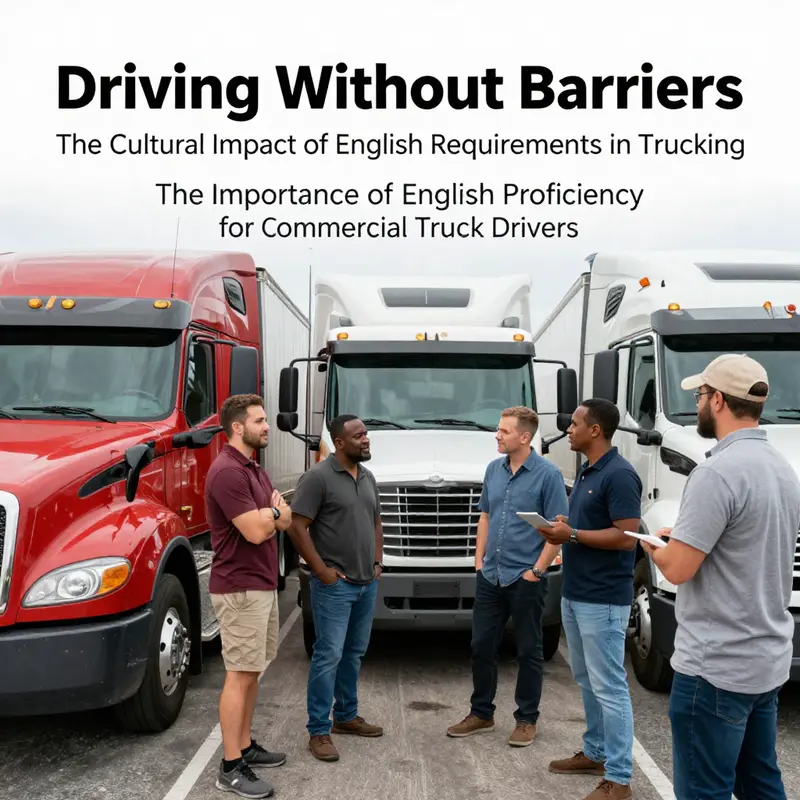
On the open highway, language moves with the traffic. In trucking, signs, dispatch orders, safety briefings, and conversations with dispatchers or law enforcement rely on a common operational vocabulary. In the United States, English proficiency is tied to safety, compliance, and professional practice. The FMCSA centers on functional English: reading road signs, understanding directives, and communicating critical information during stops or inspections, rather than mandating a universal written exam. This pragmatic approach shapes how fleets train, hire, and assess readiness for long-haul operations.
Beginning in 2025, intensified enforcement of English-language assessment rules reshaped the industry: thousands of drivers faced removal from service, impacting some states more than others. This pivot underscored language as a safety imperative and a workforce policy, while raising concerns about marginalizing capable drivers who excel at driving but struggle with formal tests or English-heavy documentation. The tension centers on balancing safety with inclusion and recognizing experiential fluency gained on the road.
Many fleets responded with bilingual supports, plain-language materials, and mentoring to bridge gaps, not just to check a box. The most effective programs combine rigorous safety standards with cultural intelligence, enabling diverse teams to communicate clearly while maintaining high safety performance. The chapter ends with a call for flexible, context-aware language development within fleets, leveraging technology, plain-language resources, and a culture that encourages questions and mutual respect.
Final thoughts
In conclusion, English proficiency is not just a regulatory compliance issue; it is a critical component that enhances safety, communication, and operational efficiency in the trucking industry. Understanding the requirements, both from a regulatory and cultural perspective, allows trucking company owners and fleet managers to make informed decisions about hiring practices, training programs, and safety protocols. It is essential to embrace the multifaceted implications of language proficiency in fostering a safer and more efficient transportation environment.