The landscape of commercial truck insurance is often viewed through the lens of high premiums and rigid policy structures. Yet, a nuanced understanding reveals a landscape ripe for negotiation. For trucking company owners, fleet managers, and logistics procurement teams, securing the best possible rates and terms on commercial truck insurance can lead to substantial savings and optimized operational coverage. Throughout this article, we will explore why negotiation in this field is essential, practical strategies for effective negotiation, key insurance elements you can negotiate, actionable strategies for achieving successful outcomes, and escalation options when negotiations become stagnant. Each chapter will enrich your understanding and empower you to take charge of your insurance strategy, driving both cost efficiency and comprehensive coverage.
Steering Toward Value: Negotiating Commercial Truck Insurance Rates for Better Coverage and Lower Costs
Negotiating commercial truck insurance is not a ritual you perform only when the renewal notice arrives. It is a disciplined practice that can align coverage with real risk, improve cash flow, and build a partnership with an insurer that values your safety records and operating discipline. In markets where premiums can feel opaque and underwriters guard their books, a fleet manager who negotiates with preparation gains not just a lower price, but a policy that truly fits daily operations on the road. This chapter weaves together the practical rationale for negotiation with a road-tested approach to doing it well, so your fleet pays for risk, not for assumptions about risk.
At the heart of the argument for negotiation lies the reality that traditional pricing models often lag behind actual operations. Vehicle type and age are reliable indicators, but they are poor predictors of current safety practices or real-world exposure. Telematics can reveal how drivers pace brake usage, how aggressively trucks accelerate, and how routes influence fatigue. Actual mileage, types of cargo, and the geographic mix of trips create a mosaic of risk far richer than a single premium might suggest. When you present insurers with concrete data—demonstrating strict adherence to safety protocols, systemized driver training, and a history of controlled claims—you are not merely asking for a discount. You are reframing the insurer’s view of your operation from a routine risk to a managed risk with a measurable risk-reduction program. This reframing, in turn, makes negotiation more about value than about price.
Information asymmetry often compounds the challenge. Brokers and carriers may keep certain pricing components—such as the exact impact of a specific deductible tier or the nuanced cost of cargo coverage—behind a veil. Negotiation becomes a tool to pry back that veil: to ask for the detailed cost breakdown, to request alternative coverage structures, and to verify whether discounts for safety technologies or clean driving records are being applied automatically or only after a request. There is a practical payoff to this approach. Experienced drivers with clean records can qualify for discounts that aren’t always baked into an initial quote. When you understand the full cost architecture of a policy, you can tailor coverage to your operations without paying for coverage you do not need.
Insurers also proceed cautiously with underwriting high-risk commercial fleets. This is not a conspiracy to keep prices high; it is prudent risk management in a market where losses from heavy trucks can be consequential. Negotiation becomes a pathway to transform a passive renewal into an active partnership. By presenting evidence of your safety program’s effectiveness and your claims history, you show the insurer that you are a responsible operator who can be trusted with a long-term relationship. This cooperative stance helps ensure that the final rate reflects both the true risk and the business’s commitment to safety and compliance. In other words, negotiation is not a tactic to extract margin; it is a process to align incentives between you and the insurer so that risk management and pricing move in lockstep.
To translate this philosophy into practice, begin with a rigorous appraisal of your own data. Collect three kinds of evidence. First, a safety and operations profile: driver hours, fatigue management, maintenance schedules, and the use of protective technologies such as telematics, collision-avoidance systems, and electronic logging devices. Second, a claims history that traces frequency, severity, and root causes, with an emphasis on corrective actions taken post-incident. Third, a risk-control plan that details driver training curricula, ongoing coaching, incident reporting, and escalation protocols. This dataset becomes the centerpiece of your negotiation narrative. It shows insurers where you stand, what you’ve improved, and where you are targeting further risk reduction.
Benchmarking is the companion to data. Market intelligence matters because you are not negotiating in a vacuum. Use online comparison tools and broker guidance to understand typical premiums for fleets of your size, with your cargo profile, and in your operating regions. The Zebra, Insurify, and Insurance.com are common reference points for broad market benchmarks, but tailored benchmarks—specific to truck types, freight origins and destinations, and regional risk—matter more when you sit across a table from an underwriter. When you can say, with confidence, that your rate is above or below the benchmark for a comparable fleet, you ground the negotiation in a shared reference frame rather than a purely subjective conversation about risk. An informed broker can be especially valuable here, translating benchmark data into concrete proposals and counteroffers.
As you prepare, outline the levers you want to pull. A comprehensive negotiation targets several elements: premium rate, deductible amount, coverage limits, policy exclusions, and add-ons or services that add real value. The likelihood of achieving favorable shifts increases when you approach each lever with a clear rationale tied to your risk-control measures. For example, a higher deductible typically yields lower premiums, but only if your risk management reduces the probability and cost of claims. If you can demonstrate tighter loss frequency due to proactive driver coaching and maintenance protocols, a higher deductible may be sustainable and economically advantageous. Likewise, you might adjust coverage limits for cargo or non-owned vehicles to better reflect actual exposure, avoiding a one-size-fits-all approach.
Packaging add-ons strategically can also yield dividends. Some insurers are willing to throw in value-added services—driver training programs, enhanced roadside assistance, or targeted risk-management consultations—at little or no incremental cost when you meet certain risk criteria. Such add-ons can improve operational resilience and reduce future costs, even if they do not immediately appear on the premium bill. The negotiation position strengthens when you demonstrate a plan for implementation and measurable post-implementation benefits, such as reductions in downtime after incidents or more consistent on-time delivery metrics due to improved driver performance.
The practical steps of negotiation are straightforward yet often underestimated. Gather three to five quotes from different insurers, including specialty carriers that focus on trucking. Present the competing offers to your preferred insurer as leverage for a match or beat. A broker with trucking expertise can broaden your options, providing access to a wider set of carriers and the inside track on how particular underwriters weigh your data. Time your renewal to when insurers are actively seeking to fill their books—often in the spring or late fall—and avoid renewals immediately after a major claim, when rates tend to rise anyway. These timing considerations are not tricks; they reflect the rhythm of the market and your own risk profile within that rhythm.
Policy details deserve equal scrutiny. Do you need cargo liability coverage, especially if you haul high-value freight? Are you protected for non-owned vehicles or for operations that involve lease-back arrangements with customers or contractors? Are there exclusions that could carve out coverage in a way that would hurt your actual risk profile? These are not abstract questions; they define the line between sufficient protection and a blind spot that could prove costly in a claim. When you examine policy terms closely, you may discover savings opportunities that are easy to miss—such as the ability to tailor cargo exclusions or to align endorsements with real routes and freight kinds. The objective is to blend practical coverage with prudent economics, ensuring that every dollar of premium funds genuine risk reduction rather than padding the insurer’s margins.
If a carrier resists adjusting key terms, escalation is appropriate but should be methodical. Request a discussion with a senior underwriter or account manager who can assess your data in the context of the carrier’s broader portfolio. If you still cannot reach a satisfactory arrangement, file a complaint with the state Department of Insurance or consider switching to another carrier that views your business as a stable, safety-minded partner. This is not about conflict; it is about ensuring your risk management investments are recognized and rewarded by the market. A disciplined approach to escalation protects your interests while preserving the possibility of a constructive, long-term relationship with your insurer.
Throughout this process, remember that the objective is not merely a lower price but a policy that aligns with the reality of your operations and supports safe, reliable service delivery. Your negotiation narrative—built on data, benchmarks, and a credible risk-control plan—turns the renewal into a strategic decision rather than a ceremonial transaction. For fleet operators navigating the complex terrain of commercial trucking insurance, negotiation is a core competency. It acknowledges that risk and cost are intertwined through a cautious market, but it also demonstrates that a well-prepared operator can steer toward value by communicating effectively with underwriters, leveraging market benchmarks, and making a thoughtful case for coverage that truly reflects the road you travel.
For further insights into the broader dynamics of negotiating insurance rates in trucking, see this industry discussion that examines practical steps and real-world outcomes: How to Lower Your Commercial Truck Insurance Rate.
Additionally, industry readers may benefit from related perspectives on how market conditions shape risk management and pricing across the trucking sector. A practical, field-tested approach to understanding risk, negotiating with calm, and building a durable coverage framework can be found by exploring the broader trucking market conversation and applying its lessons to your operations. As you implement these strategies, your goal remains clear: secure a policy that offers robust protection, aligns with your operational realities, and delivers tangible value over the life of the contract. In this sense, negotiation is not a side task. It is an essential discipline for drivers, fleet managers, and business owners who depend on consistent, cost-effective protection to keep moving forward. To deepen your understanding and draw connections to broader market trends, consider engaging with the wider trucking industry landscape and the economic context in which insurance pricing operates. And for a concise, practical view that speaks directly to fleet risk management, you may find it useful to explore the broader discussion around navigating economic uncertainties in the trucking markets.
Negotiating with Confidence: How to Secure Smart, Value-Driven Commercial Truck Insurance
Negotiating commercial truck insurance is not about chasing the lowest price alone. It is about aligning protection with the realities of your operation, your risk profile, and the reliability you bring to a carrier over time. When you approach the process with preparation and a clear sense of what you truly need, the dialogue becomes a collaborative problem-solving session rather than a zero-sum battle. The road to a smarter policy starts with market awareness and ends with a package that delivers both peace of mind and predictable costs. In practice, that means understanding the competitive landscape, translating your safety program into measurable savings, and communicating your business’s value beyond a single premium figure. The result is not merely a cheaper rate, but a better fit for today’s operations and tomorrow’s growth. A well-negotiated policy, then, acts as a strategic asset rather than a compliance checkbox, supporting uptime, driver welfare, and cargo security as your trucks roll across state lines and into complex logistics networks.
The first pillar of effective negotiation is market intelligence. The commercial trucking insurance market, like any specialized field, rewards informed buyers. While a quick quote can be appealing, you gain real leverage by collecting several detailed quotes from different carriers and evaluating them against the same baseline. You should look beyond the sticker price and examine coverage limits, deductibles, exclusions, and the quality of the claims process. This is where the broader scope of your operation matters: the mix of trailers, freight types, geographic exposure, and whether your cargo includes high-value goods or hazardous materials. These factors shape the true risk and the true value you receive. In practice, a well-researched buyer can identify reasonable market benchmarks and spot quotes that stray far from those benchmarks. A practical approach is to document the variances between offers in terms of who covers what, what the deductibles are, and how rapidly claims are adjudicated. A reader-friendly comparison sheet can prevent a misstep during negotiations and make it easier to articulate why one quote is a better fit for your business than another.
The second pillar centers on risk profile. Insurers set premiums largely based on the operator’s demonstrated safety and reliability. If your fleet has a clean driving record, a robust driver-training regimen, and a track record of low claims frequency, you enter negotiations with substantial credibility. Demonstrating the use of safety technologies—telematics that monitor speed and harsh braking, electronic logging devices that ensure compliance, adaptive cruise control, collision avoidance, and other advanced safety systems—translates into tangible premium relief. The same logic applies to training outcomes: documented programs that reduce incidents, such as defensive driving courses or simulator-based coaching, can justify lower rates or enhanced coverage. When you present data, pair it with narratives of how you respond to incidents and how you continuously improve. Carriers respond to evidence of proactive risk management, not just to promises of “being careful.” If your company operates in a lower-risk geographic zone or maintains more favorable vehicle utilization patterns, that context should be communicated clearly—it matters as much as any single statistic.
Technology and safety programs increasingly become the most credible currency in underwriting today. Many insurers offer premium discounts for fleets that adopt telematics, ELDs, GPS tracking, or driver-monitoring suites. These tools do more than record events; they enable proactive harm reduction. When a driver knows that harsh braking or speeding triggers ongoing coaching, the behavior of the entire fleet can shift over time. Presenting a concrete plan that links technology adoption to measurable outcomes—for example, a projected reduction in collision frequency by a given percentage over the next policy year—provides a compelling rationale for premium adjustments. Such a plan also reassures underwriters that you are investing in risk reduction rather than simply seeking a lower headline price. It’s worth noting that the best outcomes are often achieved when technology adoption is coupled with policy enhancements, like increased incident response support or access to risk management resources.
Beyond the technical and statistical, the relational dimension of negotiation matters. Long-term partnership potential can influence the terms carriers offer. Insurers value stability, recurring renewals, and predictable business volumes. If you can credibly articulate a plan to expand coverage as your fleet grows or to renew with the same carrier across multiple cycles, those conversations often yield more favorable terms. The emphasis on partnership does not require you to accept subpar protection; it invites a constructive dialogue about how the insurer can align with your growth strategy while maintaining robust risk coverage. In practical terms, you might propose a staged endorsement plan tied to fleet expansion, or a renewal schedule that gives the carrier visibility into your long-run plans. The bottom line is that reliability in renewals and clarity about future needs can unlock better rates and more flexible terms over time.
A broader view of value is essential. Negotiation should be about total value, not just the price tag. Ask for faster claims handling, dedicated account managers, or tailored endorsements that reflect your cargo mix. If your operations include non-owned vehicle exposure, or if you need cargo liability adjustments, bring these concerns to the table and request explicit coverage terms. You can also pursue add-ons like roadside assistance or risk management resources that keep your trucks moving and reduce downtime after incidents. The objective is a package that minimizes operational friction and keeps your fleet productive, even if the premium is not dramatically lower. When you frame the discussion around uptime, driver retention, and cargo protection, the insurer has a clearer stake in delivering a policy that aligns with your operating realities.
The process of negotiation is itself a demonstration of leverage. Presenting multiple competitive bids in a professional manner can catalyze better offers, but the mood and tone of the conversation matter as much as the numbers. A broker who specializes in commercial trucking can be a powerful ally. They access markets, know underwriting nuances, and translate the specifics of your operation into terms underwriters understand. Engaging a broker is not a signal of weakness; it’s a tactical choice that amplifies your negotiating voice. If you pursue this route, ensure your broker can demonstrate a track record with trucking clients and a clear approach to risk assessment and coverage design.
Timing is a subtle but influential factor. Renewal periods typically align with lighter underwriting activity in off-peak seasons, when carriers seek to fill books that may have openings. Approaching the market during early spring or late fall can yield room to maneuver. Conversely, renewal immediately after a claim can lock in a rate increase, even as you pursue better terms. Strategic timing does not guarantee success, but it creates a window in which underwriters are more receptive to reasoned negotiation and to proposals that reflect real-world risk improvements.
The practical mechanics of negotiation—what you can actually bargain for—deserves clear attention. You can negotiate the premium rate, often more aggressively if your risk management is strong. Deductibles are negotiable; higher deductibles usually mean lower premiums, but weigh the trade-off against your cash flow and risk tolerance. Coverage limits can be adjusted to align with the risk exposure of your cargo and routes. Endorsements and exclusions are not mere afterthoughts; they are leverage points you can use to tailor coverage to your operation. Some terms, such as certain cargo exclusions or vehicle endorsements, may be negotiable with proper justification. And don’t overlook add-ons like road service or driver training programs, which can improve operational resilience and long-term value even if they do not lower the headline premium.
If you reach a wall—if an insurer refuses to budge on core terms—escalation is the next prudent step. Request a conversation with a senior underwriter or account manager who can evaluate the rationale behind the stance. If a deal remains unfavorable or nonviable, you have options: seek a policy with a different carrier, or revisit the renewal under terms you can live with. In parallel, you can file a complaint or seek guidance from your state’s Department of Insurance. Resources offered by the National Association of Insurance Commissioners provide avenues for consumer protection and regulatory insights that can shape how you negotiate. The important point is that you should not accept a term that leaves your operation exposed or an expensive premium that undermines profitability. A disciplined, informed approach protects you and signals to the market that your business is serious about risk management and return on coverage.
All these strands—market awareness, risk-aware preparation, and a commitment to value over price—form a practical framework for negotiating commercial truck insurance. The approach outlined here is supported by industry practice: gather multiple quotes, quantify risk-reduction measures, leverage technology, and pursue a long-term partnership with carriers who value reliability and operational efficiency. A chapter on the subject would be incomplete without recognizing that the landscape evolves. Market dynamics, regulatory changes, and advances in safety technology continually shift what constitutes fair pricing and meaningful coverage for trucking operations. By staying curious, collecting data, and communicating clearly, you can navigate this landscape with confidence. For ongoing insights, many operators turn to industry-focused resources that illuminate trends and provide benchmarks you can apply to your own bids. As you deepen your preparation, you may find yourself returning to a trusted information source such as a dedicated trucking blog, which can anchor your negotiation strategy with real-world examples and practical checklists. McGrath Trucks blog serves as a useful companion in this journey, offering context on fleet dynamics, market developments, and risk-management ideas that translate into stronger negotiation positions. And when you want to ground your approach in authoritative regulatory context, you can consult the National Association of Insurance Commissioners for consumer guidance and market data. Finally, remember that the key to success is not a single tactic but a disciplined, evidence-based process conducted with integrity and a clear view of your fleet’s needs. For authoritative context, consult the NAIC: https://www.naic.org
Negotiating the Fine Print: Key Levers That Shape Commercial Truck Insurance for Your Fleet
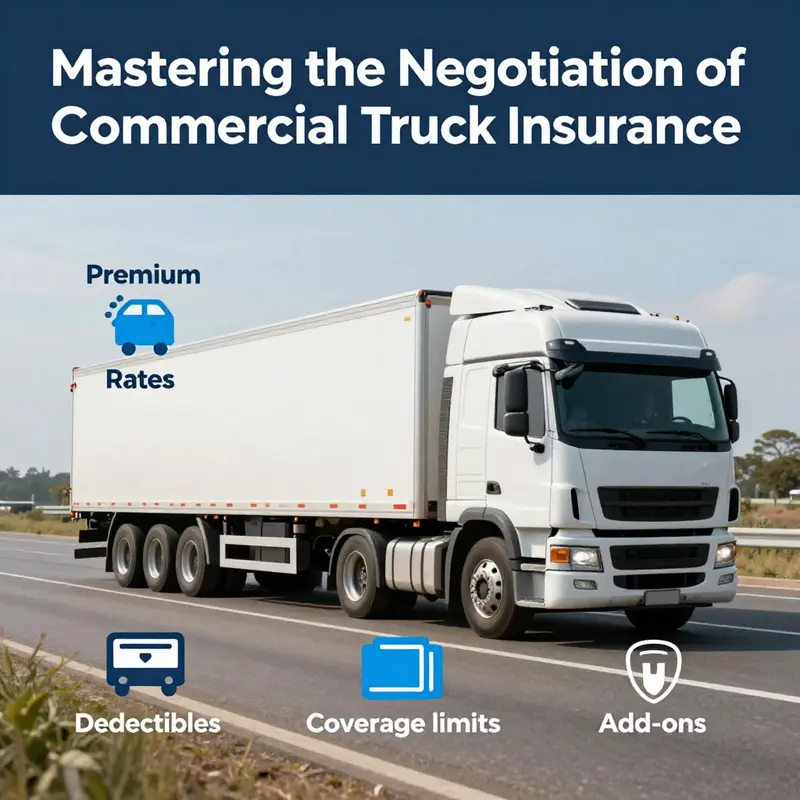
In commercial trucking, the negotiation table is not a side street; it is a core part of how you protect your operation and your bottom line. Insurance is not a fixed price menu handed to you at renewal. It is a dynamic agreement that responds to your risk profile, your fleet’s makeup, and the way you manage safety and claims. The path to better coverage and lower costs is not about chasing a single discount. It is about understanding the six levers that most often move the price, the protection, and the flexibility of your policy. Those levers – coverage limits and deductibles, policy exclusions and endorsements, discounts and premium credits, bundling of policies, claims history and risk-management programs, and the size and type of your fleet – work together to shape an insurance package that fits your operations rather than forcing you into a one-size-fits-all contract. A deliberate, data-backed approach to each lever can produce a policy that protects your cargo, your drivers, and your cash flow even in a volatile market.
First, consider coverage limits and deductibles. This is the most tangible place to negotiate because the balance between premium cost and out-of-pocket exposure is directly linked to how you run the operation. A higher deductible reduces the insurer’s risk and typically trims the annual premium. If your cash flow supports it and your risk tolerance allows, a higher deductible can be a straightforward way to achieve meaningful savings. On the other hand, if you carry high-value cargo, hazardous materials, or operate in jurisdictions with elevated risk, you may justify higher limits on liability, cargo, and physical damage. The key is to align the numbers with your risk exposure—cargo value, fleet age, maintenance practices, and the likelihood of loss. You do not want to be underinsured on the rare but high-cost claim, but you also do not want to overpay for protection you are unlikely to utilize. A practical approach is to model several scenarios: what would a claim settlement look like at a given deductible, and how would that choice affect your cash reserves and premiums over the policy term? The right balance often emerges when you couple deductible choices with robust safety and maintenance programs that reduce both the frequency and severity of losses.
Policy exclusions and endorsements sit close to the heart of coverage. Standard trucking policies come with a baseline of exclusions—things insurers won’t cover unless you ask for a rider. The art of negotiation here is not to chase blanket coverage beyond your needs, but to tailor endorsements to real risks. If you transport high-value goods or operate in cross-border lanes, you can negotiate for higher cargo limits or specific coverage that protects perishable items or temperature-controlled freight. If you rely on non-owned trailers or tractors, you might negotiate for non-owned auto coverage or broadened hired/borrowed coverage. Conversely, you may want to remove or modify exclusions that do not reflect your operations, such as certain types of third-party liability or specific cargo classes that are not part of your business model. The goal is precision: a policy that covers what you actually haul and how you haul it, not a portfolio of generic protections that inflate cost without adding real value.
Discounts and premium credits are a substantial and often underutilized part of the negotiation equation. Insurers offer a range of incentives, but the available discounts vary by carrier, region, and fleet profile. Safety training programs, telematics devices, and driver coaching can all unlock premium reductions, especially when the data show improvements in driving behavior and fleet maintenance. Bundling multiple lines of insurance—general liability, workers’ compensation, and commercial auto—into a single relationship frequently yields additional savings and simplifies claims handling. In some cases, brokers or underwriters can secure discounts not publicly advertised, particularly for fleets that demonstrate consistent risk reductions or possess an integrated risk-management program. The move here is not just to ask for discounts but to present evidence of your safety investments and outcomes. A well-documented record of training hours, incident reports, and proactive maintenance can convert an abstract promise of safety into a concrete premium credit.
Bundling policies deserves special attention because it not only reduces premiums but also streamlines risk management across the enterprise. When you consolidate coverage under one carrier or one broker, you create a single point of accountability for claims and renewals. Insurers value the predictability that comes with a multi-policy portfolio, which can translate into longer-term commitments, broader coverage, and more favorable terms. For fleets that span general liability, auto, and workers’ compensation, bundling can unleash synergies—deductibles across lines that align with your risk appetite, more coherent loss-control programs, and a unified reporting framework that makes it easier to demonstrate improvement over time. The practical impact is measurable: meaningful savings, simpler administration, and a cleaner, more integrated risk-management stance.
Your claims history and your risk-management program are powerful negotiation tools. A track record of safe operations and low claims frequency reduces the insurer’s perceived risk, which often translates into lower premiums and better coverage alignment. Demonstrating formal risk-management programs—driver safety training, ongoing coaching, regular vehicle maintenance, and proactive inspection schedules—provides tangible evidence that you are actively managing risk. Insurers prize evidence over promises; they respond to data that show real reductions in loss frequency and severity. If your organization lacks a formal program, start by documenting a minimal but robust framework: quarterly safety trainings, monthly maintenance checks, and a system for tracking and analyzing claims. Even small, consistent improvements can shift pricing and terms over a multi-year horizon. For larger fleets, the impact compounds, because the risk profile changes not just for one vehicle but across your entire network of trucks, routes, and drivers.
The size of your fleet and the mix of vehicle types you operate also shape negotiation dynamics. A larger fleet generally carries more leverage for favorable terms because insurers see a predictable revenue stream and a more diversified risk portfolio. That leverage can translate into volume discounts, tailored coverage packages, and more flexible terms that reflect the scale of your operation. The type of equipment matters as well. Refrigerated units, flatbeds, tankers, and dry vans each carry different risk profiles and costs. A fleet heavy on high-risk configurations may justify targeted endorsements or higher limits in certain coverage areas, while a fleet with newer equipment and a strong maintenance record may command more favorable deductibles and premium credits. The negotiation here is practical: present a clear fleet profile, including vehicle age, equipment types, average miles, and maintenance schedules, and ask carriers to respond with terms that recognize those realities rather than apply a generic tariff.
The strategic path through negotiation begins with preparation, not persistence. Gather current policy details, incident reports, maintenance records, and driver training metrics. Seek 3-5 competitive quotes from insurers — ideally including specialty carriers that understand trucking — but also use the data to benchmark premiums and coverages against your market. Present competing offers to your preferred insurer, not as a bluff, but as a reasoned request to match or beat the competition on terms that fit your risk profile. Timing matters: renew during periods when insurers are eager to fill their books, and avoid renewal immediately after a major claim, when a premium hike is more likely regardless of negotiation. A broker who specializes in trucking can be especially valuable here, translating industry nuances into leverage and coordinating multiple quotes to maximize your negotiating position.
If you find that an insurer wont budge on terms that matter, escalate within the organization. Request to speak with a senior underwriter or account manager who can reassess risk assumptions and account for the specifics of your operation. If discussions stall, consider filing a complaint with your state insurance department and, if necessary, explore switching carriers. The point is not to burn bridges but to ensure you are securing a policy that truly aligns with your risk tolerance and business plan. In practice, the best outcomes come from a disciplined process: a clear risk profile, documented safety investments, concrete coverage needs, and a framework for evaluating tradeoffs between premium, deductibles, and limits.
For readers seeking broader context on market dynamics and how these shifts affect negotiations, see this overview on navigating economic uncertainties in the trucking markets. It compiles insights on how volatility, demand for capacity, and regional risk factors shape the value of different terms and protections. This larger picture helps you calibrate expectations about what is negotiable, how much leverage you really have, and where focused risk-control investments can unlock the best long-term value. As you incorporate these levers into your renewal strategy, keep in mind that the ultimate goal is not to minimize price at any cost but to maximize coverage that protects your operation when it matters most – during a claim, a regulatory change, or a market downturn. The right combination of limits, deductibles, endorsements, discounts, bundled protections, and a demonstrable commitment to safety can yield a policy that serves as a reliable backbone for growth, rather than a burden that erodes profitability.
External resource for authoritative guidance on insurance practices and consumer protections can be found at the National Association of Insurance Commissioners (NAIC): https://www.naic.org. For additional operational context and market insights relevant to trucking and insurance negotiations, you may also explore industry discussions and practitioner perspectives that illuminate how fleets of varying sizes approach risk, costs, and coverage in dynamic markets. A well-structured negotiation, rooted in data and supported by formal risk management, can produce a policy that balances realistic protection with sustainable cost of risk, helping you safeguard not just your cargo, but the viability of your business for the long haul.
Steering Toward Better Coverage: Negotiation Strategies for Commercial Truck Insurance

Steering toward better coverage in the commercial trucking world means entering every renewal armed with data, discipline, and a clear sense of value. It is not enough to chase the lowest price; the aim is to secure a policy that protects your operations at a cost that makes sense over time. The negotiation process mirrors the way you manage a fleet: you start with a baseline, you defend what matters, and you continuously adjust as conditions shift. In this chapter, you will not only learn how to bargain effectively for premiums, deductibles, and coverage limits, but also how to frame the conversation around risk management, reliability, and total cost of ownership. The point is to transform insurance from a fixed expense into a strategic asset that supports growth and resilience. To begin, Picture the renewal as a risk committee meeting rather than a price comparison exercise. The insurer wants your business because it is profitable when risk is well understood and managed. Your job is to demonstrate that your operations minimize that risk through solid safety practices, accurate data, and a proactive approach to change. This is where research turns into leverage. Pre negotiation research is not an afterthought; it is the foundation that justifies favorable terms and anchors conversations in reality. Use market benchmarks to know what is reasonable for your fleet size, the type of cargo you carry, and the regions you serve. Platforms that aggregate industry data can reveal what peers with similar risk profiles pay and what discounts are commonly available for well managed fleets. When you approach an insurer with a realistic benchmark, you turn a guess into a goal and create a framework for productive dialogue. In practice, this means collecting and presenting real numbers rather than relying on general assurances. It means showing that your fleet meets certain safety criteria, that the maintenance program is robust, and that your drivers are consistently trained. It also means demonstrating how you monitor and improve risk in real time. The more concrete your data, the more confident you appear, and the more likely you are to secure terms that reflect your low risk. The idea of highlighting strengths is not about boasting; it is about translating observable discipline into tangible financial benefits. A clean driving record over the recent years, for instance, should be quantified and connected to premium reductions. The use of safety technologies such as telematics, electronic logging devices, collision avoidance systems, and proactive maintenance alerts should be framed as a comprehensive risk management program. If your fleet logs fewer incidents and demonstrates effective driver coaching, this is leverage that can reduce your exposure and lower premiums. The negotiation then shifts from a pure price contest to a discussion about the insurer’s ability to service your risk and respond efficiently when a claim occurs. This is where policy design becomes central. It is essential to understand all policy details beyond the premium. Review policy terms, deducible options, coverage limits, and exclusions with a careful eye. Do you truly need cargo liability coverage for every load, or can you tailor coverage given specific routes or cargo types? If your freight includes high value goods, consider higher policy limits to protect revenue streams. Don’t overlook the nuance of non owned vehicle coverage, which can be critical if your fleet occasionally contracts out capacity or uses client owned equipment. This is not a game of abstract terms; it is about aligning protection with operational realities and the realities of loss exposure. The next step is to bring in competition. Obtain multiple quotes, ideally three to five, from a mix of standard carriers and those specializing in trucking. Present these competing offers to your preferred insurer as a reference point and a challenge. This approach creates a constructive pressure to either match or exceed what the market is already offering. A broker who specializes in commercial trucking can be a surprisingly powerful ally in this stage. A skilled broker understands nuanced risk factors such as cargo types, route patterns, and driver qualification requirements. They can translate these into better underwriting terms and help you navigate the back and forth with underwriters. They can also surface carrier-specific programs and timing windows that you might miss on your own, increasing your leverage without inflaming negotiations. Timing matters, and it matters more than many assume. Renewal periods are when insurers assess risk portfolios for the upcoming year and are often more open to adjustments. Conversely, a renewal immediately after a major claim is a tougher battlefield where price can rise regardless of arguments about risk management. If possible, steer negotiations toward off peak times when insurers have capacity and appetite for new business. This is not about gaming the system but about working within cyclical realities of insurance markets. As you shape the dialogue, keep your focus on value rather than price. The total cost of ownership emerges from a combination of premium, deductible, coverage limits, and the efficiency of claims handling. A slightly higher premium that accompanies a more responsive claims process or faster settlements can be more valuable than the tiniest premium discount on a policy that leaves you stranded after a loss. The conversation about value should invite tailored solutions rather than generic add ons. Don’t settle for a standard policy when a customized package could better match your risk profile. For example, you might negotiate for dedicated loss prevention support, enhanced driver training packages, or proactive risk management services that help prevent claims from occurring in the first place. These services often come at little or no extra cost but deliver meaningful long term savings by reducing the frequency and severity of claims. The negotiation framework rests on what you can defend with evidence. Prepare an organized dossier that includes accident history, ELD compliance reports, vehicle inspection records, and a track record of preventive maintenance. This evidence answers a central question for underwriters: are you actively managing risk or merely reacting to it after an incident? The better your digital footprint, the better your case. Modern insurers place significant value on data and technology. Telematics and fleet management visibility provide a live window into operations, enabling insurers to monitor risk exposure and calibrate terms accordingly. If you can demonstrate that your fleet uses a robust risk management system with consistent data feeds, you stand a stronger chance of securing favorable terms. In some cases, the insurer may respond with a customized policy that weighs your specific exposures like high value cargo or particular route risks. If you reach an impasse on price, explore steady state alternatives. A longer term commitment, a multi year renewal option, or a commitment to incremental safety upgrades can unlock more favorable terms. When negotiations stall, escalation can be a stepwise process. Request to speak with a senior underwriter or account manager who can reassess risk classifications and perhaps offer parity with more favorable terms that were previously unavailable. If negotiations reach a wall, you also have recourse through state regulators and consumer protection avenues. While this can be a last resort, it signals to the insurer that you are serious about securing terms that are fair and transparent. Throughout this process, maintain a professional tone and a collaborative mindset. Insurance negotiations succeed when both sides see themselves as partners in risk management. This perspective aligns with the broader goal of staying competitive in a volatile market, keeping your fleet protected, and ensuring predictable operating costs that match your revenue streams. For broader context on market dynamics and uncertainty in trucking, consider the broader insights shared in industry analyses such as navigating economic uncertainties in trucking markets, which can inform your stance in negotiations and help you calibrate expectations against macro trends. navigating economic uncertainties in trucking markets.
By combining disciplined pre negotiation research, a data driven demonstration of low risk, and a value oriented approach to policy design, you can shift the balance of bargaining power toward terms that support long term success. The goal is not to win on every term but to secure a policy that is affordable, comprehensive, and aligned with the operational realities of your fleet. As you move through the process, remember that the right insurer is not the one who offers the lowest price today but the partner who can grow with you while maintaining strong risk controls and an efficient claims process. Finally, stay informed by consulting reputable industry resources and regulatory guidance as needed. External resource: https://www.naic.org
Beyond the First Offer: Escalation Pathways for Commercial Truck Insurance When Negotiation Fails

Negotiation is a two-way street, and in commercial truck insurance the street is long and often crowded with competing routes. When a carrier presents a price or a set of terms that doesn’t align with your risk profile or the realities of your operation, the instinct to press for a better deal is natural. Yet there are moments when the numbers simply won’t budge at the table, or when a key term—the deductible, the cargo coverage limit, or a material exclusion—feels misaligned with your operational risk. In those moments, a structured escalation becomes less a sign of hostility and more a strategic step to safeguard your business. Escalation is not about forcing a quick surrender; it’s about widening the aperture of options so you can protect cash flow, maintain coverage continuity, and ensure your fleet remains insured under terms that reflect actual risk. For fleets that run tight margins or operate in high-volume, time-sensitive markets, escalation can be the difference between a stable insurance program and a disruption that reverberates through dispatch, maintenance scheduling, and customer commitments. The core idea is simple: if the first offer doesn’t fit, there are recognized avenues to press for fairness and clarity without abruptly ending the relationship with a carrier. The process begins with the insurer’s own pathways for review and appeals, then extends to regulators and dispute resolution services, and finally to the courtroom if necessary. Each step is designed to be navigable, given the right preparation and the right framing of your case. Internal dispute resolution, filed complaints with the state, mediation and arbitration, and, as a last recourse, legal action—all of these avenues exist to balance power, protect your operations, and settle disputes with a result that reflects the actual risk you present as a business. Even when the negotiation feels stalemated, you can preserve momentum by approaching escalation with the same discipline you apply to risk management on the road: document, verify, and present a compelling case that demonstrates how your program reduces overall risk and aligns with the insurer’s business objectives. In practice, the path through escalation begins with the insurer’s internal appeals process. Most carriers have a formal process you can initiate in writing, sometimes through a portal, sometimes via a dedicated email channel. The appeal is not a mere rehash of the same numbers; it should be a documented submission that highlights updated safety data, new loss history, or changes in operations since the original quote was issued. If new evidence exists—telematics reports showing improved driver behavior, a formal driver training accreditation, or a newly implemented safety program—these should be foregrounded as part of the appeal. The objective is to show the underwriter that the risk profile has shifted in a favorable direction, even if the initial figures appear firm. It’s not uncommon for an internal reviewer to request additional information or to request a clarifying discussion. A concise, evidence-driven response can reopen the conversation and reset expectations without the need to move beyond the company’s internal channels. When internal appeals stall or fail to produce a satisfactory stance, the escalation ladder widens to the regulatory and dispute-resolution arena. Filing a complaint with the state insurance department is a formal route that introduces an outside reviewer into the process. State departments can mediate disputes, supervise the conduct of carriers, and in some cases apply penalties for unfair practice. The NAIC maintains a useful portal for consumers seeking information or submitting complaints, and it can help you locate the appropriate state regulator to contact. This step is not a substitute for negotiating a fair price or terms, but it serves as a mechanism to ensure carrier compliance with applicable rules and to evaluate whether a carrier’s behavior warrants additional scrutiny. Mediation and arbitration offer another middle-ground option that can be faster and less adversarial than litigation. Some policies include mandatory mediation or arbitration clauses for disputes over coverage, claims handling, or premium determinations. Mediation brings in a neutral third party who helps the parties communicate, identify interests, and craft a mutually acceptable resolution. Arbitration, while more formal, generally produces a binding decision, but it can still be chosen as a more cost-effective and time-efficient alternative to a full-blown lawsuit. Both processes are designed to be faster than court and typically less costly, making them attractive when the dispute centers on interpretive questions about policy language or the adequacy of a claim decision rather than on outright liability. If these channels fail to produce a satisfactory outcome, or if the insurer’s conduct appears to cross legal lines, legal action becomes a last resort. A lawsuit can seek damages for breach of contract, misrepresentation, or bad faith handling of a claim. This route is inherently costly and time-consuming, so it requires careful strategic planning. A business owner should consult an attorney who understands insurance law and has experience with trucking coverage. The goal is not to provoke litigation for its own sake but to secure a legally enforceable remedy when other mechanisms fail to deliver a fair outcome. Throughout the escalation process, the role of documentation cannot be overstated. Build a dossier that tracks all communications with the insurer, summarizes the terms offered, and chronicles any evidence added during the review process. Such documentation should include policy excerpts, endorsements, the exact wording of exclusions, and the specifics of cargo limits and deductibles. This is not just a historical record; it’s the currency you bring to every escalation discussion, argument, or hearing. In parallel, stay mindful of market realities and the insurer’s own strategic needs. The competitive environment for commercial trucking insurance means carriers are constantly balancing risk with opportunity. Any incremental improvement in your risk profile—fewer accidents, lower loss frequency, a robust driver safety program, or a demonstrated commitment to technology for safer operations—can tip the scales in your favor across these escalation pathways. To maximize your leverage, approach escalation with a narrative that ties operational improvements to measurable outcomes. For instance, if telematics data shows a downshift in speed violations and a reduction in hard braking incidents, present that data alongside a plan for continuous improvement. Insurers respond to well-documented risk management, not generic assurances. If you use a broker, their expertise can be a critical asset during escalation. A broker with trucking insurance experience understands the subtleties of policy wording, endorsements, and the nuances of claims handling across multiple carriers. They can translate risk-reduction measures into terms that carriers recognize as legitimate improvements in risk, and they can advocate for you in negotiations with underwriters who may not be as familiar with your specific operations. The timing of escalation matters as well. If possible, begin the process during the renewal window when carriers are evaluating a portfolio of clients and seeking to add value to preferred relationships. Renewal periods are often when insurers reassess pricing and terms, so presenting a well-documented case for improved terms can be more effective than mid-term pressure. Likewise, it’s prudent to avoid escalating immediately after a major claim, particularly one that you contest or one that has not yet been fully resolved. In those moments, insurers may perceive heightened risk and respond defensively, even if you believe the underlying policy terms should be honored or clarified. A disciplined approach to escalation also means staying practical about outcomes. Not every negotiation will yield a lower premium or broader coverage, and not every term will be negotiable. The objective is to secure the most favorable combination of price, coverage, and service that supports your operations. In some cases, the best outcome is a concession that aligns more closely with your risk appetite, such as a modest increase in deductibles in exchange for a meaningful premium reduction or the addition of value-added services like driver training or roadside assistance. If you need a broader frame of reference as you navigate this terrain, consider exploring resources that discuss market dynamics and risk management in trucking. For context on market conditions and how insurers view risk, this resource provides valuable insights: Navigating economic uncertainties in the Canadian and US trucking markets. While the focus is broader than insurance alone, understanding shifts in the operating environment helps you frame your escalation strategy in terms of risk management and business resilience. When escalation reaches its practical limits, regulators and ADR providers offer additional avenues for resolution. Regulatory bodies can compel carriers to justify decisions and align practices with required standards, while alternative dispute resolution channels offer non-litigation paths to binding or non-binding settlements, often at lower cost and within shorter timelines. In this landscape, the insurer’s willingness to revisit terms often correlates with the extent to which you can demonstrate a structured plan for ongoing risk reduction and a track record of reliability. Finally, for businesses that rely on a steady flow of delivery capacity and predictable cost structures, escalation is more than a tactic; it’s a policy discipline. It signals to carriers that you are a serious, prepared client who treats insurance not as a one-off purchase but as a critical component of operational resilience. It reinforces the expectation that coverage should reflect actual risk, and it preserves your ability to respond quickly to changing conditions in the market. As you move through these pathways, keep the focus on outcomes—not just negotiations. The objective is to secure coverage that protects the business, sustains the fleet, and aligns with your safety commitments. If you want more practical context on market dynamics and how they influence the price and terms offered to trucking operations, this resource offers a broader lens on the industry’s current realities and future trajectories: https://www.naic.org/consumer_tools/complaints.htm
Final thoughts
Negotiating commercial truck insurance is not merely an option; it is a strategic necessity for businesses that wish to optimize their operational costs and enhance their risk management. By understanding the key reasons to negotiate, employing effective strategies, and knowing what elements of an insurance package are negotiable, trucking professionals can secure better rates and coverage that aligns with their specific needs. Additionally, being aware of escalation options ensures that no matter the obstacles encountered in negotiations, stakeholders have pathways to achieve their goals. Ultimately, a proactive approach to negotiation empowers companies to thrive in a competitive logistics landscape.