
Kentucky features a landscape of commercial trucking regulations distinct from those of other states, molded by both state-specific needs and federal mandates. This significance is underscored by the collaboration with the Federal Motor Carrier Safety Administration (FMCSA), providing a framework that ensures safety and efficiency on the road. Each chapter of this article delves into key areas of Kentucky’s regulations, including comparisons to federal standards, unique weight and size restrictions, driver licensing requirements, and the necessary safety inspections. By grasping these elements, trucking company owners, fleet managers, and logistics firms can navigate Kentucky’s regulatory environment more effectively, ensuring compliance and optimizing operations.
When the Bluegrass State Sets Its Own Pace: How Kentucky’s Commercial Trucking Regulations Distinguish Themselves Within a Federal Framework
In the vast landscape of American trucking, federal standards established by the FMCSA create a broad, shared baseline for safety, driver fatigue management, vehicle maintenance, and licensing. Yet, every state can layer its own rules on top of that baseline. Kentucky is a case in point. While its commercial trucking regulations largely align with federal expectations, the commonwealth adds precise, state-specific requirements that influence how carriers plan routes, schedule drivers, maintain equipment, and document compliance. For operators who run full cross‑border routes or keep fleets nimble within the Bluegrass State, it is essential to understand not only the federal floor but also the Kentucky ceiling, and how the two interact in daily decision making.
From the outset, Kentucky’s framework rests on the same pillars as federal law. The FMCSA sets the overarching requirements for hours of service, vehicle inspection, maintenance, and driver licensing. Carriers must observe the federal hours-of-service rules, ensure vehicles are operated safely, and maintain records that prove compliance. Yet Kentucky’s administrative machinery adds its own contours. The state’s regulations are designed to harmonize with federal goals—moving freight efficiently while reducing the risk of fatigue, equipment failures, and unsafe operating practices—but they can shift the balance in practical, day‑to‑day terms. This dual-layered approach means a carrier that meets federal rules still faces state‑level obligations that can affect scheduling, routing, and cost-of-compliance calculations.
A central area where Kentucky diverges from the federal baseline is hours of service in the act of restarting the work clock. The FMCSA permits a 34‑hour restart under federal law, with no explicit requirement for those hours to include nighttime periods. Kentucky, however, has carved out a more stringent standard. In order for a driver’s restart to be valid under Kentucky rules, the restart must consist of at least 34 consecutive off‑duty hours and must include a minimum of two nighttime periods between 1 a.m. and 5 a.m. This night-inclusive requirement effectively narrows the window for planning a restart and can impose tighter scheduling on fleets that frequently operate through nocturnal hours to meet customer expectations or highway congestion patterns. The practical effect can be seen in dispatch planning: a route that would have been reset under federal rules now requires more foresight to ensure the two nights fall within the mandated window. Operators quickly learn that the Kentucky restart rule is not merely a procedural nuance; it is a real constraint that can ripple through multi-day trips, driver availability, and maintenance windows.
Other areas where Kentucky adds specificity relate to vehicle inspection and ongoing maintenance. Federally, there is a baseline expectation of regular inspections, but states can interpret the scope and documentation differently. Kentucky, in contrast, imposes a more explicit cadence for CMVs operating within its borders. The Kentucky Transportation Cabinet’s Commercial Vehicle Safety Unit (CVSU) emphasizes a pre-trip inspection requirement for all commercial motor vehicles engaged on Kentucky roadways. In practice, this means drivers must complete a thorough pre-trip check before every trip, and the accompanying records of these inspections must be retained for a defined period—six months in Kentucky’s case. The requirement to document pre-trip inspections and hold onto those records for half a year strengthens accountability and provides a traceable history for roadside safety checks. For fleets, this translates into disciplined recordkeeping, user-friendly inspection checklists, and robust record-retention practices that can enhance overall safety culture, even beyond compliance.
Safety safeguards in Kentucky also extend to site-specific speed and weight considerations. While federal rules set nationwide thresholds, Kentucky applies additional constraints on certain roadways and in particular geographic contexts. Urban streets and mountain corridors, for example, may feature lower posted speeds than the federal maximums, and certain highways may have weight restrictions that influence routing decisions. For drivers and planners who regularly navigate hilly terrain, river crossings, or congested urban arteries, these state-specific constraints require proactive route optimization and careful load planning. A carrier cannot assume that a looped route will be equally efficient on every segment; instead, it must account for where federal limits apply and where Kentucky-imposed limits take precedence. In practice, this means more sophisticated logistics modeling and a willingness to reroute when state-grade restrictions collide with time-sensitive customer commitments.
Licensing and credentialing also reflect Kentucky’s tailored approach to commercial trucking. Commercial drivers in Kentucky must hold the appropriate license class with the proper endorsements for the vehicle type and cargo. Endorsements—such as those needed for air brakes or hazardous materials—still follow federal guidance, but Kentucky’s licensing processes can include state-specific medical certification checks and background screening requirements as part of obtaining or renewing a CDL. The state looks for up-to-date medical certification to ensure drivers meet the health standards necessary for safe operation. This alignment with federal medical standards helps ensure interstate consistency, yet the state’s particular enrollment and renewal processes—timelines, documentation, and inspection intervals—require careful attention so that a driver who moves between intrastate and interstate operations remains compliant on both fronts.
The periodic inspection regime is another area where Kentucky has crystallized a state-level practice that complements the federal framework. Beyond annual inspections commonly described in federal language, Kentucky’s CVSU enforces and supervises routine inspections and roadside checks designed to catch issues before they escalate into safety risks. The presence of a dedicated state safety unit means that carriers operating in Kentucky’s borders should anticipate a higher frequency of inspections and a structured documentation trail. For fleets, this implies not only maintaining vehicles in peak condition but also aligning internal processes with the cadence of state inspections, recordkeeping standards, and the expectations of roadside enforcement officers who can request documentation on a moment’s notice.
Together, these Kentucky-specific provisions shape how a carrier thinks about risk, schedule reliability, and cost. The regulatory environment, while built upon FMCSA’s federal architecture, becomes a living guide for daily operations. Carriers must anticipate the state’s restart requirements, confirm that every vehicle carries the necessary inspections and maintenance records, and plan routes with a vigilant eye on local speed and weight restrictions. Compliance becomes more than a monthly checklist; it evolves into an ongoing practice that integrates dispatch software, human oversight, and a culture of safety that resonates from the dock to the highway.
What does this mean for a fleet navigating Kentucky’s roads and interfaces with federal requirements? It means that the baseline is reliable but not blanket. A company that has a robust compliance program that already tracks hours of service, pre-trip inspections, and maintenance will likely find Kentucky’s rules additive rather than contradictory. The most important step is to translate the state rules into actionable operations: scheduling a restart that guarantees the two nighttime hours, maintaining six months of inspection records in accessible form, and instituting a clear chain of custody for CDL documentation and medical qualifications. Fleet managers should embed Kentucky-specific rule checks into every trip plan, so a route that enters the state automatically prompts the system to validate restart parameters and alert dispatch if a scheduled restart would fall short of the two-night requirement.
A practical mindset for operators is to view Kentucky as a state that rewards disciplined operational discipline with clearer safety assurances. When a driver logs an off‑duty period that meets the federal standard, but misses the Kentucky nighttime criterion, the restart is invalid in Kentucky. The consequence is not merely a paperwork delay; the driver would need to accumulate another stretch of off‑duty time to comply, which can affect on‑time delivery commitments and fleet utilization. The net effect is a predictable but nontrivial shift in planning horizons. The day you account for the additional restart constraints, you gain in reliability and risk reduction. This is the kind of trade-off that seasoned operators learn to anticipate: the state rules may constrain restart timing, but they also encourage a conservative, safety-first approach that can reduce fatigue risk and prevent costly penalties.
The enforcement landscape in Kentucky is handled by the Kentucky Transportation Cabinet, through the Commercial Vehicle Safety Division, which operates both in partnership with federal inspectors and through its own field presence. This arrangement means that while a carrier’s federal compliance practices provide a solid foundation, they must be complemented by knowledge of the state’s inspection priorities, document retention expectations, and the procedural details surrounding how inspections are conducted and recorded within Kentucky. Being proactive—keeping up-to-date with CVSU announcements, maintaining fresh documentation, and training drivers on Kentucky-specific expectations—makes enforcement less burdensome and more predictable. The net result is a smoother operation with fewer surprises at the roadside and a safer, more compliant fleet.
This nuanced regulatory landscape does not exist in isolation. It interacts with the broader dynamics of the trucking industry, which include evolving safety technologies, shifting fuel economics, and the practical realities of delivering goods across a geographically diverse state like Kentucky. Operators who invest in a robust compliance program can leverage state-specific advantages, such as potential simplifications in inspection processes when records are well maintained, or the stability that comes from predictable restart timing and clearer route planning. At the same time, they must remain vigilant about any changes the state makes to speed limits, weight allowances on particular corridors, or new guidance from the CVSU that might alter inspection frequency or documentation expectations.
For readers seeking a broader vantage point on this topic, a look at industry discussions and practical insights can be helpful. The McGrath Trucks blog offers ongoing perspectives on trucking operations, while remaining mindful of the need to tailor advice to state-specific rules. This resource provides a broad context for understanding how fleet strategies adapt to regulatory environments without getting lost in generic descriptions. Access to that resource can be a useful companion to the concrete Kentucky specifics discussed here. McGrath Trucks Blog.
In the end, whether a carrier is optimizing a regional network or routing through Kentucky as part of a national footprint, the key is to treat federal and state requirements as a single, coherent safety framework. The federal baseline provides uniformity, while Kentucky’s rules refine and sharpen how that safety framework translates into daily practice. The result is a system that emphasizes safety, reliability, and accountability, with state-specific signals that guide operational decisions. Carriers that align their internal processes with both layers of regulation—federal and state—will not only meet compliance hurdles but also gain a leg up in predictable scheduling and consistent service delivery. The attention paid to restart timing, inspection documentation, and state-specific enforcement creates a foundation upon which efficient, safe trucking can be built across Kentucky’s roads and beyond.
For readers who want to connect these ideas to official guidance, the Kentucky Transportation Cabinet’s Commercial Vehicle Safety Division remains a primary resource for detailed requirements, updates, and contact points. It is the go-to reference for precise language, definitions, and the exact documentation expectations that drive day-to-day compliance on Kentucky’s highways.
External resource: Kentucky CVSD official guidance. https://www.kycabinet.com/transportation/cvsd/
Weight, Axles, and the Road: How Kentucky Sets Distinct Load Rules for Commercial Trucks
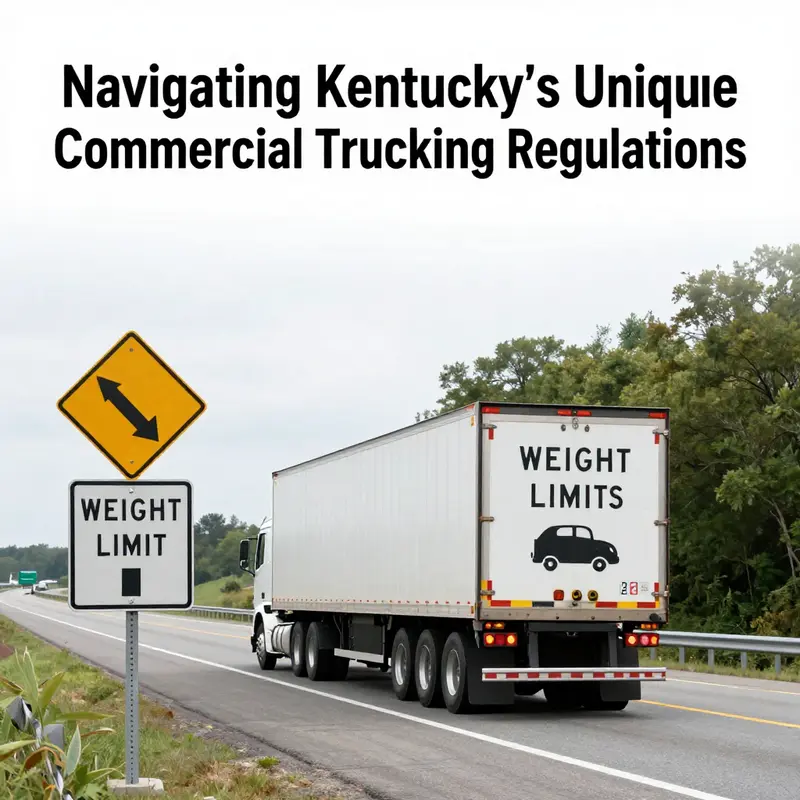
When operators map a route through Kentucky, they quickly learn that compliance is about more than federal hours-of-service rules or basic licensing. Kentucky’s commercial trucking regulations sit at the intersection of national policy and state-specific safeguards. The aim is straightforward enough—keep heavy trucks from unnecessarily wearing roads and bridges while ensuring goods move efficiently through the Bluegrass State. In practice, that means a carefully calibrated system of weight and size restrictions, coupled with licensing, inspections, and permit processes that work together to shape how trucks are loaded, routed, and rested along Kentucky’s highway network. The result is a regulatory landscape that, while broadly aligned with the federal framework overseen by the Federal Motor Carrier Safety Administration, contains distinct provisions that haulers must respect to operate legally within state lines. The most conspicuous differences surface in how Kentucky treats axle load limits and the conditions under which heavier or larger loads may be transported. The standard setting for most interstate trucking is the federal maximum gross vehicle weight of 80,000 pounds. Kentucky adheres to that ceiling on its major routes, but it also places prioritize on axle-by-axle loading, a practice designed to distribute weight in a way that minimizes stress on pavement and bridges. The kid-glove approach to road preservation that follows from these axle limits is a reminder that weight distribution matters just as much as total load in the world of practical trucking. In Kentucky, the axle-specific rules translate into concrete, enforceable constraints that guide every load plan from the moment a shipment is conceived to the moment it reaches the receiver’s dock. The logic is simple and persistent: one heavy axle can cause disproportionate damage, so the state sets precise caps for single, tandem, and even tridem configurations, ensuring that the weight carried by every wheel is appropriate for the road it travels. The numbers are explicit and non-negotiable in most contexts. A single axle is capped at 20,000 pounds, a tandem consisting of two axles can carry up to 34,000 pounds, and a tridem—the configuration with three axles—can carry no more than 48,000 pounds. These limits are not mere guidelines; they are practical boundaries that determine how loads must be distributed across trailers and how many axles are required to move a given shipment safely and legally. Taken together, these axle load constraints shape a fundamental part of Kentucky’s weight and size regime. They influence trailer choice, axle configuration, and even the planning of loading patterns at shipper facilities. If a carrier needs to move heavier freight, the state offers a pathway through overweight and oversize permits, but those permits come with conditions. They often require a defined route with designated travel times, possibly escort vehicles, and specific signage to alert enforcement officers and the public to the oversized nature of the load. The permit itself becomes a compact agreement between the carrier and the state, balancing the carrier’s need to move goods with the state’s obligation to protect road infrastructure and public safety. This framework does not operate in isolation. It coexists with the federal backbone of trucking rules—hours of service, driver qualifications, medical certification, and vehicle safety standards—so that a Kentucky-registered truck remains compliant wherever it travels, whether on a state highway or across a neighboring state line. The interplay between state-level restrictions and federal guidelines is not accidental. Kentucky’s approach reflects a broader federal philosophy that weight should be managed not just by the total pounds on the vehicle but by the way those pounds are distributed across the axles. This is why a trucker who has a load near the edge of the 80,000-pound gross limit must consider whether the load distribution meets Kentucky’s axle caps, and whether a permit is necessary to move up to a heavier configuration. In practice, a hauler might plan a shipment to stay within the 80,000-pound gross limit while carefully organizing the load so that the single axles and tandem axles do not exceed their 20,000- and 34,000-pound thresholds, respectively. The weight distribution conversation becomes a logistical exercise in real time, influencing how pallets are stacked, how trailers are configured, and which routes are selected to avoid bridges or road segments with lower weight allowances. The guidance provided by state authorities is clear, but the realities of hauling demand practical interpretation. The Kentucky Transportation Cabinet, with its Commercial Vehicle Safety Unit and related inspection regimes, reinforces the need for ongoing attention to axle weights during loading, on the road, and at weigh stations. Annual inspections and random roadside checks are part of a broader safety net designed to identify weight misallocations that could compromise road integrity. These inspections sit alongside Federal Motor Carrier Safety Administration standards, ensuring that drivers maintain valid Commercial Driver’s Licenses (CDLs), hold the appropriate endorsements, and satisfy medical certification requirements. The licensing process, in particular, binds the state to the federal expectation that professional drivers meet stringent qualifications and remain fit to operate heavy commercial vehicles over long distances. Kentucky’s approach to endorsements matters because it influences what kinds of loads a driver can legally transport and how carriers staff their fleets. The system rewards operators who invest in properly trained personnel, robust record-keeping, and disciplined maintenance and inspection routines. In addition to the licensing framework, there is a continuous emphasis on vehicle safety. The CVSU’s role in conducting periodic inspections—complemented by annual checks—ensures that vehicles entering the state’s highways are up to standard and that weight distribution remains within prescribed limits. The result is a corridor of enforcement and compliance that protects highways from accelerated wear while allowing legitimate commerce to thrive. For carriers navigating this regulatory landscape, knowledge of the precise weight and axle caps is essential. It means that load planning is not just about maximizing cubic capacity but about respecting the boundary conditions that Kentucky imposes to maintain infrastructure integrity. The numbers—20,000 pounds on a single axle, 34,000 on tandem axles, and 48,000 on a tridem—are concrete guardrails. They guide the day-to-day decisions of where and how a shipment should be loaded, how many axles a trailer should employ, and when it is appropriate to seek a state-issued overweight permit. In practice, that translates into a workflow: early involvement of load planners, conversations with shippers about weight distribution, and the selection of trucking equipment calibrated to meet state standards without sacrificing operational efficiency. The state’s rules also recognize the realities of cross-border trucking and the need to harmonize with federal law while protecting a vital infrastructure backbone. While the 80,000-pound gross limit remains a common ceiling, Kentucky’s process for overweight and oversize permits creates a controlled pathway for exceptions. Carriers that anticipate the need to move heavier loads can begin the permit process in advance, coordinate with necessary escorts, and adjust routing to accommodate bridge clearances and traffic considerations. This approach helps minimize delays and reduces the risk of inadvertent violations that could trigger penalties, fines, or unnecessary detours. The broader regulatory context for Kentucky truckers also includes the requirement to maintain appropriate endorsements and to adhere to medical certification standards. CDL holders must renew their licenses on schedule, keep their medical cards up to date, and be prepared for background checks when required. The state’s emphasis on driver qualifications aligns with federal expectations and reinforces the idea that safe operation is a shared responsibility among the carrier, the driver, and the enforcing agencies. The regulatory map in Kentucky is not a static ledger. It evolves with public safety data, infrastructure changes, and the needs of the state’s economy. Haulers who stay ahead understand that weight and axle limits are not abstract numbers; they are practical constraints that shape loading plans, route selection, and the way fleets are organized. To deepen practical understanding, readers can turn to industry-focused discussions that contextualize these rules within everyday trucking operations. For example, the widely referenced industry blog provides perspectives on how fleets adapt to regulatory realities, including weight distribution strategies, permit timing, and the balance between safety and efficiency. For readers seeking practical context, the McGrath Trucks blog offers relevant discussions. You can explore insights here: McGrath Trucks blog. In addition to the internal insights, drivers and carriers should consult authoritative sources for the official framework that governs these rules. Official details on Kentucky’s weight and size limits and related regulatory requirements can be found through the Kentucky Transportation Cabinet’s resources. While the exact wording and procedures may vary over time, the core principle remains consistent: weight must be managed with a focus on safety, infrastructure protection, and practical transport efficiency. For those planning operations within Kentucky, the path is simple in intent but precise in practice. Plan for axle-by-axle weight distribution, confirm the need for any overweight or oversize permits, and align with licensing and inspection expectations that reinforce safety and compliance. The chapter of Kentucky trucking regulations that governs weight and size is not a standalone note in the regulatory ledger; it is a living mechanism that affects every load and every mile traversed on state roadways. Those who master it understand that compliance is a feature of meticulous planning as well as a matter of regulatory obligation. As with any state-specific regulation, the real-world impact is felt most clearly where pavement meets payload—and where the engineer’s design and the carrier’s load plan converge on the highway. For operators who want to see the full, official picture, the Kentucky Transportation Cabinet remains the primary reference point, and it should be consulted whenever there is uncertainty about load distribution, axle configurations, or permit eligibility. Official details are available at the Kentucky Transportation Cabinet’s page, which provides the authoritative guidance on axle limits, gross weight parameters, and the permit process that enables heavier or oversize shipments when justified and properly managed. External resource: https://uk.gov/transportation/kentucky-transportation-cabinet
Bluegrass Licensing and Compliance: Navigating Kentucky’s Trucking Rules Within a Federal Framework
When people ask whether Kentucky has distinct commercial trucking regulations, the answer lies in a careful balance. Kentucky does align with the nationwide framework established by the Federal Motor Carrier Safety Administration, or FMCSA, yet it also retains state-specific nuances that affect how drivers qualify, how fleets stay compliant, and how the road a driver travels from Louisville to Pikeville is policed and maintained. For anyone charting a career in commercial trucking or running a fleet that operates in the state, understanding these nuances matters just as surely as knowing the federal rules that govern hours of service, inspections, and safety audits. In Kentucky, driver licensing and compliance are treated as a collective system designed to safeguard the traveling public while ensuring the transportation network remains efficient and predictable. The system is organized around clearly defined licensing pathways, robust vehicle and driver safety standards, and rigorous enforcement practices that together create a coherent, state-wide safety culture within the broader federal regime.
At the core of Kentucky’s licensing landscape are the commercial driver’s licenses themselves. A Kentucky CDL is not a single, one-size-fits-all credential but a set of classifications and endorsements tailored to the type of vehicle a driver will operate and the cargo they will carry. In practical terms, this means a driver may hold Class A, Class B, or Class C licenses, each opening doors to different vehicle configurations and operational scopes. The state emphasizes not only the basic license but also the proper endorsements that reflect the nature of the freight or the special vehicle requirements involved. Endorsements for hazardous materials or passenger transport, for example, carry additional prerequisites and testing. What matters here is the emphasis on competency and safety that underscores every step of the licensing process. Kentucky requires drivers to hold valid CDLs and to renew them on a schedule that reflects medical status, driving history, and ongoing compliance with regulatory standards. Renewal is more than a formality; it is a checkpoint that ensures the driver remains physically capable, medically certified, and legally eligible to operate a CMV. In this way, Kentucky mirrors federal expectations while applying its own administrative cadence to ensure every license issued is current and defensible should scrutiny arise during roadside or enforcement inspections.
Medical certification sits at the heart of the renewal process. The FMCSA framework requires medical qualification to operate a commercial vehicle, and Kentucky follows suit by incorporating medical certification into CDL renewals. Drivers must often demonstrate they meet core health requirements and, where applicable, provide documentation that confirms ongoing medical fitness. The state’s approach aligns with federal standards but translates into practical, state-level procedures that drivers and carriers interact with during the renewal cycle. This means a driver can expect that their CDL validity is, in part, contingent on maintaining medical certification and staying up to date with the medical status documented in state records. Where the two systems diverge is in the administrative cadence and the precise documentation demanded by state agencies responsible for licensing and compliance. The clear message is that Kentucky’s licensing regime prioritizes continuous eligibility while staying in step with federal safety goals.
Background checks play a pivotal role in Kentucky’s driver eligibility, particularly for those entrusted with hazardous materials or other high-security tasks. The state’s approach reflects a shared federal emphasis on security and safety, ensuring that drivers who handle sensitive loads undergo appropriate vetting. Background checks, when required, are not merely bureaucratic hurdles; they are risk-management tools that help guardians of the highway identify potential red flags before a driver is authorized to operate in sensitive capacities. For carriers and drivers alike, the implication is straightforward: compliance is not a once-and-done commitment but a continuous process that follows a driver from application through to active employment and renewals. Kentucky’s system reinforces the idea that licensing is a living credential, tethered to ongoing safety performance and regulatory compliance.
Beyond the license itself, Kentucky places a strong emphasis on driver qualifications and ongoing compliance through a structured, safety-oriented framework. The state requires drivers to adhere to hours-of-service rules designed to prevent fatigue—the same standards that the FMCSA enforces nationally. HOS compliance is not simply a checklist; it is a driver welfare policy and a public safety measure that shapes scheduling, dispatch planning, and enforcement. When a carrier schedules trips across the Bluegrass State, they must build in rest periods that align with federal rules while staying mindful of Kentucky’s road geometries, traffic patterns, and loading and unloading realities. The practical effect is that Kentucky’s enforcement ecosystem treats HOS as a central pillar of safety, but the exact enforcement practices—how logs are kept, how drivers report hours, and how violations are adjudicated—are administered through state channels that coordinate with federal requirements.
Compliance in Kentucky also extends to the systematic maintenance and inspection of commercial vehicles. The Kentucky Transportation Cabinet, or KYTC, oversees a comprehensive set of requirements designed to prevent mechanical failures that could lead to accidents, disruptions, or safety hazards. At the heart of these requirements are mandatory pre-trip inspections, regular maintenance logs, and adherence to a maintenance schedule that documents repairs and service history. The pre-trip inspection acts as a frontline safeguard: it forces the driver to verify brakes, tires, lights, signaling devices, coupling devices, and other critical systems before hitting the road. This routine is more than a ritual; it is a tangible, daily expression of responsibility that reduces breakdowns and protects other road users.
Maintenance logs serve a parallel purpose. They provide a transparent record of all upkeep, repairs, and component replacements. When a vehicle is drawn into an inspection, these logs are a quick, authoritative way to confirm ongoing roadworthiness and to verify that any recurrent issues are being addressed in a timely fashion. The Kentucky approach aligns with federal standards while embedding a state-level expectation that maintenance is continuous and well-documented. This emphasis on maintenance and pre-trip readiness complements the HOS rules, creating a safety net that operates across both human and mechanical elements of trucking.
The CVSU—the Commercial Vehicle Safety Unit—serves as Kentucky’s scout and sentinel for compliance, performing annual inspections and conducting random roadside checks. While federal law sets the standard for vehicle safety, Kentucky’s CVSU actively enforces it through on-road enforcement, spot inspections, and compliance checks that keep operators honest in real time. The result is a state where drivers and carriers know that inspections are part of the business cycle, not an occasional ordeal. This proactive posture helps reduce the likelihood of serious failures and creates a smoother operating environment for compliant fleets.
The licensing and compliance framework in Kentucky also explicitly supports the broader goal of seamless interstate commerce. Although state rules can feel intricate, they are designed to dovetail with FMCSA standards so that carriers that operate across state lines experience a consistent baseline of safety, qualifications, and documentation. The practical effect for drivers is straightforward: a Kentucky CDL holder must demonstrate the same fundamental competencies applicable nationwide, but the state’s processes for renewing licenses, certifying medical status, and maintaining records reflect Kentucky’s administrative realities. For fleets, this means a predictable compliance environment where day-to-day activities—such as log keeping, vehicle inspections, and adherence to HOS—are governed by a cohesive set of state and federal expectations.
Weight and permit considerations also illuminate how Kentucky’s rules vary from one jurisdiction to another while still supporting nationwide movement of goods. In Kentucky, weight restrictions on highways are typically set around 80,000 pounds for a standard tractor-trailer combination. This is a common weight limit across many states, but Kentucky, like others, allows for special permits for overweight or oversize loads under specific conditions. For fleet managers and drivers, these rules translate to planning considerations, permit procurement, and careful route selection. The ability to secure a special permit, when needed, is a critical tool that keeps operations flexible and safe, ensuring that high-capacity loads can reach their destinations without compromising road safety or infrastructure integrity. In practice, this means a motor carrier thinking about a heavy haul or a combination with unusually heavy weight must navigate both the weight restrictions and the permitting process, which is overseen at the state level but interacts with federal safety and infrastructure policies.
Taken together, Kentucky’s licensing and compliance environment presents a coherent picture. The state consistently emphasizes safety, accountability, and professional standards for drivers and fleets while aligning with federal safety priorities. It reinforces the idea that licensing is not merely about permission to operate; it is a framework for ongoing competency, medical fitness, background integrity, and the responsible maintenance of equipment. The result is not a patchwork of isolated requirements but a unified system in which a driver’s qualifications, a vehicle’s readiness, and a company’s compliance practices reinforce one another across daily operations and strategic planning. For anyone operating within Kentucky’s borders or preparing to enter the industry, the message is clear: understand the licensing routes, stay current with medical and background requirements, maintain vehicles with discipline, and honor the hours-of-service and inspection expectations that keep the highways safe and reliable.
To access the most authoritative and up-to-date information about Kentucky’s CDL requirements, the official Kentucky CDL information resource provides the guidance, forms, and procedures you’ll need. While the specifics may evolve, the core principles—licensing accuracy, medical qualification, background checks when applicable, and consistent vehicle readiness—remain central to compliant operation in the state.
External resource: https://www.kytc.gov/transportation/divisions/motor-carrier/driver-licensing/cdl-information
Keeping Kentucky’s Highways Safe: Inspections, Patrols, and Enforcement That Shape Commercial Trucking
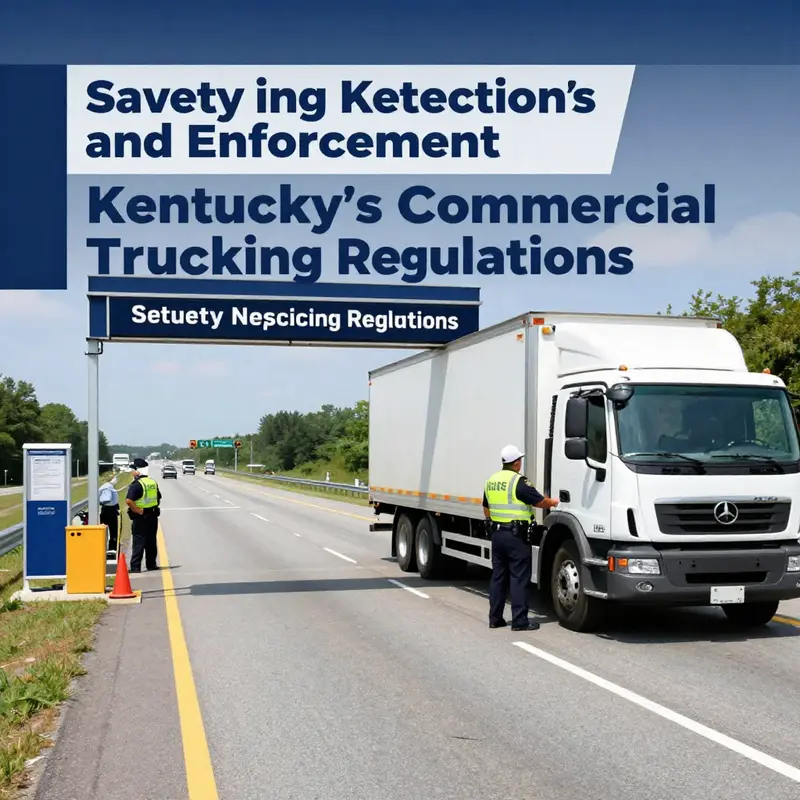
Kentucky enforces a layered system of inspections and enforcement to keep commercial motor vehicles (CMVs) safe. The framework aligns closely with federal standards set by the Federal Motor Carrier Safety Administration (FMCSA). At the same time, state authorities apply local rules and operational priorities that give enforcement a Kentucky-specific character. This chapter explains how inspections are organized, what triggers them, how violations are handled, and what carriers can do to stay compliant.
The Kentucky Transportation Cabinet (KTC) takes primary responsibility for safety oversight. Within KTC, units such as the Commercial Vehicle Safety Unit (CVSU) and the Office of Highway Safety coordinate inspection and enforcement activity. They partner with federal agencies and local law enforcement to perform routine and targeted inspections. That partnership means carriers in Kentucky see the same core safety tests required nationwide, but they also face state-level emphasis on areas like bridge weight limits and seasonal weight restrictions. Inspectors use standardized procedures derived from FMCSA guidance. Those procedures make inspection results portable across states. A citation issued in Kentucky can affect a carrier’s national safety profile. That shared standard keeps penalties and corrective actions effective beyond state borders.
A central tool in Kentucky’s approach is the Pre-Operational Inspection Program (POIP). POIP allows inspectors to perform roadside and lot-based checks before vehicles enter long-haul routes. These checks focus on mechanical readiness and driver compliance. Inspectors look for brake problems, tire defects, lighting failures, loose or missing components, fluid leaks, and securement issues. They review driver credentials, hours-of-service records, and medical certifications. POIP inspections are preventive by nature. They reduce the chance that a vehicle with a clear defect will travel through populated areas or over vulnerable infrastructure. POIP also creates opportunities for swift corrective action without formal penalties when defects are minor and corrected on the spot.
Roadside inspection authority is robust. Inspections may be routine, randomized, or intelligence-driven. Routine inspections occur at weigh stations and safety checkpoints. Randomized checks add unpredictability to enforcement, discouraging carriers from relying on predictable inspection patterns. Intelligence-driven stops occur when data flags a truck or carrier. That data can come from crash reports, past violations, or electronic monitoring systems. Suspicious behavior by drivers, such as evasive maneuvers or inconsistent shipping documentation, also prompts inspections. When inspectors find major safety issues, they can declare a vehicle or driver out of service. Out-of-service orders remove immediate risks to public safety by halting operation until repairs or corrective measures are completed.
Kentucky enforces the national five-level inspection standard used by the Commercial Vehicle Safety Alliance (CVSA). Level I is a full inspection that covers driver credentials, inspection of the driver, and inspection of the vehicle. Level II is an inspection without a vehicle inspection, focusing on credentials and driver condition. Level III is a driver-only inspection. Level IV and V serve specific purposes such as cargo securement or specialized checks. These levels determine the depth of the review and the types of violations inspectors can uncover. Using these standardized levels means inspection results and violations flow into national databases that influence a carrier’s Compliance, Safety, Accountability (CSA) score. CSA scores affect insurance, contract opportunities, and federal oversight.
Enforcement in Kentucky blends citations, civil penalties, administrative actions, and remediation requirements. Minor defects often result in repair orders that must be completed within a set time. Serious violations trigger fines and out-of-service orders. Repeated or egregious noncompliance can lead to carrier audits and compliance reviews. Those reviews examine maintenance programs, driver hiring and training policies, and safety management controls. If deficiencies are systemic, a carrier may receive a conditional rating and face restricted operations until problems are resolved. In extreme cases, the state can recommend suspension or revocation of operating authority, though such measures are rare and reserved for persistent, severe risk.
Weight and dimension enforcement is a Kentucky priority. While the federal gross vehicle weight limit for interstate commerce typically sits at 80,000 pounds, Kentucky enforces that limit and applies state-specific seasonal and bridge-related restrictions. Inspectors use portable scales and static weight stations to measure loads. Overweight citations carry steep fines and may require load redistribution or removal before a vehicle can continue. Kentucky also has permitting processes for oversize and overweight loads. Those permits include route limitations, escort requirements, and timing restrictions. Failure to follow permit conditions can produce immediate enforcement action and additional penalties.
Inspections do not function in isolation. Kentucky leverages technology to improve detection and follow-up. Electronic inspection reports, when available, speed data sharing with FMCSA and neighboring states. Kentucky also uses motor carrier monitoring systems that aggregate inspection results, crash history, and roadside violation data. That consolidated view helps enforcement prioritize carriers for audits and targeted outreach. Kentucky law enforcement increasingly uses electronic logging device (ELD) data during inspections. ELDs provide direct evidence of hours-of-service compliance and driver duty status. Inspectors trained in ELD review can identify falsified logs or operational practices that put drivers at risk.
Training and certification of inspection staff is another key element. Inspectors must be familiar with FMCSA standards, CVSA inspection protocols, and Kentucky-specific regulations. Regular training updates ensure inspectors understand evolving technology, such as advanced braking systems and telematics. Kentucky also offers outreach programs for carriers to explain inspection expectations, common violations, and simple compliance steps. Those programs reduce friction and prevent violations that arise from misunderstanding rather than willful neglect.
For carriers, the most effective approach to Kentucky inspections is proactive compliance. Regular pre-trip and post-trip checks catch defects before inspectors do. A disciplined maintenance schedule, thorough driver qualification files, and consistent hours-of-service practices form the backbone of a defensible safety program. When violations occur, timely corrective action and transparent documentation help limit penalties and reduce the chance of further enforcement. Participating in safety partnerships and attending local outreach sessions can reveal state priorities and reduce surprises.
When audits or compliance reviews arise, documentation wins. Kentucky inspectors and auditors look for evidence of preventive maintenance programs, driver training records, controlled hiring practices, and clear corrective action plans. Good recordkeeping speeds the resolution of violations. It also demonstrates a carrier’s commitment to safety, which can influence administrative outcomes. Carriers should maintain service records, repair invoices, inspection checklists, and driver qualification files in an organized system that is easy to access during an inspection or audit.
Kentucky also blends enforcement with education. Many infractions reflect operational sloppiness rather than deliberate noncompliance. To reduce repeat violations, inspectors may direct carriers to educational resources and require follow-up. That approach reserves punitive measures for willful or dangerous conduct while nudging marginal carriers toward better practices. For companies facing persistent problems, Kentucky’s enforcement strategy pushes for systemic change. That may include mandatory corrective action plans, third-party inspections, or independent verification of repairs.
Carriers should also be aware of the consequences that extend beyond state lines. Inspection violations reported in Kentucky feed national databases. Those entries affect the carrier’s overall safety profile. High violation rates can trigger federal oversight actions, higher insurance premiums, and lost business opportunities. For fleets operating regionally, compliance in Kentucky is part of a national compliance strategy.
Practical steps to reduce inspection risk in Kentucky include: instituting thorough pre-trip inspections, keeping fuel and maintenance records current, training drivers on documentation and hours-of-service requirements, using technology to monitor vehicle systems and ELD data, and engaging with KTC outreach programs. Maintaining clear communication with shippers and brokers about load weights and securement reduces surprises at weigh stations. When unusual loads require permits, carriers should obtain them in advance and follow permit conditions exactly.
Kentucky’s enforcement posture reflects a balance. The state enforces federal standards to ensure consistency. It adds state-focused measures to address local risks, like bridge vulnerabilities and seasonal weight dynamics. Inspections are both a policing tool and a public safety mechanism. They remove imminent hazards and promote long-term improvements in carrier behavior. For any fleet operating in or through Kentucky, the message is clear: federal rules matter, Kentucky specifics matter, and practical steps taken today reduce enforcement risk tomorrow.
For carriers seeking regular updates and commentary on industry compliance trends, the McGrath Trucks blog offers useful perspectives on fleet management and regulatory developments. For official details on Kentucky’s inspection procedures and enforcement policies, see the Kentucky Transportation Cabinet information linked below.
External resource: https://www.kentuckytourism.com
Final thoughts
In summation, understanding Kentucky’s commercial trucking regulations is crucial for trucking company owners, fleet managers, and logistics professionals looking to operate effectively within the state. The distinct regulations, particularly in the realms of weight limits, driver licensing, and safety inspections, necessitate thorough awareness and compliance strategies. By aligning operations with these guidelines, businesses can foster safer and more efficient transportation methodologies, ultimately enhancing their operational viability in the competitive trucking landscape.