
The intricacies of commercial truck insurance often leave trucking company owners, fleet managers, and logistics firms in a perplexing situation regarding liability for delivery delays. While these insurance policies provide crucial coverage for physical damages and liability resulting from accidents, understanding their limitations concerning delays is essential. In this discussion, we will delve into how commercial truck insurance relates to on-time delivery issues, the role of business interruption insurance, and analyze contractual obligations associated with delivery timeliness. Additionally, we will explore the implications of delay liabilities on the overall commercial truck insurance market, equipping readers with a comprehensive understanding of these critical considerations.
The Fine Line Between Protection and Delay: How Commercial Truck Insurance Relates to Late Deliveries
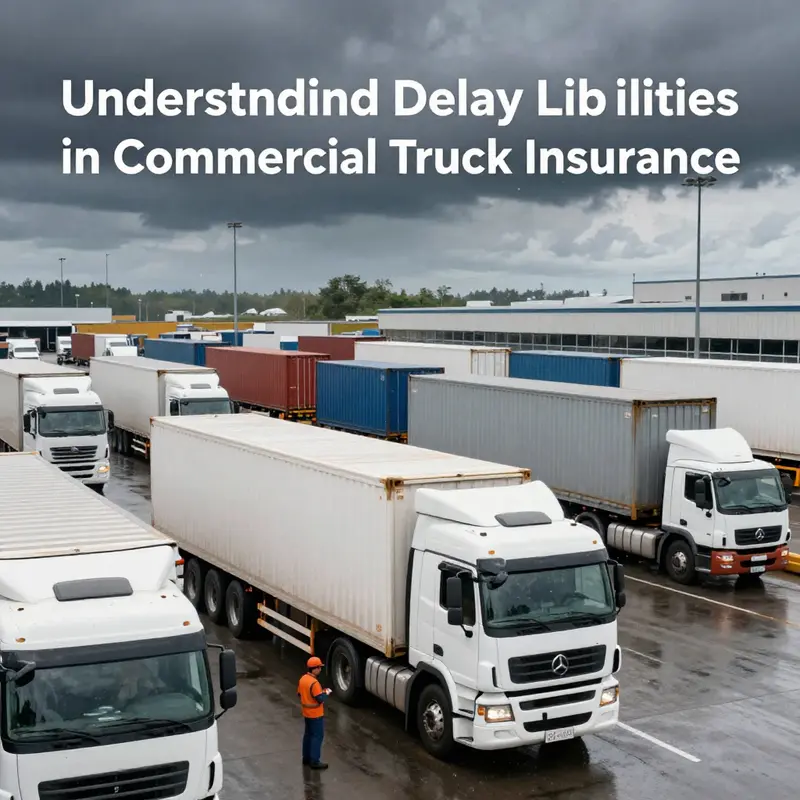
When executives look at insurance for a fleet, the instinct is often to assume coverage guards against every financial hit that might come from the road. Yet the reality of commercial truck insurance is more measured and more precise. Its core remit is to stabilize the balance sheet when the vehicle, its cargo, or its operator faces a tangible hazard—an accident that damages the truck, a load that is lost or damaged in transit, or a third party claim for bodily injury or property damage caused by a collision. Delays, on the other hand, live in a different realm of risk. They are often operational and contractual risks, not the direct, insurable events that trigger a standard policy. This distinction matters because a late delivery can ripple through a supply chain with penalties, lost profits, and dissatisfied customers, yet those consequences are not automatically absorbed by a conventional truck insurance policy. To understand where insurance stops and risk transfer or additional coverage begins, it helps to consider how coverage is structured and how delay-related costs typically arise in practice. The standard policy is built to respond to shocks that are immediate and observable—an impact, a spill, a theft, or the sudden stopping of a vehicle due to a breakdown. It is not typically engineered to absorb the cascading costs that come from a shipment arriving late because of congestion, weather, port delays, or regulatory holdups. Those are the kinds of risks that sit at the intersection of operations, contracts, and supply chain management, where the policy vehicle is not an all-purpose shield but rather one tool among many for risk mitigation. In this light, the question “Is commercial truck insurance liable for taking too long?” cannot be answered with a simple yes or no. It depends on what triggered the delay, what the policy actually covers, and what kind of endorsements or ancillary coverages the business has chosen to add. It is also essential to distinguish between the direct damages insurance pays for and the indirect costs that may flow from a late delivery. Direct damages are typically the realm of physical damage and liability protection: repair costs after an accident, medical expenses for injured parties, and liability for property damage or injuries to third parties. Cargo insurance can extend protection to the goods themselves, compensating for loss or damage to cargo while in transit. Theft coverage shields the fleet and cargo against theft scenarios. In many fleets, these protections are paired with a form of business interruption coverage, but the scope is crucial. When the business interruption component exists, it often answers to the event that interrupts operations—most often physical damage to the insured property, or a covered peril that forces downtime. If a truck is out of service because of a wreck, fire, or serious mechanical failure that necessitates repairs, business interruption insurance can help stabilize revenue during the downtime. If the truck is merely stuck in traffic, delayed by weather, or held up by a regulatory process, the same interruption coverage rarely triggers. The chain of causation matters: insurers look for an insured event that causes a quantifiable shutdown or loss of income within defined policy terms. Delays caused by common factors such as highway congestion, snowstorms, heavy rain, fog, port backlogs, or shifting regulatory constraints do not automatically transform into a covered loss. Yet the policy landscape is not monolithic, and there are niches and endorsements that can bridge a portion of the delay gap. Cargo coverage, for instance, may pick up losses tied to delayed delivery if the delay leads to damage, spoilage, or depreciation of the cargo that is explicitly covered under the policy terms. In some cases, contractual liability insurance or contingent coverage can address the costs arising from a breach of contract caused by late delivery, but this is not synonymous with standard truck insurance. Even within specialized policy language, the protection for delays tends to be conditional and limited. It can hinge on the delay being the consequence of a covered peril or event, such as an insured accident or a natural disaster, rather than the more routine, non-insured factors that influence transit times. This distinction—between the insured event and the ordinary course of delays—highlights a practical reality: businesses should not assume that delay-related penalties or lost profits are automatically insured. The question then becomes one of risk management strategy. If a company wants to hedge against delay-related liabilities, it must look beyond standard policy language and consider endorsements, additional layers of coverage, and careful contract design. One approach is to align the risk transfer with the specifics of the shipment. If a customer contract imposes penalties for late delivery, the shipper and carrier may negotiate liability allocations in the contract itself, with insurance playing a supporting role rather than acting as the primary method of risk transfer. Endorsements can sometimes provide limited protection for certain delay scenarios. For example, some policies offer endorsements that broaden the coverage to capture certain types of contingent costs or provide a narrowly tailored cushion for delays caused by particular insured events. However, these endorsements are not a universal remedy. They require tight specification of what is insured, how the costs are calculated, and under what conditions payment is triggered. In practice, businesses should approach policy design with three questions in mind: What are the likely delay scenarios we face under our standard routes and contracts? What are the corresponding financial exposures if a shipment arrives late? And what policies and endorsements exist that can close the gap between exposure and protection without introducing unsustainable premium costs? The first question is largely operational. It asks teams to map routes, clocks, and handoffs: the typical transit times, the probability of each delay factor, and the financial impact of lateness under each contract. The second question turns the focus to measurement. Lost profits, contract penalties, customer service costs, and penalties under service-level agreements must be translated into monetary terms. Without this preparedness, an insurer cannot price the risk, and the business cannot decide where to direct its risk shopping. The third question is where policy mechanics come alive. It is here that risk managers consult with brokers and carriers to explore endorsements that address time-sensitive issues. Some endorsements work best when the delay arises from a covered event like a weather disruption that causes a shipment delay and damages the goods. Others may offer limited coverage for reputational or contractual damages when the shipment was supposed to arrive by a stated date, but this coverage tends to be narrow and bound by exclusions. A knowledgeable approach also involves reviewing exclusions. Most standard truck policies include explicit exclusions for certain types of losses. Delays caused by traffic, congestion, or routine regulatory checks are often outside the scope of coverage. Even where business interruption is included, it usually requires a direct and proximate link to the insured peril and may demand evidence of revenue impact tied to the specific incident. In short, while insurance provides a robust shield against sudden, tangible losses tied to crashes and cargo damage, it does not automatically absorb the cascading financial consequences of late deliveries. Yet that does not leave shippers and carriers without options. To address delay-related liabilities, several practical avenues exist. It begins with a clear understanding of policy terms and a candid assessment of exposure. Businesses should examine policy endorsements that may widen the protection envelope for delays or provide coverage for certain categories of delay costs, such as incremental storage fees incurred while a shipment is held pending clearance or the costs of expediting a subsequent shipment to meet downstream commitments. It also involves strengthening contracts. Contracts can specify fee structures that shift risk, such as pass-through of penalty costs to the party responsible for the delay, or the inclusion of liquidated damages clauses that are settled independently of insurance. In addition, firms may pursue separate lines of coverage tailored to logistics risk. This can include contingent business interruption, which covers revenue losses arising when a supplier or a key logistics link fails and disrupts operations. Cargo risk can be augmented with perishable goods coverage that contemplates spoilage due to delay, although even here the coverage is often tightly defined and may require proof of specific causes. It is also prudent to consider non-insurance risk controls. Operational improvements—such as investing in better route planning, more robust communications with customers, improved load optimization, and real-time tracking—can reduce the probability and impact of delays. These measures, while not substitutes for insurance, complement risk transfer by lowering exposure and making the overall risk profile more predictable and manageable. A practical way to think about this is to build a layered risk management framework. Insurance sits alongside contracts, performance metrics, and contingency planning. Each layer has a role, and each reduces a different slice of the total risk. In this framework, delays are primarily managed through operational rigor and contractual clarity, with insurance providing a backstop for the high-severity, low-frequency events that can still occur despite best practices. The interplay between policy and practice is also influenced by broader market and regulatory conditions. For instance, during peak seasons or when global supply chains are strained, the probability of port backlogs and schedule delays increases. In those times, a company’s readiness to address delay costs hinges on how well it has structured its contracts and how comprehensively its coverage is understood and coordinated across all parties involved in the shipment. The overarching lesson is simple: delay-related liabilities are not a guaranteed feature of standard commercial truck insurance. They require deliberate risk management decisions, including policy reviews, endorsements, and robust contract terms. As a chapter in a broader discussion about the insurance landscape for trucking operations, it also reinforces the importance of aligning coverage with the realities of logistics and supply chain management. The question becomes not only what the policy covers, but how the business measures, transfers, and mitigates the financial consequences of late deliveries. For readers seeking further practical guidance and updated perspectives on trucking risk management, the McGrath Trucks blog provides ongoing coverage of industry trends and risk strategies that can illuminate practical steps in this area. McGrath Trucks blog
Beyond the specifics of policy language, it is worth acknowledging an authoritative external reference that frames the broader context of trucking safety, insurance requirements, and risk management strategies relevant to commercial transportation operations. The National Safety Council offers comprehensive insights into how safety practices affect risk exposure and insurance considerations in trucking, including guidance on safe operating procedures, accident prevention, and the regulatory environment. See their related resources at the National Safety Council’s trucking and transportation safety page: https://www.nsc.org/road-safety/trucking-and-transportation
Beyond the Delivery Window: Why Business Interruption Insurance Matters for Trucking Delays
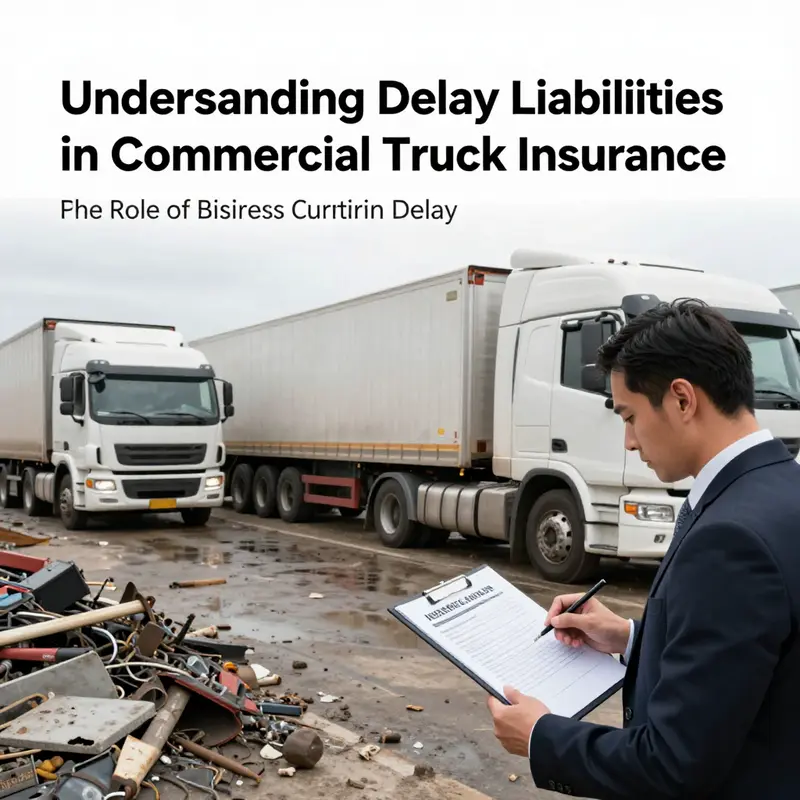
The question of whether commercial truck insurance is liable for taking too long to deliver goods sits at the intersection of risk management and financial resilience. It is tempting to expect that every cost a trucking operation faces should be cushioned by a single policy. Yet the reality is more nuanced. Standard commercial truck insurance zones in on physical damage to vehicles, liability for injuries or property damage caused by accidents, and a range of direct risks tied to the act of moving freight. Delays—the days and hours when freight sits in transit or at a dock, waiting for the next shift in traffic, weather, or logistics—are not, in most conventional policies, guaranteed safety nets. The practical consequence is simple: if a delivery runs late due to traffic, storms, or a breakdown, the policy that covers the truck is unlikely to shoulder the revenue losses, missed deadlines, or contractual penalties that accompany those delays. Those financial consequences are typically addressed through other kinds of coverage, most notably business interruption insurance, or through contractual arrangements that allocate risk and liability between shippers, brokers, and carriers. This distinction matters a great deal for operators who juggle tight delivery windows, just-in-time inventory schemes, and reputational stakes that hinge on punctuality.
To grasp why delays shift from a purely logistical challenge into a financial one, it helps to trace the flow of risk through the trucking ecosystem. A normal delivery cycle begins with a plan: a shipment is booked, a route is chosen, a truck is assigned, and an ETA is promised. On any given leg, a segment can derail—an icy stretch closes a highway, a bridge sustains damage, or a fault in the trailer’s mechanics forces a halt. A standard cargo policy might pay for the goods if they are damaged en route, but it generally won’t cover the income foregone when those goods miss a critical delivery window. If the shipper loses a sale, or if the consignee imposes penalties for late delivery, the driver’s liability policy doesn’t compensate. This gap leaves a company exposed to the financial ripple effects that follow delays: idle equipment, payroll costs that keep running, fuel that continues to burn, and the hard-to-quantify erosion of customer confidence.
Where business interruption insurance enters the picture is in its role as a financial safety net during interruptions that meaningfully disrupt ongoing operations. The case for BI coverage in trucking relies on a broader concept of what disruption means. It is not a meteor strike on a factory floor, but a disruption of the continuity of revenue streams and fixed costs caused by an operational halt tied to a covered peril. The logic that underpins BI is straightforward: if an insured event prevents a company from earning income in the normal way, BI can provide funds to cover lost profits and to sustain ongoing expenses—rent, utilities, salaries, and other fixed costs—during the restoration period. In practice, this means BI can support a carrier, logistics provider, or dispatcher when delays are rooted in events like accidents that immobilize assets, severe weather that closes major corridors, or infrastructure damage that blocks critical routes. In such cases, the policy acknowledges that the business cannot realize its standard revenue while the disruption lasts, and it steps in with financial relief to bridge the period until normal operations resume.
This framing matters because it reframes delays as a potential business risk rather than solely a scheduling problem. When a storm delays a truck, the immediate concern is safety and on-time delivery. The longer-term concern becomes whether the company can absorb the revenue shortfall and continue to operate without sliding into insolvency or losing key customers. BI coverage addresses that concern by helping to stabilize cash flow during the recovery phase. It is important to note, however, that BI is not a universal antidote for every late delivery scenario. The policy’s trigger points, the defined period of restoration, the scope of lost profits, and the treatment of ongoing expenses all determine whether a trucking operation can claim BI compensation. This makes diligence in policy selection crucial. A policy designed with manufacturing firms in mind may not align perfectly with the needs of a transport broker or a small fleet that lives on tight margins and rapid turnover.
Consider the typical distinctions that shape coverage in practice. Cargo insurance, which protects the goods from physical loss or damage while in transit, does not extend to compensation for revenue shortfalls caused by the delay in transit. A driver paying attention to fuel efficiency and route optimization is already managing one layer of risk. The other layer—how the business recovers from the interruption—requires a separate lens. BI coverage responds to the economic consequences of a disruption that causes the business to stop generating revenue at its normal pace. For a trucking company, this means BI can cover the gap between expected income and actual income during the downtime, as well as ongoing costs necessary to keep the lights on. The practical upshot is that BI transforms a logistics setback into a financially survivable setback, provided the disruption meets the policy’s definitions and triggers.
Policy structures around BI vary, and the best outcomes come from a clear alignment between risk exposure and coverage mechanics. One of the key considerations is the trigger: does the BI policy respond to a direct loss at the insured location, such as a damaged shop or warehouse? Or can BI extend to contingent losses that arise when a supplier or customer’s facility is disrupted, preventing the trucking company from delivering as promised? The latter is commonly referred to as contingent business interruption, recognizing that a company’s income can be affected not only by its own premises but also by the broader network that enables its operations. For trucking, contingent BI can be especially relevant in just-in-time supply chains where a single missed delivery cascades into multiple downstream penalties and penalties from customers who rely on strict schedules. The period of restoration is another pivotal term. It marks how long the BI coverage will pay for lost profits and ongoing expenses after the incident ends, until normal operations are restored and revenue returns to its pre-disruption trajectory. Policyholders must assess whether their conventions—eg, multi-shift operations, weekend work, or seasonal peaks—fit within the expected restoration window. A policy that underestimates this window can leave a business stranded financially even after the physical route is cleared.
Mitigation and proactive governance play essential roles in how BI performs for trucking delays. The best-risk carriers build in proactive measures to minimize downtime and expedite recovery. This includes robust incident response protocols, access to alternative routes, and pre-negotiated contracts with alternate carriers or exigent suppliers. It also means maintaining a buffer of essential costs that BI will cover, ensuring payroll and fixed expenses don’t become a source of insolvency during a disruption. Importantly, BI does not waive all consequences of delays. If a carrier’s delay stems from a controllable operational misstep—such as preventable equipment failure due to deferred maintenance—some BI policies may impose optimization or mitigation requirements that could affect coverage. In other words, BI works best when the business has demonstrated a credible commitment to resilience: documented risk assessments, clear continuity plans, and a track record of meeting contingency commitments. The coverage then acts as a backstop, not a substitute for good risk management.
For trucking firms that routinely operate under tight schedules, BI becomes more than a line item on a policy. It becomes a critical piece of a broader resilience strategy. When a major disruption unfolds, the company not only faces the direct costs of re-routing and rescheduling but also the cost of maintaining workforce stability, retaining customers, and preserving supplier and broker relationships. The reputational lift from a demonstrated ability to weather a disruption can be as important as the monetary relief BI provides. In the modern logistics landscape, where customers increasingly demand reliability and transparency, BI coverage supports not just survival but recovery with a disciplined, process-driven approach.
The practical steps to adjudicate BI relevance begin with a risk assessment that maps the company’s operational footprint to its exposure. Fleet size, route concentration, and dependency on a handful of major customers shape how likely a disruption is to trigger substantial revenue losses. Companies with heavy dependence on a single geographic corridor may find BI particularly valuable when weather events or infrastructure closures frequently interrupt that axis. Conversely, more diversified networks may rely more on the flexibility of capacity and on the use of contingent BI to cover revenue risks that arise when any single node temporarily underperforms. The next step is to translate that risk picture into policy terms: identifying the appropriate triggers, the proper scope for lost profits and ongoing expenses, and the realistic period of restoration that aligns with the business’s operating tempo. It is not unusual for brokers and risk managers to integrate BI with other coverage lines, such as extra expense coverage, which pays for the additional costs incurred to continue operations during a disruption, even if those costs do not appear in the form of lost profits. Such an integrated approach helps ensure that the trucking operation can keep wheels turning, even if the original plan is temporarily interrupted.
From a strategic viewpoint, the value proposition of BI in trucking is not merely about paying for the last mile of a delayed shipment. It is about enabling a company to preserve customer commitments and maintain operational continuity in the face of force majeure and other unpredictable events. The business case often hinges on the cost of the premium relative to the potential drop in revenue and the long tail of contractual penalties that could accumulate during a prolonged outage. Trucking executives who anchor their risk posture in BI typically emphasize three pillars: the clarity of policy language, the discipline of risk mitigation, and the agility of recovery planning. Clarity in policy language reduces disputes about whether a specific delay qualifies as a BI event. Risk mitigation reduces the probability and severity of disruptions, while agile recovery planning shortens the window during which BI funds must be deployed to keep the business on its feet.
The broader takeaway for readers who operate in or around the trucking sector is that delays are not automatically insulated by standard insurance. They require a deliberate, well-designed approach to risk transfer that recognizes the revenue-oriented nature of trucking work. BI is not a cure for every late delivery, but when used correctly, it acts as a disciplined mechanism to preserve cash flow, protect payroll, and maintain service levels. This alignment is particularly vital for those with tight delivery slots and a business model that hinges on consistent performance. In this way, BI transforms a logistical hiccup into a manageable financial event, allowing a company to recover with speed and preserve customer trust in an increasingly competitive market.
For further perspective on how these dynamics play out in broader market conditions, see the broader discussion on navigating economic uncertainties in the trucking sector navigating economic uncertainties in the Canadian and US trucking markets. This resource emphasizes how macro shifts—fuel prices, labor costs, and regulatory changes—shape the baseline risk that BI policies aim to mitigate. It also underscores that the value of BI coverage grows when a company can demonstrate disciplined risk management and continuity planning. While BI is not a universal fix for every delay, it provides a principled, financially stabilizing response to disruptions that threaten revenue streams and cost structures alike. In a field where time is directly linked to dollars and customer confidence, BI serves as a strategic anchor for continuity rather than a passive acknowledgment of adversity.
External guidance from regulators and insurance authorities also helps frame the boundaries of BI coverage in transportation contexts. As a practical matter, trucking firms should consult the relevant regulatory guidance to understand how BI products are defined in their jurisdiction, what constitutes a covered event, and how the insurer interprets “period of restoration” and “lost profits.” For a broader regulatory perspective on general insurance products, see the Insurance Authority’s guidance on general insurance offerings: https://www.insuranceauthority.gov.hk/en/insurance-products/general-insurance/
Delivery Timeliness and the Insurance Gap: Integrating Contracts, Coverage, and Dispute Resolution in Commercial Trucking
When a truck sets out to deliver, the journey is framed by a chain of obligations that go beyond miles logged and hours on the road. The risk landscape that a commercial truck policy covers is shaped by physical damage, liability for injuries, and certain direct operational perils. It is a map drawn to protect the asset and those who share the road when things go wrong, not a compass for every contingency that arises from being late. The question at the heart of this chapter—whether commercial truck insurance is liable for delays—reaches into the very architecture of coverage, the contracts that govern freight, and the legal avenues available for resolving disputes across borders. What emerges from this intersection is a nuanced picture: most standard policies do not insure the losses that flow from lateness itself, but there are specific coverage components and contractual arrangements that can influence how delay-related costs are treated, who bears the risk, and how disputes are ultimately resolved in practice.
To begin with, insurance coverage in trucking sits on a triad of protective aims. A policy may respond when the truck is involved in an accident, when a driver causes bodily injury or property damage, or when the vehicle suffers damage that interrupts service during transit. Some policies extend into freight-related costs only when a defined event triggers coverage—an event such as an equipment failure, a collision, or an unforeseen mechanical breakdown that interrupts delivery. In those scenarios, the policy may help absorb the incremental expenses that accompany the delay, such as penalties charged by a shipper, duties assessed by customs, or additional freight charges and storage costs while the cargo waits for a new arrangement. But these scenarios hinge on the cause of the delay and the terms of the policy. If delay arises from factors outside the policy’s scope—human error in scheduling, chronic underestimation of transit times, or a contractually assumed risk borne by the carrier—the insured may not recover the added costs simply by virtue of holding a truck insurance policy.
The distinction between a covered delay and an uncovered one becomes more pronounced once we examine how freight services liability insurance is framed. This line of coverage is designed to address the costs that accrue when a delay is tied to an insured event within the policy’s boundaries. Typically, the additional costs covered under such a regime include penalties charged to the carrier for late performance, duties and freight charges that must be paid to move the goods, and related overhead like storage fees and incidental expenses induced by the delay. The key limiter, however, is causation. The policy must connect the delay to a covered peril or event—commonly an accident, mechanical failure, or other unforeseen circumstance that triggers the insurer’s liability. If a delay is the natural consequence of a predictable scheduling gap, or the direct result of negligent planning on the part of the carrier, coverage may falter. In other words, the insurance line alters the equation only when the delay is tethered to a defined risk the policy is built to address; it does not automatically compensate for all time-related losses.
This is where the contract matters as much as the policy. A spacetime risk—the risk that a late delivery imposes on the recipient or the shipper—often falls outside a carrier’s insurance envelope and squarely inside the realm of contractual allocation. Many freight arrangements explicitly assign timeliness risk to the carrier. When the contract sets a delivery deadline and ties penalties or liquidated damages to missed timelines, the liability for those consequences is often treated as a contractual, not an insurance, matter. Insurers typically exclude these pure economic losses arising from breach of contract, unless the delay coincides with a covered peril. That fundamental distinction helps explain why the question of delay cannot be answered with a single, one-size-fits-all policy clause. It requires an integrated view of the policy language, the contract terms governing delivery timelines, and the risk appetite of both the carrier and the shipper.
The international dimension adds another layer of complexity. When the movement of goods spans borders, disputes about timeliness frequently move into arbitration or other forms of international dispute resolution. The legal framework governing these disputes is as important as the policy language and the contract. In markets governed by arbitration-friendly regimes, a clause mandating arbitration can steer the dispute toward a forum where a trained arbitrator can interpret the interplay between contract timing, insurance coverage, and the facts of any delay. The enforcement of such awards—whether domestic or abroad—depends on treaty status and the specific rules of recognition in the jurisdiction at issue. The synthesis of a properly drafted arbitration clause, a policy that clearly delineates covered delays, and a contract that allocates risk is what ultimately helps a carrier align expectations with a shipper and a court or arbitral panel if a dispute arises.
Against this backdrop, two practical questions emerge with clarity. First, what exactly triggers coverage for a delay under freight services liability, and when does a carrier face a liability that is not indemnified by insurance? The answer rests on causation and policy scope. If a delay results from an accident or breakdown that a carrier can trace to a covered peril, the policy may respond with the associated extra costs. If the delay stems from a breakdown for which the carrier would ordinarily be responsible under the contract or is the consequence of a foreseeable scheduling failure, insurance coverage for those time-related losses is less likely. The second question concerns the impact of breach of contract on insurance claims. If the core delay is caused by a breach of the delivery timetable—perhaps due to poor planning, misrouting, or negligence—the contract may assign the risk away from the insurer and toward the carrier. In such cases, the insurer’s liability may be limited, and the lost-profits or penalties incurred by the shipper would typically be treated as contractual damages rather than insurance losses.
The legal scaffolding that supports disputes over delivery timeliness in cross-border trucking is equally consequential. In international transactions, arbitration is a common mechanism for settling disputes about timeliness, quality of service, and payment terms. In the context of China, for example, there is a formal framework for recognizing and enforcing foreign arbitral awards. ThePrinciple that governs the recognition of foreign arbitral awards applies only when the award emerges from a contracting state, and the disputes must be commercial in nature, touching on cargo transportation, insurance, or agency services under Chinese law. When the agreement includes an arbitration clause, and the award meets the Convention’s criteria, it can be recognized and enforced in China. This framework makes arbitration a practical instrument for resolving conflicts about delays, especially in complex supply chains that involve multiple jurisdictions. The recognition and enforcement regime is not unconditional, however; it operates within a tiered legal structure that weighs jurisdiction, treaty status, and the relevant procedural rules. Even where arbitration is chosen, the eventual enforceability of an award can depend on whether China is a contracting state to the Convention and whether other procedural requirements are met. This underscores how the governance of delay-related disputes is a joint project of policy drafting, contract drafting, and the procedural laws that govern cross-border relief.
The practical timelines that often govern claims arising from cargo delays further illuminate the real-world dynamics at play. In a typical 2025 projection, a claim related to cargo delay unfolds across a sequence of phases. The initial notification to the insurer demands prompt action, ideally within 24 to 48 hours of discovering the delay. The investigation itself can occupy anywhere from one to six weeks, depending on the complexity of the loss, the availability of records, and the responsiveness of all parties involved. After the investigation, the settlement phase begins, which can involve negotiations over the scope of coverage, the calculation of recoverable costs, and the documentation required to support the claim. A properly managed process emphasizes speed and accuracy: timely notification, clear documentation, and a coherent narrative connecting the cause of the delay to the covered risks. For carriers, the takeaway is straightforward. Maintain meticulous records of the delivery schedule, the reasons for any deviations, the steps taken to mitigate delays, and the financial impact that resulted. When a policy includes time-related loss coverage, the carrier should be prepared to demonstrate how the delay falls within the policy’s scope and how it was caused by a covered event. If a delayed delivery is the product of a breach of contract or a predictable planning error, the carrier should not expect coverage for the resulting costs, and the contract terms should clearly reflect that allocation of risk.
For carriers navigating these complexities, the practical recommendations are as important as the policy text. First, accuracy and documentation cannot be overstated. The best protection against dispute over coverage is a precise record of every scheduled delivery, every deviation, and every action taken to preserve the cargo and minimize delay. This includes timestamps, route data, weather logs, maintenance records, and communications with the shipper and the carrier’s own dispatch team. Second, contractual discipline matters. Contracts should specify the allocation of timeliness risk, define penalties for late delivery, and clarify when penalties are recoverable, when they become the shipper’s burden, and how any such amounts interact with insurance coverage. Third, policy language should parallel the contract. If time-related losses may be within scope, the policy should articulate the exact triggers, the covered costs, and the exclusions that apply to breaches of contract or negligence. A policy that uses narrow phrasing without addressing time-related damages can leave the carrier exposed to large, uncovered losses that the contract alone is supposed to manage. Fourth, the potential for cross-border disputes invites strategic thinking about dispute resolution. If a multi-jurisdiction supply chain is possible, an arbitration clause that is clear about the forum, the governing law, and the enforceability of awards helps all parties anticipate how a future disagreement will be resolved. The goal is not to erase risk but to map it comprehensively so that a carrier can respond quickly to disruptions without being surprised by the failure of a single provision to cover the full spectrum of loss.
Amid these considerations, a broader practice emerges. Carriers who align their insurance coverage with the realities of their freight contracts and who anticipate the cross-border dimension of modern logistics are better positioned to manage the financial consequences of delays. The synthesis is straightforward: insurance covers the unforeseen and the involuntary, while contractual arrangements manage the predictable and the risk left to the market’s allocation of responsibility. In such a system, a delay does not automatically become an insurance dispute, but it also does not escape the accountability embedded in the contract. The real-world impact is a more resilient approach to delivery timeliness, one that recognizes the limits of insurance while leveraging the tools of contract law and arbitration to contain costs, accelerate resolution, and preserve the viability of the supply chain.
To add a note on how this topic sits within the broader discourse on trucking risk management, consider the broader literature and discussions on market uncertainties and strategic responses in the trucking industry. For readers seeking a broader view of risk management and market dynamics in the trucking sector, this chapter intersects with the wider conversations captured in discussions about navigating economic uncertainties in the trucking markets. You can explore related reflections and market analyses at the blog for industry insights, which offers context that complements the legal and policy framework described here. For practical context on market risk management and strategic planning in trucking, see the discussion on navigating economic uncertainties key insights from the Canadian and US trucking markets.
For readers looking to connect this chapter to a practical, industry-focused resource, an internal reference point is the discussion on market dynamics and risk management in trucking markets. This link provides a bridge to broader strategic considerations while staying anchored in the contractual and insurance concepts outlined here.
External resources and jurisdictional guidance are essential complements to the discussion above. In addition to the policy and contract analysis, stakeholders may consult formal arbitration guidance and the enforcement framework that governs cross-border disputes. A useful legal anchor for those pursuing the enforcement angle is the official guidance on the recognition and enforcement of foreign arbitral awards. This resource helps illuminate how arbitration outcomes travel across borders and what conditions govern their enforceability, a matter that becomes particularly salient when disputes involve international transport, cross-border insurance, and time-related obligations. See the applicable guidance for more detail on how the recognition and enforcement framework operates in practice in cross-border commercial shipping and insurance contexts.
External resource: https://www.court.gov.cn/zixun-xiangqing-348779.html
Internal link to related industry context: navigating economic uncertainties key insights from the Canadian and US trucking markets
null
null
Final thoughts
Understanding the scope of commercial truck insurance is vital for trucking companies and logistics partners facing potential liabilities from delays. While traditional policies may not cover financial losses due to prolonged delivery times, exploring options like business interruption insurance and analyzing contractual obligations can provide valuable protection. The discussed implications on the commercial truck insurance market also highlight the need for stakeholders to adapt and strategize effectively to mitigate risks associated with delivery delays. By staying informed and proactive, businesses can navigate these complexities and secure their operations within the evolving insurance landscape.