For trucking company owners, fleet managers, and logistics firms operating in Northern Virginia, the process of acquiring commercial truck registration is a critical step in ensuring compliance and efficiency in operations. This article provides a thorough guide on how to successfully navigate the registration process through the Virginia Department of Motor Vehicles (DMV) in Northern Virginia. We will explore the procedural aspects in detail, including necessary documentation, strategic online services, and the location of the primary registration center. With this comprehensive information, businesses can streamline their fleet management and stay compliant with local regulations.
Registration Roadmap: Navigating Commercial Truck Registration in Northern Virginia
Registration of a CMV in Northern Virginia is a multi-step process designed to confirm ownership, insurance, and compliance before a vehicle is allowed to operate. In this region, key activity centers around the Virginia DMV’s commercial vehicle services, with the Stafford area Northern Virginia Customer Service Center handling many CMV tasks, including title transfers, plate renewals, and registrations for trucks serving Fairfax, Loudoun, Prince William, and surrounding counties. The typical path begins with gathering documents: a vehicle title, proof of insurance meeting state minimums, and the completed VA-140 form (or the current online equivalent). If the operation crosses state lines, a valid DOT number via FMCSA URS will be relevant. Online options let you start the process, upload documents, schedule appointments, and pre-review forms to reduce in-person time at the Stafford center. Hours are generally 8:00 AM to 5:00 PM, Monday through Friday, but can vary for holidays. As you prepare, understand that online scheduling and document submission can dramatically shorten visits and help align fleet renewal cycles with internal operations. The broader message is that CMV registration in Northern Virginia is best approached as a planned workflow: confirm vehicle compliance, obtain or verify ownership and insurance, complete the necessary forms, prepare inspection documentation if required, and choose online or in-person submission that fits your schedule. While the Stafford center remains a central node, many operators benefit from using the DMV’s online tools to stage portions of the process and reduce downtime. Finally, consult the Virginia DMV’s official pages for the latest forms, fees, and procedures to ensure your registration is current and compliant.
Chapter 2: From Paper to Plates—Mastering Essential Documentation for Commercial Truck Registration in Northern Virginia
When a fleet owner or independent operator in Northern Virginia contemplates registering a commercial truck, the journey from the driveway to the highway begins long before a license plate is issued. It begins with understanding where to go, what to bring, and how the pieces fit together in a system designed to verify ownership, financial responsibility, and safety. The Virginia Department of Motor Vehicles (DMV) provides a clear path, but the practical journey is really a sequence of carefully collected documents, official forms, and concrete checks that ensure a vehicle can legally operate on regional roads and, if needed, across state lines. In Northern Virginia, the primary conduit for commercial vehicle registration is the DMV system, with a central access point that serves the broader Northern Virginia counties and their growing, commerce-driven needs. The process is not merely a bureaucratic hurdle; it is a structured, predictable sequence that, when followed, translates into accountability, insurance protection, and a clean slate for a truck’s legal identity on the road. This chapter weaves together the essential paperwork and the surrounding realities that shape the registration experience in this region, guiding readers from the moment they start collecting forms to the moment their plates arrive and the registration is officially activated.
At the heart of the registration journey is the fundamental requirement to complete the Virginia Vehicle Registration Form, known by its official designation as Form VD-1. This document is more than a simple application; it is the formal declaration of ownership and intent that binds the vehicle to a legal status in Virginia. The VD-1 is the portal through which the DMV learns the truck’s basic identity: make, model, year, and Vehicle Identification Number (VIN). It also captures the owner’s particulars—name, address, and contact information—so that the state can correlate the vehicle with the correct legal and financial responsibilities. Accuracy on the VD-1 matters. A misstep or omission can ripple into processing delays, misdirected mail, or even a mismatch between what the DMV has on file and what the owner intends to register. For that reason, the moment a prospective registrant sits down to fill out the VD-1, a careful, data-driven approach is essential. The form’s clarity is not merely a clerical preference; it is a safeguard against future conflicts and a smoother path toward licensing plates.
Diligence in documenting ownership is the natural companion to the VD-1. Virginia requires proof of ownership, most often represented by a valid title certificate—Form VD-170 is the official vehicle title in this context. The title confirms who holds the rights to the vehicle and establishes the chain of ownership that will be mirrored in the DMV’s records. If a lien exists—whether the truck is financed or leased—the lienholder’s information must be reflected on the title. This ensures that the lender retains a legal stake in the vehicle until the debt is satisfied, and it also clarifies who bears responsibility for registrations, taxes, and potential title transfers. In the realm of commercial trucking, where trucks can be part of a fleet with multiple ownership layers, ensuring the lienholder’s details are correct is not optional; it is a prerequisite to a clean registration that will stand up to audits, financings, and potential interstate operations.
For vehicles acquired through a lease or rental arrangement, a copy of the lease contract often accompanies the package. The lease documents establish the legal possessing entity—who has the right to operate the truck and who is accountable for registrations and liabilities. The DMV expects this documentation to forestall any ambiguity about who will appear on the registration records and who will be responsible for compliance with Virginia’s insurance and safety requirements.
Insurance is the financial safety net that accompanies every registered vehicle in Virginia. The DMV’s standard for liability coverage is designed to protect not just the owners or operators but the public that shares the road. In practice, applicants must provide evidence of current insurance that meets Virginia’s minimum liability thresholds—specifically, $25,000 per person and $50,000 per accident for bodily injury, plus $25,000 for property damage. These amounts—often summarized as 25/50/25—are a baseline. The evidence of coverage can take the form of a signed policy document or a declaration page from the insurer. What matters is that the proof is contemporary, accurately reflects the vehicle in question, and demonstrates ongoing coverage that remains in force for the duration of the registration period. For commercial operations, where fleets ride the line between routine deliveries and long-haul transportation, the insurance documentation is not a mere formality. It is a critical shield that underpins risk management for the operator, the customers, and the public.
Beyond ownership and insurance lies the question of safety compliance, a domain where federal and state standards intersect. The Department of Transportation (DOT) program sits at the core of this intersection. Virginia requires that commercial trucks have undergone a DOT inspection, a rigorous safety evaluation conducted by a certified inspector. The DMV itself does not perform the DOT inspection as part of the registration process; instead, it requires documentation confirming that the vehicle has passed a DOT-compliant inspection. The inspection report, completed and signed by a qualified inspector, is submitted alongside the registration application. This requirement underscores a broader principle: registration is not merely a paperwork exercise; it is a public safety checkpoint that connects regulatory compliance, vehicle integrity, and roadworthiness to the legal right to operate a commercial vehicle. For operators who run interstate routes, consistency with federal rules is reinforced by the USDOT number issued by the Federal Motor Carrier Safety Administration (FMCSA). If the truck participates in interstate commerce, the USDOT number becomes a necessary credential that accompanies the DMV registration—a reminder that some registrations exist within a larger regulatory ecosystem that transcends state lines.
As a practical matter, many applicants benefit from thinking of the registration package as a single, coherent bundle rather than a jumble of independent forms. The VD-1, the proof of ownership (and lien information if applicable), the lease documents, the insurance documentation, and the DOT inspection report must all be present and aligned. Any inconsistency—say, a mismatch between the VIN on the VD-1 and the VIN listed on the title or a lapse in insurance coverage—can trigger delays or even denial of registration. The bundle is not just about satisfying a checklist; it is about ensuring that every facet of ownership, responsibility, and safety is transparently accounted for in the DMV’s system. Arriving at the DMV with all components already gathered allows the process to move with predictability and minimizes the risk of a return trip or an added appointment.
In many cases, commercial operators begin the process online. The Virginia DMV offers an online pathway to start the registration journey, enabling applicants to schedule appointments and submit certain documents electronically. The online option is particularly valuable for busy fleets or business owners who manage multiple vehicles, as it can save time and reduce the chance of missing paperwork in person. Yet even with the online initiation, the final steps often unfold in person at a DMV office, where the paperwork is reviewed, fees are assessed, and the registration certificate and plates are issued. The in-person component is not a hurdle; it is the moment of verification where a trained DMV staff member cross-checks the documents, confirms the accuracy of the information, and ensures that the vehicle meets all state and safety prerequisites before the plates are released.
For Northern Virginia residents and businesses, the central access point for commercial vehicle registration is the Northern Virginia DMV Customer Service Center, a hub designed to handle the region’s volume and its diverse fleet needs. While the main address listed for the center sits in Stafford, the office serves a broad geography that includes Fairfax, Loudoun, Prince William, and Fauquier counties. The hours of operation are typically Monday through Friday, 8:00 a.m. to 5:00 p.m., with closures on state holidays. This schedule provides a reliable window for owners who must balance registration tasks with the daily demands of operating or managing a fleet. When planning a visit, it is prudent to confirm hours and any necessary appointments, as peak times can bring longer wait times. The DMV’s emphasis on appointments reflects a broader trend toward streamlined service while preserving the flexibility required by businesses that rely on timely registration for their operations.
The practical counsel that emerges from this framework is straightforward. Start with the VD-1, and treat it as the backbone document that ties all other pieces together. Assemble proof of ownership, ensuring the title is clear of any mismatches and that lienholder information is up to date. Gather the proof of insurance that satisfies the 25/50/25 minimum and verify that the coverage aligns with the vehicle’s weight class and use case. Collect the DOT inspection report well before the registration appointment, and if the truck operates across state borders, secure the USDOT number information from FMCSA. Keep a clean set of lease documents if the vehicle is not owned outright, and bring any business licenses or corporate documentation that may be requested to establish legitimate ownership and operating authority. Bring copies; bring originals; and, importantly, ensure that all documents reflect the same operator or business entity. In the world of commercial trucking, consistency is a quiet force that reduces friction in the registration process and supports compliance across the fleet’s lifecycle.
For the actual transaction, bring payment means that are accepted by the DMV and are appropriate for the expected fees. The registration fees, a commercial vehicle surcharge, and any additional taxes or environmental fees will depend on the vehicle’s weight, emission standards, and the nature of its use. The DMV typically accepts common payment methods such as credit or debit cards and checks, but it is wise to verify the accepted forms at the specific office you will visit. By approaching the process with a prepared bundle and a clear understanding of the requirements, a commercial operator can navigate the Northern Virginia registration landscape with confidence, knowing that the vehicle’s legal status is secured and that the plates and registration certificate will be issued in a timely manner after approval.
To anchor this overview with a reliable reference, the Virginia DMV provides an authoritative collection of forms and guidance that govern commercial vehicle registration. The VD-1 form is central to the application, and the official resources clarify how to complete it, where to obtain it, and what to attach when submitting the batch. While the specifics may adjust over time with updates to state regulations, the core principles endure: verify ownership, secure proof of insurance, document safety compliance, and complete the ownership-to-registration transition in a coordinated, paper-ready package. In practice, that means aligning every document to the same vehicle and the same ownership entity, presenting a cohesive narrative that the DMV can quickly verify and approve.
In the larger arc of a fleet’s regulatory life, the essential documentation described here forms the foundation for compliant operation. It is the quiet infrastructure that supports uptime, risk management, and predictability in a business environment where deliveries, maintenance, and optimization hinge on deadlines and legal authority. As you plan a registration effort in Northern Virginia, approach the task as a structured intake, where each document plays a defined role in proving ownership, confirming liability, and certifying safety. The result is not merely a plate on a vehicle; it is a clear signal to customers, lenders, and insurers that the vehicle is a recognized, accountable asset operating within a robust regulatory framework.
For deeper engagement with the process, consider reviewing the official Virginia DMV page dedicated to commercial vehicle registration, which consolidates form downloads, detailed requirements, and the latest guidance. This resource is an essential companion to the step-by-step overview and serves as a ready reference as regulations evolve and new scenarios arise in Northern Virginia’s dynamic trucking environment.
External resource: https://www.dmv.virginia.gov/vehicles/commercial-vehicle-registration/
Navigating Northern Virginia’s Online Truck Registration: A Fleet Manager’s Practical Guide
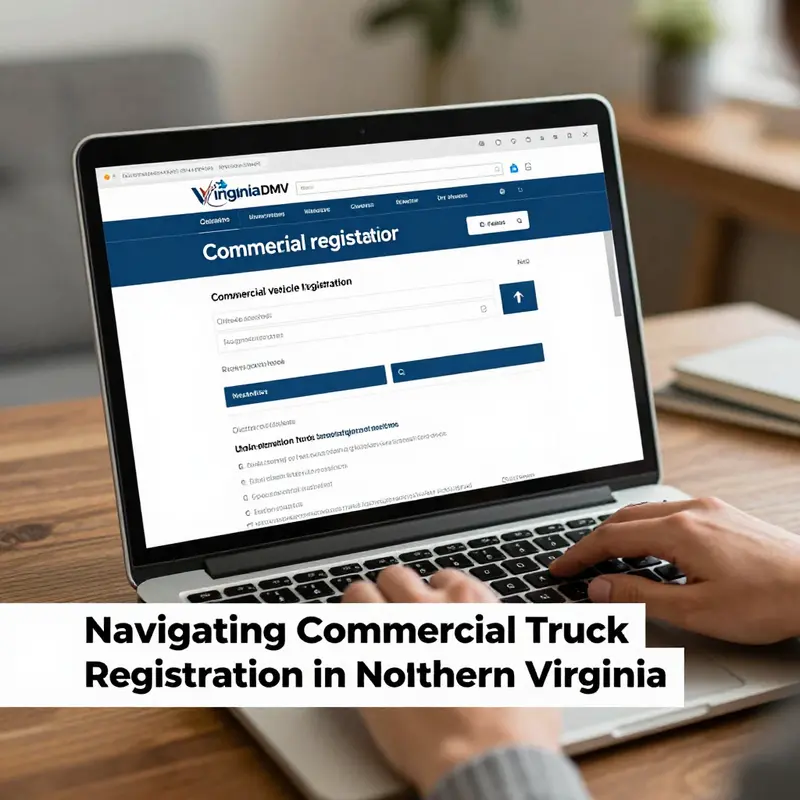
Registration is more than a bureaucratic step. For fleets in Northern Virginia, it is a lifeline that keeps goods moving and operations compliant. The online tools provided by the Virginia DMV have become essential for fleet managers who must balance uptime with regulatory deadlines. Rather than viewing online registration as only a convenience, many managers treat the portal as a first step that can reduce downtime, accelerate renewals, and improve visibility into vehicle status. The online system is designed around the realities of commercial trucking: accuracy, documentation, and timely compliance.
The heart of the online experience is the DMV’s official portal. Fleet operators begin by selecting the path that matches their vehicles and business structure. The online application submission feature is the hinge on which fast, compliant registrations turn. Submitting applications electronically reduces trips to a DMV office and supports a predictable workflow for managers who juggle insurance documents and titles. In Northern Virginia, the ability to submit applications remotely translates into less downtime for trucks waiting on paperwork.
One tangible benefit is the elimination of redundant effort. With documents uploaded in advance—proof of insurance, the vehicle title, odometer readings, and, for company-owned trucks, business licenses—the system can validate data, flag gaps, and route applications for review more efficiently than paper-based workflows. The insurance requirement is a critical checkpoint; the DMV’s online platform accepts digital copies of policies, ensuring compliance without physical file transfers. This is especially valuable for fleets with multiple sites, where a centralized manager can upload documents for all vehicles and monitor status in real time.
Electronic payment processing is another keystone. The DMV’s online system accepts major credit cards and electronic checks, enabling secure, auditable trails that simplify accounting. Online renewals keep vehicles compliant without the friction of a DMV visit, and renewal reminders can be configured to arrive by email.
Status lookup adds a layer of control. The portal allows a transparent view into the current status of titles and registrations. Managers can verify expiration dates, confirm liens, and identify items that could delay processing. This reduces last-minute surprises that often derail a renewal or transfer. In practice, procurement, dispatch, and safety teams can coordinate with the DMV online to keep trucks in service rather than waiting on paperwork.
Electronic titles, or e-titles, are another forward-looking feature. E-titles enable the transfer or management of ownership documents online, a boon for fleets that acquire used vehicles or restructure ownership. The digital ecosystem also enhances security and traceability with encryption, multi-factor authentication, and audits. For fleets handling sensitive information, these protections provide assurance that online processes remain compliant and secure.
To support users who prefer human guidance, the DMV provides a robust help center, FAQs, tutorials, and downloadable guides. When issues require human intervention, the customer service line is a critical touchpoint. Northern Virginia’s live service centers offer in-person assistance for difficult transactions, such as title transfers involving liens. The combination of online tools and in-person support reflects a deliberate design to accommodate diverse needs in a busy region.
In Northern Virginia, a practical workflow often begins online. The operator logs into the DMV portal, selects the appropriate registration path, and prepares documents including proof of insurance, the vehicle title, and odometer readings. If the vehicle is part of a company-owned fleet, the business license or corporate documentation may also be required. The platform guides users through each step, flags missing items, and helps avoid errors before submission. The next step is payment, after which the transaction is confirmed and a status tracker is available. Renewal reminders help ensure ongoing compliance.
For fleet managers, the online pathway is the default, with in-person support as a targeted safeguard. Gather documents in advance, organize them for digital access, and use the portal’s guided steps to produce a timely submission. If edge cases arise—such as complex lien arrangements or corporate restructures—use the help resources or plan a targeted in-person visit to a local center. The blend of digital efficiency and human expertise keeps Northern Virginia fleets legally compliant and operational.
Final thoughts
Navigating the commercial truck registration process in Northern Virginia can be a seamless experience with the right information and resources. By understanding the registration steps through the DMV, preparing the necessary documentation, and utilizing online services, trucking professionals can ensure their fleets are operationally compliant and efficiently managed. This resource serves as a guide to help optimized registration processes, ensuring that businesses remain focused on their core objectives while adhering to legal requirements.