The transportation sector relies heavily on compliance with federal regulations to ensure safety and efficiency. For commercial pickup trucks, understanding when a DOT number is required is crucial. This article delves into the specific criteria for obtaining a USDOT number, focusing on the truck’s weight ratings, its use in interstate commerce, and the registration process. Trucking company owners, fleet managers, and procurement teams in construction and logistics industries must grasp these regulations to stay compliant and optimize their operations. Each chapter will provide in-depth insights tailored to your business needs.
Thresholds, Weights, and Cross-Border Routes: When Commercial Pickups Must Carry a USDOT Number
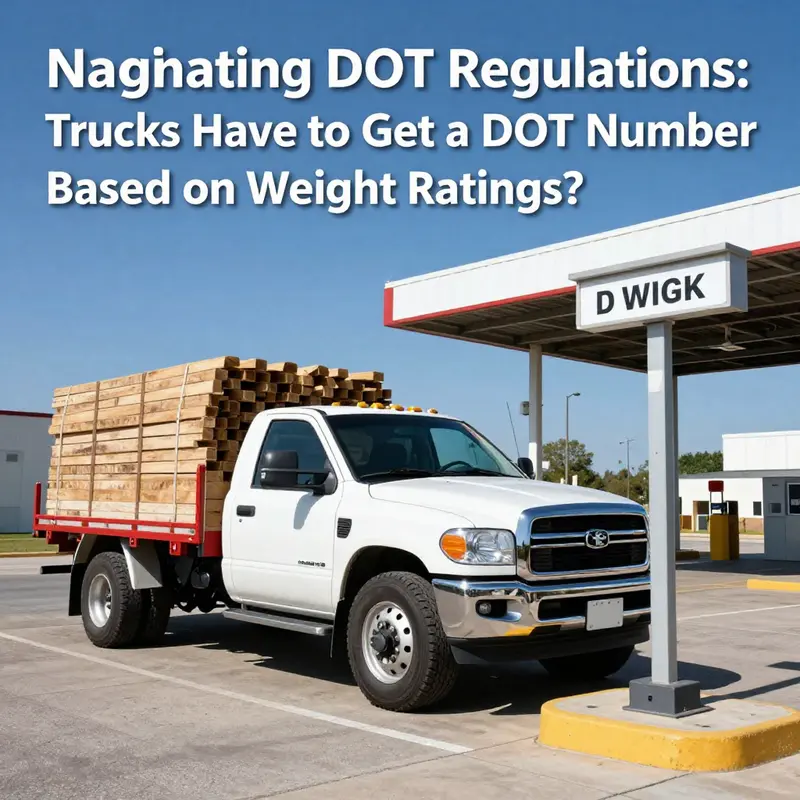
A simple weight threshold governs a surprisingly large slice of how commercial pickup trucks are regulated in the United States. When a pickup’s Gross Vehicle Weight Rating, or GVWR, reaches 10,001 pounds or more, the vehicle steps into a federal regulatory framework that can affect all aspects of its operation in interstate commerce. That threshold is not a mere number on a spec sheet; it is a practical line between vehicles that fall under the safety, insurance, and enforcement reach of the Federal Motor Carrier Safety Administration (FMCSA) and those that do not. Understanding why this distinction matters helps business owners, fleet managers, and operators make smarter choices about equipment, routes, and compliance before a load hits the highway. The USDOT number, the badge of this compliance, is not simply a bureaucratic ornament. It is the key to accountability, safety history, and ongoing regulatory responsibility across state lines, even when the vehicle is a pickup designed for daily work around a town, a farm, or a regional distribution route.
GVWR is the critical starting point. It represents the maximum operating weight of the vehicle as specified by the manufacturer. This weight includes the truck itself, fuel, fluids, passengers, cargo, and any added equipment that increases the vehicle’s load-bearing capacity. In practical terms, GVWR tells you how much the vehicle is engineered to carry safely in any given moment, not how much it might weigh when it is loaded for a single trip. A pickup with a GVWR just under the threshold—say, 9,900 pounds—does not automatically trigger USDOT registration for interstate commerce. But if that same model is equipped or configured to push the GVWR beyond 10,000 pounds, the regulatory math changes. The moment you cross that line, the FMCSA’s jurisdiction becomes relevant, and the permission to operate for hire or in commerce across state lines often comes with a corresponding set of responsibilities that must be understood and followed.
The designation applies regardless of whether the purpose of the interstate transport is to move goods, passengers, or any other commercial activity. The FMCSA’s rules define a commercial motor vehicle, a term that encompasses heavy pickups used in interstate commerce, and it treats the act of crossing state lines for business purposes as a trigger for regulatory oversight. This means that even if a business primarily uses its pickup for local work but occasionally dispatches it on routes that cross state borders, the vehicle may still fall under the USDOT registration system if its GVWR is at or above the 10,001-pound mark. The scope of the requirement is not limited to cargo alone; it includes passenger transport in certain contexts, provided the vehicle meets the GVWR threshold and operates in interstate commerce. This nuance is essential for operators who might otherwise assume that a pickup used for local jobs and occasional longer-distance trips is exempt from federal ID requirements.
To translate weight into wheels-on-road policy, it helps to unpack what GVWR actually captures. The label is not merely a static figure; it is a standardized rating that encompasses the vehicle’s structural capacity and recommended load. It factors in the vehicle’s axles, the chassis, the suspension, and the overall design that governs how much weight the truck can safely carry at peak operating conditions. Because GVWR includes payload and all other load components, it functions as a practical guardrail. If the weight of cargo, people, and fuel together could push the operation beyond the rated limit, the vehicle would be operating in a state the manufacturer did not intend for it to inhabit. This concept is central to why the FMCSA uses GVWR as the gateway to USDOT registration for interstate operations. It is not simply about a number on a window sticker; it is about maintaining safe operation over the broad spectrum of loads and routes a commercial pickup might encounter.
The interwovenness of weight, route, and regulation becomes clearer when you consider the “interstate commerce” condition. Interstate commerce means transporting goods or passengers across state lines as part of a business activity. It does not require every trip to cross the border to trigger the rule; it hinges on the nature of the business and the purpose of the movement. A company that regularly hauls goods or people between states, even if those trips occur occasionally or as a service with a narrow regional footprint, could find itself within the FMCSA’s reach if the GVWR threshold is met. The automation of this framework is designed to bring a consistent standard to operators who move freight and people across state lines, reducing the confusion that too often accompanies multi-state logistics. The USDOT number then becomes a unique identifier that FMCSA uses to track safety performance, inspections, compliance actions, and the overall history of the carrier. It is a mechanism that helps regulators identify patterns, verify endorsements, and facilitate safer operations by fostering accountability.
The practical implications of obtaining and displaying a USDOT number are often appreciated only after a close look at the consequences of noncompliance. When a vehicle that should be registered operates without a USDOT number in interstate commerce, the business risks penalties, fines, and potential delays at weigh stations or enforcement checkpoints. The USDOT number is not a decorative tag; it is a functional part of the vehicle’s regulatory profile. It allows FMCSA to connect a vehicle’s safety record with its operator, maintain a searchable history, and ensure that safety audits and inspections can be conducted with a clear organizational footprint. The system’s transparency serves both public safety interests and the operators who comply; it makes it easier to track maintenance regimes, driver qualifications, hours-of-service compliance, and vehicle inspections across a fleet. That clarity is especially valuable when a business owns a small fleet or operates a handful of pickups that routinely move across state lines for projects, deliveries, or service calls. In such contexts, knowing the correct status—whether a USDOT number is required, and if so, how to obtain it—can be the difference between a smooth operation and a costly regulatory disruption.
For those navigating the process, the registration is designed to be accessible online through the FMCSA’s official channels. The act of applying for a USDOT number is not a barrier to entry but a formalization of lawful operation in interstate commerce. In practice, the application collects information about the business, the vehicle fleet, and the people who will operate the commercial motor vehicles. The proper flow often includes confirming that the operator meets the safety and insurance prerequisites FMCSA tracks and that all drivers possess appropriate qualifications. Once issued, the USDOT number must be displayed on the commercial motor vehicle in a conspicuous place, typically on the side of the cab or the door area, so compliance officers can readily identify the carrier during roadside inspections. The number serves as a gateway to the FMCSA’s safety data systems, which contain information about inspections, crashes, and safety compliance activity for the operator. This interconnected system—GVWR, interstate commerce status, USDOT identification, and ongoing safety oversight—creates a framework that many operators find beneficial in the long run. It provides a public record that can support financial decisions, insurance considerations, and even the management of a fleet’s maintenance and training programs, since the record-keeping obligations that come with USDOT registration encourage better overall safety and reliability.
Determining whether a specific pickup falls into the 10,001-pound-and-above category is, in practice, a straightforward check when the vehicle arrives on the lot. GVWR is a specification that appears on the manufacturer’s label, usually found on the door jamb of the driver’s side, and in the owner’s manual or the vehicle’s data plate. Since GVWR represents the maximum rating, it is not the actual weight the truck carries at all times, nor is it the empty weight. It is a ceiling, reflecting design limits for safe operation. A pickup configured with heavy-duty options, large fuel tanks, or added equipment such as plows, gooseneck hitches, or heavy bed systems can tip the GVWR over the 10,000-pound threshold even if the curb weight of the truck with no payload appears modest. This distinction is where the line between casual and regulated use becomes a practical concern: two otherwise similar pickups could have different regulatory statuses solely because of their arranged GVWR. Fleet managers must account for this difference when planning equipment purchases or lease arrangements, because a shift in GVWR can alter the regulatory burden and the administrative overhead of compliance, including insurance, inspections, and driver qualification files.
The path to USDOT registration is well-trodden, and a careful operator will approach it with the same methodical thinking applied to route planning. Application is completed online through FMCSA’s portal, with attention to providing accurate business details, a description of the operating authority, and the estimated scope of interstate activity. In many cases, a company will also evaluate whether it needs an MC number in addition to the USDOT number. The MC number, sometimes referred to as the motor carrier number, is required for for-hire carriers engaged in interstate operations and is distinct but often coupled with USDOT registration. A pickup that meets the GVWR threshold and is used in interstate commerce for hire may therefore require both a USDOT number and an MC number. Conversely, private carriers that operate solely within state borders may have a different regulatory footprint, though local or state-level rules may still apply depending on the jurisdiction. The essential principle remains: GVWR plus interstate activity equals federally regulated status, with the USDOT number serving as the universal identifier across federal and state interfaces.
Display requirements reinforce the seriousness of the registration. The USDOT number must be visible on the vehicle in a legible format, usually in a contrasting color that stands out from the vehicle’s paint. The display is not only a legal requirement but a practical signal to inspectors, customers, and partners about the operator’s compliance posture. For those who manage fleets or multiple pickups, the display policy simplifies verification during roadside checks and reduces the risk of inadvertent noncompliance. In practice, this visibility helps create a culture of accountability within the operation, where drivers understand that their vehicle’s markings reflect a broader regulatory responsibility that extends beyond the single trip. The continuity of the USDOT number through the vehicle’s life cycle—through ownership changes, route expansions, or shifts in business emphasis—depends on keeping the information current and aligned with FMCSA records.
It is also important to acknowledge the broader regulatory landscape that surrounds the USDOT registration. While the 10,001-pound threshold is the trigger for interstate commerce, there are related safety and insurance considerations that often accompany this status. For example, insurance requirements for CMVs engaged in interstate commerce may scale with the scale of the operation, and certain drivers or vehicles may need specific endorsements or compliance with hours-of-service rules. FMCSA’s safety measurement systems and inspection protocols create a continuous feedback loop, where the operator’s historical performance informs risk assessments and, potentially, insurance costs. This interrelation is not an arbitrary layering of rules but a purposeful design intended to improve highway safety by encouraging consistent, data-informed operations. A pickup that crosses the threshold into USDOT-regulated territory thus enters a more formal governance regime, but it also gains access to a recognized framework for safety oversight that can support sustained reliability and protection for both the business and its customers.
From a strategic standpoint, weighing the cost and benefit of upgrading a pickup’s GVWR to meet or exceed the threshold requires careful budgeting and scenario analysis. The line between non-regulated and regulated operation can influence decisions about truck selection, payload capacity, and even insurance procurement. If a business anticipates increasing interstate activity or expects to carry heavier loads in the future, advancing to a higher GVWR class could be a proactive move that aligns with regulatory expectations and reduces the risk of a compliance surprise later on. Conversely, if the anticipated weight and route profile do not justify the compliance overhead, a smaller GVWR may be more efficient, avoiding the USDOT registration altogether while still delivering the required performance for local or intrastate work. In either case, the accuracy of the GVWR specification and the clarity of the intended operation are the foundation for a compliant, efficient fleet strategy.
For readers seeking a practical touchstone, consider the broader market context and how it intersects with policy. The landscape of heavy pickups, their configuration options, and the regulatory requirements surrounding them interact with supply chains, insurance markets, and fleet utilization patterns in meaningful ways. As markets shift, so too do the incentives for operators to re-evaluate vehicle weights, route planning, and compliance readiness. A cautious approach includes verifying GVWR during vehicle selection, confirming the intended route structure, and aligning internal policies with FMCSA guidance. This alignment can be reinforced by consulting authoritative resources and taking advantage of industry discussions found in reputable industry blogs and trade resources. For example, ongoing coverage and insights from industry-focused outlets can illuminate how other operators navigate the cost and logistics of USDOT registration as part of their broader growth strategies. To explore broader perspectives on fleet management and regulatory considerations, see the McGrath Trucks blog. McGrath Trucks blog.
While the topic of USDOT registration intersects with many operational decisions, the central takeaway remains clear: the moment a pickup’s GVWR crosses the 10,001-pound threshold and the vehicle engages in interstate commerce, USDOT identification and FMCSA oversight become part of the operational fabric. The process of applying for and maintaining a USDOT number is designed to be accessible but disciplined, and the display of the number on the vehicle is a tangible reminder of the regulatory responsibility that accompanies interstate movement. For operators, this is not merely a compliance checkmark; it is a framework that supports safety history tracking, route accountability, and a transparent record of performance that can influence every facet of the business—from driver training and vehicle maintenance to insurance pricing and customer trust. As you plan equipment purchases, route commitments, and regulatory readiness, the 10,001-pound threshold serves as a practical compass that helps you decide how your pickups should be configured, how they will be used, and what documentation you will need to keep in place for seamless operation across state lines.
External resource for official guidance: https://www.fmcsa.dot.gov/
When a Commercial Pickup Requires a USDOT Number: A Practical Guide
Understanding when a USDOT number is required for a pickup truck involves three factors: GVWR, interstate commerce, and hazardous materials. If the vehicle is built to a GVWR of 10,001 pounds or more and is used in commerce that crosses state lines, USDOT registration is typically required. If the operation stays within one state, the likelihood reduces, but other conditions can still trigger registration. Interstate trips, even occasional ones, can bring FMCSA oversight. If hazardous materials requiring placarding are involved, the USDOT number is usually required regardless of weight. The best practice is to review vehicle specifications and typical routes, then consult the FMCSA guidance and use the online registration portal to determine exact obligations. Key steps include confirming GVWR from the door placard or spec sheet, assessing whether shipments cross state lines or involve hazardous materials, and completing the FMCSA registration if required. After registration, keep the USDOT number accessible and maintain safety compliance records. Rules can evolve, so periodic reviews of the official guidance help ensure ongoing compliance.
Beyond the GVWR Line: How and When Commercial Pickup Trucks Must Register for a USDOT Number
The moment a commercial pickup crosses the threshold of legality in the eyes of federal regulators is not marked by a dramatic siren or a large sign on the bumper. It is defined by a number on the vehicle’s GVWR label and a careful reading of the rules that govern commerce across state lines. For many operators, this is the point at which a simple pickup becomes part of a nationwide safety and accountability framework. The USDOT number is more than a sticker or a badge; it is the unique identifier linking a carrier, its fleet, and its safety history to a comprehensive system of oversight that aims to protect drivers, other road users, and the cargo itself. The core trigger, in most cases, is straightforward: if a commercial pickup’s Gross Vehicle Weight Rating (GVWR) is 10,001 pounds or more, and the vehicle is used in interstate commerce to haul goods or passengers for business purposes, federal regulations require registration with the Federal Motor Carrier Safety Administration (FMCSA) and the display of a USDOT number. Yet the practical reality of the rule stretches beyond a single numeric threshold. It touches the everyday decisions of a business that relies on pickups for distribution, service, and logistics, and it invites a careful look at how interstate travel, safety requirements, and administrative responsibilities converge in the life of a single vehicle.
To understand when a pickup becomes a federally regulated carrier, one must first clarify what counts as interstate commerce. Interstate commerce refers to transportation that moves goods or passengers across state lines for compensation, or that is part of a broader business operation extending beyond a single state. A pickup used exclusively within one state and serving only intra-state needs may not fall under the same federal requirements. However, many operators encounter occasional cross-border or cross-state trips, seasonal surges in cargo, or mixed-use patterns that blur the line between intrastate and interstate activity. In those cases, the question is not merely whether a GVWR label meets a numeric threshold, but whether the activity triggers federal authority because it involves cross-state movement for business purposes.
GVWR is not a guesswork metric. The GVWR is the maximum operating weight as specified by the vehicle manufacturer, including vehicle curb weight, payload, passengers, and fuel. It is the critical specification that the FMCSA uses to determine whether a vehicle qualifies as a commercial motor vehicle subject to federal safety regulations. The label containing the GVWR can typically be found on the driver’s side door jamb or in the owner’s manual, and it must be read with care because a misread or a mislabel can lead to noncompliance that hackers no one wants. When the GVWR sits at or above 10,001 pounds, the door opens to a suite of regulatory requirements that matter to the operator’s bottom line, insurance, and fleet safety program. The distinction is not about the color or the trim of the truck; it is about the weight that changes the regulatory posture of the vehicle, and by extension, the practices the operator must follow.
Registration under the Unified Registration System (URS) is the next logical step once a truck meets that weight threshold and operates in interstate commerce. The URS is the FMCSA’s online hub for motor carriers to register, update, and maintain their federal authority. The filing is not about logistics alone; it is an audit trail that links the business, its vehicles, and its safety protocols to FMCSA oversight. The application asks for details about the business—its legal name, trade name if applicable, physical and mailing addresses,Employer Identification Number (EIN) or tax ID, and the number of vehicles operated. It also requires a profile of the types of operations the carrier conducts, including whether it is for-hire or private, the kinds of commodities hauled, and the extent of interstate activity. In many cases, the application will also require a safety management plan or at least a description of the safety practices the business intends to maintain. This is not a bureaucratic hurdle meant to slow small operators; it is a structured disclosure that enables FMCSA to assess risk, plan inspections, and target enforcement where it is needed most.
Once the URS submission is complete and accepted, the FMCSA issues a unique USDOT number. Displaying that number prominently on each commercial vehicle is not optional; it is a regulatory obligation. A common and effective practice is to place the USDOT number on the door or near the lower edge of the windshield, along with the carrier’s name and USDOT prefix. The number serves as the key to a transparent record of the carrier’s safety performance, inspection history, and compliance status. In practice, this means that a fleet manager or owner-operator must adopt a discipline of ongoing compliance that extends far beyond the initial filing. The USDOT number becomes a reference point for inspections, incident reporting, maintenance scheduling, and the documentation of hours of service (HOS) compliance where applicable.
The process, while straightforward, includes several layers of ongoing responsibility. First is the maintenance of basic regulatory compliance: regular safety inspections, routine maintenance logs, and accurate recordkeeping for each vehicle in the fleet. If the fleet operates across state lines, the operator must ensure that inspections, maintenance, and records align with federal safety standards. For drivers who operate under the federal hours-of-service rules, this includes proper log keeping or the use of an electronic logging device (ELD) to demonstrate that driving hours stay within legal limits. The HOS rules are designed to prevent fatigue-related accidents and require careful documentation of driving time, rest periods, and off-duty hours. Even if a pickup is part of a small operation, these rules can apply if the operation crosses state lines or if interstate commerce is a factor.
Another layer concerns documentation and accessibility. The USDOT number is not merely a numeric badge; it links to a set of regulatory requirements that include incident reporting, safety audits, medical certification where applicable, and drug and alcohol testing programs for drivers. The FMCSA’s safety regulations cover a spectrum of areas—from driver qualification standards and medical certification to vehicle maintenance and cargo securement. The practical implication for the operator is a need to implement and maintain a system that keeps these elements in good order: driver files, vehicle maintenance logs, scalar safety metrics, and training records. The objective is to build a reliable safety culture within the small fleet or the single-owner operation, because the USDOT number stands as a testament to ongoing compliance, not a one-time registration.
It is worth emphasizing that the weight threshold is not a mere formality. A truck that weighs 10,001 pounds or more but operates solely within one state might fall under state-level requirements rather than federal ones. Conversely, a lighter vehicle that conducts interstate commerce—such as a light-utility pickup used by a service contractor—may still encounter federal obligations if its operations expand into or cross into interstate corridors. The nuance matters, and it is why business owners should evaluate both the GVWR and the actual routing pattern when deciding whether to pursue USDOT registration. For small-business operators, the decision to register hinges on the intersection of vehicle capability, the geography of planned routes, and the formal business model—one that includes cross-border or interstate activities and the potential for future expansion.
The practical consequences of registering are real and immediate. The USDOT number anchors the company in a safety and compliance ecosystem that includes inspections and potential audits. It also informs insurance underwriting, which often uses the presence of federal authority as a proxy for the level of risk attributed to a carrier. In many cases, carriers discover that the costs of regulatory compliance are offset by improved risk management, smoother onboarding with customers who demand safety assurances, and better overall fleet reliability. Compliance is not merely about avoiding penalties; it is a pathway to building trust with clients who rely on predictable performance, secure cargo handling, and timely delivery.
A critical but sometimes overlooked aspect is the scope of what needs to be reported and kept for compliance purposes. While a small pickup fleet may feel lightly regulated, the reality is that the USDOT number becomes the central hub for a company’s safety and performance narrative. If an operator experiences an incident, a breakdown, or a mechanical defect that could affect safety, documenting and reporting such events in a timely manner becomes part of the ongoing duty of care. The USDOT framework encourages proactive maintenance, transparent reporting, and continuous improvement. For fleet managers, this means establishing a routine where vehicle inspections, driver qualification files, and safety training are regular, not episodic, activities. The end result is not only regulatory compliance but also a measurable improvement in reliability, fuel efficiency, and customer confidence.
As operators contemplate their next steps, they may also consider how the landscape is shifting in response to market and regulatory changes. Insights from broader trucking markets suggest that cross-border and cross-state operations are increasingly common, especially for fleets that span multiple regions or that participate in long-haul patterns. The broader context matters because it informs not only whether to register but how to manage the ongoing compliance burden in a way that aligns with business growth. For readers seeking a broader perspective on market uncertainties and regulatory dynamics impacting both Canadian and American trucking operations, a comprehensive discussion of those trends can be found here: Navigating economic uncertainties in the Canadian and US trucking markets. This internal resource provides perspective on how operators adapt to shifts in policy, fuel prices, and demand cycles, which in turn influence decisions about USDOT registration and safety investments.
The registration step itself is designed to be accessible. The Unified Registration System guides operators through the essential fields needed to establish federal authority. You will provide information about the business structure, contact details, and a description of the fleet. You will indicate whether the operation is for-hire or private, the likely range of miles traveled across state lines, and the types of commodities transported. If your operation changes—say you add more vehicles, or you shift from intrastate to interstate work—you should update your URS profile to reflect those changes. Similarly, if your safety record changes due to incidents or inspections, it is prudent to report those updates so FMCSA can maintain an accurate view of risk and reliability.
It would be remiss not to address how this all fits into a practical, day-to-day workflow for a small fleet. A truck with a USDOT number becomes part of a broader safety program that includes routine maintenance checks, tire and brake evaluations, and secure cargo practices. The operator will want to establish standard operating procedures for pre-trip and post-trip inspections and to ensure that drivers understand how to document hours of service, miles traveled, and any safety-related events. While the earliest days after registration can seem heavy with paperwork, the long arc of compliance yields tangible benefits: potential customers who insist on safety records, a more resilient operation during peak seasons, and a clearer path to scalable growth.
In sum, the question of when a commercial pickup must register for a USDOT number hinges on two core factors: GVWR and the nature of the operation—specifically, whether it involves interstate transport for business purposes. When a pickup weighs 10,001 pounds or more and operates across state lines, federal authority comes into play, and the URS registration with the FMCSA becomes the formal channel through which the operator enters a system designed for accountability and safety. Displaying the USDOT number is not an optional flourish; it is the visible assurance that the carrier is under federal oversight and committed to maintaining a recordable history of compliance. The process is accessible online, and the ongoing obligations—proper recordkeeping, safety audits, and driver compliance—create a steady cadence that can, with discipline, become integral to the business rather than a burdensome requirement. For operators who navigate the border between intrastate and interstate activity, the threshold serves not as a barrier, but as a signal that safety, transparency, and professional responsibility now shape every mile traveled. And for those seeking deeper context on market dynamics and cross-border considerations that influence compliance strategy, the broader landscape offers valuable lessons about how regulations adapt to evolving trucking realities. For official guidance and the most current requirements, consult the FMCSA’s official resources.
External resource: The FMCSA’s official site provides authoritative guidance on USDOT numbers, registration, and ongoing compliance responsibilities. See the FMCSA portal for the latest information and tools: https://www.fmcsa.dot.gov/.
Internal link note: For broader market context related to cross-border and interstate trucking considerations, see Navigating economic uncertainties in the Canadian and US trucking markets. This resource offers perspectives on how regulatory and economic shifts shape decisions about USDOT registration and fleet safety practices: https://mcgrathtrucks.com/navigating-economic-uncertainties-key-insights-from-the-canadian-and-us-trucking-markets/.
Final thoughts
Understanding the requirements for obtaining a DOT number is essential for compliance in the trucking industry. The decision to register hinges on the truck’s weight and its use in interstate commerce. Being well-informed about these regulations not only protects your enterprise from legal repercussions but also enhances overall operational efficiency. Adhering to these guidelines can contribute to a robust safety record and promote trust in your fleet.