Commercial truck loans are vital for trucking company owners, fleet managers, and procurement teams in construction and logistics seeking to expand their vehicle capacity. Understanding the intricacies of securing a commercial truck loan can differentiate successful operations from those that struggle to adapt in a competitive market. This guide explores eligibility requirements, necessary documentation, application processes, and critical loan terms. Each chapter systematically addresses these components, ensuring a robust understanding that empowers organizations to make informed financing decisions.
null
null
The Documentation Roadmap: Securing a Commercial Truck Loan with Precision
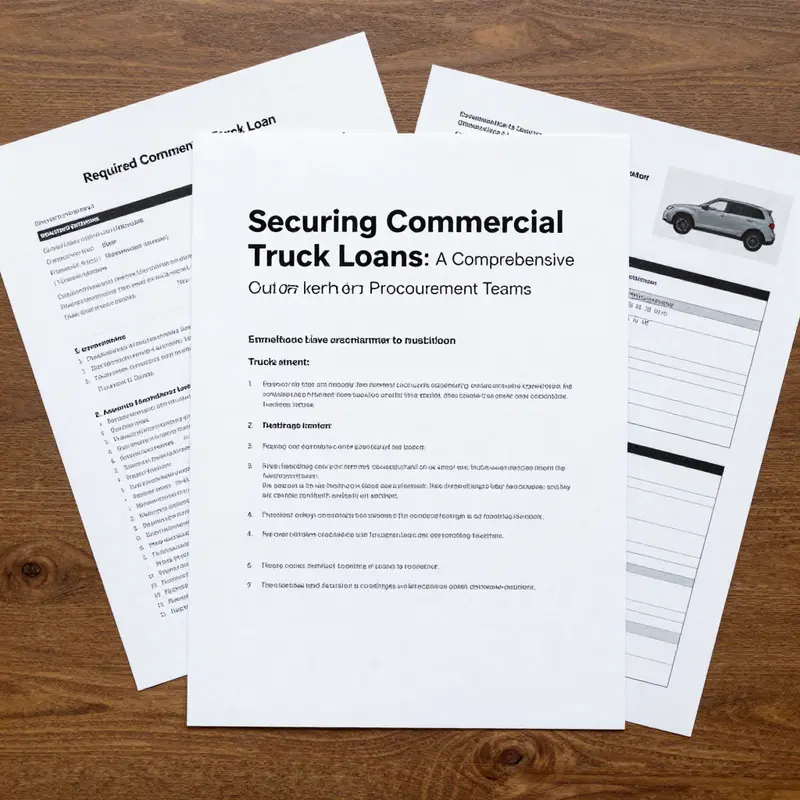
Securing a commercial truck loan begins long before the first application form is filled. It starts with gathering the right documents, each piece verifying a different slice of your business and your ability to repay. A meticulous package signals to lenders that you understand the business mechanics behind a trucking operation and that you can sustain payments even when markets shift. The clarity of your paperwork often dictates not only whether you qualify, but how quickly your application moves from submission to disbursement.
Within ICBC’s framework, eligibility is not simply a credit score. It is a composite of age, residency, income, and ownership. Applicants must be 18 to 60, hold full civil capacity, and, for non-mainland residents, have spent at least a year in the region with a fixed address and job. A clean credit record remains essential, but the bank also looks for a stable income stream that can cover monthly payments. Down payment readiness signals seriousness and helps determine how the lender views risk. Importantly, the borrower must be the legal owner of the vehicle, and joint ownership is not permitted. Operating qualifications matter too, including valid licenses for the type of transport—intercity freight, passenger service, or other commercial use. In practice, this means the lender reviews how your business is structured, whether you have a stable contract base, and how the vehicle will contribute to cash flow.
The heart of the process is the documentation. The bank requires a clear paper trail that confirms identity, financial capacity, vehicle details, and the regulatory footing to operate. The documents fall into several broad categories. The first is Personal Identification. In practical terms this means a valid ID, proof of marital status, and evidence of permanent residency or a local residence permit. The second category is Financial Proof. This covers income verification, recent tax statements, bank statements showing six months of average assets, and proof of the down payment. The third is Vehicle-Related Documents. You should bring a signed purchase contract, proof that the vehicle has been bought with a down payment, and a current vehicle insurance policy. The fourth is Business and Operational Documents. For passenger or freight vehicles, this often takes the form of a commitment letter signed by the transportation company’s shareholders or board members and stamped with the company seal. You should also have operating licenses or local authority certifications and a business plan detailing how the vehicle will be used and managed. Finally, there is Guarantee Materials. Depending on the chosen security, you may present the vehicle’s qualification certificate and purchase invoice if using vehicle collateral, or a property title deed if you offer real estate as collateral. If there is a third-party guarantor, a guarantee contract or written commitment from the guarantor is needed, and if you rely on a performance bond, the contract for that bond must be provided. The depth and organization of these documents matter as much as the documents themselves; a scattered file invites back-and-forth and slows decision-making.
The document set must be complete before the application advances. The application itself follows a straightforward rhythm: choose a lender, submit the application through a branch, an online platform, or a cooperating auto dealer, and await a document review. The bank will assess your ability to repay in light of your documented income and assets, and verify ownership and the vehicle’s appraisal where required. If the review yields an approval, you sign the loan agreement and finalize any guarantees or collateral arrangements. After the formalities are in place, disbursement follows—usually directly to the dealer or into your designated account once vehicle registration and insurance are complete. This sequence ensures funds are tied to a legitimate purchase and that the lender has a ready path to recover collateral if needed. A smooth flow depends on readiness: the more you can align with the lender’s expectations up front, the fewer surprises occur during signature and funding.
There are some constraints you should know as you prepare. The policy typically restricts you to fewer than three outstanding unrepaid commercial vehicle loans under your name or your spouse’s name, excluding closed accounts. The loan is generally offered for new vehicles only, sometimes with different caps for freight trucks and construction machinery. An account arrangement is often required, including opening a personal settlement account with the bank. And because the funding and collateral are tied to ownership and use, your ability to deliver clear, consistent documentation across categories matters as much as any single document. If you have experienced a period of high liquidity but recent irregularities in income or asset documentation, the lender will expect you to explain and demonstrate how you plan to maintain repayments going forward.
In practical terms, the best way to navigate the process is to start by assembling a complete package before you step into a branch or a dealer network. Gather identity documents, income proofs, and license information in one organized bundle. Ensure that any company-related documents are stamped and signed as required, and verify that your vehicle-related paperwork aligns with the intended use of the truck. Maintaining consistency between what you claim in your application and what appears in your bank records is critical. It reduces back-and-forth questions, speeds up review, and signals reliability to the underwriter. For those who want a wider perspective on financing journeys within the trucking world, see the McGrath Trucks blog for real-world scenarios and insights McGrath Trucks blog.
In the end, the documentation you assemble should reflect not only current eligibility but also future capacity. Banks increasingly seek evidence of growth potential and risk awareness. That means including a clear business plan that explains how the truck will generate revenue, how maintenance and fuel costs will be managed, and how seasonal cash flow will be handled. A coherent plan helps the lender see that your operation can scale predictably, even in the face of market fluctuations. It also gives you a framework to monitor performance after the loan closes, which can be crucial when planning upgrades or adding additional equipment down the line. If you need a structured starting point for what to collect, map your document collection against the categories described above, then fill in any gaps with client letters, supplier invoices, or contract renewals as needed. The result is a robust dossier that speaks to both current creditworthiness and future reliability.
Finally, keep in mind that external resources are available to aid your understanding. The official lender site provides the most current product details and application forms, and you should reference it alongside your own records. When you feel ready, approach the lender or the dealer network with your complete packet, confident that your documentation accurately demonstrates your identity, your financial health, and your operational readiness. The smoother your paperwork, the smoother your path to securing a truck loan will be, and that can translate into a faster, less stressful experience during what is often a critical business milestone.
External resource: ICBC official site
Charting the Route to a Commercial Truck Loan: From Eligibility to Disbursement
Financing a commercial truck is less about a single approval and more a voyage through a carefully charted process. At its core, the journey hinges on a mix of eligibility, preparation, and a lender’s practical requirements that align with the realities of operating a trucking business. Rather than viewing a loan as a windfall, it is a structured instrument that must fit your financial profile, your asset, and the regulatory framework that governs commercial transport. When you approach this route with clarity, you can anticipate where you might encounter checkpoints and what you must have ready to move from interest to possession, from eligibility to disbursement, with as little friction as possible.
Every path begins with understanding who qualifies to borrow for a commercial vehicle. The baseline is straightforward in principle: you must be a real person, legally capable, and within a broad age window that reflects both risk and experience. You typically need to be between eighteen and sixty, inclusive, with a proven ability to sustain repayments over the term. But beyond age, there is a need for stability and legitimacy that can be felt in a steady income stream and a clean financial record. The lender wants evidence of capacity and discipline, not merely a strong appetite for debt. For many applicants, especially those who operate far from traditional corporate settings, this means showing a reliable source of income that comfortably covers monthly payments even when fuel prices, maintenance costs, or days on the road fluctuate. A good credit history becomes a silent but decisive factor, signaling a track record of meeting obligations when due. In practice, this translates to presenting salary slips, a formal employment letter, and bank statements that reveal a pattern of consistent saving or at least liquidity across several months.
Another set of gates relates to who can borrow for what kind of vehicle. The vehicle must be owned by the borrower, and for some loan programs, joint ownership is not permitted. You will also need valid operating qualifications—licenses and permits appropriate to the vehicle’s use, whether for intercity freight or passenger transport. These details ensure that the loan is attached to a vehicle that your license and registration can support, not merely to an asset in your name. If you are a foreign national or coming from a region with a different regulatory framework, the lender will look for longer residence in the mainland, a fixed address, and a verifiable local job. The idea is to anchor the loan in a steady administrative world where the borrower can be reached, budgets can be checked, and tax records can be reconciled as part of ongoing due diligence.
Even as you consider eligibility, you begin to appreciate how the documentation becomes the handbook you carry through the process. Identity documents establish who you are and where you live. This includes government-issued identification, proof of residence, and, in some cases, a marriage status declaration that clarifies your dependents or household structure. Financial proof forms the backbone of risk assessment. Expect to assemble income verification that may include employment certificates, salary statements, and tax records. Banks routinely ask for multiple months of bank statements to demonstrate liquidity and the ability to weather irregular cash inflows that trucks can sometimes present. A down payment is not just a number on a sheet; it is a signal that you are committed and that a portion of the asset’s value you own upfront reduces risk for the lender.
Vehicle-related documents tell the story of the asset you intend to purchase. You will typically need a signed purchase contract with the dealer and the vehicle insurance policy, along with evidence of the down payment and the vehicle registration details if applicable. These pieces confirm that the car is real, insured, and already moving toward its new owner, which helps the lender assess depreciation risk and resale value in the event of a default. If you intend to use the truck for passenger transport or freight, you may be required to provide a letter of commitment from the transportation company—signed and stamped by the company’s governance body—to verify that the vehicle will contribute to a legitimate operating plan. The business and operational documents can include proof of operating licenses from local authorities and a concise business plan that explains how the vehicle will be used, who will manage it, and what the expected revenue streams look like. A lender’s checklist can feel exhaustive, but it is designed to minimize post-approval surprises, ensuring the loan remains affordable as market conditions shift.
When a lender evaluates collateral, the structure of the guarantee matters almost as much as the asset itself. If you opt to use the vehicle as collateral, be prepared to provide the vehicle’s qualification certificate and purchase invoice, and ensure any co-owners sign the necessary consent to mortgage. If you can offer real estate as collateral, you will face more formalities—property title deeds, consent to mortgage from the owner, and an appraisal report that justifies the loan-to-value ratio. In some cases, operating rights—such as the right to use a commercial vehicle in permitted operations—can be used as collateral, in which case you must supply the corresponding operating permit. Third-party guarantees or bonds, such as a professional guarantee contract or an insurer-backed performance bond, can substitute for direct collateral to boost the lender’s confidence. Each option has different implications for risk, cost, and liquidity, so it is crucial to discuss these early in the conversation with the bank’s representative.
The application process itself unfolds in a sequence designed to protect both borrower and lender while enabling a timely decision. First, you choose a lender that offers personal commercial vehicle loans and that has a national footprint or a robust dealer network. A large commercial bank with nationwide branches and dealer partnerships is a common starting point for many buyers. You will then submit your application—typically in person at a branch, through online banking platforms, or via a cooperating auto dealer. The initial submission triggers a document review. This is where the bank assesses your creditworthiness against internal policies, verifying consistency across the materials you have provided. If the review is successful, the next step is the formal approval and contract signing, which may include the arrangement of guarantees or collateral. Finally, once the legal formalities are complete, and the vehicle is registered and insured, funds are disbursed. Depending on the lender, the disbursement can be sent directly to the dealer or to your designated account, streamlining the transaction and tying the financial commitment to the asset’s transfer of ownership.
Within the terms that govern the loan, you will find a framework that shapes how much you can borrow, for how long, and at what cost. A common structure is that the loan can cover up to a substantial portion of the vehicle’s price, though this can vary by vehicle type. In many programs, the maximum loan-to-value hovers around seventy percent for the vehicle price, with a more conservative sixty percent cap for freight trucks and construction machinery. The repayment term usually spans up to three years, though freight-focused loans can be shorter—often capped at two years—with no option for extension. Interest rates track a benchmark, typically aligned with a central bank’s policy rate, but with the freedom to adjust upward as market conditions demand. In practice, this means you are in a rate environment that rewards discipline and predictability but can respond to shifts in the baseline cost of funds. Another operational requirement is that you open a personal settlement account with the lender, a step that helps manage cash flow and ensure that payments are drawn in a predictable manner.
There are additional guardrails that shape how the loan behaves over its life. One notable rule is the cap on outstanding unrepaid commercial vehicle loans. The borrower cannot hold more than three such loans under their name or their spouse’s name, excluding those that have already been settled. This constraint is designed to limit leveraged exposure and to encourage borrowers to manage a coherent fleet expansion strategy rather than financing a scattered set of assets. A related point: loans under this program are reserved for first-hand purchases, meaning new vehicles rather than used ones. This policy helps banks manage depreciation risk and ensures that the collateral remains robust relative to the outstanding balance.
All of these elements—eligibility, documentation, application steps, collateral options, and loan terms—come together to form a coherent picture of what it takes to secure a commercial vehicle loan. The process rewards preparedness and transparency. If you enter the conversation with a well-organized dossier and a clear operating plan, you increase your chances of a smooth appraisal and a favorable decision. The narrative you present to the lender—how your income supports the repayment schedule, how your license and permits align with the vehicle’s use, and how the down payment anchors the asset—becomes the story of your business’s credibility. In practice, you will be asked to articulate a simple but robust plan: how the vehicle will be used to generate revenue, how maintenance and fuel costs will be managed, and how revenue channels will be tracked and documented. A well-prepared plan signals that you are not simply financing a truck; you are financing a business that moves goods, passengers, or services with a defined route to profitability.
For readers seeking more detail about the policy landscape that informs these steps, consider exploring a practical resource that outlines market realities for trucking finance in North American contexts, which provides complementary insights into how uncertainty affects decision-making in fleet expansion. This resource can help bridge the gap between local regulatory details and broader market conditions, offering a lens through which to view risk and opportunity in your own planning.
To keep plan-makers aligned with current standards, you can visit the linked guide that covers personal commercial vehicle loan information, including eligibility nuances, required documentation, and typical disbursement flows. This external reference complements the narrative above by presenting an official, process-oriented perspective that can reassure applicants as they prepare to engage with a lender. Navigating economic uncertainties in trucking markets.
In sum, the road to a commercial truck loan is paved with preparation and clarity. When you understand the contours of eligibility, gather the right documents, align with a suitable lender, and approach the application with a credible operating plan, you transform financing from a leap of faith into a targeted investment in your business’s capacity to move goods and people. The journey from application to disbursement is not a mystery when you map each step to the assets you own, the income you generate, and the regulatory framework that binds them together. And with persistence, the truck that once existed as a goal on the horizon becomes a funded asset that expands your fleet’s reach and strengthens your company’s operational resilience.
External resource: ICBC Personal Commercial Vehicle Loan Information: https://www.icbc.com.cn/icbc/zh/PersonalBanking/Loans/PersonalCommercialVehicleLoan.htm
Reading the Fine Print: How Loan Terms Shape Your Commercial Truck Financing Strategy
When you’re planning to grow a fleet or expand a single business operation with a new truck, the terms of the loan matter as much as the loan itself. The numbers you see on the page—your monthly payment, the total interest, and the fees—are not isolated figures. They are the levers that determine how sustainably you can operate, how confidently you can price services, and how adept your business will be at weathering downturns. A clear understanding of loan terms helps you translate a financing offer into real-world decisions about cash flow, risk, and growth. In practical terms, the repayment period, the interest rate, and the fees together create a complete picture of cost over the life of the loan, and they interact with your asset’s lifetime, maintenance needs, and your revenue cycle. Getting this picture right means you are not simply borrowing money; you are sequencing capital to match the fatigue and pacing of your business, the hours on the road, and the seasonality of demand. This is especially true in trucking, where uptime and reliability translate directly into revenue, and where a misaligned term can bind you to higher payments when market conditions soften or fuel and maintenance costs rise. Understanding loan terms, therefore, is less a legalese exercise and more a strategic budgeting tool that keeps the wheels turning without sacrificing liquidity or resilience.
The repayment period is the first and most visible decision you face. Terms commonly range from short, two-year frames to longer, five-year horizons in the broader market. A longer term reduces monthly payments, easing near-term cash flow and allowing you to allocate resources to maintenance, driver wages, or dispatch technology. But it comes at a cost: more total interest paid over the life of the loan. Shorter terms compress the cost of borrowing in time and can save significant interest, yet they demand higher monthly commitments and tighter cash management. For a single truck, a two-to-three-year window can be a sweet spot if the vehicle is expected to deliver strong annual mileage and if your business forecast supports higher monthly payments without compromising operating reserves. For fleets that anticipate rapid expansion or vehicles with robust resale value, a longer window might better align with depreciation and a desire to level out expense spikes. In all cases, the choice should hinge on your projected cash flow, the truck’s expected life, and the reliability of your revenue streams.
Beyond the clock on the loan, the price of the money itself—the interest rate—shapes how feasible any term becomes. Rates rise or fall based on creditworthiness, collateral quality, and the lender’s pricing philosophy. A higher credit profile usually earns more favorable terms, including a lower margin over the base rate and potentially fewer or smaller fees. Conversely, a weaker credit picture invites a higher rate or stricter covenants. It’s important to recognize that the published rate is rarely the only number in play. Many lenders apply an origination fee, often expressed as a percentage of the loan amount, and that fee can range from well under 1 percent to several percent. In addition, there may be ongoing service charges, appraisal costs, or administrative fees that add to the total cost of financing. Even a seemingly modest 0.5 percent origination fee compounds in meaningful ways over a three-year loan. When you map out your total cost of financing, you must include these charges, because they affect your effective APR—the true annual cost of borrowing after fees.
Fees can also appear in less conspicuous forms. Some lenders impose closing costs that cover underwriting, document preparation, or legal review. Others might require prepayment penalties if you decide to settle the loan early or refinance, a factor to weigh if you envision the possibility of a lower rate opportunity or if your fleet strategy involves rapid redeployment of assets. The interplay between rate and fees matters: a lower base rate may be offset by higher up-front costs, leading to a comparable or even higher overall cost than a slightly higher rate with minimal fees. When you compare offers, you should estimate the annual percentage rate (APR) rather than looking at the nominal interest rate alone. The APR captures the effect of the interest rate plus the effect of fees spread over the term, giving you a truer sense of cost and helping you rank options on equal footing.
Another layer to consider is the structure of the loan and the collateral that backs it. Most commercial truck loans are secured by the vehicle itself, and some lenders will accept additional collateral or guarantees to soften terms. Using the vehicle as collateral can lower risk for the lender, which often translates into more favorable pricing and terms. It is not uncommon for lenders to require a down payment that aligns with their risk assessment and the loan-to-value ratio they are comfortable with. A higher down payment can improve your terms by reducing the loan amount, which cuts interest costs and sometimes preserves a longer repayment horizon without stretching cash flow. Alternate forms of security—real estate collateral, operating rights, or even guarantees from a third party—can further influence pricing and approval criteria. If you have access to other collateral, discuss it openly with the lender, as appropriate collateral can unlock more advantageous terms.
The term and pricing do not exist in a vacuum. Lenders also assess ongoing stewardship of the asset and the business’s ability to service debt. A robust set of financials—balance sheets, cash flow statements, and evidence of stable income—helps reassure lenders that you can sustain payments even when market conditions shift. They want to see that your business generates reliable cash flow, not just a good purchase price. In practice, lenders look for clear revenue streams, diversification of customers, and a defensible plan for maintenance and down time. A well-prepared package can tilt the decision toward more favorable terms, including a longer repayment period if the projected cash flow supports it, or a shorter term if the business needs tighter financial control and a faster amortization. In turn, this means the documentation you assemble plays a pivotal role in how terms are negotiated. You will typically be prepared to present income verifications, tax statements, bank statements showing liquidity, and, for the asset itself, a purchase contract, insurance, and proof of down payment.
Because market conditions shift, it is useful to consider how you might compare offers in a structured, forward-looking way. Build a simple model that translates each term scenario into monthly payments, total interest, and total cost over the term. Then layer on fees to derive the APR. This is not a one-time exercise; it’s a tool you can reuse as market rates drift or as your business evolves. When you review terms, also examine the non-financial commitments that could affect cost, such as maintenance covenants, insurance requirements, or restrictions on vehicle use. These elements can influence your operating flexibility and, ultimately, your ability to meet obligations on time. The better aligned your terms are with your operational reality, the easier it becomes to maintain reliable service and predictable costs.
The wider market context is not merely a backdrop. It informs the quality of every term you encounter. For businesses watching trends in the used-truck market or planning capital cycles, keeping track of market signals helps you calibrate expectations about asset depreciation, residual values, and the pace at which you may want to replace or upgrade vehicles. A useful lens is to consider current trends in used-truck sales growth, since demand signals often translate into higher resale values or more favorable financing scenarios. This ongoing market intelligence can guide you in choosing a term that aligns with your strategic asset plan. current trends in used truck sales growth.
As you navigate terms, remember that the goal is to secure a financing arrangement that fits your business rhythm rather than forcing your operations to bend to a loan’s schedule. It is possible to tailor a term that complements your revenue cadence, minimizes idle capacity, and supports disciplined asset management. If you anticipate rapid expansion, you may favor terms that preserve cash for growth initiatives while granting predictable payments. If you prioritize resilience, you may select a shorter term with higher monthly payments to reduce interest outlays and shorten debt exposure. Either way, the emphasis should be on a thoughtful alignment of the loan structure with your fleet utilization, maintenance planning, and dispatch efficiency.
For buyers who want a broader view of market alternatives, it helps to compare terms across lenders while maintaining a clear focus on your business plan and risk tolerance. A widely cited external resource highlights a spectrum of financing arrangements, including loan amounts, flexible repayment periods, and transparent fee structures. While shopping, you should also tally the non-financial terms that matter to your operations—service levels, underwriting speed, reliability of disbursement, and ease of integrating the loan with your accounting. The practical upshot is straightforward: understand the full cost of borrowing, measure it against your cash flow, and select a term that sustains operation while enabling growth. Finally, remember that every financing package is a negotiation. Be prepared to discuss collateral options, down payment levels, and potential concessions that can yield better terms without compromising your business’s risk profile. Keeping these elements in balance is how you turn a loan term from a bureaucratic hurdle into a strategic lever for your commercial trucking ambitions.
External resource for broader context: National Funding’s semi-truck financing overview offers additional perspectives on loan sizes, term flexibility, and fee transparency, which can help you benchmark your offers against industry practices. https://www.nationalfunding.com/semi-truck-financing
Beyond Eligibility: Building a Credit-Ready Case for a Commercial Truck Loan
Securing a commercial truck loan is rarely about meeting the minimum requirements alone. It hinges on a carefully built picture of financial reliability that sits beyond the initial checklist of age, residence, and a clean title. Lenders want to see you will stay the course, not just start the journey. The hourglass of risk narrows as you move from application to disbursement, and every piece of data you supply must reinforce your ability to repay and your commitment to legitimate business use. In this chapter, we move past the basics to explore how to assemble your case with precision, how to present it confidently, and how to anticipate lender questions before they arise. The goal is not simply to qualify but to position yourself for favorable terms that support steady cash flow in a demanding industry.
Creditworthiness sits at the center of this effort. Lenders examine a composite portrait: your credit score, your payment history, and your debt-to-income ratio. A strong score and a track record of on-time payments can unlock lower interest rates and quicker decisions. If you carry heavy balances or have opened new lines recently, expect closer scrutiny. The prudent approach is to shore up the basics well before you apply. This means bringing forward evidence of consistent repayment behavior, curbing new debt, and clarifying how your income supports a monthly loan obligation even during slow traffic periods. For operators who run a fleet or a solo trucking business, both personal and business credit can influence the assessment. A well-maintained credit file often translates into better terms and a smoother negotiation with lenders, reducing back-and-forth and the friction of revised proposals.
Proof of income sits alongside credit health as a cornerstone of risk assessment. Lenders favor a stable, verifiable income stream that clearly demonstrates the ability to cover monthly payments. For employees, conventional documents—salary statements, employment certificates, and tax statements—usually suffice when corroborated by bank statements showing a steady balance. For self-employed operators or small fleets, the demonstration becomes more nuanced. Lenders look for consistent cash flow, not just a single high month. Business revenue statements, multi-month bank statements, and even invoices that show regular client payments can provide the narrative of sustainability. The strongest applications present a forecasted cash flow that aligns with the loan terms, revealing how revenue will rise or at least remain stable as the loan matures. This often requires a disciplined record-keeping routine, a clear separation between personal and business finances, and a documented plan for growth that does not depend on one large client or a temporary surge in demand.
Vehicle condition also plays a decisive role in the approval equation. Trucks that are well-maintained, with clean titles and no liens, reduce perceived risk. In practice, lenders commonly prefer vehicles under a certain age—often not older than ten years—and with verifiable maintenance histories. An appraisal may be requested to establish market value and to verify collateral strength. A vehicle with late maintenance, undisclosed repairs, or dubious odometer readings invites red flags. The absence of liens is essential; any existing claims against the vehicle can complicate mortgage arrangements or ownership transfers at disbursement. In anticipation, gather maintenance receipts, inspection reports, and a recent title status, so you can present a transparent, enforceable asset that the bank can lean on if repayment becomes difficult.
Affiliation with a formal transportation entity remains a frequent prereq in many lending frameworks. Lenders often want to see that the vehicle will be deployed within a registered business operation rather than for casual use. A signed letter of commitment from the company’s leadership, affixed with the official company stamp, is a common requirement. This letter helps the lender verify that the tractor-trailer will be integrated into a legitimate fleet or scheduling system, with clear accountability for utilization, fuel management, and driver assignments. For sole operators, this criterion can translate into establishing a compliant operating entity and demonstrating that the business activities align with regulatory and safety standards. The aim is to reduce uncertainty about the vehicle’s purpose and to anchor the loan in a verifiable business context rather than a speculative purchase.
Documentation preparation is where many applications either accelerate or stall. The list is extensive, yet the payoff is simple: a clean, well-organized file that makes the lender’s due diligence straightforward. Expect to assemble signed purchase contracts, valid vehicle insurance, a current commercial driver’s license, and a personal settlement account with the lending institution. You will also need tax statements and bank statements that cover a meaningful period—typically six to twelve months—to demonstrate durable liquidity. Proof of down payment, the purchase invoice, and the vehicle registration are standard. For fleets or passenger operations, you’ll often submit a signed and stamped commitment letter, proof of operating license, and a business plan outlining how the vehicle will be used and managed. If collateral is involved, your materials must include the collateral qualification certificates or ownership documents; in the case of a real estate mortgage, the property title deed and appraisal report will be in play. When a third-party guarantor or a performance bond is used, you’ll include the relevant contracts and commitments. The more complete your package, the less room there is for ambiguity.
A practical, almost methodological, approach to documentation can shave days off the timeline. Start by listing every document you will need and then work backward from the lender’s checklist to confirm everything is present and accurate. Internal checks—like verifying that the vehicle’s VIN matches the purchase contract, or confirming that the insurance policy remains active through disbursement—save last-minute delays. Many borrowers also underestimate the value of a concise executive summary: a one-page document that outlines your business model, existing fleet, revenue trajectory, and how the new truck will impact service capacity and reliability. This can speed the review by giving underwriters a clear narrative to accompany the numbers.
The question of collateral adds another layer of strategic thinking. If you can offer vehicle collateral, the lender may be more forgiving of a higher loan-to-value ratio and tighter terms. However, if you propose real estate as collateral, you must be prepared for a mortgage process that includes title verification, owner consent, and a formal appraisal. Some lenders also accept operating rights as collateral, a route that is particularly relevant to fleets with established routes or contracts. Third-party guarantees or a performance bond might be options for borrowers who lack other forms of collateral, but these come with their own costs and conditions. Each path carries its own risk and complexity, so weigh the long-term obligations against the immediate financing needs. The alignment of collateral with the business use of the vehicle can improve confidence in repayment and, in turn, the terms offered by the lender.
Thoughtful organization and a clear awareness of procedural realities keep you in good standing with lenders. Even with a robust credit profile and solid income documentation, missteps—like missing a document, an incongruent name on records, or delays in obtaining a license—can stall an otherwise strong application. Build in a calendar of deadlines and a point of contact at the bank or dealer who can help smooth the process. Communicate early about any changes in your financial position or business plan, and provide supplemental materials promptly if asked. A well-coordinated approach signals reliability and reduces the back-and-forth that slows decisions. In practice, this means preparing the file in a binder or digital folder, labeling documents consistently, and keeping originals and copies organized to satisfy both the lender and the dealership.
To connect practical industry context with your preparation, consider exploring more industry insights at mcgrathtrucks.com/blog/. The blog can offer perspectives on fleet operations, market dynamics, and how lenders view equipment investments in different operating environments. This broader awareness can inform your approach to presenting forecasted income and asset utilization, helping you tailor your application to the realities of your specific route, seasonality, and client mix. For the best possible outcome, tailor every element of your package to reflect how the truck will function in your daily operations and how it will contribute to a stable, compliant business model.
Finally, keep in mind that the process is designed to protect both borrower and lender. A loan that aligns with true cash flow and asset value is far more sustainable than one that stretches capacity or leaves little room for downturns. As you assemble documents, verify each item against the lender’s requirements and the regulatory framework governing commercial vehicle finance. Ensure that your down payment is verifiable and that the vehicle is free of liens and encumbrances. Confirm that all operating licenses and permits are up to date. And remember, the ultimate objective is not merely to secure funding, but to install a financing arrangement that supports reliable service, prudent growth, and the long-term health of your transportation operation.
For official guidelines and product details, you can consult the lender’s formal policy resources. Final decisions will always depend on the specific lender, the documentation you provide, and your business profile. If you’re seeking a curated starting point, review the general guidelines and contact options through official channels, and prepare to present a strong, coherent case that speaks to risk management, cash flow, and legitimate business use. Official resources often provide the precise requirements for collateral, insurance, and legal compliance, which can help you align your documents before you even walk into the branch or sign a digital application.
External reference for additional context: https://www.icbc.com.cn/icbc/zh/loan/personalloan/commercialvehicle_loan.htm
Final thoughts
Navigating the complex landscape of commercial truck loans requires a thorough understanding of eligibility, documentation, and the application process. Each component plays a pivotal role in securing the necessary financing solutions for procurement teams and fleet managers. By proactively addressing these elements, organizations can enhance their operational efficiency and competitiveness in the market. Embracing the right financial strategies ensures that your fleet remains robust and ready to meet increasing demands.