
As pickup trucks gain popularity in various sectors, their classification as commercial vehicles has significant implications for trucking company owners, fleet managers, construction and mining enterprises, and logistics firms. This article dives deep into the global perspective of how different countries categorize pickup trucks, the specific regulations in the U.S., the economic ramifications of their classification, and the safety and emission standards that set them apart from traditional commercial vehicles. Each chapter reveals essential insights that help stakeholders navigate the complexities of vehicle classification and its impact on their operations.
Across Borders and Bureaucracy: The Complex Classification of Pickup Trucks as Commercial Vehicles
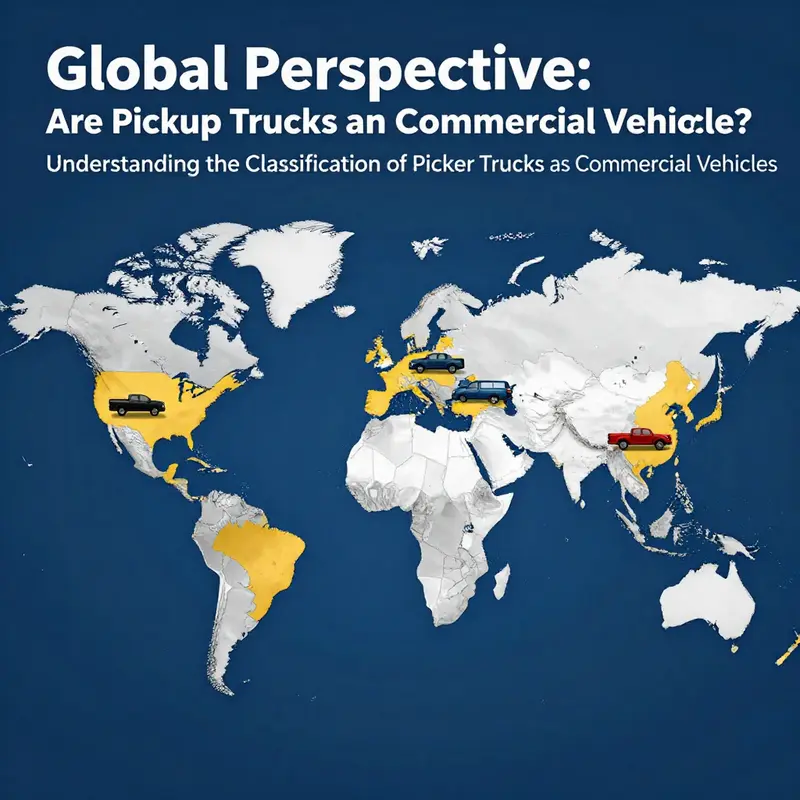
The question of whether pickup trucks are classed as commercial vehicles does not yield to a single universal answer. It is a question that unfolds differently depending on where you stand and how you use the vehicle. In many places, a pickup is seen primarily as a practical tool for everyday life. In others, the line between private transport and commercial operation blurs under weight, purpose, and policy. The diversity of regulatory design reflects two realities at once: the utility of pickups and the varied ways governments manage road safety, taxation, and infrastructure. The result is a landscape where a single model can be treated as a private car in one country and as a commercial asset in another, sometimes within the same region, depending on the precise use case and the vehicle’s technical specifications.
In the United States, the governing frame comes from the Federal Motor Carrier Safety Administration, which defines a commercial motor vehicle, or CMV, by clear criteria. A vehicle becomes a CMV if it is used to transport hazardous materials, carries 16 or more passengers including the driver, or has a gross vehicle weight rating (GVWR) of more than 10,001 pounds. Within that rule set, a typical pickup truck used for private transportation sits outside the CMV category because its GVWR is usually under the threshold and its day-to-day use is personal, not commercial. Yet the boundary is not rigid. A pickup that is modified to haul heavy, commercial payloads, or one used routinely to move goods for a business, can cross into CMV territory. If the vehicle is employed for hire, even for a limited set of deliveries, or if it winds up being used to transport hazardous materials, it triggers CMV rules such as hours of service limits and more stringent recordkeeping. The practical upshot is that the same chassis and body style can create two very different regulatory experiences depending on whether the owner treats it as a private vehicle or as a workhorse for commerce. This dual possibility reflects a broader truth in the United States: classification hinges less on the physical form and more on use, payload, and the risk profile created by that use.
Turning to the United Kingdom, the regulatory emphasis shifts toward licensing and insurance considerations tied to the vehicle’s use rather than a simple GVWR threshold. A pickup employed strictly for private purposes is treated as a private vehicle, which aligns with how personal road-use taxes and standard car insurance are structured. But that seemingly straightforward rule has a practical caveat. When a pickup begins to serve business purposes — think of routine deliveries, tool and equipment transport for a tradesperson, or a small-scale goods movement operation — the classification can tighten. The vehicle may require different licensing arrangements and, in some cases, altered insurance coverage to reflect its commercial use. The UK system illustrates a common pattern: the same vehicle can stay within the category of a private car if kept for personal use, yet step into a commercial regime as soon as business operations mount and the risk profile grows.
In Canada, the classification logic shares a focus on use and weight with the United States, but it also allows for nuance based on the vehicle’s weight, intended use, and whether it operates for profit. Pickups can be categorized as commercial vehicles when they are explicitly used for business operations or when their weight and load profiles push them into classifications that intersect with commercial road-use rules. The lines here are often drawn with a practical measure. A business that relies on pickups for delivering goods or moving equipment might need to align with provincial or federal rules that impose requirements on licensing, insurance, and even maintenance standards. Even within Canada’s provincial frameworks, the same model can carry different regulatory obligations depending on how it is employed in day-to-day activity. This dependence on use rather than mere appearance underscores a broader policy aim: ensuring that vehicles that contribute to commerce bear the accountability and safety standards appropriate to that contribution.
A different and revealing contrast appears in China, where pickups are officially categorized as commercial vehicles more broadly. That classification carries tangible regulatory consequences, including a different set of emission and safety standards relative to passenger cars. In the Chinese market, this arrangement can make pickups attractive to manufacturers and buyers who seek to optimize operational flexibility while navigating regulatory constraints. The difference here is not merely a bureaucratic label; it translates into reduced regulatory friction in areas such as emissions testing and safety compliance, reshaping product offerings and market dynamics. The Chinese framework illustrates how a nation’s regulatory philosophy can tilt the calculus of vehicle design, marketing, and ownership when it comes to pickups.
Amid these regional disparities, a common thread runs through the global landscape: the term commercial vehicle captures a function, not just a form. Pickups are inherently capable of moving cargo and serving business needs, which makes them appear in the broad spectrum of commercial activity. Yet the legal and regulatory treatment is activated by three intertwined factors: the vehicle’s weight, the character of its use, and the jurisdiction’s policy priorities. A GVWR crossing a numeric threshold can flip a pickup from private to commercial in one jurisdiction while remaining private in another. How that threshold is interpreted matters for registrations, taxes, and the cost of ownership. The same pickup, owned by a private individual, might incur different insurance premiums, licensing fees, and maintenance obligations if its use is treated as business-related.
The regulatory tango is further complicated by the practical realities of fleet management and business strategy. When a company buys a pickup for fieldwork or a small business that routinely hauls tools and materials, it is not simply acquiring a vehicle; it is acquiring a platform that will be governed by a patchwork of compliance rules. Fleet managers must consider hours of service implications, where applicable, and ensure that driver training, vehicle inspections, and recordkeeping align with the regulatory regime that applies to the vehicle’s use. They must also be mindful of emissions standards, which can vary by country and region. In some markets, commercial use can trigger stricter fuel economy or emissions requirements, even for vehicles that would otherwise be treated as private cars when used for non-commercial purposes. This intersection of use, regulation, and environmental policy shapes not only legal compliance but also strategic decisions about ownership models, fleet composition, and resale value.
The practical consequences extend to buyers who navigate the market for used pickups. In jurisdictions where regulation makes commercial use more burdensome, buyers may weigh the total cost of ownership more heavily. They account for potential licensing changes, insurance premiums aligned with commercial risk, and the possibility that a vehicle will have to meet heavier maintenance standards or periodic inspections. In markets where pickups can operate with more favorable regulatory treatment as private vehicles, buyers gain flexibility but face uncertainty if their use pattern shifts into a commercial domain. These dynamics ripple into pricing, depreciation, and even consumer confidence in the long-term viability of a vehicle as part of a business operation.
As readers consider how these global differences map onto the everyday reality of owning or renting a pickup, it is useful to remember the broader purpose behind many of these rules: road safety, fair taxation, and predictable infrastructure usage. Governments design frameworks that can adapt to evolving transport needs, whether that means supporting robust small-business activity or regulating commercial fleets with stringent safety criteria. The practical takeaway for individuals and organizations alike is clear: before purchasing or deploying a pickup for business use, verify the local regulatory standards that apply to your intended activity. That due diligence can prevent misclassification, penalties, and unanticipated costs that arise when the vehicle’s use shifts from private to commercial.
For readers seeking deeper context on how regulatory and market forces interact with trucking and vehicle classifications in North America and beyond, a resource that examines these broader patterns can be insightful. It offers a lens on how economic conditions, policy shifts, and industry dynamics shape the realities of ownership and operation in a practical sense. You can explore perspectives on this topic through the article addressing navigating economic uncertainties in the Canadian and US trucking markets. This piece provides a complementary view to the regulatory tapestry described here, emphasizing how market conditions influence decisions around vehicle use, fleet composition, and compliance strategies. navigating economic uncertainties in the Canadian and US trucking markets.
Ultimately, the question of whether a pickup is classed as a commercial vehicle hinges on jurisdictional law and concrete use. The same truck that serves as a personal daily driver in one country might perform essential commercial duties in another, triggering a cascade of regulatory implications. The global picture is not a uniform standard but a mosaic of rules, each designed to fit local priorities while allowing for cross-border trade and mobility. In an era when supply chains stretch across continents and business models increasingly blend personal and professional spheres, this mosaic demands careful attention from buyers, operators, and policymakers alike. The crucial rule of thumb remains practical and straightforward: know your use, know your thresholds, and consult the local authorities or regulatory guidance when in doubt.
For readers who want to situate these considerations within a broader regulatory framework, formal definitions and scope continue to be documented by national and international authorities. An external resource that provides authoritative definitions and enforcement considerations is the FMCSA’s official resource on commercial motor vehicles. This reference helps illuminate how a GVWR threshold, hazard materials, and passenger carriage criteria translate into real-world obligations for fleets and private operators alike. By understanding these core criteria, stakeholders can better navigate the balance between the utility of pickup trucks and the responsibilities that come with operating them in a regulated environment.
Weight, Use, and the Practical Divide: How U.S. Regulations Classify Pickup Trucks for Commercial Use
In the United States, the question of whether a pickup truck is considered a commercial vehicle is not settled by the vehicle’s badge or how its owner deploys it. Instead, federal regulation hinges on a precise metric: the gross vehicle weight rating, or GVWR. This numeric threshold shapes the notional boundary between routine consumer transportation and the demanding world of commercial motor vehicles (CMVs). For many readers, that distinction may feel abstract, but it carries tangible consequences—affecting licensing, inspections, insurance, and even the way a vehicle is taxed and registered. The FMCSA, which administers federal trucking policy, engineered the framework to be weight-based because it more consistently separates vehicles capable of heavier, more complex operations from those used primarily for personal transport. The result is a practical rule of thumb: weight first, then use and route second. Yet the story is more nuanced than a single number, especially for pickup trucks that sit near or cross the line.
At the heart of the U.S. classification is the GVWR. This rating represents the maximum permissible weight of the vehicle when fully loaded, including passengers and cargo. It is not the actual weight the vehicle weighs on the highway, nor is it the payload capacity alone. GVWR is a design specification that manufacturers publish, and it becomes the fulcrum on which many regulatory conversions pivot. When a pickup truck’s GVWR reaches 10,001 pounds or more, it is generally treated as a CMV for federal purposes. Crossing that threshold triggers a suite of regulatory expectations designed to safeguard roadways and ensure that heavier and more complex vehicles operate with appropriate professional oversight. The threshold is not arbitrary; it reflects a recognition that heavier vehicles present greater potential risk, require different braking dynamics, longer stopping distances, and potentially more demanding maintenance schedules.
For trucks that meet or exceed the 10,001-pound GVWR, the implications extend beyond weight. The driver standing behind the wheel becomes subject to a different regulatory regime. Qualifying as a CMV can bring with it the need for a commercial driver’s license (CDL) depending on the vehicle type and cargo, alongside mandatory vehicle inspections, maintenance records, and standardized hours-of-service rules. In practice, this means fleets and operators must maintain logs of driving and duty cycles, ensure periodic inspections occur before trips, and keep thorough documentation of repairs and servicing. The regulatory framework is designed to be auditable, not punitive for its own sake, and it serves to align commercial operations with road-safety expectations in a way passenger-oriented rules do not.
Yet many pickups on the road today fit squarely below the 10,001-pound GVWR line. For those vehicles, federal CMV requirements typically do not apply. They are not automatically released from all regulatory scrutiny, however. A separate set of rules governs their registration, insurance, and use, often at the state level. States may impose their own criteria for what constitutes a commercial vehicle within their jurisdictions, and those rules can differ from federal standards. In effect, the classification becomes a dance between federal thresholds and state interpretations, with a person’s use case—whether the vehicle is employed for business tasks, and if so, what kind of business tasks—adding another layer of consideration. In this space, a light-duty pickup used primarily for a small business could be treated as a passenger vehicle for many regulatory intents while still bearing the commercial character of its payload-carrying capability. The practical upshot is that the same truck can sit in two different regulatory envelopes depending on context, a reality that matters for fleet managers who juggle compliance costs, liability, and overall operating strategy.
Interstate commerce adds an additional layer of complexity. When a pickup truck is used across state lines, or when it carries hazardous materials, or when it transports passengers for compensation, federal rules can apply irrespective of the GVWR alone. In those cases, the vehicle may be subject to broader federal oversight that touches on everything from vehicle maintenance to driver qualifications. The idea is straightforward: crossing state borders and handling hazardous materials or paid passenger service increases system risk and, accordingly, invites broader regulatory guardrails. For fleets that operate regionally or domestically, this nuance matters for planning and compliance. The same truck might be treated as a low-regime vehicle within one state but fall under more stringent federal requirements in another, depending on the nature of its job and the cargo it carries.
The Department of Transportation provides further structure to this landscape through its guidance on vehicle classification. DOT guidance helps distinguish CMVs by their mission: property-carrying CMVs are treated differently from passenger-carrying CMVs. For a pickup truck that serves as a mobile toolbox for a contractor, the question may hinge on whether the vehicle’s payload and route imply a property-carrying function or a passenger-focused role. The distinction matters because it can influence insurance premiums, licensing needs for drivers, and even regulatory reporting requirements. In practice, this means that two otherwise similar trucks can inhabit different regulatory spaces if one serves cargo-heavy tasks and the other functions primarily as a commuter or client visit vehicle.
All these layers—GVWR, interstate commerce, cargo type, and DOT guidance—converge to shape how a given pickup truck is categorized legally. For manufacturers and fleet operators, the implications are not merely bureaucratic. The classification informs decisions about vehicle selection, retirement planning, and the total cost of ownership. A fleet that prioritizes regulatory simplicity might favor trucks with GVWR just below the CMV threshold to minimize the compliance burden. Conversely, a business that relies on heavy payloads and frequent long-haul runs may accept the higher regulatory load as the price of essential capability. The balance between capability and compliance becomes part of a strategic calculus, influencing which trucks stay in service, how maintenance programs are structured, and how insurance risk is assessed.
The practical consequences extend to training and safety culture as well. When a pickup is treated as a CMV, drivers may need specialized training to understand hours of service, vehicle inspection routines, and post-trip reporting conventions. Even when the GVWR is under the federal threshold, an organization may elect to adopt CMV-like practices to standardize operations across a mixed fleet. This approach can yield benefits in reliability and safety, even if the letter of the law would not compel it. Such choices often hinge on the scale of the operation, the geographic footprint, and the severity of penalties for noncompliance in specific states or regions. In short, classification is not merely a label; it is a lens through which risk, cost, and operational capability are viewed and managed.
For readers who want to place these regulatory details into a broader market context, consider how cross-border market dynamics shape fleet planning and vehicle utilization. Broader analyses that compare Canadian and American trucking conditions illuminate how regulation can indirectly influence the kind of pickups fleets choose, the way they deploy them, and the pace at which they replace aging assets. This is one reason why regulatory literacy matters beyond legal compliance: it informs strategic decisions about capital investment, maintenance scheduling, and the prudent management of uncertainty in a shifting market. See the broader discussions that synthesize cross-border insights and market trends to anticipate how regulation interacts with economics in real-world deployment. Navigating economic uncertainties in the Canadian and US trucking markets.
From the fleet operator’s perspective, getting this classification right is about clarity and cost control. When a vehicle sits near the edge of the CMV threshold, the decision to pursue a heavy payload strategy versus a lighter, more regulated approach becomes a strategic choice. It affects insurance coverage, risk management, and even how a company negotiates with regulatory bodies during audits. The potential for a misclassification—whether intentional or accidental—carries consequences that range from fines to mandated changes in vehicle usage, driver training, or reporting practices. That is why, even for owners who mainly use pickups for straightforward transport and occasional hauling, it is wise to have a clear, documented policy about how vehicles are registered, how their GVWR is communicated to drivers and service staff, and how operations are reviewed for compliance with the applicable jurisdiction. The clarity gained from this approach extends beyond compliance; it helps align fleet strategy with the realities of the market, including shifts in fuel prices, changes in labor costs, and evolving operational risks.
For those who want to see the regulatory landscape expressed in a broader, market-oriented frame, the literature on used-truck prices, market stability, and shifts in demand offers useful context. While those analyses do not replace the formal rules, they illuminate how the classification rules interact with the economics of buying, maintaining, and disposing of pickups in a commercial setting. In practical terms, a business evaluating whether to add a heavy-duty pickup to its fleet will weigh the incremental regulatory requirements against the additional payload capacity, the potential for favorable tax treatment in certain states, and the resale dynamics of heavier vehicles. It is a balancing act where weight, use, and route converge with policy, shaping not only day-to-day operations but the longer arc of fleet modernization.
External considerations and industry-wide trends inevitably blend into the on-the-ground realities of evaluating a pickup truck for commercial use. For operators who cross borders, the experience can vary with jurisdiction and regulatory mood, underscoring the importance of staying informed about both federal and state provisions. The interplay between GVWR-based classifications and practical fleet needs means that a truck’s rating is more than a technical spec; it is a compass guiding how a vehicle fits into a company’s risk, cost, and capability profile. In the end, the question of whether pickup trucks are classed as commercial vehicles in the United States is answered not by convention, but by a precise constellation of weight, operation, and route. The best practice for any fleet is to map those factors to the regulatory framework, then translate that map into clear, actionable policies that keep operations compliant, efficient, and resilient in the face of market change.
For readers seeking official, weight-based definitions and the federal rules that govern them, the FMCSA’s vehicle weighing regulations provide authoritative guidance on GVWR thresholds and CMV status. This resource is essential for anyone who needs to translate the label on the door into day-to-day compliance decisions and fleet management strategies: https://www.fmcsa.dot.gov/regulations/vehicle-weighing
Between Purpose and Policy: How Pickup Trucks Traverse the Line Between Passenger and Commercial Classifications
Classification of pickup trucks is not a single label but a spectrum defined by use, regulation, and economics. The same pickup may serve as a family vehicle on weekends and a fleet asset on weekdays, depending on the rules applied by regulators, insurers, and tax authorities. This fluidity means that the practical effects—insurance pricing, depreciation schedules, and eligibility for deductions or incentives—can vary with the vehicle’s reported use, even if the chassis remains the same.
In the United States, for example, federal standards separate light trucks from passenger cars for fuel economy and emissions, a distinction that can influence design, cost of ownership, and corporate efficiency goals. In other regions, the criteria shift toward usage and fleet status, so a pickup’s classification may flip with a change in operation or business context. The policy environment thus becomes a market signal: it shapes which features automakers emphasize, which sales channels fleets prefer, and how buyers weigh private versus commercial ownership.
Beyond regulatory labels, the economics of classification extend to insurance, leasing, and taxation. Commercial status can change underwriting assumptions, grant access to fleet programs, and alter depreciation timelines—effects that accumulate into a measurable difference in total cost of ownership. For individual buyers who occasionally perform business tasks, the classification can determine whether a vehicle qualifies for tax incentives, deductions, or favorable insurance terms, creating a decision hinge in an otherwise straightforward purchase.
As technology evolves—electric powertrains, advanced safety systems, and modular cab-and-bed designs—the underlying question remains: does the utility of a pickup redefine its status, or do rules and incentives preserve a stable boundary? The answer varies by market and policy priorities, but the trend is clear: the line between personal and commercial use continues to be negotiated through regulation, market practice, and the economics of ownership.
Redrawing the Line: How Use, Safety, and Emissions Shape Pickup Trucks’ Commercial Status
Pickup trucks occupy a space between family sedans and work vehicles, and their regulatory status depends on how they are used rather than on body style alone. In many places personal use keeps them aligned with passenger vehicle rules for safety and emissions, while commercial operation triggers a more stringent oversight that can include fleet requirements, driver qualifications, and inspections. This chapter outlines how classification shifts with use, what counts as commercial across different jurisdictions, and the practical implications for owners, fleets, and regulators.
Final thoughts
Understanding the classification of pickup trucks as commercial vehicles is critical for stakeholders in the trucking and logistics industries. Global variations in classification can impact regulations, safety standards, and economic considerations. In the U.S., unique distinctions arise based on usage, while other countries may impose different frameworks altogether. Being well-acquainted with these differences enables organizations to optimize their fleet operations and comply with relevant legal requirements effectively. As the landscape shifts, continuous awareness of these classifications will be paramount in making informed business decisions.