
In an increasingly complex regulatory environment, trucking company owners, fleet managers, and procurement teams must grapple with the question of whether carrying firearms in commercial trucks is permissible. Understanding the nuances of federal regulations, state laws, and employer policies is essential in making informed decisions regarding firearm carrying and safety on the road. The following chapters explore these crucial elements, offering a comprehensive look at the legal landscape surrounding firearms in commercial trucking.
Road Rules and Road Realities: Federal, State, and Employer Policies on Carrying a Gun in a Commercial Truck
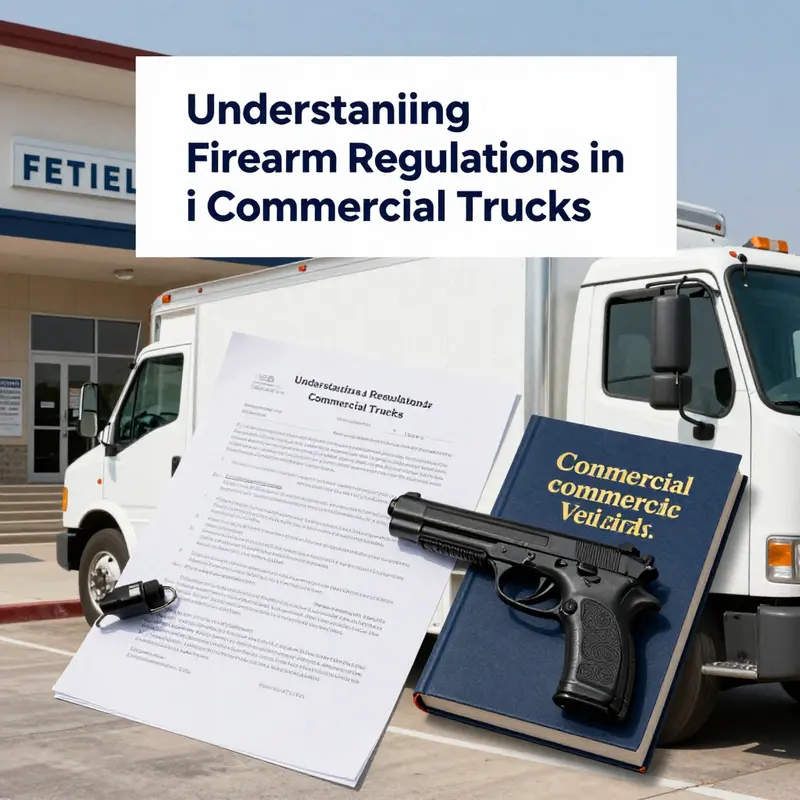
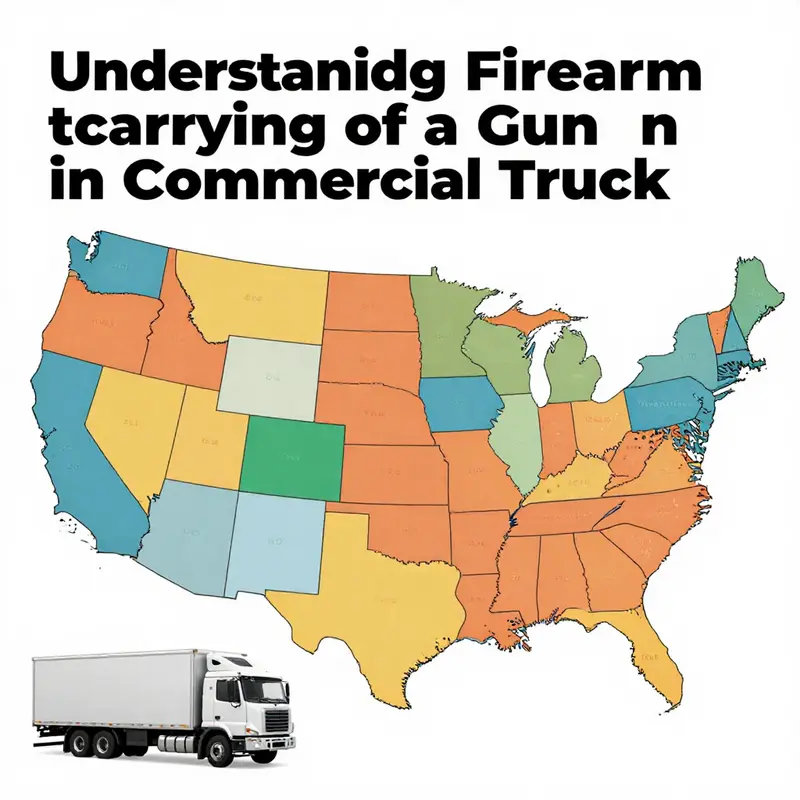
Drivers who spend weeks on the road often find themselves facing questions that matter far beyond routing and fatigue management. The simplest problem at hand—whether you can carry a firearm in a commercial truck—peels back into a layered calculation that involves federal statutes, state laws, the specific job you perform, and the policies your employer enforces. It is not a matter of one clear yes or no. It is a negotiation among legal allowances, safety concerns, insurance constraints, and workplace discipline. In practice, the decision to tote a gun inside a truck depends on where you are, who owns the vehicle, what you are transporting, and who pays the premiums for the risks you introduce. This is the kind of topic that reveals how the law operates not as a single statute but as a web of intersecting rules that aim to reduce danger while preserving legitimate rights and duties on the road. The federal layer looks simple at a glance, but it is a web of exceptions and conditions. There is no blanket federal prohibition on carrying firearms in a commercial vehicle, yet there are specific contexts where federal law bites hard. For example, when a driver transports across state lines with a firearm, the protection of the Gun Control Act and its implementing regulations may apply. If the firearm is possessed by a person who holds a valid license and the weapon is carried in a way that complies with federal requirements, there may be a lawful path, but it is not a universal green light. The practical effect is that federal law sets boundaries that drivers cannot ignore, while leaving space for state rules to shape what is permissible in a given corridor on the highway. A key reality is that federal property considerations matter too. If a truck parks at a federal facility, such as a federal warehouse or a military installation, the vehicle is a different stage for firearms than it is on a public highway. The law under 18 U.S.C. § 921(a)(32) generally makes firearms unlawful on federal property unless special permission is granted. For a driver whose route occasionally touches federal domains, this is not a theoretical point but a concrete constraint that can determine where a vehicle can be parked and how the weapon is stored during a stop. The presence of hazardous materials adds another layer. When a truck is transporting dangerous goods under the purview of the Department of Transportation and the federal hazardous materials regulations, the vehicle becomes a high-alert environment where firearms are typically prohibited to prevent any likelihood of accidental ignition or explosive interaction. In short, the federal landscape does not categorically ban firearms in every commercial vehicle, but it imposes tight limits in contexts that mirror the larger aim of federal law: to balance the right to self-defense with the necessity of safety in regulated transport. The state arena then fills in the gaps and adds its own color. State laws differ widely, reflecting political culture, public safety priorities, and the everyday experiences of people who work on the road. A driver’s ability to carry a concealed weapon inside a commercial vehicle hinges on the state’s approach to concealed carry permits, permit recognition, and vehicle-specific rules. In Texas, for example, a driver can carry a concealed handgun in a commercial vehicle if they possess a valid license to carry and the firearm is not loaded and is secured in a proper container. This setup mirrors Texas’s broader policy posture toward permit holders exercising constitutional rights in regulated contexts, but it remains highly contingent on proper storage and the non-loaded condition within the vehicle. Elsewhere, California provides a much stricter reality. Even with a permit, carrying in a commercial vehicle is generally prohibited unless there is a narrow personal-use transport exception that does not align with typical work-related duties. In New York, the restrictions are even more stringent, and employers must comply with strict safety policies that effectively keep firearms out of company vehicles, except under highly unusual circumstances. These state-level dynamics shape the practical options a driver has on any given run. It is not simply about what a state law would allow in isolation; it is about how that law interacts with the vehicle’s ownership, who is behind the wheel, what the route looks like, and what the business allows. The trucking companies themselves often set the tempo. Employer policies frequently trump what a law might permit because the trucking industry is anchored to liabilities and insurance frameworks that care more about risk than the philosophical rights of a driver. Many large carriers prohibit firearms in company-owned or leased trucks, citing safety concerns, potential liability, and the requirements of insurers who underwrite the fleet. The practical point is stark: policy matters more than personal preference in the typical workday of a professional driver who operates a vehicle in which thousands of pounds of freight, potentially hazardous cargo, or a insulated cargo environment can become a scene for miscalculation or accident. Carriers such as major national fleets have codified prohibitions in employee handbooks, and these prohibitions hold even when state law might offer a permissive path. That is not to say the regulation landscape is a simple binary. It is instead a mosaic in which federal statutory frameworks, state-specific carry regimes, municipal restrictions, and corporate policies collide and converge. Add to this the realities of safety culture and liability concerns, and the decision tree becomes clear: the safest approach for most drivers is to refrain from carrying a firearm in a commercial vehicle while on duty. Yet the discussion remains essential for those who want to understand the why behind these rules and how different drivers, routes, and employers shape what is permissible in the real world. To navigate this landscape, it helps to understand where the different layers draw their authority and how those authorities interact. Federal law provides the baseline, with important caveats about cross-border transport, entry into federal facilities, and hazardous materials. The state framework then layers in jurisdictional specifics that either broaden or narrow the federal allowances. The employer policies operate above all as the controlling standard for day-to-day operations, often superseding even otherwise lawful activity to preserve safety and insurance. This hierarchy is not inherently adversarial. It reflects a shared aim: to minimize the risk of gun-related incidents in the complex, high-stakes environment of commercial trucking. For readers who want a broader sense of how policy translates into daily practice, the trucking industry’s policy landscape can be better understood by following industry-wide discussions and case studies in trusted professional resources such as the industry blog maintained by the company that serves as a knowledge hub for drivers and fleet managers alike. See the McGrath Trucks blog for a snapshot of how policy discussions unfold in everyday trucking life. You can explore the resource here: McGrath Trucks blog. The point is not to adopt a particular stance but to appreciate how policy decisions ripple through a driver’s itinerary, stops, and responsibilities. Embedded within this conversation is an important reminder about the role of official guidance. The federal government has published materials intended for the general public that describe how different scenarios intersect with gun laws, including cross-state transport, possession on federal property, and compliance during commercial transportation. These guides help demystify the law and offer a reference point for drivers, safety officers, and fleet managers who need a sober account of what is legally permissible and what falls outside the lines. While the details can be dense, the practical takeaway remains straightforward: the default assumption for most drivers is to avoid carrying firearms in work vehicles unless there is a clear and compliant pathway established by federal clearance, state authorization, and employer acceptance. The reality is that the combination of cross-border routes, the presence of hazardous materials, and the fact of being under a company umbrella creates a context where default caution is the most prudent policy. The law’s intent aligns with the industry’s priority: reduce risk, protect cargo and people, and maintain consistent safety standards across a vast and varied network. As a result, most drivers will find that carrying a gun in a commercial truck is either prohibited or heavily constrained by the combination of federal restrictions, state law disparities, and company policy. In situations where a driver operates under a carrier that explicitly forbids firearms in their vehicles, the path forward is straightforward: do not carry, or store the firearm in a compliant, secure manner that is not inside the vehicle while on duty. In environments where a state law permits, drivers may think about pursuing personal permissions in a way that aligns with the employer’s policy. Yet even in permissive states, the overarching company policy often remains the controlling factor that defines the practical reality of work. For those who must balance risk and responsibility, the key is to be proactive: know the law, know the policy, and know how your route and your cargo interact with both. This means reviewing the state’s approach to concealed carry, recognizing whether your permit is recognized, and understanding the rules about where the firearm can be kept inside a vehicle. It also means understanding whether the route includes stops at federal facilities or in zones where hazardous materials are present. It means acknowledging that even if you could lawfully carry under state law, you might be disallowed by your employer, and that distinction matters for your job, your reputation, and your insurance. The practical lens is often the most persuasive one. If you drive for a company with strict anti-firearm policies, taking a gun on board could lead to termination or other disciplinary actions. Even if state law would permit the carry under narrowly defined conditions, the consequence could be as severe as losing your employment. Insurance is another crucial factor. Insurance providers can reevaluate coverage based on the presence of firearms in vehicles, which changes the risk profile and can void or modify policy terms if a weapon is found in a truck involved in a claim. This is not just about a procedural violation; it is also about financial exposure that can ripple through pay, benefits, and the viability of the operation. Beyond legal risk and insurance implications lies the reality of training and background checks. Some employers require background checks or safety training related to weapons, though in the trucking industry this is relatively rare. When it happens, it is typically linked to specialized roles or industries where the vehicle interacts with highly sensitive environments or where the equipment and cargo represent greater risk. Even when training occurs, it focuses on safe handling, secure storage, and emergency procedures rather than on the weapon’s use in self-defense. The overarching truth is that firearms complicate the already complicated job of trucking. The vehicle is a mobile workspace where a single misstep—an improper storage, an unsecured weapon, or a lapse in procedure—can escalate into legal trouble, safety incidents, or an insurance claim. Therefore, most professionals in the field err on the side of caution. They comply with employer policies, observe state law, and operate under federal restrictions that shape their day-to-day decisions. The reader should take away that this is not a debate about constitutional rights in a vacuum but a conversation about how those rights intersect with a highly regulated industry. In the end, the road rules you follow are the product of a layered system designed to protect everyone on the road, from fellow motorists to the people who work in distribution centers. If you are planning a career in long-haul, regional, or local trucking, the prudent stance is to treat firearms as off-limits while on duty and to maintain compliance with the highest standard your employer requires. For drivers who want to understand the broader policy landscape and how such policies are formed and debated, the following federal resource provides a comprehensive framework for thinking about the law and its application to cross-state transport, federal facilities, and related scenarios: https://www.justice.gov/opa/resource/10586/download. Keeping a close eye on state statutes and your employer’s policy will help ensure you can focus on safe, efficient delivery without the friction of regulatory conflicts or liability concerns. In the day-to-day, these rules do not exist to hamper legitimate self-defense but to keep the road safer for everyone who shares it. For readers seeking a broader sense of the industry’s policy conversations and practical considerations, the blog referenced earlier offers a window into how companies discuss these issues in real time and how drivers can navigate the evolving policy landscape without sacrificing safety or legal compliance.
null
null
Between Policy and Peril: How Employer Rules, Liability, and Law Shape Carrying a Gun in a Commercial Truck
On the surface, the question of carrying a gun in a commercial truck might evoke two competing instincts: personal protection and professional responsibility. But the reality that governs this question is a layered, evolving network of federal statutes, state laws, and tightly worded employer policies that together determine what is permissible, what is discouraged, and what could trigger serious consequences for the driver, the company, and the public. To understand where the boundaries lie, one must follow the thread from the wheel to the statute book, and then to the risk management procedures that most fleets rely on to keep operations safe and compliant. The journey through this terrain starts with federal considerations, moves through state variations, and lands squarely in the realm of corporate policy, training, and liability. It is a journey that does not reduce to a single answer, because the right choice depends on where the truck travels, who is behind the wheel, and what promises a fleet to its customers in terms of safety, reliability, and financial prudence.
At the federal level, the landscape is not dominated by an outright prohibition on firearms in commercial motor vehicles. There is no blanket ban that forbids a driver from transporting a firearm in a CMV when the vehicle is used for private or non-federal business purposes. Instead, the applicable federal framework carves out restrictions and conditions in places where firearms should not be present: on federal property, at certain government compounds, or in contexts tied to specific crimes or statuses, such as prohibitions that follow individuals convicted of domestic violence from possessing firearms. The Gun-Free School Zones Act, for example, creates clear exceptions for certain locations and uses, while other federal statutes may apply depending on an individual’s status and the precise location of the vehicle. In practice, this means that a driver who travels through or to federal facilities could face prohibitions that other drivers do not experience, and this distinction alone can chart a course for how a fleet administers its policies.
The federal framework also interacts with broader safety standards that shape how a company thinks about weapons in its vehicles. The Department of Transportation, the agency most closely associated with safe driving and the oversight of commercial motor carriers, does not issue a blanket prohibition on firearms in CMVs. Yet the same safety ecosystem that governs hours of service, vehicle maintenance, and driver distraction also influences how a company codifies firearm policies. The possibility that a firearm could become a distraction or a point of potential risk increases the likelihood that a fleet will treat firearms as safety concerns requiring formal handling procedures. In this sense, federal safety expectations are not about gun control per se; they are about minimizing any factor that could compromise safe operation. If a firearm is not stored securely or is accessible in the cab during driving, it can become a distraction, a liability, and a trigger for disciplinary action under company policy. In the end, the federal layer largely nudges fleets toward explicit internal controls rather than prescribing a universal prohibition or allowance.
State laws then take the stage, and here the landscape can change dramatically from one state to the next. Some states have established robust frameworks that allow concealed carry with appropriate permits, while others impose strict limitations on carrying in vehicles, and a few require open carry or impose other constraints that complicate enterprise risk management. Take the example of a state that permits concealed carry with a license, provided the firearm is not loaded and is kept in a secure container. In such a jurisdiction, a driver might argue there is a legal basis for transporting a firearm in a commercial vehicle, but that argument quickly collides with the policy requirements of the carrier and the insurance underwriters who must assess risk across a fleet that crosses state lines. In practice, a carrier operating in or through this state would need to ensure that any allowance is bounded by a rigorous policy on storage, handling, and accessibility. The scenario gets even more complex in states with stringent gun-control regimes. In those places, the mere presence of a firearm in a CMV could be illegal under certain conditions, or open carry might be prohibited in commercial vehicles altogether. A driver in such a state could risk criminal penalties even if the firearm is owned lawfully and carried for personal protection outside work duties. The intersection of state law and employer policy means that the same driver could be within the law on a highway segment in one jurisdiction but in potential violation when crossing an imaginary line into another state, all while the vehicle is in the course of its commercial function.
For employers, the challenge is to translate this mosaic of laws into a coherent, enforceable, and auditable policy that reduces liability while preserving legitimate safety considerations. Most large fleets that operate across multiple states and serve diverse customers adopt remarkably cautious stances. They emphasize that firearms in company-owned or leased vehicles pose heightened safety risks, complicate liability coverage, and may contravene insurance requirements. These concerns are not merely theoretical. The liability calculus runs deep: the presence of a firearm in a vehicle could invite negligent supervision claims if the company failed to implement credible policies and training; it could also affect whether an employer is deemed to have provided a safe work environment or whether its security protocols were reasonable under the circumstances of a specific incident. A 2023 report by the National Safety Council underscored that distracted driving remains a leading cause of truck crashes, and it highlighted how any object that competes for a driver’s attention—including a firearm—could contribute to risk. The practical implication of this is clear: even where state law might permit a firearm under certain conditions, an employer’s duty to maintain a distraction-free, controlled cockpit is often the decisive factor.
Policy makers and safety professionals recognize that a one-size-fits-all rule cannot capture every scenario a driver encounters on the road. Instead, a robust policy typically adopts a structured framework. It may authorize a firearm only under tightly defined circumstances—such as when a vehicle is not in operation, when the firearm is stored securely and inaccessible to the driver during driving, and when the vehicle contains an approved, locked storage container that is compliant with applicable safety standards. The policy would specify the chain of custody for the firearm, including who may transport it, where it can be stored, and how it must be secured to prevent unauthorized access or accidental discharge. It would also require explicit training on safe handling, storage, and legal considerations, including an understanding of state restrictions in any jurisdiction the fleet serves. In such a framework, the policy becomes less about asserting a universal right to carry and more about balancing personal security with collective safety, operational continuity, and legal compliance. The goal is not to prohibit firearms merely for the sake of policy. The aim is to delineate a safe, auditable path that minimizes risk and aligns with the company’s broader safety culture.
But policy alone does not determine outcomes. It must be implemented through concrete practices that reflect both legal obligations and the realities of daily trucking. Training sits at the heart of this implementation. Without training, even a permissive policy can fail to protect the driver and the fleet. Training programs should cover safe handling and storage practices, recognition of prohibited behaviors, and the procedural steps if a driver encounters a situation that requires the firearm’s removal from the vehicle. They should also address the escalation path: who is responsible for inspecting or auditing storage facilities, how to report incidents, how to document compliance, and how to keep records that can withstand scrutiny in audits or investigations. In other words, training should treat firearms in CMVs as part of a broader safety discipline rather than as a stand-alone issue. This approach helps ensure that drivers understand not just what is allowed but why it is restricted in the ways it is restricted, and how those restrictions connect to liability, insurance, and the company’s reputation for safety.
Alongside training, there are explicit storage requirements. A typical policy would mandate that any firearm kept in a CMV be stored in a locked container that is securely fastened to the vehicle structure and inaccessible to passengers, cargo handlers, or unauthorized personnel. It might specify the separation of the weapon from ammunition, the use of tamper-evident seals, and the prohibition of loaded firearms while the vehicle is in operation. Storage rules like these reduce the risk of accidental discharge and theft, two outcomes that would dramatically magnify liability exposure for both driver and company. They also support a safer work environment by preventing easy access to weapons by other workers or by write-of-way couriers who interact with the CMV in loading and unloading operations. When a policy clearly describes storage expectations in measurable terms, it becomes a practical tool for enforcement. It helps supervisors assess compliance during pre-trip inspections, post-trip reviews, and random audits, while also setting clear expectations for drivers who must reconcile personal beliefs about self-protection with operational safety.
The insurance dimension adds another layer of complexity. Insurance providers routinely require carriers to disclose whether drivers transport firearms in CMVs, and they may adjust premiums or even deny coverage if storage and handling requirements are not met or if the policy lacks the necessary controls. The risk transfer inherent in insurance means that a company’s safety program must be auditable and demonstrably effective. A policy that looks strong on paper but fails in actual practice will not withstand the scrutiny of an insurer after a loss or incident. Accordingly, the most responsible fleets design their policies with an eye toward evidence: procedures, checklists, training records, incident reports, and regular compliance reviews that can be produced during audits. In this sense, the liability calculus is not only about what could happen in the moment of a crash or a confrontation, but also about what could happen in the event of a claim or a lawsuit. Will the company be able to show that it took reasonable steps to prevent risk? Will it be able to produce documentation that confirms the driver was trained and that the firearm was stored properly? Will it be able to demonstrate that it did not tolerate careless handling or unapproved access? Each of these questions matters, and each demands that policy, training, and storage practices be integrated, repeatable, and verifiable.
A practical way to address state law compliance while maintaining a coherent safety posture is to anchor firearm policy in a broader framework of risk management and regulatory alignment. In states with more permissive gun laws, fleets may face less friction in principle, yet they still must align their policies with the realities of interstate travel, where the vehicle might cross into states with stricter rules. The policy thus becomes a living document, one that evolves with changes in statute and regulation, and one that is tested by day-to-day operations. It also serves as a bridge to the human element — the driver who must reconcile personal sense of safety with professional obligations. Leaders in transportation safety know that the human factors at play are not mere footnotes. They are central to reducing risk. Drivers who believe that their safety depends on a firearm must be persuaded that the vehicle is a safer, more predictable workplace when a firearm is secured, not when it sits in the cab within reach. In practice, this means the policy must be framed not as a constraint but as a set of clear choices that protect life, property, and the carrier’s ability to operate without interruption.
For readers seeking practical templates and community-driven discussions on how to implement these policies, industry conversations often point toward resources that collect best practices and real-world experiences. In the spirit of shared learning, readers may want to explore discussions that delve into policy design, training paradigms, and compliance strategies. A convenient reference that captures these conversations can be found in the broader industry blogosphere, where practitioners discuss how fleets balance security, safety, and operational efficiency. For readers looking for actionable ideas and a community context, consider the insights available at the McGrath Trucks blog, which offers a range of perspectives on policy development, training, and safety culture within trucking operations. This resource can serve as a practical starting point for fleets seeking to translate theory into everyday practice while maintaining compliance and safeguarding livelihoods. McGrath Trucks blog.
Ultimately, the question of carrying a gun in a commercial truck is not a simple yes or no. It is a decision shaped by the law in which the vehicle operates, the safety obligations the company adopts, and the risk posture it chooses to endorse. The most responsible answer for a fleet is not to rely on a personal assessment of risk or on a casual interpretation of what is legally permissible. It is to rely on a formal, well-communicated policy that is supported by training, secure storage, clear lines of accountability, and an evidence-based approach to risk management. The aim is to keep drivers on the road, cargo protected, and the company operating in a way that stands up to inspection, litigation, and the unpredictable realities of road transportation. In pursuing that aim, fleets acknowledge a simple truth: the road is a shared space, and safety is a collective discipline. When a firearm enters the vehicle, it changes the calculus of risk for everyone on board. When it is managed through careful policy, rigorous training, and stringent storage standards, it becomes less a personal choice than a controlled element of a broader safety culture. The policy does not erase the competing interests at play, but it does provide a framework within which those interests can be honestly weighed, documented, and defended when questions arise.
For authoritative guidance on regulatory expectations and safety standards, readers can consult the FMCSA’s official site: https://www.fmcsa.dot.gov.
Final thoughts
As the legal landscape surrounding firearms in commercial trucks continues to evolve, it remains imperative for trucking company owners, fleet managers, and procurement teams to stay informed about federal regulations, state laws, and employer policies. By understanding these facets, businesses can effectively navigate the complexities of firearm carrying, ensuring compliance and promoting safety on the road. The implications of carrying firearms extend beyond legality, highlighting the importance of responsible decision-making in protecting employees and the public.